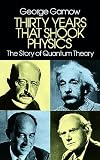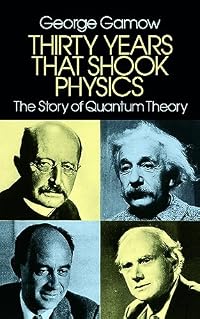
Thirty Years that Shook Physics: The Story of Quantum Theory
by George Gamow
On This Page
Description
Entertaining, rigorous introduction to the development of quantum theory traces the subject's history, from Max Planck's revolutionary discovery of quanta and Niels Bohr's model of the atom to anti-particles, mesons, and Enrico Fermi's nuclear research. Numerous line drawings. 1966 edition.Tags
Recommendations





Member Reviews
I have a bachelor of science degree in physics, and though I'm not the best at it I'm pretty solid in both advanced math and basic physics. I just wasn't cut out to be like the physicists George Gamow writes about at the turn of the century that turned classical physics on its head.
Though some people say this book is directed at laymen, you really should have some physics background to appreciate it. It starts with the ultraviolet catastrophe prediction which led to the rethinking light as photons and ultimately the birth of quantum mechanics. Later, Niels Bohr applied the same thinking to atomic structure.
George Gamow was a Russian physicist and contemporary of many of the famous physicists in this book. He offers up a lot of the show more history of the science, as well as humorous anecdotes of those involved firsthand at the revolution in physics that occurred at the beginning of the twentieth century.
Do yourself a favor and only get the version that includes the 1932 parody of "Faust" if you read this book.
I cannot recommend it to non-physicists, but this is my second time reading this book and I find not only quantum mechanics fascinating, but George Gamow's matter-of-fact way of describing the problems and how those scientists came up with their radical ideas to model what we observe in nature. show less
Though some people say this book is directed at laymen, you really should have some physics background to appreciate it. It starts with the ultraviolet catastrophe prediction which led to the rethinking light as photons and ultimately the birth of quantum mechanics. Later, Niels Bohr applied the same thinking to atomic structure.
George Gamow was a Russian physicist and contemporary of many of the famous physicists in this book. He offers up a lot of the show more history of the science, as well as humorous anecdotes of those involved firsthand at the revolution in physics that occurred at the beginning of the twentieth century.
Do yourself a favor and only get the version that includes the 1932 parody of "Faust" if you read this book.
I cannot recommend it to non-physicists, but this is my second time reading this book and I find not only quantum mechanics fascinating, but George Gamow's matter-of-fact way of describing the problems and how those scientists came up with their radical ideas to model what we observe in nature. show less
Breezy introduction to the modern physics revolution 1900–1930, with cute line illustrations. Somewhat amusing to hear Gamow refer to the next generation of theoretical physicists (Feynman, Hoyle, etc.) as less promising than the previous…but was he right after all?
Ratings
Members
- Recently Added By
Lists

Books Read in 2016
4,666 works; 197 members

The Great Courses: Quantum Mechanics
29 works; 1 member
Recommendations by TGC (Quantum Mechanics)
29 works; 1 member
Author Information

62+ Works 4,133 Members
Born in Odessa, Russia, George Gamow, the son of a teacher, studied at the University of Leningrad, becoming professor of physics in 1931. He emigrated to the United States in 1933 and taught at George Washington University (1934-56) and at the University of Colorado (1956-68). His scientific work covered many fields, mostly related to nuclear show more physics. In the field of molecular biology, Gamow suggested the triplet mechanism for coding DNA. He and his associate Ralph Alpher developed a detailed model of the early stages of cosmic evolution in the "big bang" theory. Although Gamow's basic assumption that the primordial universe contained only neutrons was incorrect, this assumption stimulated a great deal of subsequent work in cosmology. Gamow wrote 30 popular books on astronomy, physics, and related sciences. In his "Mr. Tompkins" series (one of the most famous), Gamow used the figure of a curious, interested bank clerk as a protagonist for various journeys into quantum physics and gravity. His sense of humor is evident in his books and in his scientific career. For example, one of the key papers on the "big bang" theory is called the alpha-beta-gamma paper. In 1956, UNESCO awarded Gamow the Kalinga Prize for science writing. (Bowker Author Biography) show less
Series
Belongs to Publisher Series
Common Knowledge
- Original publication date
- 1966
- People/Characters
- Max Planck; Niels Bohr; Wolfgang Pauli; Louis de Broglie; Werner Heisenberg; Paul Dirac (show all 8); Enrico Fermi; Hideki Yukawa
- Dedication
- To the friends of my youth.
- First words
- The opening of the twentieth century heralded an unprecedented era of turnover and re-evaluation of the classical theory that had governed Physics since pre-Newtonian times.
Classifications
- Genres
- Science & Nature, Nonfiction, General Nonfiction, History, Biography & Memoir
- DDC/MDS
- 530.1209 — Natural sciences & mathematics Physics Physics Theoretical Physics Quantum Mechanics Biography And History
- LCC
- QC174.12 .G35 — Science Physics Physics Atomic physics. Constitution and properties of matter
- BISAC
Statistics
- Members
- 457
- Popularity
- 66,542
- Reviews
- 2
- Rating
- (3.89)
- Languages
- Danish, English, Italian, Swedish
- Media
- Paper, Ebook
- ISBNs
- 6
- UPCs
- 1
- ASINs
- 9