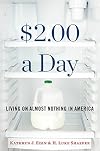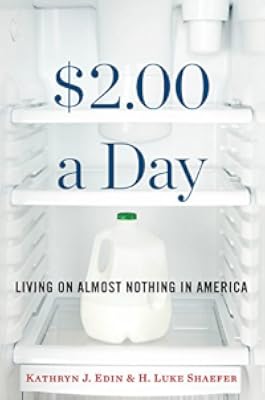
$2.00 a Day: Living on Almost Nothing in America
by Kathryn Edin, H Luke Shaefer
On This Page
Description
"A revelatory account of poverty in America so deep that we, as a country, don't think it exists Jessica Compton's family of four would have no cash income unless she donated plasma twice a week at her local donation center in Tennessee. Modonna Harris and her teenage daughter Brianna in Chicago often have no food but spoiled milk on weekends. After two decades of brilliant research on American poverty, Kathryn Edin noticed something she hadn't seen since the mid-1990s -- households show more surviving on virtually no income. Edin teamed with Luke Shaefer, an expert on calculating incomes of the poor, to discover that the number of American families living on $2.00 per person, per day, has skyrocketed to 1.5 million American households, including about 3 million children. Where do these families live? How did they get so desperately poor? Edin has "turned sociology upside down" (Mother Jones) with her procurement of rich -- and truthful -- interviews. Through the book's many compelling profiles, moving and startling answers emerge. The authors illuminate a troubling trend: a low-wage labor market that increasingly fails to deliver a living wage, and a growing but hidden landscape of survival strategies among America's extreme poor. More than a powerful expose, $2.00 a Day delivers new evidence and new ideas to our national debate on income inequality. "-- show lessTags
Recommendations


















Member Reviews
I can't say very much about this book because it will fill me with rage and spike my blood pressure. But the number of families in the US with no cash income - none, zero, nada - is outrageous and heartbreaking. They basically subsist on SNAP (formerly known as food stamps) and selling SNAP when they need cash. This books follows several people living on less that $2.00 a day and contrary to political myth, they are not lazy or stupid or addicted to drugs or out to game the system. They are parents and spouses and grandmothers who have had not just the system, but the entire organization of society, rigged against them. This book made me mad and sad and left feeling dirty when I spend more than double these people's daily income on a show more routine trip to Starbucks.
There was some discussion about housing insecurity in the book which made me want to read Evicted even more than I already did, but I am going to have to wait until I cool off a bit, I think. show less
There was some discussion about housing insecurity in the book which made me want to read Evicted even more than I already did, but I am going to have to wait until I cool off a bit, I think. show less
Deeply distressing. I finished this during a drive around the Washington peninsula, staring at idyllic forests and tiny tiny towns, left to wonder about how precariously balanced the lives of those within are.
I found the book's conclusion, that we must develop a system that works for and within our "American values" interesting, especially the bits about how the prior system led to a sense of disincorporation among welfare recipients-- but worry that the proposed solution still leaves many at risk. Any system that leaves families in the situations this book describes has failed.
I've been doing some reading over the past year about universal basic incomes, which I think will become more viable as larger and larger chunks of the show more population are automated out of the labor force by the current AI revolution. That's a solution, though, that at least on surface seems to be the opposite of the public ethic this book ascribes to the country.
Having seen the examples presented by Edin et al of how support systems can fail, both in practice and in public opinion, I feel like there's a lot more thinking to be done here. show less
I found the book's conclusion, that we must develop a system that works for and within our "American values" interesting, especially the bits about how the prior system led to a sense of disincorporation among welfare recipients-- but worry that the proposed solution still leaves many at risk. Any system that leaves families in the situations this book describes has failed.
I've been doing some reading over the past year about universal basic incomes, which I think will become more viable as larger and larger chunks of the show more population are automated out of the labor force by the current AI revolution. That's a solution, though, that at least on surface seems to be the opposite of the public ethic this book ascribes to the country.
Having seen the examples presented by Edin et al of how support systems can fail, both in practice and in public opinion, I feel like there's a lot more thinking to be done here. show less
The authors profile several families living on less than $2 per day (per person). If you've read books about poverty in America before, the profiles are sad but not shockingly so. The general thread is that people are working, or are trying to work, but they can't get enough hours, or jobs at all, and the jobs they do get are precarious and easily lost.
After the profiles, the authors offer their suggestions for welfare reform. Their ideas follow the same blueprint as Clinton's 1996 welfare reform bill - essentially, make more opportunities for work - along with suggestions for expanded housing subsidies and cash safety nets. After reading about living conditions, health problems, and instability faced by the families in the book, it is show more astounding that the authors thought that the solution was essentially "welfare just needs a little help." The family in rural Mississippi can't be helped to get jobs that simply don't exist. All of the people suffering from abuse and violence desperately need protection and support. The people with untreated or undertreated health problems need care. Hoping that jobs - which often do not provide health insurance, sick leave, or even particularly stable incomes - would solve the problem feels unrealistic. (The authors praise companies that are good places to work, but don't suggest how other companies could be induced to adopt similar practices)
In 2023 - and even in 2015, when this book was published - we have a fair bit of evidence that direct cash transfers are effective and helpful. At one point in this book, the authors mention a poor woman who received $50 for participating in a study; when the researchers returned the next day, the woman had bought food for her baby and an outfit for interviews. When working to solve homelessness, the Housing First approach, where people are first given housing, then support to address the issues that made them homeless, has all but eradicated homelessness in the cities that have used it. I don't think a "Cash First" approach would eliminate poverty as thoroughly - in some places, the jobs and opportunities are too rare, a problem that can't be addressed at an individual level - but it would help more than the work-based attempts proposed here. show less
After the profiles, the authors offer their suggestions for welfare reform. Their ideas follow the same blueprint as Clinton's 1996 welfare reform bill - essentially, make more opportunities for work - along with suggestions for expanded housing subsidies and cash safety nets. After reading about living conditions, health problems, and instability faced by the families in the book, it is show more astounding that the authors thought that the solution was essentially "welfare just needs a little help." The family in rural Mississippi can't be helped to get jobs that simply don't exist. All of the people suffering from abuse and violence desperately need protection and support. The people with untreated or undertreated health problems need care. Hoping that jobs - which often do not provide health insurance, sick leave, or even particularly stable incomes - would solve the problem feels unrealistic. (The authors praise companies that are good places to work, but don't suggest how other companies could be induced to adopt similar practices)
In 2023 - and even in 2015, when this book was published - we have a fair bit of evidence that direct cash transfers are effective and helpful. At one point in this book, the authors mention a poor woman who received $50 for participating in a study; when the researchers returned the next day, the woman had bought food for her baby and an outfit for interviews. When working to solve homelessness, the Housing First approach, where people are first given housing, then support to address the issues that made them homeless, has all but eradicated homelessness in the cities that have used it. I don't think a "Cash First" approach would eliminate poverty as thoroughly - in some places, the jobs and opportunities are too rare, a problem that can't be addressed at an individual level - but it would help more than the work-based attempts proposed here. show less
I read this book not long after reading Hillbilly Elegy. I think this book does a much more accurate job of explaining the history of the fall of the middle and lower classes, as well as the actual lives of the poor. Hillbilly Elegy, I would argue is a story about a middle class white man, in a poor area, who had many opportunities to take advantage of, although, obviously, not as many as a middle class white guy in a middle class area (where his income and family life would have possibly dipped him into poverty, but I doubt it based on the fact that he never once mentions issues like the cost of shoes or food.) I am saying that as a middle class white woman, who grew up in a poor area, and now lives in a rich area, where my family's show more income would never have afforded me the same opportunities.
If you want a look at what poverty in America is actually like, this is the book to read. Yes, the middle class is slipping, yes books like Hillbilly Elegy are trying to shine a light on poverty in rural areas, but IMHO it did a shitty job, because it's a lot easier for us middle class kids to "pull ourselves up by our boostraps" when there's money, food, shelter, and opportunities to go around. This book sheds a real life on what many are facing and the real dangers of class slip in America. It's also not a book of pure anecdotes, as it covers history, politics and statistics in an interesting and easy to follow way. Highly recommended if you were nodding your head at the "lazy" poor people in Hillbilly Elegy. That view sure didn't fit the majority of the poor I grew up friends with. show less
If you want a look at what poverty in America is actually like, this is the book to read. Yes, the middle class is slipping, yes books like Hillbilly Elegy are trying to shine a light on poverty in rural areas, but IMHO it did a shitty job, because it's a lot easier for us middle class kids to "pull ourselves up by our boostraps" when there's money, food, shelter, and opportunities to go around. This book sheds a real life on what many are facing and the real dangers of class slip in America. It's also not a book of pure anecdotes, as it covers history, politics and statistics in an interesting and easy to follow way. Highly recommended if you were nodding your head at the "lazy" poor people in Hillbilly Elegy. That view sure didn't fit the majority of the poor I grew up friends with. show less
Twenty years after "welfare reform" abolished the cash safety net designed to protect the poorest Americans, sociologists Kathryn Edin and H. Luke Shaefer find through their fieldwork that 1.5 million families with children are caught in the trap of extreme poverty. All too often the "$2.00-a-day poor", as Edin and Shaefer call them, are invisible to mainstream Americans.
As the authors reveal, most of today's extreme poor don't fit the lazy "welfare queen" stereotype. Rather, the men and women profiled in the book work hard every day, whether that means toiling at low-paying jobs for shady employers who routinely violate labor laws, or finding ways to generate small amounts of cash to lend dignity and freedom of choice to their mostly show more cashless lives. Some sell their plasma, and others run "informal" (under the table) businesses. All dream of the day they can break out of the $2.00-a-day trap, but they have very limited means of doing so permanently.
In their conclusion the authors suggest a number of ways the government could help the poorest of the poor, including restoring the cash safety net and offering subsidized work programs. In today's economic and political climates, however, these proposals seem unlikely to be adopted.
$2.00 a Day is a quick, eye-opening read. I recommend it to all those who are concerned about the plight of the poorest Americans. show less
As the authors reveal, most of today's extreme poor don't fit the lazy "welfare queen" stereotype. Rather, the men and women profiled in the book work hard every day, whether that means toiling at low-paying jobs for shady employers who routinely violate labor laws, or finding ways to generate small amounts of cash to lend dignity and freedom of choice to their mostly show more cashless lives. Some sell their plasma, and others run "informal" (under the table) businesses. All dream of the day they can break out of the $2.00-a-day trap, but they have very limited means of doing so permanently.
In their conclusion the authors suggest a number of ways the government could help the poorest of the poor, including restoring the cash safety net and offering subsidized work programs. In today's economic and political climates, however, these proposals seem unlikely to be adopted.
$2.00 a Day is a quick, eye-opening read. I recommend it to all those who are concerned about the plight of the poorest Americans. show less
A short book about people in the US who are surviving on almost no cash income, and how governmental aid programs are failing to help them they way they're supposed to. Most of the book consists of frankly rather heartbreaking profiles of individual families: how they ended up in such financial circumstances, what life is like for them, and how difficult it is for them to improve their conditions. There is, however, also some history of the welfare program, how it's changed, and how it works (or fails to), with some suggestions for improving matters that are designed to appeal to even the most conservative of Americans. Certainly, the book makes it very, very clear that the problem is not that "people don't want to work." And yet, show more somehow, I suspect we'll never stop hearing that idea expressed by people who have no idea what it's like to desperately want a job, but to live in conditions that makes it almost impossible to find or keep one.
This was published in 2015, and no doubt things have changed since then, but it's not like this is a problem that's going away, so it's still worth reading, and perhaps for some it is likely to be eye-opening. show less
This was published in 2015, and no doubt things have changed since then, but it's not like this is a problem that's going away, so it's still worth reading, and perhaps for some it is likely to be eye-opening. show less
This book is completely disheartening, and it doesn't even dwell on the politicians post-Bill Clinton's "welfare reform" who made even worse policy. The authors are astounded at how many American families live only on SNAP (food stamps), with no cash coming in at all. They also avoid reminding the reader how all Republicans and Libertarians despise the poor and re-victimize them by punishing them for selling SNAP so that they can buy diapers, school uniforms, and transportation. The usual culprits are in evidence: deteriorated housing, high rentals, lack of public transport, horrible exploitative employers, bad schools, lack of coordination of social services, poor decisions. The authors offer three remedies: higher wages and better show more jobs, some in the form of subsidized private-public job training; a change in the mortgage interest deduction to stop subsidizing wealthy homeowners who don't need it and fixing zoning exclusions; and reestablishing a cash safety net and taking block grants away from the states that use them for any other purpose other than for what they were intended. Add this to "Nickeled and Dimed" and "Evicted", for a vivid picture of the mountain of misery for what seems like half of the population at this point. show less
Members
- Recently Added By
Published Reviews
ThingScore 75
This essential book is a call to action, and one hopes it will accomplish what Michael Harrington’s “The Other America” achieved in the 1960s — arousing both the nation’s consciousness and conscience about the plight of a growing number of invisible citizens. The rise of such absolute poverty since the passage of welfare reform belies all the categorical talk about opportunity and show more the American dream. show less
added by susieimage — edited by karenb
Harrowing...[An] important and heart-rending book, in the tradition of Michael Harrington's "The Other America."
added by ArrowStead
Powerful...Presents a deeply moving human face that brings the stunning numbers to life. It is an explosive book...The stories will make you angry and break your heart.
added by ArrowStead
Lists

Club Read's Recommended Nonfiction Written by Women
618 works; 30 members
Author Information

6+ Works 1,085 Members
Kathryn Edin is Associate Professor of Sociology at the University of Pennsylvania.
4 Works 719 Members
Awards and Honors
Common Knowledge
- Original publication date
- 2015
- Dedication
- To our children,
Bridget, Kaitlin, Marisa, and Michael - First words
- Deep in the south side of Chicago, far from the ever-evolving steel skyline of America's third-largest city, sits a small, story-and-a-half white clapboard house clad in peeling paint.
- Last words
- (Click to show. Warning: May contain spoilers.)Clearly, there is much to cherish here - much worth protecting and nurturing.
- Canonical DDC/MDS
- 339.460973
- Canonical LCC
- HC110.P6
Classifications
- Genres
- Sociology, Economics, Nonfiction, General Nonfiction
- DDC/MDS
- 339.460973 — Society, government, & culture Economics Macroeconomics and related topics Factors Impacting GDP Poverty
- LCC
- HC110 .P6 — Social sciences Economic history and conditions Economic history and conditions By region or country
- BISAC
Statistics
- Members
- 617
- Popularity
- 47,478
- Reviews
- 23
- Rating
- (4.01)
- Languages
- English
- Media
- Paper, Audiobook, Ebook
- ISBNs
- 7
- ASINs
- 5