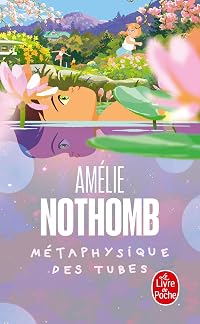
The Character of Rain: A Novel
by Amélie Nothomb
On This Page
Description
The Japanese believe that until the age of three children, whether Japanese or not, are gods, each one an okosama, or "lord child." On their third birthday they fall from grace and join the rest of the human race. In Amélie Nothomb's new novelThe Character of Rain, we learn that divinity is a difficult thing from which to recover.Tags
Recommendations











































Member Recommendations

Member Reviews
What is it like to be treated like a god? According to this novel the Japanese treat newborn children like gods until about their third year of life. The newborn in this story is certainly more precocious than I would expect most of these babies, but in spite of her extraordinary intelligence, or perhaps because of it, she is careful in how and to whom she demonstrates her true nature.
With that brief introduction I must say that this short novel is very different from almost anything I have ever read. The story is primarily told in the first person, but that person being a newborn there are necessarily exceptions to this narrative mode. For example, early on the following occurs:
"The cradle became too small. The tube was transplanted to show more a crib, the same one used previously by its older brother and sister.
“Maybe moving the Plant will wake it up,” said the mother, sighing.
It didn't.
From the beginning of the universe, God had slept in the same room as its parents. This didn't pose problems for them, of course. They could forget it was even there."
The perspective of this very young girl is one of the most interesting aspects of the story. Everything is new for her thus her reactions are different than her parents or the reader. She takes delight in her senses , but is preternaturally judicious in the use of them. For a long time she did not speak and when she did decide to speak she chose her words very carefully. She started by naming things, in a very philosophic way sort of like a miniature Plato. Or Heraclitus, whom the narrator quotes using his famous observation that "nothing endures but change" early in the story when the little god appeared to be exceptionally unchanging. That being only her outward appearance she, when the narrative shifts to her point of view we realize that she is taking in everything that is happening around her and is truly changing on the inside. She was seeing and in doing so making choices.
Eventually she begins to speak and makes a great discovery:
"Careful examination of what other people said led me to the conclusion that speaking was as much a creative as a destructive act. I decided I would need to be careful about what to do with this discovery."
Thus her life progresses slowly, but carefully, and this occurs under the tutelage of two nannies. They are exact opposites of each other nullifying each other out in a sense, at least they would be doing so except the little god had her say and she preferred the nice nanny, Nishio-san, who thought she was beautiful and treated her like a god, to the unlikable nanny, Kashima-san, who refused her, denied her, and did not adore the little god; all this in spite of a "charm" offensive that with few exceptions had no effect.
The story is odd in its perspective, but gradually a rationale of a sort begins to emerge. I would call that rationale discovery; the child's discovery of the world around her and both her delight and dislike of the experience and consequences of that discovery. Her experiences are fascinating, like the experience of a rain storm:
"Sometimes I left the shelter of the roof and lay on top of the victim to participate in the onslaught. I chose the most exciting moment, the final pounding downpour, the moment in the bout when the clouds delivered a punishing, relentless hail of blows, in a booming fracas of exploding bones."
"THE RAIN SOMETIMES WON, and when it did it was called a flood."
This short novel only chronicles the first three years of the child's life, enough time for her to decide to become Japanese, to discover people and nature, and ultimately to make a choice about whether she would continue to live and grow. As for that last choice you will have to read the book yourself to find out her answer. show less
With that brief introduction I must say that this short novel is very different from almost anything I have ever read. The story is primarily told in the first person, but that person being a newborn there are necessarily exceptions to this narrative mode. For example, early on the following occurs:
"The cradle became too small. The tube was transplanted to show more a crib, the same one used previously by its older brother and sister.
“Maybe moving the Plant will wake it up,” said the mother, sighing.
It didn't.
From the beginning of the universe, God had slept in the same room as its parents. This didn't pose problems for them, of course. They could forget it was even there."
The perspective of this very young girl is one of the most interesting aspects of the story. Everything is new for her thus her reactions are different than her parents or the reader. She takes delight in her senses , but is preternaturally judicious in the use of them. For a long time she did not speak and when she did decide to speak she chose her words very carefully. She started by naming things, in a very philosophic way sort of like a miniature Plato. Or Heraclitus, whom the narrator quotes using his famous observation that "nothing endures but change" early in the story when the little god appeared to be exceptionally unchanging. That being only her outward appearance she, when the narrative shifts to her point of view we realize that she is taking in everything that is happening around her and is truly changing on the inside. She was seeing and in doing so making choices.
Eventually she begins to speak and makes a great discovery:
"Careful examination of what other people said led me to the conclusion that speaking was as much a creative as a destructive act. I decided I would need to be careful about what to do with this discovery."
Thus her life progresses slowly, but carefully, and this occurs under the tutelage of two nannies. They are exact opposites of each other nullifying each other out in a sense, at least they would be doing so except the little god had her say and she preferred the nice nanny, Nishio-san, who thought she was beautiful and treated her like a god, to the unlikable nanny, Kashima-san, who refused her, denied her, and did not adore the little god; all this in spite of a "charm" offensive that with few exceptions had no effect.
The story is odd in its perspective, but gradually a rationale of a sort begins to emerge. I would call that rationale discovery; the child's discovery of the world around her and both her delight and dislike of the experience and consequences of that discovery. Her experiences are fascinating, like the experience of a rain storm:
"Sometimes I left the shelter of the roof and lay on top of the victim to participate in the onslaught. I chose the most exciting moment, the final pounding downpour, the moment in the bout when the clouds delivered a punishing, relentless hail of blows, in a booming fracas of exploding bones."
"THE RAIN SOMETIMES WON, and when it did it was called a flood."
This short novel only chronicles the first three years of the child's life, enough time for her to decide to become Japanese, to discover people and nature, and ultimately to make a choice about whether she would continue to live and grow. As for that last choice you will have to read the book yourself to find out her answer. show less
Despite not having read French literature for quite some time, I took up Nothomb’s sardonic and bittersweet quasi-autobiography in the fall and quickly delved into Nothomb’s self-deprecating and delightfully raw stroll down memory lane. In fact, the quasi-fictional heroine’s experiences were reminiscent of my own childhood. Indeed, I was a late bloomer and did not speak well after my third birthday. . . one might say that I was plagued by similar crises of conscience and precocious worry and the mischievous protagonist has reminded me of my introvert younger self. Indeed, such vacuous memories have not visited in so long that it felt so wickedly comforting and full of yearning to share in the tube’s trials and tribulations
“In the beginning was nothing, and this nothing had neither form not substance –it was nothing other than what it was.” I read the opening sentence of Amélie Nothomb’s, The Character of Rain (Métaphysique des Tubes), and was hooked. I was not disappointed. Using the belief that children are gods in Japan until age 2 at which time they fall and become human Nothomb constructs a brilliant study of infancy. Deeply autobiographical, like all her work, and deeply philosophical, like all her work, what amazed me most was how completely she captured or imagined the self-preoccupation that is early childhood. Any child will believe it is the center of the universe (and why not an infant must be watched and waited on), and yet the same show more child will experience “the fall,” the recognition that he or she is not a god, is not the center of the universe. Nothomb’s ability to recognize this essential problem of being a child and tease out of her own experience the joys and pains of existence in a way that is as imminently and entertainingly readable as it is philosophical is where her genius lies. I haven’t read anything like it. show less
Amelie Nothombe does it for me once again; I loved this book. It's my third Nothombe book, after Fear and Trembling and Le Sabotage Amoureux. Again this is an "autobiographical fiction" novel, as one can hardly trust Nothombe that she truly recounting her experiences and memories from infancy...
Nothombe was born in Kobe, Japan, while her father was serving as the Belgian consul there. The family lived in a small village, Shukugawa, and the story begins with the birth of Amelie. Only she wasn't Amelie yet; she was only a tube. A tube that thought of itself as God. This God did nothing but eat, digest and excrete its food (hence the "tube") but as far as it was concerned, the tube was happy with its existence. Its parents and doctors, on show more the other hand, were at a loss. This tube did not develop as a normal child and up until the age of two, it is basically a vegetable and indeed it does not have a name. It is named "the plant" by its parents.
But then everything changes. Suddenly "the plant" starts to cry and protest and from a baby that needed nothing but cleaning and feeding, it becomes an insufferable nightmare. Day and night it cries and cries, and its parents no longer know what to do. They miss the days of "the plant".
The turning point in the life of the tube comes with the visit of her grandmother from Belgium (the visit is somewhat delayed due to the visitor's sartorial needs in preparation for the trip to the east). The grandmother enters the room where the tube is protesting, produces a piece of white chocolate (which the tube accepts after some hesitation), and the transformation occurs. The sweet taste releases the identity of the baby, and Nothombe switches to writing in the first person. Amelie is finally "born".
I will stop here. But the story just begins, with many wonderful and dramatic events in the infant's life unfolding at a fast and spellbinding pace. It's a small book, but it succeeds where many a mightier book fail: a captivating story that is both amusing and dramatic. show less
Nothombe was born in Kobe, Japan, while her father was serving as the Belgian consul there. The family lived in a small village, Shukugawa, and the story begins with the birth of Amelie. Only she wasn't Amelie yet; she was only a tube. A tube that thought of itself as God. This God did nothing but eat, digest and excrete its food (hence the "tube") but as far as it was concerned, the tube was happy with its existence. Its parents and doctors, on show more the other hand, were at a loss. This tube did not develop as a normal child and up until the age of two, it is basically a vegetable and indeed it does not have a name. It is named "the plant" by its parents.
But then everything changes. Suddenly "the plant" starts to cry and protest and from a baby that needed nothing but cleaning and feeding, it becomes an insufferable nightmare. Day and night it cries and cries, and its parents no longer know what to do. They miss the days of "the plant".
The turning point in the life of the tube comes with the visit of her grandmother from Belgium (the visit is somewhat delayed due to the visitor's sartorial needs in preparation for the trip to the east). The grandmother enters the room where the tube is protesting, produces a piece of white chocolate (which the tube accepts after some hesitation), and the transformation occurs. The sweet taste releases the identity of the baby, and Nothombe switches to writing in the first person. Amelie is finally "born".
I will stop here. But the story just begins, with many wonderful and dramatic events in the infant's life unfolding at a fast and spellbinding pace. It's a small book, but it succeeds where many a mightier book fail: a captivating story that is both amusing and dramatic. show less
Witty, clever, entertaining and very well written, but it was a mistake to read Biographie de la faim before this: there's simply too much overlap between the two, even though Biographie de la faim technically only starts where this one leaves off, shortly after the narrator's third birthday. You start to wonder whether she is really saying something profound, or just having fun playing with paradoxes.
Obviously, the great advantage of writing very short books like this (apart from making more money than you would if you just wrote one long book) is that you can stop while the reader is still gasping in amazement at the cleverness of your technique. The author gets the benefit of the doubt in a way she wouldn't if we had half a metre of show more A la recherche des Amélies perdues to struggle through. Probably all to the good... show less
Obviously, the great advantage of writing very short books like this (apart from making more money than you would if you just wrote one long book) is that you can stop while the reader is still gasping in amazement at the cleverness of your technique. The author gets the benefit of the doubt in a way she wouldn't if we had half a metre of show more A la recherche des Amélies perdues to struggle through. Probably all to the good... show less
This is a book about babyhood and childhood told as if an adult could interpret how a very small child actually thinks, but also giving the child the adult abilities of talking and reading.
I loved the book, not least because it was suitably short, but it turns out that her one, not quite phobia, but absolute real dislike, is also mine, and for the same reason too. I intensely dislike koi, or carp, waiting to be fed with their mouths open and being able to see their disgusting rubbery lips and the smooth pink tube that is their mouth cavity and digestive tract tube.
I think both the protagonist and myself had the same feeling on feeding them for the first time where they crowd up, pushing pushing, to the side of the pond and in their show more mindless, greedy way open their maws for the crumbs thrown at them. Intimations of our own mortality indeed, wide open mouths and a tube of throat and gullet straight to our stomachs.
Good book though. Worth reading because its nothing like any other book I've ever read and the writing is sensitive and lovely and never belabours a point. Unlike me. So enough. show less
I loved the book, not least because it was suitably short, but it turns out that her one, not quite phobia, but absolute real dislike, is also mine, and for the same reason too. I intensely dislike koi, or carp, waiting to be fed with their mouths open and being able to see their disgusting rubbery lips and the smooth pink tube that is their mouth cavity and digestive tract tube.
I think both the protagonist and myself had the same feeling on feeding them for the first time where they crowd up, pushing pushing, to the side of the pond and in their show more mindless, greedy way open their maws for the crumbs thrown at them. Intimations of our own mortality indeed, wide open mouths and a tube of throat and gullet straight to our stomachs.
Good book though. Worth reading because its nothing like any other book I've ever read and the writing is sensitive and lovely and never belabours a point. Unlike me. So enough. show less
Not quite as good as the other Am̩lie Nothomb books I have read, but The Character of Rain is still excellent. It is a memoir of Nothomb's first three years of life, in Kobe Japan, with the conceit that she is a "god" which is what she says the Japanese treat all children as through the age of three. It begins with her as an essentially inanimate tube but then at two she becomes animate and quickly teaches herself to speak both French and Japanese fluently and to read, all by around two and a half. The novel is narrated through her young eyes and is a combination of sophistication (e.g., her thoughts about suicide at age three) and humorous ignorance (e.g., not understanding what her father's job as Belgian consul was, and mistakenly show more seeing him fall into a storm drain and confuse that with his actual job). As usual, the short novella has some very humorous riffs, a lot of perceptive observations, and a bunch that you cannot quite figure out whether it is true or imagined or somewhere in between--but depicting a two year old with this sophistication certainly feels like towards the imagined end of the spectrum. show less
Members
- Recently Added By
Published Reviews
ThingScore 75
Ms. Nothomb has attempted, with some success, to perform an amalgam of memory and a devised artistic heightening of it.
added by DieFledermaus
Lists

Short and Sweet
246 works; 24 members

Libros que todos deberíamos leer al menos una vez en la vida (Librotea)
14 works; 1 member
Author Information

87+ Works 16,102 Members
Some Editions
Series
Belongs to Publisher Series
Work Relationships
Is contained in
Has the adaptation
Common Knowledge
- Canonical title
- The Character of Rain: A Novel
- Original title
- Métaphysique des tubes
- Alternate titles*
- Метафизика труб
- Original publication date
- 2000
- People/Characters
- Juliette (sister); Andre (brother); Daniele (mother); father; Nishino-san; Kashima-san (show all 8); Narrator (God, the Tube, the Plant); Hugo
- Important places
- Shukugawa, Japan
- Related movies
- Little Amélie or the Character of Rain (2025 | IMDb)
- First words
- In the beginning was nothing, and this nothing had neither form nor substance - it was nothing other than what it was.
- Quotations
- They already had two children who were full-fledged members of the human race. Having a third who was a vegetable wasn't so bad. It even elicited tender feelings on their part.
Eating or not eating, drinking or not drinking, it was all the same. To be or not to be was not the question.
God's parents were of Belgain nationality, meaning that it, too, was Belgian. This may help explain not a few of the disasters that have occurred since biblical days; centuries ago, a priest from the Low Countries proved sci... (show all)entifically that Adam and Eve spoke Flemish.
Seeing involves choice. Whoever looks at something has decide to fix his attention on that one thing, to the exclusion of other things. That is why sight, the very essence of life, first and foremost constitutes a rejection... (show all).
Therefore, to live means to reject. Anyone who looks at everything at once is as alive as a toilet bowl.
I knew myself, and I soon discovered that life was a vale of tears in which one was forced to eat pureed carrots with small bits of meat.
Kashima-san refused me; she denied me. She was the equivalent of the anti-Christ; she was the anti-me. I felt deep sorrow for her. How terrible it must have been for her not to adore me.
Because the truth seemed to be locked in the rectangular pages of books, I decided to learn to read them.
I had just been told what at some point everyone learns: that eventually we lose what we love. That which is given you will be taken back. That was how I formulated the theme of my childhood, of my adolescence, and o... (show all)f all the years that followed.
Had I asked anyone they might have explained the cycle of seasons to me. At the age of three you don't remember the year before, so you don't have any sense of the eternal return. Every new season seems irreversible.
... (show all) At the age of two, you don't notice these changes and you don't care. At four, you notice them but the memory of the year before takes the drama out of them. But at three, the anxiety you feels is overwhelming, because you see everything and understand nothing. There is no legal precedent to consult. - Last words
- (Click to show. Warning: May contain spoilers.)After that, nothing more happened.
- Original language*
- Français
*Some information comes from Common Knowledge in other languages. Click "Edit" for more information.
Classifications
Statistics
- Members
- 1,297
- Popularity
- 18,781
- Reviews
- 30
- Rating
- (3.72)
- Languages
- 11 — Catalan, Dutch, English, Estonian, French, German, Italian, Portuguese, Romanian, Russian, Spanish
- Media
- Paper, Audiobook, Ebook
- ISBNs
- 31
- ASINs
- 15