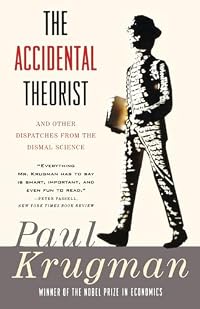
The Accidental Theorist and Other Dispatches from the Dismal Science
by Paul Krugman
On This Page
Description
This analysis of poor economic reasoning "weaves together recent articles and addresses, some of them never before published, into a short, compelling narrative on the major issues of the 1990s: unemployment, globalization, economic growth, financial speculation ... corporate downsizing," and more.--Jacket.Tags
Recommendations
Member Reviews
It's impossible to read these twenty-year-old essays and not feel like many of them haven't aged a day. Whether you agree with them or not, or whether you even like the infamously acerbic Krugman or not, to a remarkable extent the logic behind the majority of these columns still feels fresh and relevant. I'm a big fan of his for a few reasons: I learned a lot of macro from his writings in grad school, I enjoy his lucid writing style, and I share his social-democratic political leanings with an appreciation for free trade and strong markets. All of these elements are here (though he's still in his "criticize both sides equally" phase; the first few essays have a slight hippie-punching feel to them before he gets around to deflating show more conservative myths), and out of his pre-George W. Bush books this might be the strongest of the lot due to its wide range of subjects and compact ability to educate and entertain.
Krugman's mission in this assortment of Slate columns is popularization, taking on a Carl Sagan-ish role of accessibly discussing contemporary economic issues. And, much like Sagan, in addition to simply explaining what simple concepts are he also wants his readers to respect the idea of rigor, and to have an appreciation of how difficult it is to make true intellectual progress when it comes to seemingly-simple economic questions. Complicated subjects like inequality ("An Unequal Exchange"), inflation (like "A Good Word For Inflation"), technological progress ("Technology's Wonders"), unemployment ("What Is Wrong With Japan"), and commodity speculation ("How Copper Came a Cropper") have clearly presented numbers and reasoning, with an eye towards teaching the reader how to know when someone is grounding their analysis in facts or opinion. He's of course unsparing in his criticism of people who he thinks are fools or liars, but even if you don't like Krugman because of his tone, facts don't lie; it really is truly remarkable that a guy like Newt Gingrich is even stupider today than he was back in 1995.
One of the main takeaways from this this essay collection, above and beyond whether you agree with any specific column or not, is that it really helps to have a consistent framework for thinking about economic issues. Is globalization good or bad? Should the US reduce the trade deficit? What are the effects of inflation on interest rates? Can we reduce unemployment to zero and have fast growth like we did in the 60s? One well-thought-out theory can be worth dozens of unsorted facts. Not every essay is as strong as it could be, but even a blunt and infuriating essay like "In Praise of Cheap Labor" is more sophisticated than its critics admit, and looks stronger every day that formerly closed countries like China develop and transform their sweatshops into boring Western 9-to-5s. He hasn't ever written a big profession-shaking epic like his hero Keynes, and at this phase in his career he probably won't ever get around to it, but his guiding ethos of progress through and with - not instead of - capitalism remains a worthy philosophy to subscribe to. show less
Krugman's mission in this assortment of Slate columns is popularization, taking on a Carl Sagan-ish role of accessibly discussing contemporary economic issues. And, much like Sagan, in addition to simply explaining what simple concepts are he also wants his readers to respect the idea of rigor, and to have an appreciation of how difficult it is to make true intellectual progress when it comes to seemingly-simple economic questions. Complicated subjects like inequality ("An Unequal Exchange"), inflation (like "A Good Word For Inflation"), technological progress ("Technology's Wonders"), unemployment ("What Is Wrong With Japan"), and commodity speculation ("How Copper Came a Cropper") have clearly presented numbers and reasoning, with an eye towards teaching the reader how to know when someone is grounding their analysis in facts or opinion. He's of course unsparing in his criticism of people who he thinks are fools or liars, but even if you don't like Krugman because of his tone, facts don't lie; it really is truly remarkable that a guy like Newt Gingrich is even stupider today than he was back in 1995.
One of the main takeaways from this this essay collection, above and beyond whether you agree with any specific column or not, is that it really helps to have a consistent framework for thinking about economic issues. Is globalization good or bad? Should the US reduce the trade deficit? What are the effects of inflation on interest rates? Can we reduce unemployment to zero and have fast growth like we did in the 60s? One well-thought-out theory can be worth dozens of unsorted facts. Not every essay is as strong as it could be, but even a blunt and infuriating essay like "In Praise of Cheap Labor" is more sophisticated than its critics admit, and looks stronger every day that formerly closed countries like China develop and transform their sweatshops into boring Western 9-to-5s. He hasn't ever written a big profession-shaking epic like his hero Keynes, and at this phase in his career he probably won't ever get around to it, but his guiding ethos of progress through and with - not instead of - capitalism remains a worthy philosophy to subscribe to. show less
Krugman, Paul. The Accidental Theorist: And Other Dispatches from the Dismal Science. W.W. Norton, New York, 1998. I'm in the middle of a "I need to understand economics and business" phase. I enjoy Paul Krugman because he reinforces one of my preconceptions about economics: most people who make economic predictions don't know what they're talking about. This book is filled with Mr. Krugman popping the bubbles of various political figures (I'm surprised at the number of ad hominum attacks, actually). Krugman has certainly made many enemies. However, I'm disappointed with how short most of the essays are. He'll pop a bubble, but he won't replace it with anything else. It's nice to know that I need to question what I hear from various show more media figures; however, this book won't teach you much about economics. I guess that's what textbooks are for. show less
quite enjoyable, understandable. he's quite willing to dump on anyone.
Ratings
Members
- Recently Added By
Author Information

77+ Works 7,385 Members
Paul Krugman was born on February 28, 1953. He received a B.S. in economics from Yale University in 1974 and a Ph.D from MIT in 1977. From 1982 to 1983, he worked at the Reagan White House as a member of the Council of Economic Advisers. He taught at numerous universities including Yale University, MIT, UC Berkeley, the London School of Economics, show more and Stanford University before becoming a professor of economics and international affairs at Princeton University in 2000. He has written over 200 scholarly papers and 20 books including Peddling Prosperity; International Economics: Theory and Policy; The Great Unraveling; and The Conscience of a Liberal. Since 2000, he has written a twice-weekly column for The New York Times. He received the 1991 John Bates Clark Medal and the 2008 Nobel Memorial Prize in Economic Sciences. His title End This Depression Now! made The New York Times Best Seller List for 2012. (Bowker Author Biography) show less
Common Knowledge
- Original publication date
- 1998
Classifications
Statistics
- Members
- 460
- Popularity
- 66,049
- Reviews
- 3
- Rating
- (3.61)
- Languages
- 7 — Dutch, English, Finnish, German, Greek, Korean, Spanish
- Media
- Paper, Ebook
- ISBNs
- 13
- ASINs
- 4