On This Page
Description
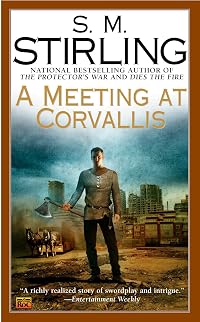
In the tenth year of the Change, the survivors in western Oregon have learned how to live in a world without technology. The city-state of Corvallis has preserved its university, and trade flourishes via riverboats and horse-drawn railways. Under the strong hand of Michael Havel, the Bearkillers hold the lands west of Salem in peace and order. And in the eastern half of the Willamette Valley, the Clan Mackenzie flourishes under the charismatic leadership of Juniper Mackenzie, bard and High show more Priestess. Together, they have held the Lord Protector, Norman Arminger--the warlord of Portland--at bay. With his dark fantasies of a neofeudal empire, Arminger has extended his power over much of the Pacific Northwest, spreading fear with his knights, castles, and holy inquisition. Even more dangerous, and perhaps Arminger's most powerful weapon of all, is the ruthlessly cunning mind of his consort, Lady Sandra. The tensions between these factions have been building for some time, and the only reason they haven't confronted one another on the battlefield is because Arminger's daughter has fallen into Clan Mackenzie's hands. But Lady Sandra has a plan to retrieve her--a plan that threatens to plunge the entire region into open warfare. show lessTags
Recommendations









Member Reviews
I think the best way to conceptualize this, the third book in Stirling’s series that began with Dies the Fire, is as the second part of The Protector’s War. The storylines and themes that began there are woven through into A Meeting at Corvallis and completed therein.
The pace of this book starts off somewhat slow in comparison to its two predecessors, however the action soon arises and regains the rapid and gripping pace that made the first two books of the series quite enjoyable. Again, as in the first two books, Stirling explores the impact of mythology, lore and religion in an agrarian society, comparing and contrasting healthy individual spirituality with domineering organized religious establishments. Along with this, he also show more presents contrasting ethical frameworks that showcase some of the fundamental aspects of liberated societies and tyrannies. During this exploration, all the major plot lines are left resolved, yet the overall milieu Stirling has created is left in a wonderful spot for the next book, which apparently will jump forward in time to the next generation of post Change survivors.
One interesting facet of the series as a whole is how much the setting is reminiscent of ancient Greece. While I doubt that Stirling intentionally set out to create an allegorical account of Grecian antiquity, one thing I found myself pondering as I read these books is their loose relationship to the pre Socratic classical era that seems to lie just beneath the surface. One does not need to stretch the imagination far to picture the Spartans (Bearkillers), Athenians (Clan Mackenzie), or the collected empirical states of Persia and Asia Minor under Xerxes (Lord protector and the Portland Protectorate Authority) portrayed in the series. Any detailed analysis will show vast differences in any one of these allegorical mappings, but the loose connection kept recurring to me as I read and continually mapping fiction back to history was an integral part of the enjoyment of the series.
For anyone who enjoys post-apocalyptic fiction, I would definitely recommend picking up this series. It is escapist fiction of good merit, not challenging the reader heavily in any academic way, yet intelligent and engrossing enough to allow the reader to slip away into a new yet plausible reality. show less
The pace of this book starts off somewhat slow in comparison to its two predecessors, however the action soon arises and regains the rapid and gripping pace that made the first two books of the series quite enjoyable. Again, as in the first two books, Stirling explores the impact of mythology, lore and religion in an agrarian society, comparing and contrasting healthy individual spirituality with domineering organized religious establishments. Along with this, he also show more presents contrasting ethical frameworks that showcase some of the fundamental aspects of liberated societies and tyrannies. During this exploration, all the major plot lines are left resolved, yet the overall milieu Stirling has created is left in a wonderful spot for the next book, which apparently will jump forward in time to the next generation of post Change survivors.
One interesting facet of the series as a whole is how much the setting is reminiscent of ancient Greece. While I doubt that Stirling intentionally set out to create an allegorical account of Grecian antiquity, one thing I found myself pondering as I read these books is their loose relationship to the pre Socratic classical era that seems to lie just beneath the surface. One does not need to stretch the imagination far to picture the Spartans (Bearkillers), Athenians (Clan Mackenzie), or the collected empirical states of Persia and Asia Minor under Xerxes (Lord protector and the Portland Protectorate Authority) portrayed in the series. Any detailed analysis will show vast differences in any one of these allegorical mappings, but the loose connection kept recurring to me as I read and continually mapping fiction back to history was an integral part of the enjoyment of the series.
For anyone who enjoys post-apocalyptic fiction, I would definitely recommend picking up this series. It is escapist fiction of good merit, not challenging the reader heavily in any academic way, yet intelligent and engrossing enough to allow the reader to slip away into a new yet plausible reality. show less
11/11 I think this is my favorite of the series as it stands right now. One can see who Rudi is becoming, and which way the wind blows there. I like Tiphanie, who begins to have depth and nuance here. I like the tying up of knots, and the promises left hanging. There is, of course, a lot of thwacking of swords into bone, and plenty of blood and bone splinters flying about, but it's all part and parcel of this well-imagined world.
12/10 I suppose saying "astronomical body count" and "graphic violence of the most lurid sort" is redundant in a review of any of the books in this series. Or so it appears, after I've read three of 'em.
Solid action, taut plotting, no real surprises (well, there's the one, but I'm not telling you about that) show more and a satisfying conclusion to the first trilogy in the series. show less
12/10 I suppose saying "astronomical body count" and "graphic violence of the most lurid sort" is redundant in a review of any of the books in this series. Or so it appears, after I've read three of 'em.
Solid action, taut plotting, no real surprises (well, there's the one, but I'm not telling you about that) show more and a satisfying conclusion to the first trilogy in the series. show less
Much better than the last, with an actual plot and dramatic ending. The world building can be a bit tedious but it's also at the core of this series. While it could use some editing, it is memorable and fun.
The third in the "Dies the Fire" series, a post-apocalypse America in which the apocalypse consisted of something (alien space bats?) somehow twisting the laws of physics so that electricity and engines stop working. Thrown back on medieval technology, nearly everyone dies horribly. But of course we focus on the survivors.
The survivors are tough and skilled people, who have learned blacksmithing and sword fighting in the SCA and such, and who work hard to grow their food. Enclaves spring up, some tolerant meritocracies, and some vicious feudalisms. This is the story of the conflict between the Evil Feudalists and the Good Egalitarians. Guess who wins.
SM Stirling is something of a guilty pleasure - his books are just so much more fun show more than they have any right to be. The detail of the societies is fascinating; the farms and battles and technologies have a complexity of realism and detail that makes up for the rather two dimensional characters. show less
The survivors are tough and skilled people, who have learned blacksmithing and sword fighting in the SCA and such, and who work hard to grow their food. Enclaves spring up, some tolerant meritocracies, and some vicious feudalisms. This is the story of the conflict between the Evil Feudalists and the Good Egalitarians. Guess who wins.
SM Stirling is something of a guilty pleasure - his books are just so much more fun show more than they have any right to be. The detail of the societies is fascinating; the farms and battles and technologies have a complexity of realism and detail that makes up for the rather two dimensional characters. show less
The best compliment I can pay to this third installment in Stirling’s Emberverse series, and sixth in the Nantucket event series, is that it brings most plot points to an end. Finally, we have the war between the Portland Protectorate Association and the alliance of Bearkillers, the monks of Mount Angel, and Clan McKenzie promised in the previous book, The Protector’s War. Two campaigns detailing the end game of the war are laid out, in fact. Unfortunately, while Stirling delivers on the gripping action scenes and florid descriptions of post-America that endeared me to this series in the first place, “Meeting in Corvallis” suffers from disjointed pacing and wandering focus.
I was expecting a linear buildup of action leading to show more the ubiquitous final battle that are typical of this genre of disaster fiction. It seems instead that “Corvallis” is more of a seris of novellas, typical of Analog Magazine mashups (such as Brin’s “The Postman”).
It starts off as a kind of spy story, where the heroes of the previous two novels hold a conference with the leaders of the University of Corvallis as indicated by the title and are hampered by a murder mystery. There is a buildup to large battle and just when you think the protagonists are going to triumph over evil the battle ends and a year-long détente ensues. It’s almost like another story starts up. I am tempted to blame the insertion of a new character into the plot. Some authors have a certain tick, a signature character that crops up in their writing over and over; telepathic intelligent dogs for Dean Koontz or mentally retarded yet central to the plot young men for Stephen King, for instance. I can only guess that Stirling realized he had gone nearly two books into this series without writing in a lesbian ninja. "We can't have that!" he may have thought. After putting one in as a villain at the end of "The Protector’s War" but he killed her off, so with this book we have her lover out for revenge as an even more capable, dealy, and ruthless lesbian ninja. In the center of the book there is a seemingly separate plot arc detailing her life. It’s an interesting story and all, but I kept waiting for things to wrap up.
Finally with the end of another harvest season a second battle gets underway and we have get the conclusion we were expecting, but it comes suddenly and is rather jarring. I won’t second guess the author and accuse him of being in a hurry, but for a guy who usually can stretch a duel into several pages, agonizing over descriptions of the weaponry and tactics involved, in this last skirmish of the series he merely describes the internal sensations of the lead character and leaves much up to the imagination. It’s over before you realize. It is an intriguing change of storytelling style but might lead readers wanting something a bit more. However, if you’re made it thus far in the series it remains a satisfying read and you are likely to be entertained. show less
I was expecting a linear buildup of action leading to show more the ubiquitous final battle that are typical of this genre of disaster fiction. It seems instead that “Corvallis” is more of a seris of novellas, typical of Analog Magazine mashups (such as Brin’s “The Postman”).
It starts off as a kind of spy story, where the heroes of the previous two novels hold a conference with the leaders of the University of Corvallis as indicated by the title and are hampered by a murder mystery. There is a buildup to large battle and just when you think the protagonists are going to triumph over evil the battle ends and a year-long détente ensues. It’s almost like another story starts up. I am tempted to blame the insertion of a new character into the plot. Some authors have a certain tick, a signature character that crops up in their writing over and over; telepathic intelligent dogs for Dean Koontz or mentally retarded yet central to the plot young men for Stephen King, for instance. I can only guess that Stirling realized he had gone nearly two books into this series without writing in a lesbian ninja. "We can't have that!" he may have thought. After putting one in as a villain at the end of "The Protector’s War" but he killed her off, so with this book we have her lover out for revenge as an even more capable, dealy, and ruthless lesbian ninja. In the center of the book there is a seemingly separate plot arc detailing her life. It’s an interesting story and all, but I kept waiting for things to wrap up.
Finally with the end of another harvest season a second battle gets underway and we have get the conclusion we were expecting, but it comes suddenly and is rather jarring. I won’t second guess the author and accuse him of being in a hurry, but for a guy who usually can stretch a duel into several pages, agonizing over descriptions of the weaponry and tactics involved, in this last skirmish of the series he merely describes the internal sensations of the lead character and leaves much up to the imagination. It’s over before you realize. It is an intriguing change of storytelling style but might lead readers wanting something a bit more. However, if you’re made it thus far in the series it remains a satisfying read and you are likely to be entertained. show less
My only issue with this, and really the second book in the series as well, was the repeated kidnapping attempts/subplots. It seemed a little overdone after the second one, I feel like it was a real plot stretch to keep a focus on the kids since the author knew the next generation was going to be the focus of the series moving forwards.
A fitting end to the Dies the Fire trilogy; damned book had me in tears on the Tube by the end. The hostilities between the Protector and the protagonists comes to a climax. a wonderfully imagined world where technology no longer works, plunging civilisation back into the middle ages.
Members
- Recently Added By
Author Information

149+ Works 32,507 Members
Stephen Michael Stirling is a French-born Canadian-American science fiction and fantasy author. His Birthday is September 30, 1953. He has lived in several countries and currently resides in the United States in New Mexico with his wife. He is probably best known for his Draka series of novels and his more recent time travel/alternate history show more Nantucket series and Emberverse series. In 2014 his title The Golden Princess made The New York Times Best Seller List. (Bowker Author Biography) show less
Some Editions
Series


Work Relationships
Is contained in
Common Knowledge
- Canonical title
- A Meeting at Corvallis
- Original title
- A Meeting at Corvallis
- Original publication date
- 2006-09
- People/Characters
- Mike Havel; Norman Arminger; Juniper Mackenzie; Signe Larsson (Signe Havel); Astrid Larsson; Eric Larsson (show all 77); Luanne Hutton (Luanne Larsson); Eilir Mackenzie; Sam Aylward; Nigel Loring; Alleyne Loring; John Hordle; Mathilda Arminger; Rudi MacKenzie; Sandra Arminiger; Lord Jabar Jones de Molalla; Lady Phillipa Jones de Molalla; Lord Chaka de Molalla; Lord Emiliano Gutierrez de Dayton; Lady Mary Liu de Gervais; Chuck Barstow; Aoife Barstow; Judy Barstow; Daniel Barstow; Andy Trethar; Diana Trethar; Melissa Aylward; Garm; Grip; Richard Aylward; Father Andrew; Sir Jason Mortimer of Loiston Manor; Peter Jones; Pamela Larsson; Hugo Zeppelt; Edward Finney; Gertrude Finny née Feuchtwanger; Sally Chen; William Hatfield; Tiphaine Rutherford; Harry Simmons; Dave Trevor; Aaron Rothman; Simon Terwen; Bob Norton; Lord Carl Wythman; Thomas Franks; Miguel Lopez; Tamar Aylward; Will Hutton; Angelica Hutton; Hank Bauer; Sir Buzz Akers; Conrad Renfrew; Crystal Dawson; Ulf (dog, welp of Cuchulaine); Fenra (dog, welp of Cuchulaine); Lord Piotr Stavarov; Sir Ernaldo Machado; Sir Jeff Wereton of Laurelwood; Sir Richard Furness; Dennis Martins; Ivo Marks; Ruffin Velin; Joris Stein; Pope Leo; Sister Antonia; Abbott-Bishop Dmwoski; Sir James Wickham; Lord Emiliano Gutierrez; Gustav (horse); Delia Mercer; Estella Maldonado; Rogelio Maldonado; Steve Collins; Mike Havel, jr.; Leather Dunling
- Important places
- Corvallis, Oregon, USA; Sutterdown, Oregon, USA; Willamette Valley, Oregon, USA
- Dedication
- To Harry Turtledove: true gentleman, wise scholar, fine writer, good friend, and inspiration to us all. We need every kalos k'agathos we can get.
- First words
- Norman Arminger-he rarely thought of himself as anything but the Lord Protector these days-stared at the great map that showed his domains, and those of his stubbornly independent neighbors; it covered the whole of the former... (show all) Oregon and Washington, with bits of the old states of Idaho and northern California thrown in.
- Last words
- (Click to show. Warning: May contain spoilers.)We earned it, as the Gods themselves know.
- Blurbers
- Drake, David; Birmingham, John; Ringo, John
- Original language
- English
Classifications
Statistics
- Members
- 1,404
- Popularity
- 16,849
- Reviews
- 24
- Rating
- (3.87)
- Languages
- English
- Media
- Paper, Audiobook, Ebook
- ISBNs
- 11
- UPCs
- 2
- ASINs
- 7