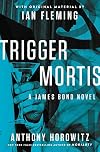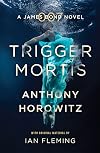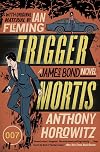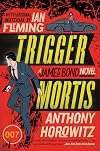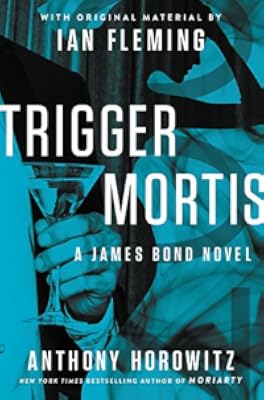
Trigger Mortis
by Anthony Horowitz
James Bond Novels: Continuation Series (46), James Bond Novels (46)
On This Page
Description
Incorporating original, never-before-published material from 007 creator Ian Fleming, New York Times bestselling author Anthony Horowitz returns literary legend James Bond to his 1950s heyday in this exhilarating and dashing thriller.The world's most famous spy, James Bond, has just returned victorious from his showdown with Auric Goldfinger in Fort Knox. By his side is the glamorous and streetwise Pussy Galore, who played no small part in his success. As they settle down in London, the show more odds of Galore taming the debonair bachelor seem slim—but she herself is a creature not so easily caught.
Meanwhile, the struggle for superiority between the Soviet Union and the West is escalating. In an attempt to demonstrate Soviet strength, SMERSH plans to sabotage an international Grand Prix in the hot zone of West Germany. At the Nürburgring Racing Circuit, Bond must play a high-speed game of cat and mouse to stop them, but when he observes a secretive meeting between SMERSH's driver and a notorious Korean millionaire, it becomes clear that this is just the infamous organization's opening move.
An orphan of the Korean War, he has a personal reason for wanting to bring America to its knees. He's helping SMERSH decisively end the white-hot space race—but how? With the help of an American female agent, Bond uncovers a plan that leads first to Florida and then to New York City, where a heart-stopping face-off will determine the fate of the West.
This thriller has all the hallmarks of an original Ian Fleming adventure and features welcome familiar faces, including M and Miss Moneypenny. Horowitz delivers a smooth and seductive narrative of fast cars and beautiful women, ruthless villains and breathtaking plot that will leave readers hanging until the very end.
. show less
Tags
Recommendations



















Member Reviews
To begin, LOVE the title!
This book, is the "sequel" to Fleming's "Goldfinger" and picks up two weeks after that book. Which means, the greatest Bond girl name is still around, Pussy Galore! The Prologue hooked me right away for two reasons - the way it ends (which totally rocked!) and because it mentions my birth place (Fort Bliss in El Paso, Texas)!!! As for the "sequel" thing, it really is in spirit only. The story take on a life of its own after it breaks ties to "Goldfinger". Bond goes from a Grand Prix race to the "space" race, battling SMERSH and Jason Sin along the way! And Sin has a deck of cards that you really, really don't want to touch! Of course, Bond has a "girl", and this time it's Ms. Jeopardy Lane of the good ol' show more USofA. All that being said, you pretty much get a Fleming type Bond book here, and it is an enjoyable ride! show less
This book, is the "sequel" to Fleming's "Goldfinger" and picks up two weeks after that book. Which means, the greatest Bond girl name is still around, Pussy Galore! The Prologue hooked me right away for two reasons - the way it ends (which totally rocked!) and because it mentions my birth place (Fort Bliss in El Paso, Texas)!!! As for the "sequel" thing, it really is in spirit only. The story take on a life of its own after it breaks ties to "Goldfinger". Bond goes from a Grand Prix race to the "space" race, battling SMERSH and Jason Sin along the way! And Sin has a deck of cards that you really, really don't want to touch! Of course, Bond has a "girl", and this time it's Ms. Jeopardy Lane of the good ol' show more USofA. All that being said, you pretty much get a Fleming type Bond book here, and it is an enjoyable ride! show less
‘Don’t say that to me, you bastard! It’s what you want too – don’t think I don’t see it. You know what the big difference is between us? You can’t live with a woman in your life.’
Trigger Mortis is Anthony Horowitz’s continuation of the Bond series. The story sets in after Goldfinger and begins with the description of what happens after Bond gets the girl – in this case, of what happens to Bond’s relationship with Pussy Galore. (I know, it’s implausible….but let’s just roll with it….)
I thought it was an interesting concept to show this side of Bond’s life. Fleming didn’t really do this. There were flashbacks to some of Bond’s previous adventures and mentions of previous characters, but apart from show more professional acquaintances, characters did not appear again – as far as I can gather – in the later books. But of course, each book is a new adventure, and that is famously just as true of Bond’s love life.
Plot-wise, the story gets going after Bond’s relationship breaks up. He’s sent on a mission to investigate some goings on at the motor races, which may or may not be manipulated by SMERSH in the efforts to win at …. everything.
This is a new environment for Bond. He can drive, but not well enough to compete at the professional races, nevermind at one of the most difficult courses in the F1 circuit – the Nuerburgring, which back in the day of when the book is set (1957) still only consisted of the infamous North Loop.
So, adventure ensues and before long Bond encounters the real villain of this book:
Curiouser and curiouser, Bond thought to himself, although he doubted he was going to bump into any white rabbits. Much more likely a mad hatter.
Jason Sin is a truly magnificent villain. He is evil to the core and makes Dr. No look like a big old softie. The main difference of course being that while Dr. No had an agenda doing his evil deeds, Jason Sin has neither values nor interests – he’s arbitrary, and seemingly without emotions of any kind, the epitome of the notion that the opposite of love is not hate, but indifference. He, of course, also has an inventive way to dispose of his enemies:
‘Right now, in front of you, there are forty-five different ways to die. They are printed on the backs of these cards. Some of them demand your own co-operation.
The interesting thing about the villain in this piece is that Horowitz, quite contrary to Fleming’s tradition, made Sin not only the perpetrator of crime but also a victim. In a way, Sin’s actions are the result of the trauma he endured. It’s a simplistic explanation of Sin’s psychology. Too simplistic, but this is a Bond novel, BS is the order of the day.
Nevertheless, Sin’s background story does something that is different in that is places responsibility for crimes against humanity at the door of the parties that usually are portrayed as the heroes. In this case, the US in the Korean war.
Another interesting aspect was that, unlike Fleming, Horowitz added in comments about the time in which Bond lives. I have often wondered what a Bond novel would be like if it contained criticism of contemporary society as part of any of the characters’ parts. Now we know, even though it’s clear that it’s Horowitz’s own reflection written from a point in the future. It still helped to create context for Bond and the way he acts in the books.
Anyway, the service is crawling with sisters. You know it and I know it. Look at that dreadful man Burgess. It’s a gift to the Soviets, letting them set up their honeytraps, snaring civil servants who are too young and too scared to know better. God knows how many secrets we’ve lost that way. Change the law and let people be what they want to be – that’s what I say. And as for you, maybe you should try to be a bit less of a dinosaur. This is 1957, not the Middle Ages! The second half of the twentieth century!’
So, with all of these intriguing aspects going on, why did the book not work for me as well as Goldfinger – it is a sequel after all?
It’s not like I did not enjoy the book, but I also didn’t like it. I think the most important aspect was that the book consisted of mostly description. The story seemed to take a backseat. It was just really hard to keep interested because all of the endless description (and explanation) between the scenes that moved the plot forward were just really boring. Incredibly boring actually. While I might despise Fleming for many of his views, I do admit that he could write. Descriptions in the original series were evocative and helped to show the characters as Fleming needed them to be understood. In Trigger Mortis, I got the impression that Horowitz included a lot of description to show that he had done his research as an author (which I applaud, but I don’t want to read about it). So descriptions did not work for me to picture the scenes or experience the atmosphere, but seem to be used to tell why something was happening.
A great evil had been done to him but it had not made him evil. Sin might claim that what had happened at No Gun Ri had turned him into the monster that he undoubtedly was but Bond had escaped from the hell of a living grave and he had left nothing of his inner self, not an inch of his humanity, behind. That was the difference between them. It was why he would win. show less
Trigger Mortis is Anthony Horowitz’s continuation of the Bond series. The story sets in after Goldfinger and begins with the description of what happens after Bond gets the girl – in this case, of what happens to Bond’s relationship with Pussy Galore. (I know, it’s implausible….but let’s just roll with it….)
I thought it was an interesting concept to show this side of Bond’s life. Fleming didn’t really do this. There were flashbacks to some of Bond’s previous adventures and mentions of previous characters, but apart from show more professional acquaintances, characters did not appear again – as far as I can gather – in the later books. But of course, each book is a new adventure, and that is famously just as true of Bond’s love life.
Plot-wise, the story gets going after Bond’s relationship breaks up. He’s sent on a mission to investigate some goings on at the motor races, which may or may not be manipulated by SMERSH in the efforts to win at …. everything.
This is a new environment for Bond. He can drive, but not well enough to compete at the professional races, nevermind at one of the most difficult courses in the F1 circuit – the Nuerburgring, which back in the day of when the book is set (1957) still only consisted of the infamous North Loop.
So, adventure ensues and before long Bond encounters the real villain of this book:
Curiouser and curiouser, Bond thought to himself, although he doubted he was going to bump into any white rabbits. Much more likely a mad hatter.
Jason Sin is a truly magnificent villain. He is evil to the core and makes Dr. No look like a big old softie. The main difference of course being that while Dr. No had an agenda doing his evil deeds, Jason Sin has neither values nor interests – he’s arbitrary, and seemingly without emotions of any kind, the epitome of the notion that the opposite of love is not hate, but indifference. He, of course, also has an inventive way to dispose of his enemies:
‘Right now, in front of you, there are forty-five different ways to die. They are printed on the backs of these cards. Some of them demand your own co-operation.
The interesting thing about the villain in this piece is that Horowitz, quite contrary to Fleming’s tradition, made Sin not only the perpetrator of crime but also a victim. In a way, Sin’s actions are the result of the trauma he endured. It’s a simplistic explanation of Sin’s psychology. Too simplistic, but this is a Bond novel, BS is the order of the day.
Nevertheless, Sin’s background story does something that is different in that is places responsibility for crimes against humanity at the door of the parties that usually are portrayed as the heroes. In this case, the US in the Korean war.
Another interesting aspect was that, unlike Fleming, Horowitz added in comments about the time in which Bond lives. I have often wondered what a Bond novel would be like if it contained criticism of contemporary society as part of any of the characters’ parts. Now we know, even though it’s clear that it’s Horowitz’s own reflection written from a point in the future. It still helped to create context for Bond and the way he acts in the books.
Anyway, the service is crawling with sisters. You know it and I know it. Look at that dreadful man Burgess. It’s a gift to the Soviets, letting them set up their honeytraps, snaring civil servants who are too young and too scared to know better. God knows how many secrets we’ve lost that way. Change the law and let people be what they want to be – that’s what I say. And as for you, maybe you should try to be a bit less of a dinosaur. This is 1957, not the Middle Ages! The second half of the twentieth century!’
So, with all of these intriguing aspects going on, why did the book not work for me as well as Goldfinger – it is a sequel after all?
It’s not like I did not enjoy the book, but I also didn’t like it. I think the most important aspect was that the book consisted of mostly description. The story seemed to take a backseat. It was just really hard to keep interested because all of the endless description (and explanation) between the scenes that moved the plot forward were just really boring. Incredibly boring actually. While I might despise Fleming for many of his views, I do admit that he could write. Descriptions in the original series were evocative and helped to show the characters as Fleming needed them to be understood. In Trigger Mortis, I got the impression that Horowitz included a lot of description to show that he had done his research as an author (which I applaud, but I don’t want to read about it). So descriptions did not work for me to picture the scenes or experience the atmosphere, but seem to be used to tell why something was happening.
A great evil had been done to him but it had not made him evil. Sin might claim that what had happened at No Gun Ri had turned him into the monster that he undoubtedly was but Bond had escaped from the hell of a living grave and he had left nothing of his inner self, not an inch of his humanity, behind. That was the difference between them. It was why he would win. show less
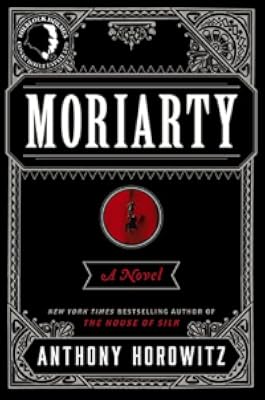
Fresh off his triumph as pseudo-Arthur Conan Doyle in [Moriarty] and [House of Silk], Anthony Horowitz scores again giving voice to Ian Fleming in [Trigger Mortis]. Horowitz explains in the afterward he was contacted by the Fleming estate and given access to some original material in developing the story. It was a happy convergence of two authors. James Bond flits from London to the grand prix racing circuit to rocket launches to trains with as much facility as he has with cocktail shakers. I am amazed by Horowitz’s facility in changing from a late Victorian writing style with Conan Doyle to impersonating a 1950’s debonair Secret Service operative. Bond’s escapades with women are perhaps a little too objectifying for modern show more tastes, but Horowitz perfectly captures the era. An enjoyable addition to the Bond canon. show less
Although not particularly a fan of the James Bond Films (I've never read any Ian Fleming) I read this one because it was written by Anthony Horowitz and I loved his take on Sherlock Holmes in A House of Silk. I must admit I found this book great fun and I really surprised myself by how much I enjoyed it, so much so that I may search out some Ian Fleming Bond books. This moved along at a gripping pace, and I loved the central 'evil' character, and enjoyed the roles of Pussy Galore and Jeopardy Lane and their interactions with Bond. Although many many years since I saw a James Bond film it does feel somewhat like the Bond I remember.
This is something like my 51st or 52nd James Bond book I've read. But even so, I was reluctant to read this book. Several reasons - (1) I got the book for free, not normally an obstacle to my enjoyment, but why was this book, a James Bond book of recent vintage, free?; (2) it has been a rather long while since I read a Bond book; (3) the concept of Bond, his place in society, and his vaguely out-dated way with women had finally reached a breaking point years before I read this book. So . . . could I actually read this book here?
Well, attempt to read it I did. *shrugs* I mean, it was free, it was Bond, and I did have a challenge on GoodReads that would accept this book and so, I attempted it.
Unlike many of the non-Fleming Bond books, show more this one actually took place back in the time of Fleming's Bond - literally moments after the Goldfinger mission. The book actually opens up with him dealing with the aftermath of that mission (which includes having him have Pussy Galore in his apartment in London - because she needed to get away from the US authorities, the criminal element and stuff).
Goldfinger was released in 1959. I do not recall a date appearing in Trigger Mortis, but since the story takes place immediately after Goldfinger, I assume that the events taking place have to have occurred some time around 1959. There is mention of Eisenhower as the president, and mention of the Republicans in power, so 1959 works.
While dealing with the weird situation of actually having a woman in his apartment (he tries to keep his spy life separate from his London life), Bond is contacted by his superiors. Asked about his driving abilities. Apparently the Soviets have built a race car and they are going to be racing at a specific race track. One that has already claimed [insert some high number here] deaths.
All well and good, of course, but . . . SMERSH is involved. And they have apparently targeted the English race driver - the favorite in the race. So, the book turns to having Bond train to drive a race car (actually, retrain since he had apparently had some practice at that in the past). He is going to go undercover as some rich guy buying his way into the race, which apparently happens. He is going to use the lovely cover name of 'James Bond'. As an aside, this is one of the reasons I kind of always assumed Bond itself was a cover name - who the hell goes around and tells everyone asking his name 'Bond, James Bond' unless he's using the name itself as part of his cover? Both in terms of it not actually being his real name, and in terms of that's a name well-known in spy circles, with a rather big elite reputation. But, I'm getting off track here.
The car training/racing scenes were quite fun. Not a large part of the book, but still exciting. Then the story turns to the after-party for the car racers and hangers-on. Some action in a castle, meeting a woman there, stuff happens. Spy stuff, I mean.
The spy stuff there lead to spy stuff taking place in the USA directly connected to the USA space program. And a plan by enemies of the USA to impact the USA space program. Some exciting scenes here as well - in Virginia and New York. Mostly.
I was on edge throughout most of the book, tittering on the edge of 'is he going to do something now? Now? Now? To piss me off with his cave-man 'me-man, you-woman, obviously want to hump me' ways. But there were some surprises along the way. Some of which I doubt would have actually appeared in a book released in 1959/1960 (some elements of it, just not the full bits). Like how a woman Bond was eyeing, dodges his advances, and goes off with another woman. In a Bond book. And he didn't immediately rape her (sorry, overpower her) and show her what she was missing - man-wise (like, say, in most of his encounters with women - there's even a scene, the after party for the car racers, where Bond looks around in disdain. All the women were purring and eager for action. Bond turned his nose up at them - he needs a challenge, to overpower. Which goes along with Bond's character as shown in other works - like that one specific woman in a film who eagerly bounced around him and tried to hump him at every opportunity, and Bond kept kicking her away).
The action was interesting. The characters and events were 'Bond' like. Bond himself . . . hmms. I was thinking at the time that Bond was feeling vaguely off for some reason. As if someone in about 2014 or 2015 had the task of writing a Bond book, set back in the 'bad old days' aka Fleming's macho man days, while also knowing that they were writing a book to be released today. There's this vague vibe of 'need to show him looking macho, but not piss people off' type of vibe. That, actually, made Bond look less Bond like than he should have. But, whatever.
Good book. I enjoyed it.
April 30 2016 show less
Well, attempt to read it I did. *shrugs* I mean, it was free, it was Bond, and I did have a challenge on GoodReads that would accept this book and so, I attempted it.
Unlike many of the non-Fleming Bond books, show more this one actually took place back in the time of Fleming's Bond - literally moments after the Goldfinger mission. The book actually opens up with him dealing with the aftermath of that mission (which includes having him have Pussy Galore in his apartment in London - because she needed to get away from the US authorities, the criminal element and stuff).
Goldfinger was released in 1959. I do not recall a date appearing in Trigger Mortis, but since the story takes place immediately after Goldfinger, I assume that the events taking place have to have occurred some time around 1959. There is mention of Eisenhower as the president, and mention of the Republicans in power, so 1959 works.
While dealing with the weird situation of actually having a woman in his apartment (he tries to keep his spy life separate from his London life), Bond is contacted by his superiors. Asked about his driving abilities. Apparently the Soviets have built a race car and they are going to be racing at a specific race track. One that has already claimed [insert some high number here] deaths.
All well and good, of course, but . . . SMERSH is involved. And they have apparently targeted the English race driver - the favorite in the race. So, the book turns to having Bond train to drive a race car (actually, retrain since he had apparently had some practice at that in the past). He is going to go undercover as some rich guy buying his way into the race, which apparently happens. He is going to use the lovely cover name of 'James Bond'. As an aside, this is one of the reasons I kind of always assumed Bond itself was a cover name - who the hell goes around and tells everyone asking his name 'Bond, James Bond' unless he's using the name itself as part of his cover? Both in terms of it not actually being his real name, and in terms of that's a name well-known in spy circles, with a rather big elite reputation. But, I'm getting off track here.
The car training/racing scenes were quite fun. Not a large part of the book, but still exciting. Then the story turns to the after-party for the car racers and hangers-on. Some action in a castle, meeting a woman there, stuff happens. Spy stuff, I mean.
The spy stuff there lead to spy stuff taking place in the USA directly connected to the USA space program. And a plan by enemies of the USA to impact the USA space program. Some exciting scenes here as well - in Virginia and New York. Mostly.
I was on edge throughout most of the book, tittering on the edge of 'is he going to do something now? Now? Now? To piss me off with his cave-man 'me-man, you-woman, obviously want to hump me' ways. But there were some surprises along the way. Some of which I doubt would have actually appeared in a book released in 1959/1960 (some elements of it, just not the full bits). Like how a woman Bond was eyeing, dodges his advances, and goes off with another woman. In a Bond book. And he didn't immediately rape her (sorry, overpower her) and show her what she was missing - man-wise (like, say, in most of his encounters with women - there's even a scene, the after party for the car racers, where Bond looks around in disdain. All the women were purring and eager for action. Bond turned his nose up at them - he needs a challenge, to overpower. Which goes along with Bond's character as shown in other works - like that one specific woman in a film who eagerly bounced around him and tried to hump him at every opportunity, and Bond kept kicking her away).
The action was interesting. The characters and events were 'Bond' like. Bond himself . . . hmms. I was thinking at the time that Bond was feeling vaguely off for some reason. As if someone in about 2014 or 2015 had the task of writing a Bond book, set back in the 'bad old days' aka Fleming's macho man days, while also knowing that they were writing a book to be released today. There's this vague vibe of 'need to show him looking macho, but not piss people off' type of vibe. That, actually, made Bond look less Bond like than he should have. But, whatever.
Good book. I enjoyed it.
April 30 2016 show less
Picked this up from a Little Free Library, not because I'm a huge Bond fan, but more of an Anthony Horowitz fan. I've really enjoyed his other books and styles (and his TV shows) so wanted to see what this was like. Again, not being much of a Bond fan (I've only ever seen a few of the movies and haven't read any Ian Fleming); having said that, this reads like a Bond movie. Mr Horowitz does seem to get the style down. This probably is fairly similar in style to what Mr. Fleming would do, though probably a little less misogyny. It was a good read, but probably not going to go out of my way to read more of this series. Back to the Little Free Library this goes.
Despite a weak villain and an even weaker Bond girl, this novel works, because Horowitz has skilfully brought back the original Bond of Ian Fleming and the Sean Connery movies. Bond is suave and polished, but also cruel, ruthless and even brutal. He is also fallible, in this book he makes numerous mistakes (fails to spot a tail, leaves his gun in his car, allows a SMERSH hitman to get the drop on him). The major disappointments of the book are the story, which is really "meh, been there done that", the villain, who is boring and predictable and doesn't even rate on the Scaramanga level, let alone a Blofeld or Goldfinger, and the obligatory Bond girl. Pussy Galore makes a terriffic cameo at the start but doesnt contribute to the story show more and departs before the halfway point. She is replaced by Jeopardy Lane, one of the least interesting Bond heroines ever. She is essentially a woman-shaped blank space on the page, who does the requisite Bond girl things before showing a bit of skill on a motorbike, sleeps with Bond and then exits the story. But none of this matters, because the real Bond is back. That, and that alone, is enough to elevate this book to a must-read. show less
Members
- Recently Added By
Author Information

234+ Works 84,219 Members
Author and television scriptwriter Anthony Horowitz was born in Stanmore, England on April 5, 1956. At the age of eight, he was sent to a boarding school in London. He graduated from the University of York and published his first book, Enter Frederick K. Bower (1979), when he was 23. He writes mostly children's books, including the Alex Rider show more series, The Power of Five series, and the Diamond Brothers series. The Alex Rider series is about a 14-year-old boy becoming a spy and was made into a movie entitled Stormbreaker. He has won numerous awards including the 1989 Lancashire Children's Book of the Year Award for Groosham Grange and the 2003 Red House Children's Book Award for Skeleton Key. He also writes novels for adults including The Killing Joke and The Magpie Murders. He has created Foyle's War and Midsomer Murders for television as well as written episodes for Poirot and Murder Most Horrid. He made The New York Times Best Seller list with his titles The House of Silk Russian Roulette: The Story of an Assassin and Moriarity.Most recently he was commissioned by the Ian Fleming Estate to write the James Bond novel Trigger Mortis. Anthony was awarded an OBE for his services to literature in January 2014. (Bowker Author Biography) show less
Awards and Honors
Distinctions
The Guardian Book of the Day (2015-09-02)
Series


Common Knowledge
- Canonical title
- Trigger Mortis
- Original publication date
- 2015-09-08
- People/Characters
- James Bond; Pussy Galore; Logan Fairfax; Jeopardy Lane; Jai Seung Sin (Jason Sin); M (show all 26); Bill Tanner; Lancy Smith; Loelia Ponsonby; Henry Fraser; Harry Johnson; Luther; Artmann; Vladimir Gaspanov; Ivan Dimitrov; Costello; Abbott; Ronnie Vallance; Thomas Keller; Gloria Keller; Charles Henry Duggan; Johnny Calhoun; Eugene T. Lawrence; Danny Slater; Agent 279 (Dickson); Bernardo Hertogs
- Important places
- Coney Island, Brooklyn, New York, New York, USA; Nürburgring, Nürburg, Rhineland-Palatinate, Germany; Nürburg, Rhineland-Palatinate, Germany; Wallops Island, Virginia, USA; London, England, UK
- First words
- It was that moment in the day when the world has had enough.
- Quotations
- No agent had ever survived long in the Double O section and one day someone, somewhere would have the edge and it would be he lying there dead, flat-out in the rain.
- Last words
- (Click to show. Warning: May contain spoilers.)But not today.
Classifications
Statistics
- Members
- 624
- Popularity
- 46,568
- Reviews
- 20
- Rating
- (3.63)
- Languages
- 5 — English, Finnish, French, German, Polish
- Media
- Paper, Audiobook, Ebook
- ISBNs
- 34
- ASINs
- 10