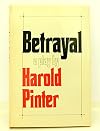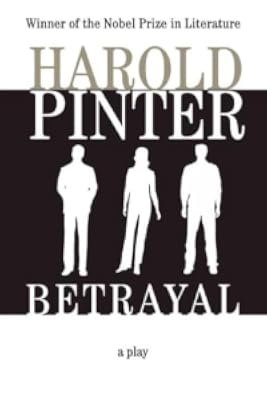
Betrayal
by Harold Pinter
On This Page
Description
Upon its premiere at the National Theatre, Betrayal was immediately recognized as a masterpiece. It won the Olivier Award for best new play, and has since been performed all around the world and made into an Academy Award-nominated film starring Jeremy Irons, Ben Kingsley, and Patricia Hodge. Betrayal begins with a meeting between adulterous lovers, Emma and Jerry, two years after their affair has ended. During the nine scenes of the play, we move back in time through the stages of their show more affair, ending in the house of Emma and her husband Robert, Jerry's best friend. show lessTags
Recommendations




















Member Reviews
I actually listened to this as a BBC Radio Drama (http://www.bbc.co.uk/programmes/b01kr71s)that starred Olivia Colman and Andrew Scott. I'd heard he'd won the BBC Audio Drama, Best Actor Award for it, and I liked him from BBC Sherlock so I thought it would be interesting.
This is a interesting play. First of all, it's presented chronologically backwards... We meet the two people who had an affair after their affair is over, as they are having a discussion over lunch. The woman reveals she has told her husband that she'd cheated on him with the ex-lover, who is his best friend. He's angry because she didn't consult him first, and then we hear his conversation with his friend... who has really known for several years. The ex-lover / wife show more had lied when we first heard her.
It proceeds from there, slowly revealing various lies the friends/spouses/lovers have told each other over the years and highlights their reactions to the various "betrayals".
Very thought provoking. I think my favourite moment of the play was when Andrew Scott's character, Jerry, angrily shouts at his best friend, Robert, for not telling him that he's known about the affair that he'd had with his wife, Emma, for four years... Jerry feels a fool for thinking all was fine between them and that his betrayal of his friend with Emma was a secret, while his friend Robert simply didn't act on the knowledge and acted normally. The bizarreness of Jerry being angry about NOT being confronted for having an affair with his best friend's wife was incredibly well acted... and while he didn't really have any moral right to be angry, you could see why he was upset. Both Emma and Robert knew the truth was out, and neither had told him.
It was really a great moment, well acted... In a play full of moments worth listening to. Makes you think about all the different lies and different kinds of betrayals we have in daily life.
(Evidently the play was based on the author's real life affair with a famous female BBC broadcaster.) show less
This is a interesting play. First of all, it's presented chronologically backwards... We meet the two people who had an affair after their affair is over, as they are having a discussion over lunch. The woman reveals she has told her husband that she'd cheated on him with the ex-lover, who is his best friend. He's angry because she didn't consult him first, and then we hear his conversation with his friend... who has really known for several years. The ex-lover / wife show more had lied when we first heard her.
It proceeds from there, slowly revealing various lies the friends/spouses/lovers have told each other over the years and highlights their reactions to the various "betrayals".
Very thought provoking. I think my favourite moment of the play was when Andrew Scott's character, Jerry, angrily shouts at his best friend, Robert, for not telling him that he's known about the affair that he'd had with his wife, Emma, for four years... Jerry feels a fool for thinking all was fine between them and that his betrayal of his friend with Emma was a secret, while his friend Robert simply didn't act on the knowledge and acted normally. The bizarreness of Jerry being angry about NOT being confronted for having an affair with his best friend's wife was incredibly well acted... and while he didn't really have any moral right to be angry, you could see why he was upset. Both Emma and Robert knew the truth was out, and neither had told him.
It was really a great moment, well acted... In a play full of moments worth listening to. Makes you think about all the different lies and different kinds of betrayals we have in daily life.
(Evidently the play was based on the author's real life affair with a famous female BBC broadcaster.) show less
One of a few plays I am happy to reread/rewatch. Harold Pinter's inspiration for this was his long-term affair with Joan Bakewell, and he has said how he felt betrayed when he learnt that Joan's husband had known about the affair for a long time and not confronted him. And a wonderful exposure of human nature in the first scene when Jerry says, having heard talk that his ex-lover is seeing another man that he felt irritation that no one gossiped about us like that. Funny and painful, sparse mundane dialogue and plenty of pauses that speak a thousand thoughts. And an arresting back-to-front structure, so the audience know more than the characters as the play progresses. Wonderfully thought-provoking about relationships and what we show more remember about ourselves. show less
A three-hander first performed in 1978, with Penelope Wilton, Michael Gambon and Daniel Massey appearing in Peter Hall's original NT production. Jerry and Robert are best friends who studied together, play squash together, and both ended up working as publishers. They are both married and have children, but Jerry has had a seven-year-long affair with Robert's wife Emma. In a sequence of short, ambiguous scenes full of fragmented dialogue that never quite means what it says, Pinter digs back in time to explore different meanings of "betrayal", with each stage that we dig back into the characters' memories revealing another level of their dishonesty to each other and to themselves.
About as serious a take as it's possible to have on the show more banal topic of bourgeois adultery. show less
About as serious a take as it's possible to have on the show more banal topic of bourgeois adultery. show less
I studied Pinter years ago at school and fell in love with his plays. I was prompted to re-read Betrayal because of an imminent trip to see a theatre production and I had forgotten just how good a play this is. The dialogue is sparse and deceptively simple, but is sharp and cuts like a knife to the core of the play, 'I don't need to think about you.' The simple device of telling the story of an affair backwards enables Pinter to expose the complexities of the affair, enabling this play to transcend the mundane, and, as Samuel Beckett commented to Pinter, 'wrings the heart'.
An interesting twist on a familiar tale of infidelity - Pinter tells the story backwards. He begins at the end, and ends at the beginning, so you already sort of know how it's going to "end", but you stick around because he has hooked you by the peculiar twist. Without that gimmick, it might be just another familiar story with nothing to keep you in your seat. The dialogue is stark and nearly barren, but that can be misleading. It isn't so much the words the characters say as the interplay between the characters, what the words mean rather than strictly what they say.
خیلی دوست داشتم و خوشحالم بعد از چند سال که دوست داشتم بخونمش بالاخره موقعیتش رو پیدا کردم!
Members
- Recently Added By
Lists

Time is out of joint
19 works; 3 members

Read the book and saw the movie
1,170 works; 195 members

1970s
657 works; 23 members

Plays I Like
230 works; 31 members
My Play Collection
769 works; 3 members

Next Plays / 2025
352 works; 1 member

Next Plays to Watch
50 works; 1 member
Author Information

254+ Works 9,352 Members
English playwright, poet, and political activist Harold Pinter was born on October 10, 1930, in London's East End. From childhood he was interested in literature and acting. He studied at both the Royal Academy of Dramatic Arts and the Central School of Speech and Drama. Pinter was a Nobel Prize-winning English playwright and screenwriter. One of show more the most influential modern British dramatists, his writing career spanned more than 50 years. His best-known plays include The Birthday Party (1957), The Homecoming (1964), and Betrayal (1978), each of which he adapted to film. Pinter published his first poems in 1950. He worked as a bit-part actor in a BBC Radio program and also toured with a Shakespearean troupe. Pinter has written over 30 plays, achieving great success internationally. He has also directed several of his dramas. Pinter was married to actress Vivien Merchant from 1956 to 1980, before wedding biographer Lady Antonia Fraser. From his first marriage he has a son who is a writer and musician. Pinter has won numerous prestigious literary prizes in poetry and theatre. He was awarded the Hermann Kesten Medallion for outstanding commitment on behalf of persecuted and imprisoned writers. He has been granted honorary degrees at universities in England, Scotland, the United States, Bulgaria, Ireland, Italy, and Greece. In 2005, Pinter received the Nobel Prize for Literature. He died from cancer on December 24, 2008 at the age of 78. (Bowker Author Biography) show less
Awards and Honors
Series
Belongs to Publisher Series
Faber Plays (Pinter)
Work Relationships
Is contained in
Common Knowledge
- Canonical title
- Betrayal
- Original title
- Betrayal
- People/Characters
- Emma; Jerry; Robert; Judith; Caisey
- Important places
- London, England, UK; Venice, Veneto, Italy
- Related movies
- Betrayal (1983 | IMDb)
- Quotations
- Well, it’s nice, sometimes, to think back. Isn’t it?
I don't think we don't love each other
Classifications
Statistics
- Members
- 679
- Popularity
- 42,277
- Reviews
- 9
- Rating
- (3.88)
- Languages
- 6 — Catalan, English, German, Hungarian, Italian, Farsi/Persian
- Media
- Paper, Ebook
- ISBNs
- 19
- ASINs
- 8