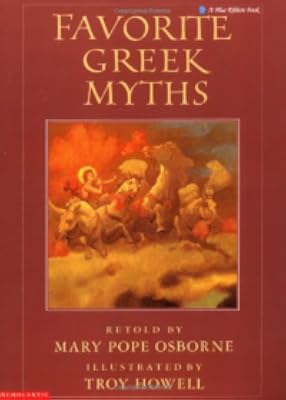
Favorite Greek Myths
by Mary Pope Osborne (Retold by)
On This Page
Description
Retells twelve tales from Greek mythology, including the stories of King Midas, Echo and Narcissus, the Golden Apples, and Cupid and Psyche.Tags
Recommendations













Member Reviews
This is an OK introduction to Greek Myths for 7-9 year olds. Mary Pope Osborne was a favorite when my child was young. We both enjoyed her Magic Tree House series. The illustrations are nice too, reminiscent of N. C. Wyeth's style. However, I only gave the book 2 and 1/2 stars because of the inexplicable mixing of Greek and Roman names in the stories. The author does say she used mostly Ovid's Metamorphoses as a resource, but still why call them "Greek" myths but use the Roman names for the gods, while keeping some of the other characters' Greek names? I found this irritating, though a child would certainly not be bothered by it due to ignorance. Also at the end there is a list of "modern words with Greek origins" and again, there are show more many words in the list of Latin origin, though this is not distinguished (for example: cereal from Ceres, the Latin name of Demeter). I understand that the author didn't want to get into these pesky details since the book is geared towards elementary age children (all the myths are 'cleaned up' by the way, no sexual violence), but then just use only the Greek names. Or if the Roman names are more suited for whatever reason, then use only the Roman names -- not this mix. show less
Favorite Greek Myths by Mary Pope Osborne. Age: gr. K-5. Library section: 9 A: Juvenile, Religion and Values. This author has written many outstanding children’s books. Here she tells kids about those groovy Greeks and what exactly they believed about god. Or should I say gods. They were a polytheistic culture, meaning that they worshiped many gods – gods of the harvest, of war, of the moon, the underworld.
The main part of this book is stories about Greek gods and goddesses – Apollo and Daphne, Echo and Narcissus, Orpheus and Eurydice (you-RID-i-see.) Each story has a beautiful full-page illustration of the gods in the story. The back of the book lists the gods, goddesses and mortals in the myths, modern words with Greek origins show more such as arachnid, cereal, and mercury, as well as a short mention of who wrote these myths.
These seem like fairy stories to us, but the Greeks took their worship very seriously, going so far as to erect giant temples to honor them and house deity statues, such as the Parthenon in Athens. These temples were used for worship and as a place in which to leave offerings to these gods. For example, the Parthenon was dedicated to the Greek goddess Athena, patroness of the city of Athens. An interesting sidelight is that many of these marble temples had areas that were painted with bright colors, so as you imagine the Parthenon, the figures above the front row of columns in the triangular pediment were painted in color. That gives a whole new vision of the temple in your imagination. They were fairly gaudy, not all white as are the ruins.
This worship of many deities was going on at the same time as the Hebrews worshiped their one God. It is good for our kids to know as much religious history as possible because by comparison they can understand how Christianity developed alongside these other belief systems. show less
The main part of this book is stories about Greek gods and goddesses – Apollo and Daphne, Echo and Narcissus, Orpheus and Eurydice (you-RID-i-see.) Each story has a beautiful full-page illustration of the gods in the story. The back of the book lists the gods, goddesses and mortals in the myths, modern words with Greek origins show more such as arachnid, cereal, and mercury, as well as a short mention of who wrote these myths.
These seem like fairy stories to us, but the Greeks took their worship very seriously, going so far as to erect giant temples to honor them and house deity statues, such as the Parthenon in Athens. These temples were used for worship and as a place in which to leave offerings to these gods. For example, the Parthenon was dedicated to the Greek goddess Athena, patroness of the city of Athens. An interesting sidelight is that many of these marble temples had areas that were painted with bright colors, so as you imagine the Parthenon, the figures above the front row of columns in the triangular pediment were painted in color. That gives a whole new vision of the temple in your imagination. They were fairly gaudy, not all white as are the ruins.
This worship of many deities was going on at the same time as the Hebrews worshiped their one God. It is good for our kids to know as much religious history as possible because by comparison they can understand how Christianity developed alongside these other belief systems. show less
A great introduction to Mythology. I had the pleasure of meeting the author at a conference earlier and she spoke of this collection fondly. I enjoyed these stories. Also included are appendices, which are definitely a good reference - it offers both the Roman and Greek names of the characters, descriptions, and a short bibliography of other mythological works. My one quibble is that the Roman names were using in text as opposed to the Greek names.
A good collection of Greek classics is essential for early childhood reading. This link to our primitive (and perhaps more elegant) storytelling must not be forgotten, or broken. The illustrations in this collection are top notch, and capture the imagination of the listeners and readers alike throughout. Highly recommended.
This is the second Mary Osborne Pope Osborne book that I included in my library. This book was mainly selected due to convenience as it was very difficult to find a traditional literature chapter book. This book includes numerous different Greek myths, some I was familiar with, some were new to me. I enjoyed the style of writing, as it was written in my child-friendly verse, as opposed to a lot of greek myths. I think the authors purpose for writing this book was to make Greek mythology more accessable to younger audiences.
A great collection of Greek Myths. I especially liked the story, The Golden Touch: The Story of Bacchus and King Midas. It taught a great lesson on greed and that money doesn't buy happiness. King Midas is granted a wish, everything he touches turns to gold. Much to his surprise this includes his food and water. He has to call for Bacchus to reverse the wish and Bacchus does because he thinks King Midas has learned his lesson.
This collection of Greek myths retold by Mary Pope Osborne is a treasure. Osborne does an outstanding job of writing the myths in a format that is enjoyable and easy to read. The collection contains 12 Greek myths with accompanying illustrations. In addition, there are sections titled God, Goddesses, and Mortals, Modern Words with Greek Origins, and Who Wrote the Greek Myths?. Overall, this is a beautiful collection and a joy to read.
Members
- Recently Added By
Lists

Finish Strong 2015
15 works; 1 member

Before Austen Comes Aesop
318 works; 9 members
Author Information

Mary Pope Osborne was born in Fort Sill, Oklahoma on May 20, 1949. She grew up in a military family, and by the time she was 15 she had lived in Oklahoma, Austria, Florida, and four different army posts in Virginia and North Carolina. She attended the University of North Carolina at Chapel Hill where she majored in religion. After graduation, she show more traveled around Europe and Asia. Before becoming an author, she worked as a window dresser, a medical assistant, a Russian travel consultant, a waitress, an acting teacher, a bartender, and an assistant editor for a children's magazine. Her first book, Run, Run as Fast as You Can, was published in 1982. She is the author of the Magic Tree House series and the Merlin Missions series. Her husband, actor Will Osborne, helps her write the nonfiction companion series, Magic Tree House Research Guides. Her other books include The Deadly Power of Medusa, Jason and the Argonauts, Haunted Waters, and Moonhorse. (Bowker Author Biography) show less
All Editions
Awards and Honors
Series
Belongs to Publisher Series
Common Knowledge
- Original publication date
- 1989
- Important places
- Greece
- Epigraph
- "My intention is to tell
of bodies changed to different forms;
the gods, who made the changes will help me,
or so I hope,
with a poem that runs from the world's beginnings
to our own days."
--Ovid's Metam... (show all)orphoses - Dedication
- For MICHAEL, BECCA, and NATHANIEL
M.P.O.
To DAVID GRAHAM:
He that has light within his own cleer brest
May sit i'th center and enjoy bright day
(from Comus by John Milton)
T.H. - First words
- Welcome to a strange and beautiful world where human forms turn into seagulls, lions, bears, and stars. (Introduction)
- Last words
- (Click to show. Warning: May contain spoilers.)Dante, Chaucer, Milton, Shakespeare, and many other great writers show traces of Ovid in their work. (Who Wrote the greek Myths?)
Classifications
- Genre
- Nonfiction
- DDC/MDS
- 292.13 — Religion Other religions Greek & Roman Mythology Religious mythology, general classes of religion, interreligious relations and attitudes, social theology Mythology and mythological foundations
- LCC
- BL782 .O86 — Philosophy, Psychology and Religion Religions. Mythology. Rationalism Religions. Mythology. Rationalism History and principles of religions European. Occidental Classical (Etruscan, Greek, Roman)
- BISAC
Statistics
- Members
- 1,547
- Popularity
- 14,896
- Reviews
- 42
- Rating
- (3.72)
- Languages
- English, Spanish
- Media
- Paper, Audiobook
- ISBNs
- 11
- ASINs
- 3