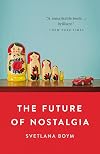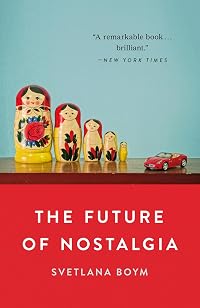
The Future of Nostalgia
by Svetlana Boym
On This Page
Description
"Why is it that the age of globalization is accompanied by a no less global epidemic of nostalgia? What happens to Old World memories in a New World order? Do we even know what we are nostalgic for?" "Combining philosophical essay, aesthetic analysis and personal memoir, Boym explores the spaces of collective nostalgia, national myths and the personal stories of exiles. She guides us through the ruins and construction sites of post-communist cities such as St. Petersburg, Moscow and Berlin, show more explores the imagined homelands of writers and artists like Vladimir Nabokov, Joseph Brodsky and Ilya Kabakov and examines the souvenir collections of ordinary immigrants. In short, Boym has written a new kind of encyclopedic meditation that captures the mysteries and rhythms of longing, a calendar that schedules out of time daydreaming and a treatise that diagnoses our global epidemic of longing and its antidotes."--BOOK JACKET. show lessTags
Recommendations











Member Reviews
Is nostalgia an eternal lack, or an alternative ironic fulfilment? Is it a disorder; or even a disease? Is nostalgia the manifest of the body-mind dynamic only humans are known to affect? Is nostalgia, in its spectral forms, human condition itself?
There are issues spinning around threads such as these and other philosophical & psychological, social & historical queries which Svetlana Boym, the Russian-American-nostalgic, has undertaken to address.
In this brilliantly focussed meditation on the philosophy of Nostalgia, Svetlana becomes increasingly interested in unveiling the creative potential of the concept in terms of that ever-ambivalent but human-all-too-human idea, known to us as 'Modernity'. She covers pretty much enough art show more history of the time: such as Paul Klee's 'The Angel of History' as emphasized by Walter Benjamin's discourse about its possibilities to traverse and go beyond fixed categories or isms.
In the first part of the book, Boym argues how nostalgia became a polarized or binarized category, in terms of the local and the universal.
Subsequently, the space and time vis-a-vis 'modernity' is unpacked by Boym daringly close to and in relation to the postmodernist concepts from critical theory. The paradox of our age emerges out of culture, art history, and the lives of the exiles whose sharp literary wisdom enable the past, present and future to coexist; in their poetry, architecture, essays and installation art.
...
With a vision of the 'reflective nostalgic', the author commentates on the capitalist outlook, and along with its perpetual commodification of our world, anticipates the 'ersatz nostalgia' / 'armchair nostalgia" (Appadurai) -- guides the reader detour and return to our age -- where everything could be put on sale, in a constantly advertised space, packed and delivered at the scale of the arenas of the metropolis/megapolises. As a corollary of that system, memories (genuine or manufactured and projected endlessly) are commodified. This effects the fine-tuning of the scrutinizing light of enquiry on ourselves amid our nostalgias.
...
and tells thus of the politics of nostalgia welded with politics of nationalism:
"American popular culture is growing more and more self-referential and all-embracing; it quickly absorbs the inventions of high culture, but as in Clement Greenberg’s good old definition of kitsch, the entertainment industry still mass reproduces the effects of art and stays away from exploring the mechanisms of critical consciousness."
All ideas, as they come to life, given thus by those who think them, emerge and advance towards their natural evolution as philosophical concepts. Svetlana Boym, in the 'Future of Nostalgia' achieves not only charting out the inception, conception, the historical evolution of the idea of 'Nostalgia' but conceptualizes it with the eyes of our paradoxical worlds. This means that what we are discussing here with respect to the 'modern condition' which stretches up to the postmodern times, and read or rather consumed now in a post-truth environment, is available as an essential reading of our most urgent inhibitions, as well as the concerns of the day, in general. For instance, the writer's injunction that unlike the popular conception, postmodernism was first developed in the post-soviet Russia, is a revelation of sorts, with respect to the human-nostalgic-condition.
In a comprehensive chapterization on tracing the historical roots of 'nostalgia' and re-reading it in the age of AI, the book facilitates our faculty of critical reading. The chapters on the city and the metropolis identify credibly our generations' existential strife: "The city, then, is an ideal crossroads between longing and estrangement, memory and freedom, nostalgia and modernity."
The way Svetlana Boym sees the three cities (which are always more than three cities) in philosophical detail, opens us a novel way of visualizing the phenomenon of a city; as a simultaneous perception of the authentic and fake experience.
In particular it is those sections that argue for the enabling side or power of Nostalgia, which is the core of the book for me: The Proustian return to the home is a return to his self.
...
Nostalgia, regardless, is a dynamic movement between forgetfulness and remembering ...
this dynamic keeps shaping into metamorphosed forms, informed by erased memories, enforced forgetfulness, manufactured recollections, or manufactured nostalgia of memories, and so on.
... leading up to reveal to ourselves the nostalgias: local, domestic, national, individual, social, personal, collective, commercial, political, ... and the 'nostalgia for world culture' in Mendelstam's words, or Benjamin's 'ironic nostalgia'...
not to mention the selective nostalgia/memory...
... and the nostalgia of the "many potentialities that have not been realized"...
... and what about "nostalgia for nostalgia" ...
to be read and perceived from the point of view of the 'ethics of remembering'...
The author devotes considerable space to the politics of the erasure of nostalgia, and thereby projecting/planting a reconstructed one:
"There are no ruins on the site ..... The obliteration of memory is at the foundation of each new project. .... enforces a collective amnesia about past destructions..."
...
Thus, reading 'into' nostalgia, to deepen understanding of its inherent paradoxes, allows accessing the philosophic vision of nostalgia... which is the most enabling force to take away the veneers and veils that shroud the immanent ambivalences of reality; nostalgically speaking then, would be seeing into the fissures, the interstices that embodies the nature of reality.
Boym approaches nostalgia, through the alleyways of memory and forgetfulness of memories; through accounts and rumours and misrepresentations of information, through the visible and the invisible both; the modus operandi to access human condition, which refuses to be pinned down: such as Nabokov's mediations:
"The literal is less truthful than the literary" ~ in Nabokov's seeing the photographs o
....
"Nostalgia is akin to unrequited love, only we are not sure about the identity of our lost beloved."
...
"Homecoming does not signify a recovery of identity; it does not end the journey in the virtual space of imagination. A modern nostalgic can be homesick and sick of home, at
once..."
... because sometimes the homecoming doesn't cure; it rather aggravates the longing.
'The Future ( Past Present) of Nostalgia' is a significant book simply to traverse cities from the eyes of a modern nostalgic ... and meet, in other nostalgics, with authors and artists introduced by way of sensitive excursions taken to the museums, houses, the places where the literary augments the literal ... steering away the idea of nostalgia from the Russian 'poshlost' and the German 'kitsch'... or the sentimentalization of emotions and human feelings entrenched in nostalgia; ... like Kabakov's much ubiquitous "horizontality of the banal"...
There is much that would require coming back to this book for a well deserved repeat reading, a revisiting; even as I felt the deliberation to slow down finishing it the first time, to escape bringing it to the inevitable close, and with that the advent of a pining nostalgia that is brewing already--being nostalgic about all the peers, people and places that Svetlana has documented or archived with love. show less
There are issues spinning around threads such as these and other philosophical & psychological, social & historical queries which Svetlana Boym, the Russian-American-nostalgic, has undertaken to address.
In this brilliantly focussed meditation on the philosophy of Nostalgia, Svetlana becomes increasingly interested in unveiling the creative potential of the concept in terms of that ever-ambivalent but human-all-too-human idea, known to us as 'Modernity'. She covers pretty much enough art show more history of the time: such as Paul Klee's 'The Angel of History' as emphasized by Walter Benjamin's discourse about its possibilities to traverse and go beyond fixed categories or isms.
In the first part of the book, Boym argues how nostalgia became a polarized or binarized category, in terms of the local and the universal.
Subsequently, the space and time vis-a-vis 'modernity' is unpacked by Boym daringly close to and in relation to the postmodernist concepts from critical theory. The paradox of our age emerges out of culture, art history, and the lives of the exiles whose sharp literary wisdom enable the past, present and future to coexist; in their poetry, architecture, essays and installation art.
...
With a vision of the 'reflective nostalgic', the author commentates on the capitalist outlook, and along with its perpetual commodification of our world, anticipates the 'ersatz nostalgia' / 'armchair nostalgia" (Appadurai) -- guides the reader detour and return to our age -- where everything could be put on sale, in a constantly advertised space, packed and delivered at the scale of the arenas of the metropolis/megapolises. As a corollary of that system, memories (genuine or manufactured and projected endlessly) are commodified. This effects the fine-tuning of the scrutinizing light of enquiry on ourselves amid our nostalgias.
...
and tells thus of the politics of nostalgia welded with politics of nationalism:
"American popular culture is growing more and more self-referential and all-embracing; it quickly absorbs the inventions of high culture, but as in Clement Greenberg’s good old definition of kitsch, the entertainment industry still mass reproduces the effects of art and stays away from exploring the mechanisms of critical consciousness."
All ideas, as they come to life, given thus by those who think them, emerge and advance towards their natural evolution as philosophical concepts. Svetlana Boym, in the 'Future of Nostalgia' achieves not only charting out the inception, conception, the historical evolution of the idea of 'Nostalgia' but conceptualizes it with the eyes of our paradoxical worlds. This means that what we are discussing here with respect to the 'modern condition' which stretches up to the postmodern times, and read or rather consumed now in a post-truth environment, is available as an essential reading of our most urgent inhibitions, as well as the concerns of the day, in general. For instance, the writer's injunction that unlike the popular conception, postmodernism was first developed in the post-soviet Russia, is a revelation of sorts, with respect to the human-nostalgic-condition.
In a comprehensive chapterization on tracing the historical roots of 'nostalgia' and re-reading it in the age of AI, the book facilitates our faculty of critical reading. The chapters on the city and the metropolis identify credibly our generations' existential strife: "The city, then, is an ideal crossroads between longing and estrangement, memory and freedom, nostalgia and modernity."
The way Svetlana Boym sees the three cities (which are always more than three cities) in philosophical detail, opens us a novel way of visualizing the phenomenon of a city; as a simultaneous perception of the authentic and fake experience.
In particular it is those sections that argue for the enabling side or power of Nostalgia, which is the core of the book for me: The Proustian return to the home is a return to his self.
...
Nostalgia, regardless, is a dynamic movement between forgetfulness and remembering ...
this dynamic keeps shaping into metamorphosed forms, informed by erased memories, enforced forgetfulness, manufactured recollections, or manufactured nostalgia of memories, and so on.
... leading up to reveal to ourselves the nostalgias: local, domestic, national, individual, social, personal, collective, commercial, political, ... and the 'nostalgia for world culture' in Mendelstam's words, or Benjamin's 'ironic nostalgia'...
not to mention the selective nostalgia/memory...
... and the nostalgia of the "many potentialities that have not been realized"...
... and what about "nostalgia for nostalgia" ...
to be read and perceived from the point of view of the 'ethics of remembering'...
The author devotes considerable space to the politics of the erasure of nostalgia, and thereby projecting/planting a reconstructed one:
"There are no ruins on the site ..... The obliteration of memory is at the foundation of each new project. .... enforces a collective amnesia about past destructions..."
...
Thus, reading 'into' nostalgia, to deepen understanding of its inherent paradoxes, allows accessing the philosophic vision of nostalgia... which is the most enabling force to take away the veneers and veils that shroud the immanent ambivalences of reality; nostalgically speaking then, would be seeing into the fissures, the interstices that embodies the nature of reality.
Boym approaches nostalgia, through the alleyways of memory and forgetfulness of memories; through accounts and rumours and misrepresentations of information, through the visible and the invisible both; the modus operandi to access human condition, which refuses to be pinned down: such as Nabokov's mediations:
"The literal is less truthful than the literary" ~ in Nabokov's seeing the photographs o
....
"Nostalgia is akin to unrequited love, only we are not sure about the identity of our lost beloved."
...
"Homecoming does not signify a recovery of identity; it does not end the journey in the virtual space of imagination. A modern nostalgic can be homesick and sick of home, at
once..."
... because sometimes the homecoming doesn't cure; it rather aggravates the longing.
'The Future ( Past Present) of Nostalgia' is a significant book simply to traverse cities from the eyes of a modern nostalgic ... and meet, in other nostalgics, with authors and artists introduced by way of sensitive excursions taken to the museums, houses, the places where the literary augments the literal ... steering away the idea of nostalgia from the Russian 'poshlost' and the German 'kitsch'... or the sentimentalization of emotions and human feelings entrenched in nostalgia; ... like Kabakov's much ubiquitous "horizontality of the banal"...
There is much that would require coming back to this book for a well deserved repeat reading, a revisiting; even as I felt the deliberation to slow down finishing it the first time, to escape bringing it to the inevitable close, and with that the advent of a pining nostalgia that is brewing already--being nostalgic about all the peers, people and places that Svetlana has documented or archived with love. show less
Ratings
Members
- Recently Added By
Lists

culture
320 works; 1 member
Author Information

18+ Works 474 Members
Svetlana Boym was born in Leningrad, Russia on April 29, 1959. She received a bachelor's degree in Hispanic languages and literatures from the Herzen State Pedagogical Institute in Leningrad, a master's degree in Hispanic languages and literatures from Boston University, and a Ph.D. in comparative literature from Harvard University. She became an show more assistant professor at Harvard in 1988. Her work included the nonfiction books Death in Quotation Marks: Cultural Myths of the Modern Poet, Common Places: Mythologies of Everyday Life in Russia, The Future of Nostalgia, and Another Freedom: The Alternative History of an Idea; a novel entitled Ninochka; and a play entitled The Woman Who Shot Lenin. She was also known as a photographer, with her work exhibited at galleries around the world. She died from cancer on August 5, 2015 at the age of 56. (Bowker Author Biography) show less
Common Knowledge
- Canonical title
- The Future of Nostalgia
Classifications
Statistics
- Members
- 325
- Popularity
- 97,639
- Reviews
- 1
- Rating
- (4.21)
- Languages
- English, Spanish, Turkish
- Media
- Paper, Ebook
- ISBNs
- 6
- ASINs
- 2