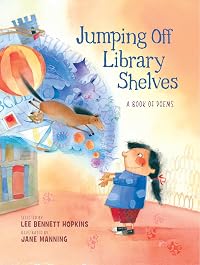
Jumping Off Library Shelves
by Lee Bennett Hopkins
On This Page
Description
Here is the library, not just as a place that houses books, but as an experience. Fifteen poems celebrate the thrill of getting your first library card, the excitement of story hour, the fun of using the computer, the pride of reading to the dog, and the joy of discovering that the librarian understands you and knows exactly which books you'll love. The poems, compiled by noted poet and anthologist Lee Bennett Hopkins, pay homage to the marvels of books and reading. Accompanied by Jane show more Manning's colorful, imaginative illustrations, this collection lyrically celebrates the magic of libraries. show lessTags
Recommendations






Member Reviews
This is a story of poems written by different authors, all coming together to tell how magical a library can be. Although there are many different authors in this book, including Nikki Grimes (my author study person), they all used imagery in their own unique way. For example, author Cynthia S. Cotten wrote that a library card is more powerful than "the smartest phone, more powerful than a TV remote, more powerful than a hundred apps". To me, not only is Cotten using repetition, but she is showing that people are so wrapped up in today's technology that they do not see how libraries are more beneficial. I think this is an amazing book of poetry, and all library lovers can relate.
I liked the book for three reasons. First, I liked how all of the poems are related by one theme. This theme revolves around the idea of a library being a warm and inviting environment. Each poem has the reader look at the items found within a library in a different way than it usually is. There are poems about walking inside a library, reading books, librarians, and library cards. Each poem suggests and offers alternative perspectives on the classic library items. For instance, in the poem “My Card,” the author shows how a library card is this amazing item that can bring a person book after book. The library card is not just a simple card; rather, it is an item that opens doors.
Second, I like the illustrations that are present show more throughout the book. For each poem, an illustration fills the whole page. These illustrations are filled with color and grab the reader’s attention. In addition, the illustrations support the concepts within each poem. For instance, in the poem “Enchantment,” the illustration is of a wizard. This supports the idea of books being enchanting items that are attention grabbing. Then, in the poem “Internet Explorer,” there is a picture of a child on a boat sailing out into the world. This is similar to how a child explores the world of information when on the internet. Furthermore, during the poem “Storyteller,” there is one image of a teacher reading to a group of kids and then another image with a dragon and other magical items. This brings out the point of how when a book is read, a story is produced, which can be filled with imagination and wonder.
Third, the lines of the poems are organized in a way that adds interest. Rather than the lines simply following each other in a straight downward form, the lines at times are in curves or off-center. For instance, in the poem, “I’d like a Story,” the lines are curved as if following a semi-circle shape. Furthermore, many of the poems end with the words in the last line spaced out and in a descending form. This occurs in the poems: “Library,” “Enchantment,” and “Midnight.” In addition, the words themselves are differentiated by some being italicized. This happens in “The Poetry Section,” when the author writes, “it reached out and grabbed me.” By italicizing certain words, there is an emphasis placed upon the text. This deepens the meaning of the text and engages the reader.
The overall message that the author seeks to display through this book is that libraries are warm and inviting places that contain mystery and excitement. On the front flap of the book, the author writes “Open library doors. Enter a world of wonder - your home away from home.” The author is seeking to show the reader how a library can grant you access to a world of ideas and worlds. By reading a book, the reader can be transported into a story filled with excitement and adventure. All one must do, is walk through the doors. show less
Second, I like the illustrations that are present show more throughout the book. For each poem, an illustration fills the whole page. These illustrations are filled with color and grab the reader’s attention. In addition, the illustrations support the concepts within each poem. For instance, in the poem “Enchantment,” the illustration is of a wizard. This supports the idea of books being enchanting items that are attention grabbing. Then, in the poem “Internet Explorer,” there is a picture of a child on a boat sailing out into the world. This is similar to how a child explores the world of information when on the internet. Furthermore, during the poem “Storyteller,” there is one image of a teacher reading to a group of kids and then another image with a dragon and other magical items. This brings out the point of how when a book is read, a story is produced, which can be filled with imagination and wonder.
Third, the lines of the poems are organized in a way that adds interest. Rather than the lines simply following each other in a straight downward form, the lines at times are in curves or off-center. For instance, in the poem, “I’d like a Story,” the lines are curved as if following a semi-circle shape. Furthermore, many of the poems end with the words in the last line spaced out and in a descending form. This occurs in the poems: “Library,” “Enchantment,” and “Midnight.” In addition, the words themselves are differentiated by some being italicized. This happens in “The Poetry Section,” when the author writes, “it reached out and grabbed me.” By italicizing certain words, there is an emphasis placed upon the text. This deepens the meaning of the text and engages the reader.
The overall message that the author seeks to display through this book is that libraries are warm and inviting places that contain mystery and excitement. On the front flap of the book, the author writes “Open library doors. Enter a world of wonder - your home away from home.” The author is seeking to show the reader how a library can grant you access to a world of ideas and worlds. By reading a book, the reader can be transported into a story filled with excitement and adventure. All one must do, is walk through the doors. show less
A few gems, like "The Poetry Section" by Alice Schertle, which includes:
"That poetry sound/ set my heart singing/ spun me around"
and "Dictionary Dare" by Deborah Ruddell:
Lift my chunky syllables,
my pounds of nouns,
my burly verbs.
Raise me above your head,
feel the quiet weight
of words.
But, imo, mostly meh, and the pictures, though bright & lively, are not to my taste.
"That poetry sound/ set my heart singing/ spun me around"
and "Dictionary Dare" by Deborah Ruddell:
Lift my chunky syllables,
my pounds of nouns,
my burly verbs.
Raise me above your head,
feel the quiet weight
of words.
But, imo, mostly meh, and the pictures, though bright & lively, are not to my taste.
Poems can either interest a reader or bore a reader, but this book made poetry so much fun! Between the selection of poems by different authors to the illustrations, the reader is instantly hooked form the beginning. The selection of different poems through out the book draws the reader in to see what comes next. Although they have different authors, they all relate back to the library. The language through out was different because of the different authors. Each poem was written on a different level. “The library rocked from the roof to the floor.” “On your desk sits the vagabond tutor.” This can also draw a reader in because you can use the book for many different audiences. Most authors used rhyming through out to create the show more story. The big idea of this book was to bring the library to life and everything that happens inside. Even though a library may seem like a dull place, it has many adventures hidden inside. show less
Jumping Off Library Shelves by Lee Bennett Hopkins features a collection of poetry that all share the theme of the joy of reading. Each poem is specifically and stylistically shaped when it comes to the format, making it very appealing to the eye. There are some words and phrases that are purposely separated from the other parts of the poem. Some of the poems are written in a more traditional poetry style, while others are not. This is especially apparent during the poem, “Roller Coaster.” For example, when the poem mentions how a roller coaster dips, the letters in the word ‘dips’ are arranged to make a visual comparison how a roller coaster takes a big drop. Words and letters from the poems are incorporated into many of the show more illustrations, making the poems come to life. The big message of this book is that reading results in new knowledge and endless possibilities. show less
I liked this book for many reasons. First, the language was easy to understand and used good vocaublary for young readers. The writing was engaging and funny for children as well as provided excitement towards going to the library and choosing books. The plot was organized with a sequence order to the poems that the reader followed. The illustrations enhanced the magic of the poetry that was written about the library. The main idea or message of the anthology was to encourage readers to continue reading and visiting the library whenever they could because it is a magical place that will expose you to new books and ideas.
A fun group of poems that all relate to libraries
Members
- Recently Added By
Lists

At the Library ::: Children's Picture Books about Libraries
103 works; 6 members
Author Information

161+ Works 9,123 Members
Lee Bennett Hopkins was born in Scranton, Pennsylvania on April 13, 1938. Hopkins' education was rather sporadic, since he often had to care for his younger sister while his mother worked to support the family. As a child, Hopkins read little other than comic books and movie magazines until a teacher inspired in him a love of the theatre and, show more subsequently, of reading. Though Hopkins did well in his high school English courses, he did not enjoy other subjects and his grades in those were poor. Still, he had decided on an eventual career as a teacher and after graduating high school he began classes at the Newark State Teachers College, working several jobs in order to afford his tuition. After receiving his Bachelor of Arts degree in 1960, Hopkins began teaching sixth grade at a public school in Fair Lawn, New Jersey. In his third year at Westmoreland School in Fair Lawn he became the school's resource teacher. Through the principal at his own school, Hopkins obtained a scholarship to pursue a master's degree at the Bank Street College of Education in New York City. While working toward this degree, which he received in 1964, Hopkins continued as Resource Teacher at Westmoreland. In 1966 he took a position as senior consultant for Bank Street College's new Learning Resource Center in the Harlem area of New York City. Hopkins also began writing articles on children's literature and the use of poetry in the classroom, which were published in journals such as Horn Book and Language Arts. With colleague Annette F. Shapiro he wrote Creative Activities for Gifted Children, his first book. In 1967 Hopkins received a Professional Diploma in Educational Supervision and Administration from Hunter College of the City University of New York. Racial tension following the assassination of Dr. Martin Luther King, Jr., in 1968 forced Hopkins and others to reluctantly leave Harlem. He then secured another position as a curriculum and editorial specialist at Scholastic, Inc. Hopkins' career as a writer progressed; more than two dozen of his books were published during his eight-years at Scholastic. In 1976 Hopkins quit his job at Scholastic in order to become a full- time writer and poetry anthologist. He has written or compiled more than seventy-five books for children and young adults, in addition to his professional texts and his numerous contributions to education and children's literature journals. Apart from his many poetry anthologies and professional texts, Hopkins has also written young adult novels, children's stories, and non-fiction books for children. He hosted the fifteen-part children's educational television series Zebra Wings, and has also served as a literature consultant for Harper and Row's Text Division. Hopkins has won numerous honors and awards, including an honorary doctor of laws degree from Kean College in 1980 and the University of Southern Mississippi's Silver Medallion in 1989. His poetry autobiography, Been to Yesterdays, received both the Christopher Medal and a Golden Kite Honor. He has also received awards from Booklist, School Library Journal, The New York Times, The American Library Association and the American Booksellers Association. Hopkins founded the Lee Bennett Hopkins Poetry Award presented annually since 1993, and the Lee Bennett Hopkins/International Reading Association Promising Poet Award presented every three years since 1995. Lee Bennett Hopkins passsed away on August 8, 2019, at the age of 81. (Bowker Author Biography) show less
Awards and Honors
Classifications
- Genres
- Poetry, Children's Books, Picture Books
- DDC/MDS
- 811.008 — Literature & rhetoric American literature in English American poetry Specific kinds of poetry {only by more than one author} Modified standard subdivisions Collections of literary texts
- LCC
- PS586.3 .J86 — Language and Literature American literature American literature Collections of American literature Poetry
- BISAC
Statistics
- Members
- 48
- Popularity
- 626,088
- Reviews
- 7
- Rating
- (4.05)
- Languages
- English
- Media
- Paper, Ebook
- ISBNs
- 3
- ASINs
- 1