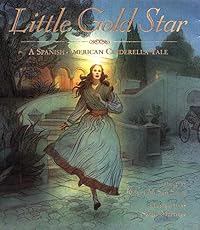
Little Gold Star: A Spanish American Cinderella Tale
by Robert D. San Souci
On This Page
Description
A Spanish American retelling of the familiar story of a kind girl who is mistreated by her jealous stepmother and stepsisters. In this version, the Virgin Mary replaces the traditional fairy godmother.Tags
Recommendations
Member Reviews
When a widowed New Mexican sheepherder named Tomás remarries, his new wife and stepdaughters treat his own daughter, Teresa, with unkindness. A kind and obedient girl, Teresa encounters the Virgin Mary while washing a sheepskin at the local stream, and after a miraculous visit in which she cares for Saint Joseph and the infant Jesus, she is given a blessing - a blessing which manifests itself as a little gold star on her forehead. Her stepsisters do not fare so well, and after they treat the Holy Family with scorn, are given horns and donkey ears. When Teresa catches the eye of the handsome Don Miguel, and dances with him at his feast, he is determined to find and wed her. Teresa's stepmother stands in the way of the marriage, until show more the Virgin Mary once again interceded...
Taken from a variety of sources, this folktale from the American Southwest - New Mexico is the setting - is a lovely variant of the Cinderella tale-type. It is quite interesting to note that in Little Gold Star: A Spanish American Cinderella Tale the magical elements provided by the fairy godmother in the more well-known French variant of this story, are instead provided by a religious figure. There seem to be a wealth of stories in the American Southwest concerning the Virgin Mary - see Eric A. Kimmel's The Lady in the Blue Cloak: Legends from the Texas Missions for one example - so it isn't really surprising that she would surface in regional retellings of widespread tales. I appreciated the different outlook that the inclusion of religious elements provided, and I liked the fact that the wicked stepmother and stepsisters were reformed in the end. This latter feels more appropriate, given the inclusion of Christian elements, and the fact that that religion emphasizes redemption and forgiveness. The accompanying artwork here, from Mexican illustrator Sergio Martinez, is absolutely lovely, and added to my reading pleasure. Recommended to young folk and fairy-tale lovers, and to anyone interesting in the Cinderella tale-type. show less
Taken from a variety of sources, this folktale from the American Southwest - New Mexico is the setting - is a lovely variant of the Cinderella tale-type. It is quite interesting to note that in Little Gold Star: A Spanish American Cinderella Tale the magical elements provided by the fairy godmother in the more well-known French variant of this story, are instead provided by a religious figure. There seem to be a wealth of stories in the American Southwest concerning the Virgin Mary - see Eric A. Kimmel's The Lady in the Blue Cloak: Legends from the Texas Missions for one example - so it isn't really surprising that she would surface in regional retellings of widespread tales. I appreciated the different outlook that the inclusion of religious elements provided, and I liked the fact that the wicked stepmother and stepsisters were reformed in the end. This latter feels more appropriate, given the inclusion of Christian elements, and the fact that that religion emphasizes redemption and forgiveness. The accompanying artwork here, from Mexican illustrator Sergio Martinez, is absolutely lovely, and added to my reading pleasure. Recommended to young folk and fairy-tale lovers, and to anyone interesting in the Cinderella tale-type. show less
Very interesting version of Cinderella.The theme is very similar to the traditional version We know. The story takes place in New Mexico where Theresa (Cinderella) has two mean stepsisters Isabel and Inez and stepmother. Virgin Mary (Fairy godmother) marks Theresa with a Golden Star in her forehead (instead of giving her the glass slippers) for her kindness after she clans the little shack with Jesus and Joeph and rocks baby Jesus to sleep with a nana.
On the other side, the stepsisters are given horns and donkey ears for their evil hearts.
When Don Miguel (the prince) asks Theresa's stepmother to have Theresa's hand in Marriage, she agrees with the condition Theresa has to complete three impossible tasks first:
- fill 10 bottles with show more birds' tears.
- Fill and fluff 12 matresses with bird feathers.
- Prepare a tableful of fine food.
With Mary's help and her magic golden star comes a happy ending.
I like how there's redemption for the stepmom and the stepsisters who learn to be kinder with time and their horns and ears disappear with it. show less
On the other side, the stepsisters are given horns and donkey ears for their evil hearts.
When Don Miguel (the prince) asks Theresa's stepmother to have Theresa's hand in Marriage, she agrees with the condition Theresa has to complete three impossible tasks first:
- fill 10 bottles with show more birds' tears.
- Fill and fluff 12 matresses with bird feathers.
- Prepare a tableful of fine food.
With Mary's help and her magic golden star comes a happy ending.
I like how there's redemption for the stepmom and the stepsisters who learn to be kinder with time and their horns and ears disappear with it. show less
“Little Gold Star” is based off of the traditional story Cinderella, however with a twist of religion and Spanish culture. It was a beautiful story about a young girl who became blessed by Mary, who could see the love and compassion within her. In the text the Blessed Mary says to her, “Good child, your kindness carries its own blessing.” The main themes of this story are love, hope, and family. The Blessed Mary rewarded her for being kind and pure. It is interesting to read stories that are based off of very common folk tales. This story was very creative and interesting, and definitely great for children to read.
I honestly love Cinderella retellings. Not because of the story, but because the art and the culture really makes the difference. And this one had lovely art.
A Spanish American retelling of the Cinderella story with a very Catholic twist. In this version, The Virgin Mary replaces the fairy godmother. This would be great book for a comparison with the original Cinderella story for older students, and how the Catholic culture influenced the story. Reading level is listed at 3.2 and I still don't agree with the interest level.
A funny Spanish-version of the classic Cinderella story. The protagonist of the story is Teresa who was an only child and had a father because her mother had died. One day, new neighbors had come to live next door to them. The neighbor begged to marry Teresa's father Tomas, and alas she did. The stepmother was harsh with the girl in that she made her do all the chores. When their father gifted the whole family, "Teresa's stepmother killed the lamb," to Teresa's dismay. The lamb came with a fleece of which the stepmother obliged Teresa to wash so that it could be used for her stepmother's pillow. As she was washing it in the river, a fish came and grabbed the fleece. To her happiness, the Blessed Mary helped. Because of their harsh show more treatment towards Saint Joseph and baby Jesus, Isabel grew horns and Inez got big long donkey ears. Teresa had a little star on her head for her positive treatment to Saint Joseph and baby Jesus. A fiesta comes along the way in town and Teresa joins it and dances with Miguel only to be snatched away by her stepmother. No shoes this time, instead Miguel reaches Teresa through a talking cat that shows where exactly did the stepmother hide the girl. Miguel sees Teresa and asks for her hand. Before allowing Miguel to marry Teresa, the stepmother and stepsisters have a task ready for Teresa to complete. She has to stuff twelve mattresses with the bird feathers, fill ten bottles of bird tears, and a well done dinner on the table. A good book for K-3 after reading the classic Cinderella story to do a comparison/contrast. show less
A version of Cinderella set in a Spanish America historical setting. It really shows the moral in Cinderella about good things coming to do those who do good. I really enjoyed this version of Cinderella, but I also really enjoy Spanish American history.
Members
- Recently Added By
Lists

Cinderella Stories
111 works; 15 members
Author Information

79+ Works 12,244 Members
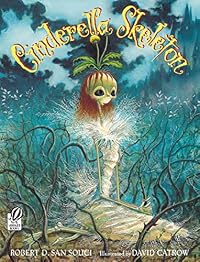
Robert D. San Souci was born on October 10, 1946 in San Francisco, California. He attended college at St. Mary's College in Moraga. After holding jobs in book stores and in publishing, he became a full-time author in 1974. He was best known for his adaptations of folklore for children. During his lifetime, he wrote more than 100 books for young show more readers including Song of Sedna, Kate Shelley: Bound for Legend, The Talking Eggs, Two Bear Cubs, Cendrillon: A Caribbean Cinderella, Brave Margaret: An Irish Tale, Robin Hood and the Golden Arrow, and Cinderella Skeleton. He wrote 12 books which were illustrated by his younger brother Daniel San Souci including The Legend of Scarface, Sister Tricksters: Rollicking Tales of Clever Females, and As Luck Would Have It: From The Brothers Grimm. He also wrote nonfiction works for children, several novels for adults, and the film story for Disney's Mulan. The Legend of Scarface won the Notable Children's Trade Book in the Social Studies, National Council for the Social Studies, and was a Horn Book honor list citation. Sukey and the Mermaid won the American Library Association's Notable Book citation in 1992 and Cut from the Same Cloth won an Aesop Award from the Children's Folklore Section of the American Folklore Society. He died on December 19, 2014 at the age of 68. (Bowker Author Biography) show less
All Editions
Classifications
Statistics
- Members
- 161
- Popularity
- 202,478
- Reviews
- 14
- Rating
- (3.82)
- Languages
- English
- Media
- Paper
- ISBNs
- 2