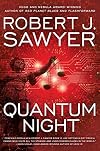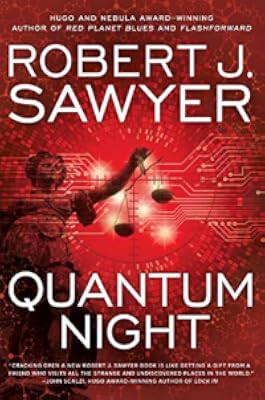
Quantum Night
by Robert J. Sawyer
On This Page
Description
"With such compelling and provocative novels as Red Planet Blues, FlashForward and The WWW Trilogy, Robert J. Sawyer has proven himself to be "a writer of boundless confidence and bold scientific extrapolation" (New York Times). Now, the Hugo and Nebula Award-winning author explores the thin line between good and evil that every human being is capable of crossing... Experimental psychologist Chris Marchuk has developed a flawless technique for identifying the previously undetected show more psychopaths lurking everywhere in society. But while being cross-examined about his breakthrough in court, Chris is shocked to discover that he has lost his memories of six months of his life from twenty years previously--a dark time during which he himself committed heinous acts. Chris is reunited with Kayla Huron, his forgotten girlfriend from his lost period and now a quantum physicist who has made a stunning discovery about the nature of human consciousness. As a rising tide of violence and hate sweeps across the globe, the psychologist and the physicist combine forces in a race against time to see if they can do the impossible--change human nature--before the entire world descends into darkness. "-- show lessTags
Recommendations
















Member Reviews
Like the “WWW” series by Sawyer, this book too has to do with the nature of consciousness, and there is a great deal of (actual) research presented about the possibility that consciousness could be explained by quantum mechanics. In addition, like previous books, Sawyer explores the nature of evil and the development of morality. Finally, once again Sawyer incorporates political commentary into his story.
While all of these issues are extremely interesting, Sawyer doesn’t use much of a plot as scaffolding for rumination on these ideas.
His main protagonist is Jim Marchuk, 39, a psychologist at the University of Manitoba in Winnipeg, who is teaching a course of “The Neuroscience of Morality.” By accident, Jim discovers he is show more missing memories for an entire six month period in 2001 (the story is set in 2020). Something happened to him when he was 18 to cause the loss of these memories, and furthermore, Jim has come to believe that during that six-month period, he was a psychopath.
Along with the quantum physicist Kayla Huron, apparently his girlfriend from that period, Jim postulates a three-state model of consciousness corresponding to quantum states in the brain: “the emptiness of a ‘p-zed’ [a philosophical zombie, or someone with no inner life, who just follows whatever memes come their way], the cunning of a psychopath [“an individual devoid of empathy and conscience . . . who only cares about his or her own self-interest”], or the conscience of a ‘quick’ [i.e., CWC or consciousness with conscience]”, with each level showing progressively more complex consciousness in successively smaller cohorts.
Intermittent commentary on political developments (none of which, unfortunately, sounds too far-fetched) serves to illustrate the large numbers of the first two groups, making it ever more likely that civilization may not survive. (The p-zeds, by following the lead of the psychopaths, are as likely to commit wicked acts, as is true with much of "mob behavior.") Jim, out of desperation, comes up with an idea to alter the ratios of consciousness on the entire planet - the only hope that the psychopathic leaders around the world won’t wage a war that would herald the final destruction of the earth.
Evaluation: While much of what Sawyer writes is clever and contains a bit of his trademark sense of humor (although this book is darker than earlier books), and while he is much better at explaining the ideas of, e.g., Roger Penrose, than Roger Penrose, I would have preferred more of an interesting story. This one seems like just the minimal amount to justify his romp through current theories about consciousness and about morality.
Nevertheless, as always with Sawyer, his work is so thought-provoking and impressively erudite that I liked it in spite of the thin plot. show less
While all of these issues are extremely interesting, Sawyer doesn’t use much of a plot as scaffolding for rumination on these ideas.
His main protagonist is Jim Marchuk, 39, a psychologist at the University of Manitoba in Winnipeg, who is teaching a course of “The Neuroscience of Morality.” By accident, Jim discovers he is show more missing memories for an entire six month period in 2001 (the story is set in 2020). Something happened to him when he was 18 to cause the loss of these memories, and furthermore, Jim has come to believe that during that six-month period, he was a psychopath.
Along with the quantum physicist Kayla Huron, apparently his girlfriend from that period, Jim postulates a three-state model of consciousness corresponding to quantum states in the brain: “the emptiness of a ‘p-zed’ [a philosophical zombie, or someone with no inner life, who just follows whatever memes come their way], the cunning of a psychopath [“an individual devoid of empathy and conscience . . . who only cares about his or her own self-interest”], or the conscience of a ‘quick’ [i.e., CWC or consciousness with conscience]”, with each level showing progressively more complex consciousness in successively smaller cohorts.
Intermittent commentary on political developments (none of which, unfortunately, sounds too far-fetched) serves to illustrate the large numbers of the first two groups, making it ever more likely that civilization may not survive. (The p-zeds, by following the lead of the psychopaths, are as likely to commit wicked acts, as is true with much of "mob behavior.") Jim, out of desperation, comes up with an idea to alter the ratios of consciousness on the entire planet - the only hope that the psychopathic leaders around the world won’t wage a war that would herald the final destruction of the earth.
Evaluation: While much of what Sawyer writes is clever and contains a bit of his trademark sense of humor (although this book is darker than earlier books), and while he is much better at explaining the ideas of, e.g., Roger Penrose, than Roger Penrose, I would have preferred more of an interesting story. This one seems like just the minimal amount to justify his romp through current theories about consciousness and about morality.
Nevertheless, as always with Sawyer, his work is so thought-provoking and impressively erudite that I liked it in spite of the thin plot. show less
I am at a loss to explain how this atrocious novel was published, let alone how it found itself on the Canada Reads long list this year.
Before I get into its significant ethical and scientific flaws, I'll take a moment to point out that as a story, it also sucked. The characters were flat and gender stereotyped. The plot was nonsensical. All of the relationships in the book conveniently fit the needs of the plot; the dialogue was 95% info-dump; the main character was, besides an awful person (that below), a total bore. I couldn't put the novel down, not because I was enjoying it, but because I kept waiting for the plot twist that would make this piece of crap into something other than a piece of crap, which, needless to say, never came. show more I haven't hated a book this much since maybe [b:Tathea|72759|Tathea (Tathea, #1)|Anne Perry|https://images.gr-assets.com/books/1309212170s/72759.jpg|1994891], or even [b:Race Against Time|15505|Race Against Time|Piers Anthony|https://images.gr-assets.com/books/1388566320s/15505.jpg|891293].
Scientifically, this novel is like someone reading a think piece about a butterfly's wings causing hurricanes on the other side of the world, and writing a novel in which global warming is caused by masses of undiscovered butterflies in the Amazon, which the protagonist vanquishes in order to save us all. You have to be so willfully ignorant to write it that it can't in any way claim to be science fiction.
Fair warning: spoilers galore. Since I can't in good conscience recommend anyone read this, I'd say go ahead and read the spoilers.
Quantum Night is the story of a middle-aged self-righteous bore with an inflexible obsession with utilitarian philosophy as expressed, and only as expressed, by Peter Singer. The hidden results of a freak accident caused by a psychological experiment gone awry twenty years ago reveal to him the shocking truth: 4/7 human beings do not have consciousness, have no feelings, and aren't really people (referred to as p-zeds, for "philosophical zombies"). 2/7 human beings are psychopaths. Only 1/7 humans on this planet have both consciousness and a conscience. It goes without saying that Our Hero is one of these latter.
Further freak accidents--exclusively involving friends, loved ones, and friends and loved ones of friends and loved ones--make it plain that it is possible to switch someone between states from lower to higher using either a good blow to the head or a highly specialized piece of quantum equipment called a "tuning fork." Imagine that. Hundreds of years of psychologists and psychiatrists diligently working to understand psychopathy and how to change it, and all they needed was a 2x4 or a large hadron collider. Who knew? These states loop, so that zombies become psychopaths and psychopaths become empaths and empaths become zombies. Moreover, as our mental states are quantum-ly entangled, you can switch lots of people between states at the same time.
Meanwhile, global violence against minorities of various kinds is spinning out of control, set off by a hockey riot in Winnipeg. Yes indeed. Having newly discovered that it is possible to turn all 4 billion "zombies" into empaths and disable all 1 billion global "psychopaths" by turning them into zombies (i.e. forcing them all to switch up twice) by use of a collider in Saskatoon, and this being the only way Our Hero can think of to stop imminent nuclear war, he bravely charges off to do just that. Does it matter to him that his theoretical construct has not undergone any kind of experimental scrutiny? That all they have is a couple of suggestive anecdotes and a mathematical model? That he is engaging 7.7 billion human beings in a psychological experiment without their consent that could have disastrous consequences for their lives?
Nope. Off he goes. He and he alone, you understand, has a proper ethical understanding of the greatest good for the greatest number as expressed by Peter Singer's utilitarian philosophy, so even if his horrified girlfriend is doing everything she can to stop him because she doesn't want his experiment to turn her beautiful daughter into a psychopath, he must soldier on. After all, this is just irrational maternal feelings. So he successfully switches the states of everyone's consciousness, and nuclear war is avoided. Huzzah! Girlfriend, of course, is now a psychopath and disposes of her daughter with Our Hero, who is now going to be a fantastic father, because who wouldn't want to grow up in a household with a man who knows exactly what to do in every situation based on his detailed understanding of the utilitarian philosophy of Peter Singer? No one, obviously. The End.
You may have thought this was long already, Dear Readers, but I have a lot more to say, so get yourself a cup of tea or coffee and settle in for the long haul as I describe the ethical and scientific flaws, to put it politely, of this horrendous book:
1. The Utilitarian Philosophy of Peter Singer
In the Does This Really Need to be Said category: Oh my god are you fucking kidding me our protagonist the uber-philosopher never questions Peter Singer? Peter Singer is infallibly right about everything, always? Lots of people like Peter Singer, I get it; he's an influential guy; and he's got a ton of critics even within utilitarian philosophy. Surely someone as passionately married to this general philosophy would know something about someone other than Peter Singer and not just be his mindless disciple--besides which, the irony of the book's hero due to his very-conscious-consciousness being unable to question or debate the ethics of ONE utilitarian philosopher!
Hey, here's ONE utilitarian critic of Peter Singer. He makes some good points. And yet Our Hero is a total slave to Singer's every dictate.
Even I, armchair philosopher that I am, can poke holes in the "ethics" displayed by Our Hero's choices. Example: Our Hero begins a long-distance relationship with a woman in Saskatoon. He can't justify the money spent on airfare to see her, as he currently donates $20k/year for starving children in Africa and doesn't want to cut back, so resigns himself to driving there. Oh yeah. OK. Yup in an era of global warming, which Our Hero references regularly throughout the book, driving every weekend from Winnipeg to Saskatoon to have sex with your girlfriend is a morally blameless choice. It has no harm for any human or animal or any living thing. That is 100% consistent with his 'philosophy.'
2. 4/7 human beings are "zombies" and not really people
Ethically: this shouldn't need to be said, but we hardly need another book, whether fiction or not, positing that a majority of the world's population can be safely dehumanized. Putting this in a science fiction book with a bunch of pseudo-scientific gobblydegook pretending to give this abhorrent claim some veneer of scientific plausibility is so unethical it completely, utterly undoes any claim he has to an interest in ethics through his main character. You might think he doesn't really mean it, but I suspect he does. At the end of the book, he lists a bunch of books he claims support the science in the novel. Nowhere in the acknowledgements or in the further-reading section or *anywhere* does Sawyer say, hey, in case you were wondering, I don't think 4/7 people in the world are zombies without thought or real feelings.
Scientifically: There is substantial evidence that this is not the case. It's not like consciousness hasn't been scientifically examined, for god's sake; there are a bunch of theories for what it is and where in the brain it's produced and how it works, but there are NO scientific theories that claim that A MAJORITY OF HUMAN BEINGS ARE NOT CONSCIOUS. This is like writing a science fiction novel about gravity not existing 3/7 of the time: if it flatly contradicts science it is fucking not science fiction.
3. 2/7 of human beings are psychopaths and 1/7 people are conscious and have a conscience
Ethically: Sawyer claims here that good people are outnumbered by assholes 2:1. The judgement and arrogance of that claim is breathtaking.
Scientifically: a) If there are twice as many psychopaths as people with conscience, then how can one justify the claim that psychopathy is the disorder and that having a conscience is healthy?
b) It is not true that estimates of the prevalence of psychopathy in the population come solely from prison studies, as he claims. These are studies of the general population and the results indicate that the prevalence is very low, about 1%. One can dispute it but to jump from 1% to 30% is ... bizarre, to put it mildly. How in the world has society cooperatively functioned for millennia if only 1/7 human beings are functionally capable of or interested in cooperations?
4. People "switch" between being zombies, psychopaths and good people whenever they lose consciousness. Umm ... even though 4/7 people don't have consciousness to begin with.
This is so unbelievably stupid it doesn't even merit a takedown.
5. It is ethically in line with Peter Singer's utilitarian philosophy to switch people between mental states en masse without their prior knowledge or consent.
I mean ....
There are a number of classroom scenes in which Our Hero lays out actual and thought experiments on moral philosophy as barely-disguised info dumps in which the reader is encouraged to take particular stances on determining "the greatest good for the greatest number," including the Trolley Problem. Go ahead and click through: I won't make this any longer by describing it.
Beside the substantial ethical problems posited by a situation in which one self-righteous asshole is entitled to make decisions for all of humanity based on a brainstorming session he had with his girlfriend (really), the internal ethics of the novel aren't even consistent. He comes right out and says in a classroom scene that in the Fat Man version of the Trolley Dilemma, people feel morally hesitant to push him on to the tracks for good reason: do I know this will work? What if it doesn't? Am I sure that it wouldn't work if I volunteered to jump in front of the tracks? etc.
OK, so: How the hell does Our Hero know, surely enough to justify this course of action, that what he is doing is going to work? He doesn't. There is no experimental data. Everything that has occured to that point in the novel is a fluke accident. None of it has been investigated or replicated. He is operating on wish fulfillment, guesswork and hubris.
6. His horrified girlfriend is operating only on maternal feelings rather than a solid understanding of Peter Singer's utilitarian ethics, and thus can be safely ignored
Ethically: This is sexist bullshit, pure "women are so emotional and irrational" nonsense. Not a surprise, coming in a novel where we are treated to a typical middle-aged man engaging in a relationship with a super-hot middle-aged mom who shows no physical evidence of childbirth and whose pubic hair grooming habits, for the benefit of whom isn't made clear because she doesn't date prior to Our Hero, is described for the reader for no reason I can fathom.
Scientifically: Every. Single. Time. Society. Intervenes. In Childrearing practics. On the assumption that maternal instincts are flawed and "science knows better." Absolute disaster ensues.
This has been demonstrated so many times for so long that there is no longer any question.
It has been examined and proven scientifically recently so many times that no actual scientist believes differently any longer.
Not all mothers are functional, and that is a problem; but maternal instincts as expressed by functional mothers evolved over a very long time to enhance the survival and fitness of offspring. They can generally be trusted.
Children do not need parents who are paragons of utilitarian philosophy as described by Peter Singer. They need parents who love them and act like it.
Our Hero took that away from his girlfriend's beautiful daughter, but the novel posits that this is ok because the "greater number" received the "greater good" through his heroic actions preventing nuclear war, which surely could not have happened any other way.
7. His description of society is so clueless and tone deaf it deserves its own savaging.
Says Sawyer, racism is only a problem for black people in the US.
And anti-semitism is only a problem for Jewish people in Europe.
And anti-native racism is only a problem for indigenous people in Canada.
Each society has one, and only one, racialized scapegoat out-group, and therefore other minorities are by default treated well there.
In Canada, non-native minorities are treated like white people, per the unnecessary input of the book's single, transitory black character. Yeah. I mean, this is clearly what we've seen with the spotless record of Canadian police departments and their utter lack of brutality towards black Canadians, and the 100% unanimous fully open-hearted embrace of Syrian refugees, and the total absence of any terrorist attacks against Muslims in, say, a mosque in Quebec ....
8. THE ETHICS OF THE MAIN CHARACTERS ARE FUCKING AWFUL
It did deserve the caps-lock treatment, per:
a) Middle-aged mom reuniting with previously-psychopathic boyfriend immediately introduces him to her daughter and has him stay the night. Speaking as a middle-aged single mom .... Hell No.
b) Said boyfriend immediately steps into the father-figure role without any qualms on the part of him, his girlfriend, or girlfriend's mom. Like on the first date. Apparently there are no negative impacts to be considered to the young girl if the relationship does not continue.
c) The entire cast is so psychotically secretive about everything it is ridiculous. The professors running the decades-ago experiment, in particular, will not alert the authorities or the police no matter how many awful things happen for no apparent reason except that the plot would not otherwise hold up. Someone kills your colleague and gouges out your eyeballs? No biggie. Just hide the body and pretend you were in a car accident. Why would you want this person in jail? Just because he's shown an ability to kill people brutally for no good reason and you have no idea when he's going to switch states and stop--and also, what if you lose your project funding? I just can't.
Keep in mind that these characters are all the 1/7 good guys with a conscience who are apparently capable of independent reasoning and interested in morals, ethics and philosophy. And then look at those actions and wonder where the hell their concern was for the wellbeing of that little girl, or the safety of society, or any good thing for any person other than themselves at all.
~~~~~
This book is like the Da Vince Code set in a psychological research institution, in which all 7.7 billion people engage unwillingly in an experimental treatment that fundamentally changes who they are because one middle-aged asshole thought it was the only way to avoid nuclear war, and it was totally ok anyway because 4/7 people aren't really people.
And then it was published and put on the Canada Reads long list.
WTAF show less
Before I get into its significant ethical and scientific flaws, I'll take a moment to point out that as a story, it also sucked. The characters were flat and gender stereotyped. The plot was nonsensical. All of the relationships in the book conveniently fit the needs of the plot; the dialogue was 95% info-dump; the main character was, besides an awful person (that below), a total bore. I couldn't put the novel down, not because I was enjoying it, but because I kept waiting for the plot twist that would make this piece of crap into something other than a piece of crap, which, needless to say, never came. show more I haven't hated a book this much since maybe [b:Tathea|72759|Tathea (Tathea, #1)|Anne Perry|https://images.gr-assets.com/books/1309212170s/72759.jpg|1994891], or even [b:Race Against Time|15505|Race Against Time|Piers Anthony|https://images.gr-assets.com/books/1388566320s/15505.jpg|891293].
Scientifically, this novel is like someone reading a think piece about a butterfly's wings causing hurricanes on the other side of the world, and writing a novel in which global warming is caused by masses of undiscovered butterflies in the Amazon, which the protagonist vanquishes in order to save us all. You have to be so willfully ignorant to write it that it can't in any way claim to be science fiction.
Fair warning: spoilers galore. Since I can't in good conscience recommend anyone read this, I'd say go ahead and read the spoilers.
Quantum Night is the story of a middle-aged self-righteous bore with an inflexible obsession with utilitarian philosophy as expressed, and only as expressed, by Peter Singer. The hidden results of a freak accident caused by a psychological experiment gone awry twenty years ago reveal to him the shocking truth: 4/7 human beings do not have consciousness, have no feelings, and aren't really people (referred to as p-zeds, for "philosophical zombies"). 2/7 human beings are psychopaths. Only 1/7 humans on this planet have both consciousness and a conscience. It goes without saying that Our Hero is one of these latter.
Further freak accidents--exclusively involving friends, loved ones, and friends and loved ones of friends and loved ones--make it plain that it is possible to switch someone between states from lower to higher using either a good blow to the head or a highly specialized piece of quantum equipment called a "tuning fork." Imagine that. Hundreds of years of psychologists and psychiatrists diligently working to understand psychopathy and how to change it, and all they needed was a 2x4 or a large hadron collider. Who knew? These states loop, so that zombies become psychopaths and psychopaths become empaths and empaths become zombies. Moreover, as our mental states are quantum-ly entangled, you can switch lots of people between states at the same time.
Meanwhile, global violence against minorities of various kinds is spinning out of control, set off by a hockey riot in Winnipeg. Yes indeed. Having newly discovered that it is possible to turn all 4 billion "zombies" into empaths and disable all 1 billion global "psychopaths" by turning them into zombies (i.e. forcing them all to switch up twice) by use of a collider in Saskatoon, and this being the only way Our Hero can think of to stop imminent nuclear war, he bravely charges off to do just that. Does it matter to him that his theoretical construct has not undergone any kind of experimental scrutiny? That all they have is a couple of suggestive anecdotes and a mathematical model? That he is engaging 7.7 billion human beings in a psychological experiment without their consent that could have disastrous consequences for their lives?
Nope. Off he goes. He and he alone, you understand, has a proper ethical understanding of the greatest good for the greatest number as expressed by Peter Singer's utilitarian philosophy, so even if his horrified girlfriend is doing everything she can to stop him because she doesn't want his experiment to turn her beautiful daughter into a psychopath, he must soldier on. After all, this is just irrational maternal feelings. So he successfully switches the states of everyone's consciousness, and nuclear war is avoided. Huzzah! Girlfriend, of course, is now a psychopath and disposes of her daughter with Our Hero, who is now going to be a fantastic father, because who wouldn't want to grow up in a household with a man who knows exactly what to do in every situation based on his detailed understanding of the utilitarian philosophy of Peter Singer? No one, obviously. The End.
You may have thought this was long already, Dear Readers, but I have a lot more to say, so get yourself a cup of tea or coffee and settle in for the long haul as I describe the ethical and scientific flaws, to put it politely, of this horrendous book:
1. The Utilitarian Philosophy of Peter Singer
In the Does This Really Need to be Said category: Oh my god are you fucking kidding me our protagonist the uber-philosopher never questions Peter Singer? Peter Singer is infallibly right about everything, always? Lots of people like Peter Singer, I get it; he's an influential guy; and he's got a ton of critics even within utilitarian philosophy. Surely someone as passionately married to this general philosophy would know something about someone other than Peter Singer and not just be his mindless disciple--besides which, the irony of the book's hero due to his very-conscious-consciousness being unable to question or debate the ethics of ONE utilitarian philosopher!
Hey, here's ONE utilitarian critic of Peter Singer. He makes some good points. And yet Our Hero is a total slave to Singer's every dictate.
Even I, armchair philosopher that I am, can poke holes in the "ethics" displayed by Our Hero's choices. Example: Our Hero begins a long-distance relationship with a woman in Saskatoon. He can't justify the money spent on airfare to see her, as he currently donates $20k/year for starving children in Africa and doesn't want to cut back, so resigns himself to driving there. Oh yeah. OK. Yup in an era of global warming, which Our Hero references regularly throughout the book, driving every weekend from Winnipeg to Saskatoon to have sex with your girlfriend is a morally blameless choice. It has no harm for any human or animal or any living thing. That is 100% consistent with his 'philosophy.'
2. 4/7 human beings are "zombies" and not really people
Ethically: this shouldn't need to be said, but we hardly need another book, whether fiction or not, positing that a majority of the world's population can be safely dehumanized. Putting this in a science fiction book with a bunch of pseudo-scientific gobblydegook pretending to give this abhorrent claim some veneer of scientific plausibility is so unethical it completely, utterly undoes any claim he has to an interest in ethics through his main character. You might think he doesn't really mean it, but I suspect he does. At the end of the book, he lists a bunch of books he claims support the science in the novel. Nowhere in the acknowledgements or in the further-reading section or *anywhere* does Sawyer say, hey, in case you were wondering, I don't think 4/7 people in the world are zombies without thought or real feelings.
Scientifically: There is substantial evidence that this is not the case. It's not like consciousness hasn't been scientifically examined, for god's sake; there are a bunch of theories for what it is and where in the brain it's produced and how it works, but there are NO scientific theories that claim that A MAJORITY OF HUMAN BEINGS ARE NOT CONSCIOUS. This is like writing a science fiction novel about gravity not existing 3/7 of the time: if it flatly contradicts science it is fucking not science fiction.
3. 2/7 of human beings are psychopaths and 1/7 people are conscious and have a conscience
Ethically: Sawyer claims here that good people are outnumbered by assholes 2:1. The judgement and arrogance of that claim is breathtaking.
Scientifically: a) If there are twice as many psychopaths as people with conscience, then how can one justify the claim that psychopathy is the disorder and that having a conscience is healthy?
b) It is not true that estimates of the prevalence of psychopathy in the population come solely from prison studies, as he claims. These are studies of the general population and the results indicate that the prevalence is very low, about 1%. One can dispute it but to jump from 1% to 30% is ... bizarre, to put it mildly. How in the world has society cooperatively functioned for millennia if only 1/7 human beings are functionally capable of or interested in cooperations?
4. People "switch" between being zombies, psychopaths and good people whenever they lose consciousness. Umm ... even though 4/7 people don't have consciousness to begin with.
This is so unbelievably stupid it doesn't even merit a takedown.
5. It is ethically in line with Peter Singer's utilitarian philosophy to switch people between mental states en masse without their prior knowledge or consent.
I mean ....
There are a number of classroom scenes in which Our Hero lays out actual and thought experiments on moral philosophy as barely-disguised info dumps in which the reader is encouraged to take particular stances on determining "the greatest good for the greatest number," including the Trolley Problem. Go ahead and click through: I won't make this any longer by describing it.
Beside the substantial ethical problems posited by a situation in which one self-righteous asshole is entitled to make decisions for all of humanity based on a brainstorming session he had with his girlfriend (really), the internal ethics of the novel aren't even consistent. He comes right out and says in a classroom scene that in the Fat Man version of the Trolley Dilemma, people feel morally hesitant to push him on to the tracks for good reason: do I know this will work? What if it doesn't? Am I sure that it wouldn't work if I volunteered to jump in front of the tracks? etc.
OK, so: How the hell does Our Hero know, surely enough to justify this course of action, that what he is doing is going to work? He doesn't. There is no experimental data. Everything that has occured to that point in the novel is a fluke accident. None of it has been investigated or replicated. He is operating on wish fulfillment, guesswork and hubris.
6. His horrified girlfriend is operating only on maternal feelings rather than a solid understanding of Peter Singer's utilitarian ethics, and thus can be safely ignored
Ethically: This is sexist bullshit, pure "women are so emotional and irrational" nonsense. Not a surprise, coming in a novel where we are treated to a typical middle-aged man engaging in a relationship with a super-hot middle-aged mom who shows no physical evidence of childbirth and whose pubic hair grooming habits, for the benefit of whom isn't made clear because she doesn't date prior to Our Hero, is described for the reader for no reason I can fathom.
Scientifically: Every. Single. Time. Society. Intervenes. In Childrearing practics. On the assumption that maternal instincts are flawed and "science knows better." Absolute disaster ensues.
This has been demonstrated so many times for so long that there is no longer any question.
It has been examined and proven scientifically recently so many times that no actual scientist believes differently any longer.
Not all mothers are functional, and that is a problem; but maternal instincts as expressed by functional mothers evolved over a very long time to enhance the survival and fitness of offspring. They can generally be trusted.
Children do not need parents who are paragons of utilitarian philosophy as described by Peter Singer. They need parents who love them and act like it.
Our Hero took that away from his girlfriend's beautiful daughter, but the novel posits that this is ok because the "greater number" received the "greater good" through his heroic actions preventing nuclear war, which surely could not have happened any other way.
7. His description of society is so clueless and tone deaf it deserves its own savaging.
Says Sawyer, racism is only a problem for black people in the US.
And anti-semitism is only a problem for Jewish people in Europe.
And anti-native racism is only a problem for indigenous people in Canada.
Each society has one, and only one, racialized scapegoat out-group, and therefore other minorities are by default treated well there.
In Canada, non-native minorities are treated like white people, per the unnecessary input of the book's single, transitory black character. Yeah. I mean, this is clearly what we've seen with the spotless record of Canadian police departments and their utter lack of brutality towards black Canadians, and the 100% unanimous fully open-hearted embrace of Syrian refugees, and the total absence of any terrorist attacks against Muslims in, say, a mosque in Quebec ....
8. THE ETHICS OF THE MAIN CHARACTERS ARE FUCKING AWFUL
It did deserve the caps-lock treatment, per:
a) Middle-aged mom reuniting with previously-psychopathic boyfriend immediately introduces him to her daughter and has him stay the night. Speaking as a middle-aged single mom .... Hell No.
b) Said boyfriend immediately steps into the father-figure role without any qualms on the part of him, his girlfriend, or girlfriend's mom. Like on the first date. Apparently there are no negative impacts to be considered to the young girl if the relationship does not continue.
c) The entire cast is so psychotically secretive about everything it is ridiculous. The professors running the decades-ago experiment, in particular, will not alert the authorities or the police no matter how many awful things happen for no apparent reason except that the plot would not otherwise hold up. Someone kills your colleague and gouges out your eyeballs? No biggie. Just hide the body and pretend you were in a car accident. Why would you want this person in jail? Just because he's shown an ability to kill people brutally for no good reason and you have no idea when he's going to switch states and stop--and also, what if you lose your project funding? I just can't.
Keep in mind that these characters are all the 1/7 good guys with a conscience who are apparently capable of independent reasoning and interested in morals, ethics and philosophy. And then look at those actions and wonder where the hell their concern was for the wellbeing of that little girl, or the safety of society, or any good thing for any person other than themselves at all.
~~~~~
This book is like the Da Vince Code set in a psychological research institution, in which all 7.7 billion people engage unwillingly in an experimental treatment that fundamentally changes who they are because one middle-aged asshole thought it was the only way to avoid nuclear war, and it was totally ok anyway because 4/7 people aren't really people.
And then it was published and put on the Canada Reads long list.
WTAF show less
It includes reflections on utilitarianism, Zimbardo’s prison experiment, Milgram’s obedience experiment, the nature of consciousness, and more. It also has a Trump-like US president, and a fascinating cast of characters. When I read it the first time, I got some of the Canadian references but now I get most of them. Also glad to see the book drawing attention to the issue of missing and murdered Indigenous women and girls (possibly even before the inquiry started).
I’m not sure I’m convinced that people’s consciousness stays in the same quantum state (Q1, Q2, or Q3) all the time barring total loss of consciousness followed
A Sawyer book always has a fascinating idea, and often bobbles the execution. This one doesn’t screw up the dismount, exactly, but the idea is so frustrating that I couldn’t put this on my list of Sawyer novels worth reading even if it weren’t for the more-extensive-than-I-remember-others-being infodumps. (FWIW, the lead characters are all professors, and we totally do talk that way, so there was decent justification for the infodumps.) Basically, the book posits that about 60% of humanity are just stimulus-response machines, emulating consciousness without having any internal monologue—so-called philosopher’s zombies, or what I thought of as John Searle’s Chinese room. Two-thirds of the rest are psychopaths, and the show more remainder are conscious and have a conscience. Plot: When a psychologist discovers that he’s lost a year’s worth of memories, he embarks on a journey that puts him at the center of this research—because he was shifted from one state to the next. As the world descends into ever more violence at the local and international levels, he has to decide whether to try to shift everyone. Sawyer often tends to strong biological determinism, and this is pretty much the strongest I can recall. His leads all conclude that the emptiness of the majority of people has to be kept a secret or it will justify slavery, genocide, etc., and of course a conscious person can’t really love a zombie. I didn’t get it: if your measurements suggest that 60% of humans lack consciousness (setting aside debates about what that might mean), doesn’t Occam’s Razor suggest that you are measuring the wrong thing and might need to look elsewhere? The supportive description of humans mostly flocking to follow whatever the nearest people to them do was also unconvincing: the protagonist suddenly starts noticing his sister going along with whatever’s nearest, including nearly getting them swept up in a riot.
And this leads into the creepy gender politics—though the two key scientists who work with the protagonist are women, he’s a utilitarian and literally muses near the climax about how sad it is that his girlfriend (one of the scientists) is so focused on her own kid and not on the universal good, like he is. Then, at the end, when she’s been converted to a psychopath and he’s still got a conscience due to convenient plot reasons, she immediately hands over her kid to him because she doesn’t want to deal with neediness, thus providing him a replacement kid for the son he never sees because he wanted his then-wife to get an abortion when the son was diagnosed with Downs syndrome in utero. Which, not for nothing, contradicts what they’ve posited before about newly minted psychopaths remembering that they had consciences and thus behaving accordingly. Ugh. So that’s it for me for a while; as I recall, Sawyer’s trilogy on hominids had different, but also creepy, gender stuff/biological determinism. show less
And this leads into the creepy gender politics—though the two key scientists who work with the protagonist are women, he’s a utilitarian and literally muses near the climax about how sad it is that his girlfriend (one of the scientists) is so focused on her own kid and not on the universal good, like he is. Then, at the end, when she’s been converted to a psychopath and he’s still got a conscience due to convenient plot reasons, she immediately hands over her kid to him because she doesn’t want to deal with neediness, thus providing him a replacement kid for the son he never sees because he wanted his then-wife to get an abortion when the son was diagnosed with Downs syndrome in utero. Which, not for nothing, contradicts what they’ve posited before about newly minted psychopaths remembering that they had consciences and thus behaving accordingly. Ugh. So that’s it for me for a while; as I recall, Sawyer’s trilogy on hominids had different, but also creepy, gender stuff/biological determinism. show less
Seeing as I feel that Sawyer did his best work years ago, and there is so much new fiction to read, I wouldn't have picked up this novel had not my book group wanted to read something by the man, since he's going to be guest of honor at our local SF convention. In the end I wound up feeling rather annoyed since there is a lot going on here that now feels just wrong headed.
Keeping in mind that Sawyer has a reputation for writing about ideas first and characters second the moment that said characters invoked Stanley Milgram and Philip Zimbardo the alarms went off for me, as the notorious social-psychology experiments run by these men have been demonstrated to my satisfaction as being incompetently conducted at best and perhaps out and out show more fraudulent at worst. To be fair to Sawyer this book was published at just about the last moment where you could take Zimbardo's "Stanford Prison" Experiment and Milgram's "Obedience to Authority" work seriously. I am currently contemplating how confrontational about this point I want to be when I have the chance to meet the man.
Probably more serious are Sawyer's speculations on the sociopathic personality which seem rather half-baked to me, as satisfying as they might be to wallow in when contemplating the people that one finds annoying. I have a professional degree as a mediator and any system of analysis that doesn't take seriously the values and loyalties that people actually have and how they respond under stress isn't worth talking about. At a certain point what Sawyer seems to have here is a gentler, kinder version of Cyril Kornbluth's "The Marching Morons." Though again, to be fair, Sawyer probably thought that he was writing a new take on Poul Anderson's "Brain Wave." To put it another way, how much would you care to be under judgement in a society where "normal" mental health is mandated by the authorities? It certainly doesn't seem very appealing to me.
As for the notion that there could be a quantum aspect to the functioning of conscious thought; sure, why not. It certainly makes as much sense as assuming that Humans are simply meat versions of computers, which looks less and less likely.
Apart from that I'll credit Sawyer with having written a competent piece of commercial fiction but I tend to want more than that from my entertainment reading. show less
Keeping in mind that Sawyer has a reputation for writing about ideas first and characters second the moment that said characters invoked Stanley Milgram and Philip Zimbardo the alarms went off for me, as the notorious social-psychology experiments run by these men have been demonstrated to my satisfaction as being incompetently conducted at best and perhaps out and out show more fraudulent at worst. To be fair to Sawyer this book was published at just about the last moment where you could take Zimbardo's "Stanford Prison" Experiment and Milgram's "Obedience to Authority" work seriously. I am currently contemplating how confrontational about this point I want to be when I have the chance to meet the man.
Probably more serious are Sawyer's speculations on the sociopathic personality which seem rather half-baked to me, as satisfying as they might be to wallow in when contemplating the people that one finds annoying. I have a professional degree as a mediator and any system of analysis that doesn't take seriously the values and loyalties that people actually have and how they respond under stress isn't worth talking about. At a certain point what Sawyer seems to have here is a gentler, kinder version of Cyril Kornbluth's "The Marching Morons." Though again, to be fair, Sawyer probably thought that he was writing a new take on Poul Anderson's "Brain Wave." To put it another way, how much would you care to be under judgement in a society where "normal" mental health is mandated by the authorities? It certainly doesn't seem very appealing to me.
As for the notion that there could be a quantum aspect to the functioning of conscious thought; sure, why not. It certainly makes as much sense as assuming that Humans are simply meat versions of computers, which looks less and less likely.
Apart from that I'll credit Sawyer with having written a competent piece of commercial fiction but I tend to want more than that from my entertainment reading. show less
Bob Sawyer was just awarded the Order of Canada and this book shows why it was time for that honour. Not only does Sawyer write a great book but he gives you plenty to think about. I suspect I am going to be looking at people differently for quite a while as a result of this book.
Jim Marchuk is a tenured professor in the Psychology Department of the University of Manitoba. His specialty is determining if someone is a psychopath and he has developed an objective test for this. He is around forty years old, is divorced and practices the philosophy of utilitarianism which means, among other things, that he is a vegetarian and gives over ten percent of his salary to charity. When he discovers that he is missing memories of about six months show more of his life from the year 2001 he is determined to find out what happened. A girlfriend from that time, Kayla, who is now a physicist at the Canadian Light Source in Saskatoon shows up in Winnipeg for a conference and calls Jim. Although Jim has no memory of their relationship he wants to meet Kayla to see if she can fill in some blanks for him. Over a meal Kayla explains that she and her research partner have discovered that people have one of three forms of quantum states in the microtubules of their brains. The largest group have only one electron in the quantum state (called Q1s), about half that number have two electrons in the quantum state (Q2s) and then half again of that number have three electrons in the quantum state. If the ration holds true across the earth then about four billion people are Q1, two billion are Q2 and one billion are Q3. Since both Jim and Kayla know that there are probably two billion psychopaths in the world it seems obvious that Q2 equates with psychopathy i.e. having knowledge of their actions but not caring who gets hurt by them. Jim postulates that the Q1 state is what affects people who have been called philosopher's zombies i.e. doing things by rote or by order of someone else without having any free will. Only the Q3s have consciousness with conscience, the category that both Jim and Kayla fall into. It seems inevitable that Jim and Kayla will rekindle their relationship and continue to work on the ramifications of this knowledge. As it turns out the future of the world may depend on it.
Great story and I especially loved all the details about my hometown of Winnipeg. Hope we don't have to wait another 3 years for another book from Sawyer. show less
Jim Marchuk is a tenured professor in the Psychology Department of the University of Manitoba. His specialty is determining if someone is a psychopath and he has developed an objective test for this. He is around forty years old, is divorced and practices the philosophy of utilitarianism which means, among other things, that he is a vegetarian and gives over ten percent of his salary to charity. When he discovers that he is missing memories of about six months show more of his life from the year 2001 he is determined to find out what happened. A girlfriend from that time, Kayla, who is now a physicist at the Canadian Light Source in Saskatoon shows up in Winnipeg for a conference and calls Jim. Although Jim has no memory of their relationship he wants to meet Kayla to see if she can fill in some blanks for him. Over a meal Kayla explains that she and her research partner have discovered that people have one of three forms of quantum states in the microtubules of their brains. The largest group have only one electron in the quantum state (called Q1s), about half that number have two electrons in the quantum state (Q2s) and then half again of that number have three electrons in the quantum state. If the ration holds true across the earth then about four billion people are Q1, two billion are Q2 and one billion are Q3. Since both Jim and Kayla know that there are probably two billion psychopaths in the world it seems obvious that Q2 equates with psychopathy i.e. having knowledge of their actions but not caring who gets hurt by them. Jim postulates that the Q1 state is what affects people who have been called philosopher's zombies i.e. doing things by rote or by order of someone else without having any free will. Only the Q3s have consciousness with conscience, the category that both Jim and Kayla fall into. It seems inevitable that Jim and Kayla will rekindle their relationship and continue to work on the ramifications of this knowledge. As it turns out the future of the world may depend on it.
Great story and I especially loved all the details about my hometown of Winnipeg. Hope we don't have to wait another 3 years for another book from Sawyer. show less
Pretty terrific book. Jim Marchuk is a researcher into consciousness, who has developed a testable theory about psychopaths, and how they don't have an internal voice, and it's related to quantum effects in the brain. He finds that, dovetailing with this theory, he is missing memories from a specific time 15 years earlier. When he meets up with his girlfriend from that time, he learns some unpleasant truths about himself that tie into his theories.
Though I found the book slow going early on, it became fascinating in its last half, and at the end became very tense and exciting. Sawyer pulls in lots of consciousness theory here in the service of a pretty good theory that seems to explain a lot of things happening these days. Of course show more it's fiction, but pretty provocative stuff and highly recommended. show less
Though I found the book slow going early on, it became fascinating in its last half, and at the end became very tense and exciting. Sawyer pulls in lots of consciousness theory here in the service of a pretty good theory that seems to explain a lot of things happening these days. Of course show more it's fiction, but pretty provocative stuff and highly recommended. show less
Members
- Recently Added By
Author Information

107+ Works 20,035 Members
Robert J. Sawyer was born in Ottawa on April 29, 1960, but raised in Toronto. In 1980, while still in high school, Sawyer submitted a short story to the the Rochester Museum and Science Center, which was running a contest for light show ideas. Sawyer didn't win, but the Museum purchased his story Motive anyway and it ran for 192 performances. show more Sawyer went on to attend Toronto's Ryerson Polytechnical Institute, majoring in Radio and Television Arts. In September 1979, he had his first piece of fiction published at the end of his first year, in Ryerson's literary annual, White Wall Review. Sawyer graduated from Ryerson in 1982. Sawyer was hired back the following semester to teach television studio production techniques to second- and third-year students. In the four months interim, he worked for minimum wage at the local SF bookstore, spending all his earnings on books. From 1984 to 1992, while teaching, Sawyer also coordinated a social group of Toronto-area science-fiction writers founded by SF editor Judith Merril. He established a Canadian region of the Science Fiction and Fantasy Writers of America; and in 1998, served as that organization's president. Sawyer also retained freelance nonfiction writing contracts, writing articles for newspapers and magazines, press releases and brochures for corporations, newsletters for government departments. He churned out vast amounts of promotional materials and over 200 articles for computing and personal-finance magazines in a span of five years. But in that time, his only really significant publication was the novelette Golden Fleece, which appeared as the cover story in the September 1988 edition of Amazing Stories. The novel-length Golden Fleece was sold to Warner Books a year later in 1989. The sales of his first five books were uninspiring and Sawyer faced being dropped by his publisher. Sawyer decided to take the time to write a book, without a contract, take as long as necessary, and produce a blockbuster. He also wanted to tackle a controversial issue and deal with it head on. With that in mind, Sawyer wrote The Terminal Experiment, about abortion and the soul. His publisher rejected it on grounds of controversy. HarperPrism then bought the book and serialization rights were sold to Analog, the number-one best-selling English-language SF magazine. The Terminal Experiment went on to win the Science Fiction and Fantasy Writers of America's Nebula Award for Best Novel of 1995. His novel Frameshift was his first book published in hardcover, and was nominated for the Hugo Award, and won Japan's Seiun Award for best foreign novel of the year. (Bowker Author Biography) show less
Awards and Honors
Awards
Work Relationships
Is contained in
Common Knowledge
- Original publication date
- 2016-03
- People/Characters
- James 'Jim' Marchuk; Menno Warkentin; Kayla Huron; Travis Huron; Dominic Adler; Victoria Chen (show all 7); Bhavesh Namboothiri
- Important places
- Winnipeg, Canada
Classifications
Statistics
- Members
- 282
- Popularity
- 114,068
- Reviews
- 23
- Rating
- (3.42)
- Languages
- Czech, English
- Media
- Paper, Audiobook, Ebook
- ISBNs
- 13
- ASINs
- 4