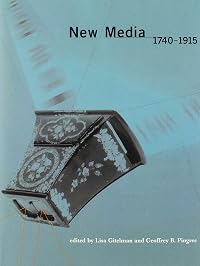
New Media, 1740-1915
by Lisa Gitelman (Editor), Geoffrey B. Pingree (Editor)
On This Page
Description
"Reminding us that all media were once new, this book challenges the notion that to study new media is to study exclusively today's new media. Examining a variety of media in their historic contexts, it explores those moments of transition when new media were not yet fully defined and their significance was still in flux. Examples range from familiar devices such as the telephone and phonograph to unfamiliar curiosities such as the physiognotrace and the zograscope. Moving beyond the story show more of technological innovation, the book considers emergent media as sites of ongoing cultural exchange. It considers how habits and structures of communication can frame a collective sense of public and private and how they inform our apprehensions of the "real.""--Jacket. show lessTags
Recommendations





Member Reviews
This interesting volume collects essays about how various technologies, many of them now disappeared, were understood and used when they were new. I liked: Wendy Bellion’s study of profiles – created by a device that physically traced over a person’s body – and the meaning of “representationâÂ? in art and politics in Jeffersonian American; Patricia CrainâÂÂs exploration of the âÂÂoptical telegraph,âÂ? used to teach large numbers of school children in rote learning, and the ways it was used to homogenize and enculturare Native American children; Katherine Stubbs on âÂÂtelegraphic fiction,âÂ? stories written by telegraph operators about telegraphy, used to express and negotiate anxieties show more about the feminization of the initially all-male profession; Diane Zimmerman UmbleâÂÂs piece on competing meanings of the telephone in Amish country â its arrival was so disruptive that it caused both the Amish and the Mennonites to split; and Ellen Gruber GarveyâÂÂs fascinating essay on the hobby of scrapbooking, showing how nineteenth-century families created their own identities by clipping bits and pieces from newspapers and other sources and pasting them into books; the scrapbooks often werenâÂÂt blank, but were printed books repurposed to function as scrapbooks, industrial-age palimpsests. show less
Many of the chapters were longwinded and clearly stretching to connect anecdote with theory; the only ones that seemed really solidly argued were the article on telegraph operator fiction by Katherine Stubbs and the article on silhouettes by Wendy Bellion. The others are useful mainly for the historical facts and theory references.
In their introduction, Gitelman and Pingree question the two "futurological tropes" related to modern media: 1) the idea of supersession, which believes that new media replace old media, and 2) the idea of increasing transparency, where it's believed that newer media mediate less (xiii).
In "Zograscopes, Virtual Reality, and the Mapping of Polite Society in Eighteenth-Century England," Erin C. Blake argues that zograscopes of the mid-18th century allowed for the creation of "a virtual space that was domestic and public at the same time," allowing "observers to imagine a new relationship with the nondomestic world around them"—a space that could be available and controlled, dynamic yet polite (5). The depictions created by zograscopes show more allowed for the commodification of space (14) and allowed the enjoyment of space within the private sphere of the home (20).
In "Heads of State: Profiles and Politics in Jeffersonian America," Wendy Bellion argues that the physiognotrace, which traced profiles, appealed to people because of their "actual representation, a period rhetoric that optimistically imagined political representation to be direct, particular, and true" (32).
In "Telegraphy's Corporeal Fictions," Katherine Stubbs historicizes anonymity online through the telegraph, which allowed for anonymity and masquerading (92). She focuses on the social drama around the technology, rather than the technology itself (93), and explores literature about telegraphy in the 19th century, which include tropes such as the "depiction of the female operator as a threat to the technology" (98), the suspicious of women as morally suspect and deceiving of men (98-99).
In "Scissoring and Scrapbooks: Nineteenth-Century Reading, Remaking, and Recirculating," Ellen Gruber Garvey explores the practices of scrapbooking in the 19th century, arguing that "A variety of technologies have long existed to assist readers in managing the confusing abundance of texts" (209). She writes, "The scrapbook asserted nondominant, if not subversive, readings" and that they were not original, but reused and recirculated material, "making the old continually new" (214). Scrabooking was also "an accession for domestic sociability" (220). We might understand scrapbooking in similar ways as the Web: bricolage, repurposing, and recirculating material (224). show less
In "Zograscopes, Virtual Reality, and the Mapping of Polite Society in Eighteenth-Century England," Erin C. Blake argues that zograscopes of the mid-18th century allowed for the creation of "a virtual space that was domestic and public at the same time," allowing "observers to imagine a new relationship with the nondomestic world around them"—a space that could be available and controlled, dynamic yet polite (5). The depictions created by zograscopes show more allowed for the commodification of space (14) and allowed the enjoyment of space within the private sphere of the home (20).
In "Heads of State: Profiles and Politics in Jeffersonian America," Wendy Bellion argues that the physiognotrace, which traced profiles, appealed to people because of their "actual representation, a period rhetoric that optimistically imagined political representation to be direct, particular, and true" (32).
In "Telegraphy's Corporeal Fictions," Katherine Stubbs historicizes anonymity online through the telegraph, which allowed for anonymity and masquerading (92). She focuses on the social drama around the technology, rather than the technology itself (93), and explores literature about telegraphy in the 19th century, which include tropes such as the "depiction of the female operator as a threat to the technology" (98), the suspicious of women as morally suspect and deceiving of men (98-99).
In "Scissoring and Scrapbooks: Nineteenth-Century Reading, Remaking, and Recirculating," Ellen Gruber Garvey explores the practices of scrapbooking in the 19th century, arguing that "A variety of technologies have long existed to assist readers in managing the confusing abundance of texts" (209). She writes, "The scrapbook asserted nondominant, if not subversive, readings" and that they were not original, but reused and recirculated material, "making the old continually new" (214). Scrabooking was also "an accession for domestic sociability" (220). We might understand scrapbooking in similar ways as the Web: bricolage, repurposing, and recirculating material (224). show less
Ratings
Members
- Recently Added By
Author Information
Lisa Gitelman is Professor of English and of Media, Culture, and Communication at New York University.
Series
Belongs to Publisher Series
Common Knowledge
- Canonical title
- New Media, 1740-1915
Classifications
- Genres
- Nonfiction, General Nonfiction, History, Technology
- DDC/MDS
- 302.23 — Society, government, & culture Social sciences, sociology & anthropology Mass Communication & Media Communication Media (Means of communication)
- LCC
- P90 .N5 — Language and Literature Philology. Linguistics Communication. Mass media
- BISAC
Statistics
- Members
- 85
- Popularity
- 376,460
- Reviews
- 3
- Rating
- (4.13)
- Languages
- English
- Media
- Paper, Ebook
- ISBNs
- 4
- ASINs
- 2