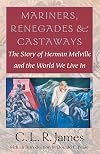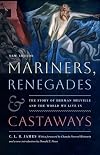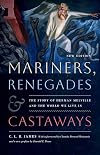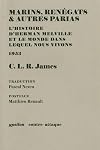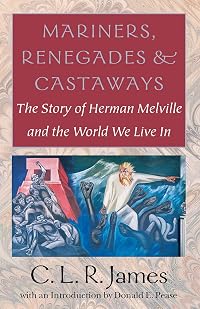
Mariners, Renegades and Castaways: The Story of Herman Melville and the World We Live In
by C. L. R. James
On This Page
Description
Political theorist and cultural critic, novelist and cricket enthusiast, C. L. R. James (1901 - 1989) was a brilliant polymath who has been described by Edward Said as "a centrally important 20th-century figure." Through such landmark works as The Black Jacobins, Beyond a Boundary, and American Civilization, James's thought continues to influence and inspire scholars in a wide variety of fields. "There is little doubt," wrote novelist Caryl Phillips in The New Republic, "that James will come show more to be regarded as the outstanding Caribbean mind of the twentieth century." In his seminal work of literary and cultural criticism, Mariners, Renegades and Castaways, James anticipated many of the concerns and ideas that have shaped the contemporary fields of American and Postcolonial Studies, yet this widely influential book has been unavailable in its complete form since its original publication in 1953. A provocative study of Moby Dick in which James challenged the prevailing Americanist interpretation that opposed a "totalitarian" Ahab and a "democratic, American" Ishmael, he offered instead a vision of a factory-like Pequod whose "captain of industry" leads the "mariners, renegades and castaways" of its crew to their doom. In addition to demonstrating how such an interpretation supported the emerging US national security state, James also related the narrative of Moby Dick, and its resonance in American literary and political culture, to his own persecuted position at the height (or the depth) of the Truman/McCarthy era. It is precisely this personal, deeply original material that was excised from the only subsequent edition. With a new introduction by Donald E. Pease that places the work in its critical and cultural context, Mariners, Renegades and Castaways is once again available in its complete form. show lessTags
Recommendations














Member Reviews
Like cold water to drink in the desert, the first half or so of this book has no equal. I didn't know I needed to read an essay on the totalitarian goals of Ahab, and the banality of evil in the rest of the crew. The second half of the book was less even, but forgivable to this reader as James was writing in a vain attempt to stave off his deportation from the US.
I am so glad I stumbled across this, and look forward to reading more CLR James.
A forgotten masterpiece.
I am so glad I stumbled across this, and look forward to reading more CLR James.
A forgotten masterpiece.
A fine look at the rise of mono-maniacal fascism through the lens of Ahab and the Pequod. Also takes in Melville's other writing as lead up and release from Moby Dick. Very smart. Written in the 1950's when James was being held before deportation as some kind of subversive.
Political power grows out of the barrel of a[n] gun [ulcer]
— Quotations from Chairman Mao Tse-Tung (1964)
Does Captive Writing Do What You Want
We've heard plenty times the communist position on class ideology: The bourgeois subject, whose worldview [transparently] serves his class interest, always describes this [interest] as the neutral, objective position — and moreover he actually believes it. To what extent does this apply to those on the receiving end political power's double-barrel — the scholars in extremis who, under threat of [political] violence, write gratifying works for those Bourgeois. And in particular we might ask after those political prisoners wasting away on Ellis Island with ulcers of the duodenum — do they show more also come to believe.
Frankly, we find the argument of Mariners (1953) somewhat implausible. Does the work of Herman Melville anticipate the totalitarian [communist] regimes of the 20th century, well probably not, except in the sense that we find its drama caught up in the continuum of history. (A storm is blowing from paradise.) And neither is Moby Dick (1851) a particularly shrewd psychological study of the authoritarian personality, at least not in its direct portrayal of Captain Ahab. To find praise of the "Great American Novel" more unqualified than in Mariners (1953) you'd have go to back to D.H. Lawrence. (Let's not.) It's hard to resist the temptation of a New Historicist reading here, knowing that, were the author to touch the heart of just one well-placed Cold Warrior, he would be [ulcer] free.
And yet a Cold Warrior won't be moved so easily. You'll be hard-pressed to find more unstinting condemnation of "the communists" in any other text. Let's see what it gets him. 'Well,' the author clarifies, 'I'm certainly Not a Communist . . . actually more of a Trotskyist . . . Oh, you've probably never heard of it . . . or rather a Menshevik . . . if I had to choose . . . you see. . . so not really a Bolshevik per se. . . Don't get me started on Comrade Stalin. . . And, well, yes . . . it was me who wrote The Black Jacobins (1938) . . . Which was . . . uh, of course . . . merely an . . . historical study . . .' James's mistake is he's so far inside the system he seems to forget the ideal anti-communist couldn't tell you what a 'Jacobin' is, let alone tease out the details for four-hundred pages. All he does know — if he had to guess — is that the Black kind must be even worse.
When the text praises a fellow-prisoner, the card-carrying communist, it's part of a rhetorical strategy of condemnation; but the Cold Warrior won't forget that it leads with praise. At the same time, C.L.R. James appears to have shot past his mark — perhaps compensating for the defense he hasn't quite pulled off — and finds himself, on the question of communism, more Catholic than the pope; criticizing the FBI of J. Edgar Hoover [of all things!] for its softcore stance. The text doesn't seem to consider that the FBI negotiates with [certain] communists, but only because it's maximally-leveraged. The secret dysphoric mode of the Cold Warrior — who presents himself as a confidence man [sic] advancing from victory to victory — is that he actually believes, in the end, that communism will win. This is how he justifies his actions, which are all already overreactions. And also why he deigns to negotiate with the [redacted] communist "M," an imprisoned indigent soon-to-be deported, and whom he [conspiratorially] believes represents a mass movement.
The [surreptitious] dysphoric mode of the Cold Warrior has its counterpart in the unspoken Euphoric mode of the Critical Theorist (read: 'Not a Communist'). As Sloterdijk notes, "If one surveys the older Critical Theory, it becomes immediately evident how sharply the dualism between the euphoric and the dysphoric mode is marked in it. Yet to its distinctive features belongs the fact that one may only speak about the dysphoric mode, while the euphoric mode presents a secret that is to be stringently guarded [. . .] The appeal [. . .] arises from the incommensurable experiences of happiness, in comparison with which most profane situations seem unreal, insipid, and unacceptably crude" (Peter Sloterdijk, Not Saved: Essays After Heidegger, 2016) In short, it's important to ask the forbidden question: to what extent is C.L.R. James having a laugh.
What this text praises in Melville — the darling of [White] American literature — is precisely the highly-implausible claim that the author of Moby Dick (1851) is a 'prescient political pundit for the atomic age.' Against the grain of obsequious praise we're tempted to recall the maxim that, "Praising the powerful for virtues they do not possess is one way of insulting them with impunity" (La Rochefoucauld, Maxims, 1665). So we find this text remains, even now, in tension. It's hard to write with an ulcer — like doing it at gun-point. It's hard to be certain that the gift of this text for Melville scholarship [and the House Committee on Un-American Activities] isn't a Gift-gift (a poisoned gift). If there is a flaw, it's the sense that C.L.R. James is a little too clever to be writing what he's writing, a little too . . . dialectical. Perhaps what's really needful, then, is a treatment of that stomach ulcer. This should help sort things out: the standard-of-care necessitates stool-testing for H. pylori — i.e. a definitive way to tell if he's full of it. show less
James's celebrated study of Herman Melville, written while James was interned on Ellis Island awaiting deportation.
Ratings
Members
- Recently Added By
Lists

In Our Time books
4,934 works; 2 members
Author Information

66+ Works 3,983 Members
A native of Trinidad, C. L. R. James grew up in a very respectable middle-class black family steeped in British manners and culture. Although justifiably well-known in the British world as a writer, historian, and political activist, his contributions have been underappreciated in the United States. A student of history, literature, philosophy, show more and culture, James thought widely and wrote provocatively. He also turned his words into deeds as a journalist, a Trotskyite, a Pan-African activist, a Trinidadian nationalist politican, a university teacher, and a government official. James was a teacher and magazine editor in Trinidad until the early 1930s, when he went to England and became a sports writer for the Manchester Guardian. While in England he became a dedicated Marxist organizer. In 1938 he moved to the United States and continued his political activities, founding an organization dedicated to the principles of Trotskyism. His politics led to his expulsion from the United States in 1953, and he returned to Trinidad, from which he was also expelled in the early 1960s. He spent the remainder of his life in England. Among James's extensive writings, the two most influential volumes are Black Jacobins (1967), a study of the anti-French Dominican (Haitian) slave rebellion of the 1790s, and Beyond a Boundary (1963), a remarkable exploration of sport, specifically cricket, as social and political history. Other important works include A History of Negro Revolt (1938) and The Life of Captain Cipriani (1932). James represents an unusual combination of activist-reformer (even revolutionary) and promoter of the best in art, culture, and gentility. (Bowker Author Biography) show less
Some Editions
Series
Belongs to Publisher Series
Common Knowledge
- Canonical title
- Mariners, Renegades and Castaways: The Story of Herman Melville and the World We Live In
- People/Characters
- Herman Melville
Classifications
- Genres
- Nonfiction, Literature Studies and Criticism, Fiction and Literature
- DDC/MDS
- 813.3 — Literature & rhetoric American literature in English American fiction in English Middle 19th Century 1830-1861
- LCC
- PS2388 .P6 .J36 — Language and Literature American literature American literature Individual authors 19th century
- BISAC
Statistics
- Members
- 172
- Popularity
- 189,924
- Reviews
- 4
- Rating
- (3.29)
- Languages
- English, French, Italian
- Media
- Paper, Ebook
- ISBNs
- 11
- ASINs
- 4