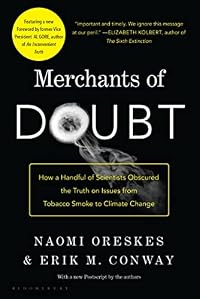
Merchants of Doubt: How a Handful of Scientists Obscured the Truth on Issues from Tobacco Smoke to Global Warming
by Naomi Oreskes, Erik M. Conway
On This Page
Description
Tells the story of how a loose-knit group of high-level scientists and scientific advisers, with deep connections in politics and industry, ran effective campaigns to mislead the public and deny well-established scientific knowledge over four decades that link smoking to lung cancer, coal smoke to acid rain, and CFCs to the ozone hole.Tags
Recommendations













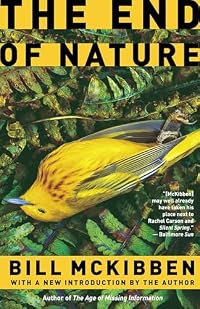

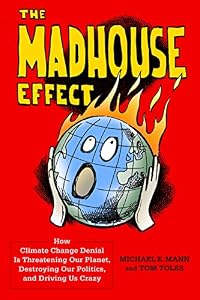



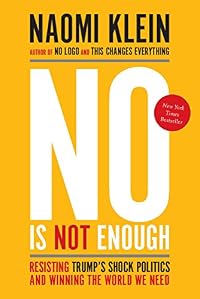

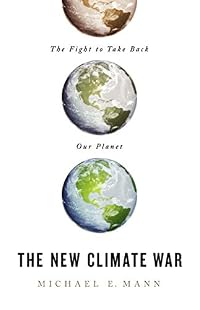

Member Recommendations
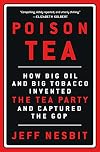
M_Clark Poison Tea also utilizes the documents from the tobacco lawsuit to find evidence of how the tea party grew out of the efforts of the tobacco lobby to fight regulation of tobacco.
Member Reviews
In the mid-1990s the tobacco industry was frequently sued by state governments, the US federal government, and class actions, because a tipping point had finally been reached and most everyone was in agreement that tobacco smoke causes cancer. These lawsuits brought to the public eye tens of thousands of documents - studies, articles, dossiers, emails, paychecks - implicating the tobacco lobby in a massive capitalist conspiracy to hide the health dangers of tobacco from users, shareholders, governments, and the public. Science historians Oreskes and Conway combed through these documents to look for trends and connections. They were contacted by a climate scientist, Ben Santer, who believed there was a connection between the tobacco show more lobby documents and the discrediting of his own work on global warming. Oreskes and Conway uncovered not only the same strategy, but the same four people - Fred Singer, Fred Seitz, William Nierenberg, and Robert Jastrow - retired physicists who devoted the rest of their lives to the discrediting of scientific research regarding smoking, the Strategic Defense Initiative, acid rain, the ozone hole, secondhand smoke, global warming, and the slander of Rachel Carson in the mid ‘00s. Their method was to use the skepticism ingrained in scientists and the scientific method to sow doubt. They funded and promoted research showing other causes of lung cancer to muddy the water, spread unfounded rumors about the advanced weapons capability of the Soviet Union, blamed volcanoes for acid rain and faulty satellites for the ozone hole. They invented the concept of “junk science” to cherry-pick only studies that supported their beliefs (or more accurately, the beliefs of the signers of their paychecks) and weaponized the already-abolished-but-habitual “fairness doctrine” to demand their lobbying be given the same amount of press as actual science. They used their power as Presidential advisors to get quotes and op-eds in the New York Times, the Washington Post, and the Wall Street Journal, while real scientists kept their heads down lest their work be specifically attacked and discredited by this well-funded unstoppable machine.
It’s very depressing how little anything has changed since the ‘70s, when this story begins, or even since the book was published in 2010. While it is astounding to see all of the evidence laid out in a row, plain as day, connecting all of the environmental and health crises of 40 years to each other and to the same four men, this book is not really readable enough to recommend. It’s very dense and detailed and well-researched, but at 15 years old too outdated to be worth it. If you have any doubts (hah) about the reality of tobacco harms, climate change, or pesticides, this book certainly has enough evidence to show you you've been duped, but it's been decades...have you been living under a rock? Surprisingly when I started the book the least-relevant chapter was the one about the folly of the Strategic Defense Initiative - the pet project of money-hungry defense contractors - but midway through my read it became extremely relevant. Depressing. I would love to see an updated edition or sequel continuing to connect the dots onward to more climate denial, opioids, the Green New Deal, the election of Trump, and of course extensive COVID-19 and vaccine denial. Let this serve as a lesson to me and others to read this kind of work more promptly and not wait 15 years. show less
It’s very depressing how little anything has changed since the ‘70s, when this story begins, or even since the book was published in 2010. While it is astounding to see all of the evidence laid out in a row, plain as day, connecting all of the environmental and health crises of 40 years to each other and to the same four men, this book is not really readable enough to recommend. It’s very dense and detailed and well-researched, but at 15 years old too outdated to be worth it. If you have any doubts (hah) about the reality of tobacco harms, climate change, or pesticides, this book certainly has enough evidence to show you you've been duped, but it's been decades...have you been living under a rock? Surprisingly when I started the book the least-relevant chapter was the one about the folly of the Strategic Defense Initiative - the pet project of money-hungry defense contractors - but midway through my read it became extremely relevant. Depressing. I would love to see an updated edition or sequel continuing to connect the dots onward to more climate denial, opioids, the Green New Deal, the election of Trump, and of course extensive COVID-19 and vaccine denial. Let this serve as a lesson to me and others to read this kind of work more promptly and not wait 15 years. show less
Oreskes' and Conway's "Merchants of Doubt" is an excellent look into a world were science has less to do with data, and much more to do with business and politics. The book outlines the progression of professional scientific denialism from the initial tobacco industry backlash of the seventies to S.D.I., acid rain, the ozone, secondhand smoke, and global warming. Well researched and thoroughly cited, the book demonstrates that the small related cadre of individuals and organizations responsible for originally denying tobaccos deadly side effects are the same groups casting doubt on current science (such as on climate change). The book avoids any preaching, relying instead on strong research and facts to demonstrate clear links and show more allowing the reader to make the connections themselves. A highly recommended book for anyone interested in science, politics, or both. show less
 This review was written for LibraryThing Early Reviewers.
God knows I’ve written a few crass or aggressive reviews before but I’m not even going to review this one — I don’t know if I could stop myself from offending everyone, even those in agreement. The problem is not the book — it’s well done and probably every American should read it. It’s just that I spent 20 years of my life as a 3-pack per day smoker — of Camel unfiltered no less. I quit cold turkey in August 2006, but I’ve had a number of relatives die from the cancers they got from lifetimes of smoking and even though I was cognizant of a number of things in the book, reading this info, this tale laid out so well by the author comes close to sending me over the edge. I’m not going to say anymore except that I do show more recommend this book. show less
Merchants of Doubt reads like a case presented by the prosecution. Oreskes and Conway look at several late 20th century scientific controversies: the link between cigarettes and cancer; the risks of nuclear weapon, the damage done by acid rain, CFCs and the ozone layer, and above all climate change, to find that these controversies extend far beyond the limits of reasonable doubt. This is no accident, but rather the result of a deliberate public relations strategy formulated by a small group of Cold War physics, propagated by a network of conservative think tanks, and funded by companies with a business model that creates threats to human life.
The scientists are Fred Singer, Frederick Seitz, Robert Jastrow, and William Nierenberg. All show more of them parleyed real scientific work around the Manhattan Project and the early Cold War into political positions connected with the Republican party. In the mid 60s, as the dangers of smoking became apparent, the tobacco industry began supporting scientific research to create a bench of trial experts to cast doubt on the link between cigarettes and cancer. Seitz, Nierenberg, and Jastrow founded the staunchly freemarket George C. Marshall Institute in 1984 to provide structure for for their work. Singer was loosely affiliated with the network. The charges are serious enough, and timeline involved complex enough, that I'll leave the details to the book. Whatever the nature of the debate and the connection between science and policy, the goal was always to inhibit regulatory action by the government, and the playbook almost identical.
The Merchants of Doubt playbook is not laid out in the text, so I'll do it here:
Step 1 is Developing the Controversy: This begins innocently enough with emerging scientific issue of regulatory significant and locating legitimate uncertainties. Science is always incomplete, and particularly in early stages models may be crude approximations with unclear causal mechanisms. But rather than contributing actual work, (the scientific CVs of the merchants are notably thin post-1970) criticize the science for lack of realism and certainty, without offering testable hypotheses of your own. Extend personal uncertainty to willful density. Hold up official government reports through bureaucratic delays and denying consensus.
Step 2 is to Launder the Controversy: Demand equal time for "your side" to a news media that lacks the time or expertise to check the validity of both sides, and knows that a story headlined "scientists argue" is more interesting than "scientists say". Launder your own credentials in an unrelated field to present yourself as an expert on whatever is required beyond all standards of professionalism. A scientist might master two fields, but cannot master the details of physics, atmospheric modeling, epidemiology, forest ecology, and so on. Develop press materials which mimic scientific articles in style and format, but have not passed review. Present glowing assessments of your position in friendly media like The Wall Street Journal.
Step 3 is to Amplify the Controversy: Make sure everybody, not just friendly venues, sees the conflict. Get politicians and media figures to present your views as fact. Accuse your opponents of politicizing science and scientific misconduct. Attack, slander, and when necessary, lie. Cast attacks on your own evidence and backing as censorship akin to that suffered by Galileo. The end goal is to make the controversy the story, leaving doubt in the public mind long after the science has settled.
I believe that Oreskes and Conway's case, as presented, is bulletproof. The titular merchants of doubt systematically violated scientific norms out of an ideological commitment that any sin was valid in pursuit of their political goal. They accused the scientific community of tampering with evidence and ideological bias, two acts which they were consistently and shamelessly guilty of.
The end of this book, where Oreskes lays out the motives of these scientific antagonists, is not as strong. She describe an ideological journey, where Cold War anti-communists came to believe that anything was permissible in defense of American liberty. With the collapse of the Soviet Union, they made the errors of identifying Free Market Fundamentalism as the only economic system compatible with American democracy, and environmentalist sentiment of all sorts as the new communism. Rather than a blind faith in the efficiency, justice, and wisdom of markets, environmentalism recognizes many market failures of externalities, imperfect information, and various kinds of monopolies and technological lock-in. The ultimate logic of environmentalism is simple: The freedom to pollute cannot indefinitely stand above ecosystem integrity and human life. It's opponents would rather commit mass suicide than stop believing this.
Merchants of Doubt is not a scholarly book, despite exhaustive research and footnotes. The authors include a chapter on Rachel Carson and the posthumous attack on Silent Spring because I believe Oreskes sees Carson as role model. Silence Spring wasn't strictly science either; it was a case prepared for public opinion, and one the launched the modern environmental movement.
The point of both Silent Spring and Merchants of Doubt was to launch a movement. As I write this review, on the day of the first March for Science, that movement is ever more necessary. We live in a world trending towards Step 4, a nihilistic universal skepticism that expertise is even possible, that's there's anything other hidden motives and a desire for power in claims of scientific authority. Oreskes and Conway argue that we can't do our own science, that at a certain point there must be faith in the integrity of what's presented, because no-one can understand the full extent of the network that is activated in making a scientific claim. This may be correct, but it's also unsatisfying.
The tactics developed by the merchants of doubt are a near perfect psuedo-science, carrying all the epistemic markers of scientific validity while containing a deadly poison of social paralysis. In this moment of Trumpian "alternative facts", we need to do more than push back against doubt, we need to make producing it a marker of perfidy, partaking in it a road to self-destruction rather than further prestige. I don't yet know how to do that, but Merchants of Doubt precisely lays out the cause of our present troubles. show less
The scientists are Fred Singer, Frederick Seitz, Robert Jastrow, and William Nierenberg. All show more of them parleyed real scientific work around the Manhattan Project and the early Cold War into political positions connected with the Republican party. In the mid 60s, as the dangers of smoking became apparent, the tobacco industry began supporting scientific research to create a bench of trial experts to cast doubt on the link between cigarettes and cancer. Seitz, Nierenberg, and Jastrow founded the staunchly freemarket George C. Marshall Institute in 1984 to provide structure for for their work. Singer was loosely affiliated with the network. The charges are serious enough, and timeline involved complex enough, that I'll leave the details to the book. Whatever the nature of the debate and the connection between science and policy, the goal was always to inhibit regulatory action by the government, and the playbook almost identical.
The Merchants of Doubt playbook is not laid out in the text, so I'll do it here:
Step 1 is Developing the Controversy: This begins innocently enough with emerging scientific issue of regulatory significant and locating legitimate uncertainties. Science is always incomplete, and particularly in early stages models may be crude approximations with unclear causal mechanisms. But rather than contributing actual work, (the scientific CVs of the merchants are notably thin post-1970) criticize the science for lack of realism and certainty, without offering testable hypotheses of your own. Extend personal uncertainty to willful density. Hold up official government reports through bureaucratic delays and denying consensus.
Step 2 is to Launder the Controversy: Demand equal time for "your side" to a news media that lacks the time or expertise to check the validity of both sides, and knows that a story headlined "scientists argue" is more interesting than "scientists say". Launder your own credentials in an unrelated field to present yourself as an expert on whatever is required beyond all standards of professionalism. A scientist might master two fields, but cannot master the details of physics, atmospheric modeling, epidemiology, forest ecology, and so on. Develop press materials which mimic scientific articles in style and format, but have not passed review. Present glowing assessments of your position in friendly media like The Wall Street Journal.
Step 3 is to Amplify the Controversy: Make sure everybody, not just friendly venues, sees the conflict. Get politicians and media figures to present your views as fact. Accuse your opponents of politicizing science and scientific misconduct. Attack, slander, and when necessary, lie. Cast attacks on your own evidence and backing as censorship akin to that suffered by Galileo. The end goal is to make the controversy the story, leaving doubt in the public mind long after the science has settled.
I believe that Oreskes and Conway's case, as presented, is bulletproof. The titular merchants of doubt systematically violated scientific norms out of an ideological commitment that any sin was valid in pursuit of their political goal. They accused the scientific community of tampering with evidence and ideological bias, two acts which they were consistently and shamelessly guilty of.
The end of this book, where Oreskes lays out the motives of these scientific antagonists, is not as strong. She describe an ideological journey, where Cold War anti-communists came to believe that anything was permissible in defense of American liberty. With the collapse of the Soviet Union, they made the errors of identifying Free Market Fundamentalism as the only economic system compatible with American democracy, and environmentalist sentiment of all sorts as the new communism. Rather than a blind faith in the efficiency, justice, and wisdom of markets, environmentalism recognizes many market failures of externalities, imperfect information, and various kinds of monopolies and technological lock-in. The ultimate logic of environmentalism is simple: The freedom to pollute cannot indefinitely stand above ecosystem integrity and human life. It's opponents would rather commit mass suicide than stop believing this.
Merchants of Doubt is not a scholarly book, despite exhaustive research and footnotes. The authors include a chapter on Rachel Carson and the posthumous attack on Silent Spring because I believe Oreskes sees Carson as role model. Silence Spring wasn't strictly science either; it was a case prepared for public opinion, and one the launched the modern environmental movement.
The point of both Silent Spring and Merchants of Doubt was to launch a movement. As I write this review, on the day of the first March for Science, that movement is ever more necessary. We live in a world trending towards Step 4, a nihilistic universal skepticism that expertise is even possible, that's there's anything other hidden motives and a desire for power in claims of scientific authority. Oreskes and Conway argue that we can't do our own science, that at a certain point there must be faith in the integrity of what's presented, because no-one can understand the full extent of the network that is activated in making a scientific claim. This may be correct, but it's also unsatisfying.
The tactics developed by the merchants of doubt are a near perfect psuedo-science, carrying all the epistemic markers of scientific validity while containing a deadly poison of social paralysis. In this moment of Trumpian "alternative facts", we need to do more than push back against doubt, we need to make producing it a marker of perfidy, partaking in it a road to self-destruction rather than further prestige. I don't yet know how to do that, but Merchants of Doubt precisely lays out the cause of our present troubles. show less
I read Merchants of Doubt: How a Handful of Scientists Obscured the Truth on Issues from Tobacco Smoke to Global Warming by Naomi Oreskes & Erik M. Conway because a friend recommended it. I started reading with a sense of skepticism, but found the presentation of facts, history, and science compelling. Merchants of Doubt used facts and science to illustrate how people have twisted science for corporate greed, political agendas, and personal greed. Oreskes & Conway showed the documentation to back up their claims. They made the excellent point that science itself isn't biased; however, people with agendas are. Oreskes & Conway not only discuss the science, but how and why it was manipulated in a clear, easy to comprehend manner that is show more at once fascinating, enraging, enlightening, and frightening. They emphasize time and again the reality that facts and science don't change just because people choose not to believe them. Read Merchants of Doubt if you want to better understand how the government, the media, and corporations manage to manipulate the general public to believe things that support corporate interests but go against the interests of all Earth's inhabitants. show less
My confirmation bias predicted I would like this book, as I am familiar with many of the names and their histories. My bias was correct, but I still needed to check what the authors were presenting, because I like to think I think. Well sourced, and well written, this is another book that needs to be read by everyone...but won't be.
Beyond exposing Fred Seitz, Robert Jastrow, William Nierenberg, and Fred Singer (and a few others) for the despicable disgraces to the scientific world that they are, Ms. Oreskes and Mr. Conway do an excellent job explaining what true peer review and true science really consist of. From defense of smoking, an indefensible Star Wars program, acid rain, ozone depletion, second-hand smoking to denial of climate show more science, these guys have had devastating effects on US policy. And that was before Fox"News". Now they don't even need to use the pseudo-science bait-and-switch tactics; the right-wing media has devolved to simple gainsaying - and their viewers/listeners don't have a critical thought in their heads to question their confirmation biases.
My one complaint about the book is that the authors more than not used the term "skeptics" (they did also use "deniers"). All science is about skepticism, but these disruptors, obfuscators, ... liars ... are not "skeptics". Singer is lower than low, and still at it.
I'm disgusted. At the "scientists". show less
Beyond exposing Fred Seitz, Robert Jastrow, William Nierenberg, and Fred Singer (and a few others) for the despicable disgraces to the scientific world that they are, Ms. Oreskes and Mr. Conway do an excellent job explaining what true peer review and true science really consist of. From defense of smoking, an indefensible Star Wars program, acid rain, ozone depletion, second-hand smoking to denial of climate show more science, these guys have had devastating effects on US policy. And that was before Fox"News". Now they don't even need to use the pseudo-science bait-and-switch tactics; the right-wing media has devolved to simple gainsaying - and their viewers/listeners don't have a critical thought in their heads to question their confirmation biases.
My one complaint about the book is that the authors more than not used the term "skeptics" (they did also use "deniers"). All science is about skepticism, but these disruptors, obfuscators, ... liars ... are not "skeptics". Singer is lower than low, and still at it.
I'm disgusted. At the "scientists". show less
You knew that there was a concerted, well-funded campaign to convince people that “99 scientists agree, 1 doesn’t” justified reporting issues as controversial, right? This is a book-length exegesis of the past sixty years of such campaigns. The thing that I didn’t know—a lot of the time it was the same guys behind the media blitz defending cigarettes, SDI (Star Wars), acid rain, carbon emissions. The exact same men, with the exact same expertise (a lot of physicists, very little actual field knowledge). It wasn’t just that they developed and perfected the techniques, enough so that our kids are going to suffer for their sins—they themselves just transferred the techniques to new fields when the initial ones were decisively show more lost (cigarettes) or rendered irrelevant (Star Wars). If you aren’t outraged, you aren’t paying attention—but then journalists weren’t. It's useful information, but the repetition eventually just gets really depressing: the techniques that worked on cigarettes continue to work, as Rome burns. show less
Members
- Recently Added By
Lists

Climate Change
87 works; 7 members

Climate Change
39 works; 2 members
Author Information

10+ Works 2,076 Members
Naomi Oreskes, Ph.D. Stanford, is Associate Professor of History at the University of California, San Diego. She lives in Del Mar, California.

8+ Works 1,790 Members
Erik M. Conway serves as historian, Jet Propulsion Laboratory, Pasadena, California
Some Editions
Awards and Honors
Work Relationships
Has the adaptation
Common Knowledge
- Canonical title
- Merchants of Doubt: How a Handful of Scientists Obscured the Truth on Issues from Tobacco Smoke to Global Warming
- Original publication date
- 2010
- People/Characters
- Oswald Avery; I. L. Baldwin; David Baltimore; Tim Barnett; Joseph Barton; Joseph Bast (show all 221); Frederic Bastiat; Christa Beran; Isaiah Berlin; Chris Bernabo; Lisa Bero; Hans Bethe; John Bickle; Marlin Billings; Bert Bolin; John Boltz; F. Herbert Bormann; Max Boykoff; Jules Boykoff; Allan Brandt; William Broad; Norma R. Broin; George E. Brown Jr.; Reid Bryson; George H. W. Bush; Rachel Carson; Jimmy Carter; Jule Charney; Ralph Cicerone; Martin J. Cline; Bonner Cohen; Barbara A. Cohn; Joseph Coors; Curt Covey; Candace Crandall; Michael Crichton; Paul Crutzen; John Dalton; Norman D'Amours; Richard Darman; Christie Davies; Tom DeLay; Thomas M. Donahue; Riley Dunlap; Freeman Dyson; Gregg Easterbrook; J. Gordon Edwards; Paul Ehrlich; Mohamed El-Ashry; Hugh Ellsaesser; Walster Elsasser; Kerry Emanuel; Roger Ferger; Richard Feynman; Gerald Ford; Sir Christopher Foxley-Norris; Mark Freeman; Milton Friedman; Edward Frieman; Craig Fuller; Michael Fumento; Richard Garwin; Lawrence Gates; Ross Gelbspan; Peter Geren; Ronald Giere; Stanton Glantz; Barry Goldwater; Mikhail Gorbachev; Al Gore; William C. Gorgas; Daniel O. Graham; S. J. Green; Herbert Gutowsky; Victor Han; Philip Handler; James E. Hansen; William Webser Hansen; Garrett Hardin; F. Kenneth Hare; Lord Harris of High Cross; Klaus Hasselmann; Takeshi Hirayama; Tom Hockaday; Donald Hodel; John Houghton; David Hounshell; Wilhelm C. Hueper; Carolyn Hufbauer; Donald Hunten; Peter Jacques; Robert Jastrow; Kent Jeffreys; Lyndon Baines Johnson; Noye M. Johnson; Harold Johnston; J. Bennett Johnston; Alan Katzenstein; Charles David Keeling; William Kellogg; Henry Kendall; Donald Kennedy; Gail Kennedy; John F. Kennedy; John Maynard Keynes; George Keyworth; Gina Kolata; Charles Krauthammer; Laurence Kulp; Myanna Lahsen; Justin Lancaster; Dwight Lee; John C. Lenzi; Gene E. Likens; Rush Limbaugh; Eugene Linden; Richard Lindzen; C. C. Little; Bjørn Lomborg; James Lovelock; Gordon MacDonald; Lestser Machta; Colin MacLeod; Rogelio Maduro; Jerry Mahlman; Thomas Malthus; Syukuro Manabe; Michael Mann; Roy E. Marden; Robert Mauldin; Maclyn McCarty; James E. McDonald; Steve McIntyre; Bill McKibben; Ellen Merlo; John Mica; Patrick Michaels; Steven J. Milloy; Ludwig von Mises; George Mitchell; Chris Mooney; Daniel Patrick Moynihan; Emil Mrak; Paul Müller; Walter Munk; Edward R. Murrow; Homer Newell; William Nierenberg; Paul Nitze; Richard M. Nixon; William Nordhaus; Svante Odén; William O'Keefe; George Orwell; Theophrastus Paracelsus (1493? to 1541); Donald Pearlman; Richard Perle; John Perry; Tom Pestorius; Robert S. Pierce; Richard Pipes; James Pollack; Robert Proctor; Stanley B. Prusiner; Kenneth Rahn; V, Ramanathan; Dixy Lee Ray; Ronald Reagan; Roger Revelle; Abraham Ribicoff; Walter Orr Roberts; John Robertson; Dana Rohrabacher; Sherwood Rowland; William Ruckelshaus; Mal Ruderman; Richard C. Rue; Carl Sagan; Benjamin Santer; Richard Mellon Scaife; Antonin Scalia; Thomas Schelling; Harold Schiff; Mike Schlesinger; Steven Schneider; Richard Scorer; Howard Scripps; Frederick Seitz; Russell Seitz; James Shannon; Julian Simon; William Simon; S. Fred Singer; Michael Smithson; C. P. Snow; Susan Solomon; George Soros; Gus Speth; Sylvester Stallone; Chauncey Starr; Nicholas Stern; David Stockman; Colin H. Stokes; Richard Stolarski; Edward Teller; Luther L. Terry; John Tierney; Alexis de Tocqueville; O. Brian Toon; James Tozzi; John Tukey; Richard Turco; Nicholas Wade; Robert T. Watson; Alvin Weinberg; Robert M. White; Tom Wigley; Eugene Wigner; Robert Windom; Tim Wirth; George Woodwell
- Important places
- Antarctica; Mt. Augustine; Boeing Laboratories; Bohemian Grove, California, USA; Canada; Mount Erebus, Antarctica (show all 16); Helena National Forest; Hiroshima, Japan; Nagasaki, Japan; Lawrence Livermore National Laboratory; Massachusetts Institute of Technology; NASA Ames Research Center; Panama Canal, Panama; Rockefeller University; USSR (Soviet Union); Sri Lanka
- Important events
- Acid Precipitation Act (1980); Airborne Antarctic Ozone Experiment (AAOE); Airborne Arctic Stratospheric Expediction (AASE); British Antarctic Survey; Clean Air Act; Cold War (show all 34); DDT ban; Extinction of the dinosaurs; Earth Summit; Fairness Doctrine; Kyoto Protocol; Great Depression; Hubbard Brook Ecosystem Study; Inadvertent Modification of the Stratosphere; Indoor Residual Spraying; Intergovernmental Panel on Climate Change (IPCC); International Geophysical Year; International Symposium on Acid Precipitation and the Forest Ecosystem; Iraq War; Massachusetts et a. v. the EPA; Montreal Protocol on Substances that Deplete the Ozone Layer; National Climate Act (1978); National Environmental Policy Act (1970); National Ozone Experiment; New Deal; Nierenberg Acid Rain Peer Review Panel; Ozone Trends Panel; Panel on Atmospheric Chemistry; RICO Act; Science and Environmental Policy Project (SEPP); Strategic Defense Initiative (SDI); Strategic Objectives Panel; UN Framework Convention on Climate Change; Vietnam War
- Related movies
- Merchants of Doubt (2014 | IMDb)
- Dedication
- To Hannah and Clara. It's in your hands now.
- First words
- Ben Santer is the kind of guy you would never imagine anyone attacking.
- Last words
- (Click to show. Warning: May contain spoilers.)We agree.
Classifications
Statistics
- Members
- 1,237
- Popularity
- 19,838
- Reviews
- 32
- Rating
- (4.20)
- Languages
- 5 — English, French, German, Italian, Spanish
- Media
- Paper, Audiobook, Ebook
- ISBNs
- 14
- ASINs
- 15
