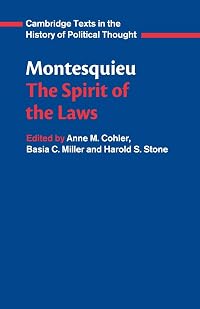
The Spirit of the Laws
by Montesquieu
On This Page
Description
Montesquieu's The Spirit of Laws is an enduring classic of social and political theory deserving a fresh reading every generation. The modern reader, however, is likely to find a work that ran to over a thousand pages in its two-volume first edition a bit overwhelming. Presented here, therefore, is the first English-language compendium of The Spirit of Laws, together with the first English translation of the posthumously published treatise containing the physiological theory underlying show more Montesquieu's theory of climate. show lessTags
Recommendations


Member Reviews
A French aristocrat spent his life looking at the laws of various people, though mostly those of his native country, to develop political theories related to different governments that would influence the coming “Age of Revolution”. The Spirit of the Laws by Montesquieu is a treatise on political theory that covers a large range of topics including law, social life, and the study of anthropology that would change the way people would look at the development of government.
In a little over 700 pages Montesquieu covers a lot of material but three major themes throughout this treatise that influenced readers of his time and up to the modern day. Those three themes were the classification of political systems and the “principles” show more that motivate them and that the lack of means they don’t endure, the political liberty that is defined as personal security especially that provided by system of dependable and moderate laws, and the development of political sociology in which geography and climate interact with particular cultures to produce a spirit of the people that influences their politics and laws. Based on these themes Montesquieu pleads for a constitutional system of government with separation of powers, the preservation of legality and civil liberties, and the end of slavery. At times the material Montesquieu covers could be somewhat tedious especially close to the end of the treatise as he covered the transition of French institutions from the Frankish conquest of Gaul to the medieval French monarchy. Yet even with that tediousness the reader gets the thoroughness in which Montesquieu dedicated a lifetime of study to produce this treatise, which influenced the American Founding Fathers, French republicans, and others around the world.
The Spirit of the Laws is the life’s work of Montesquieu, a pioneering work on comparative law, but a treatise on political theory that would be influential almost immediately after it’s publication and be relevant to this day. show less
In a little over 700 pages Montesquieu covers a lot of material but three major themes throughout this treatise that influenced readers of his time and up to the modern day. Those three themes were the classification of political systems and the “principles” show more that motivate them and that the lack of means they don’t endure, the political liberty that is defined as personal security especially that provided by system of dependable and moderate laws, and the development of political sociology in which geography and climate interact with particular cultures to produce a spirit of the people that influences their politics and laws. Based on these themes Montesquieu pleads for a constitutional system of government with separation of powers, the preservation of legality and civil liberties, and the end of slavery. At times the material Montesquieu covers could be somewhat tedious especially close to the end of the treatise as he covered the transition of French institutions from the Frankish conquest of Gaul to the medieval French monarchy. Yet even with that tediousness the reader gets the thoroughness in which Montesquieu dedicated a lifetime of study to produce this treatise, which influenced the American Founding Fathers, French republicans, and others around the world.
The Spirit of the Laws is the life’s work of Montesquieu, a pioneering work on comparative law, but a treatise on political theory that would be influential almost immediately after it’s publication and be relevant to this day. show less
In this classic of Enlightenment Thought, Montesquieu, Charles Louis Secondat de la Brède discusses Laws and the thought behind them. Montesquieu divides governments into three primary categories; the Republic, the Monarchy, and the Despotic Government. Going through all of the governments, he discusses the pros and cons of each. It is quite informative in some ways, but looking back from now it really makes one think. While he talks about the dangers of each government it is difficult to avoid making comparisons of our current world situation. In that sense, Montesquieu was far ahead of his time in political thought.
Originally I took this out from the Library, but I found an old copy of it and was able to finally finish it. It seems show more that the bulk of the book is contained in other people discussing the book. show less
Originally I took this out from the Library, but I found an old copy of it and was able to finally finish it. It seems show more that the bulk of the book is contained in other people discussing the book. show less
One of the best books I have ever read and ever shall hope to read at least three more times in my lifetime... if only all books were only a slight fraction of the merit of this (and all of M's works I have read) book then I daresay I would never stop reading.
BIBLIOGRAPHIC DETAILS:
Print: COPYRIGHT: (1748/Translated to English 1750) ) 3/1/2005; PUBLISHER: Kessinger Publishing, LLC; 1st edition; ISBN 978-1432620790; PAGES 448; Unabridged
Digital: COPYRIGHT: 1/2/2019; PUBLISHER: e-artnow; ISBN B07MBFHWK2; 446 pages; Unabridged
*Audio (MP3): COPYRIGHT: 8/18/2011; ISBN: 9781483073712; PUBLISHER: Blackstone Publishing; DURATION: 22:24:24; PARTS: 22; File Size: 646023 KB; Unabridged
Feature Film or tv: No
SUMMARY/ EVALUATION:
How I picked it: I don’t think I sought this one out, but just came upon it. I don’t recall for sure.
What it’s about: Customs, economics, laws of nature, government, religions, philosophies, and the effect of the interplay of all that on individuals. He discusses the ways show more that countries, past and present have governed themselves and prescribes what he believes is best suited for establishing a government. Wikipedia mentions that subsequent British and American governmental systems took many queues from this work, such as having three separate but interdependent administrative branches (executive, legislative, judicial) with the intent of maintaining governmental balance with the least susceptibility to tyranny and corruption.
What I thought: The vocabulary is such, and the concepts, that much of it requires longer consideration than allowed by reading straight through at the normal pace, so this took quite some time to get through, and some reversing/replaying. And it’s the kind of book that I would learn more from with each re-reading.
People of the author’s current time are often mentioned by first name only, as though the readers would know who is referred to.
I felt here that what was often considered a law of nature, was actually a law of religion (as evidenced in the statement that they are laws established by God—in his presumption that God, as he understood him, was the creator of nature). I also felt that the Baron was not all that familiar with “brutes”, as he says they are not affected by our fears—perhaps he was only referring to certain fears, such as those related to keeping up our good image, but I had the impression he meant fears in general—which would completely dismiss their obvious fears around survival—he also says they don’t have our hopes—again, not a pet owner. You can’t tell me my dogs weren’t hoping to go for a walk, go for a car ride, receive treats, see me returning home soon after a long day away. He also states that animals have no positive laws (by which, he refers to legislations, or regulations. I disagree. Obviously, they have no written laws, but I believe many animals receive teachings from their parents that I would consider their version of laws. Despite this, I found the books (it was written as 31 books – here they are gathered together.) exceedingly informative.
AUTHOR:
Baron de Montesquieu
From Wikipedia___ “Charles Louis de Secondat, Baron de La Brède et de Montesquieu (/ˈmɒntəskjuː/;[3] French: [mɔ̃tɛskjø]; 18 January 1689 – 10 February 1755), generally referred to as simply Montesquieu, was a French judge, man of letters, historian, and political philosopher.
He is the principal source of the theory of separation of powers, which is implemented in many constitutions throughout the world. He is also known for doing more than any other author to secure the place of the word despotism in the political lexicon.[4] His anonymously published The Spirit of Law (1748), which was received well in both Great Britain and the American colonies, influenced the Founding Fathers of the United States in drafting the U.S. Constitution.”
TRANSLATOR:
Thomas Nugent
From Wikipedia____ “Thomas Nugent (c. 1700 – 27 April 1772 in Gray's Inn, London) was an erudite Irish historian and travel writer. Today he is known most of all for his travelogue of the Grand Tour, which was at that time popular particularly among English noblemen taking educational tours through Europe. His detailed descriptions of the France, Italy, Germany, and the Netherlands of the time provide a rich source for historians of the situation in the second half of the 18th century.”
EDITOR:
J. V. Prichard
(I found no biographical info.)
NARRATOR:
Wanda McCaddon
From AudioFile.com___ “When Wanda McCaddon began narrating audiobooks in the early 1980s, the famous publisher for which she worked paid female narrators less than men--$15 per recorded hour versus $25. "I just accepted it! Can you believe that? Times do change, thank heavens."
What hasn't changed is the quality of McCaddon's performances. This year, she turned in stellar renditions of Barbara Tuchman's THE PROUD TOWER and THE GUNS OF AUGUST , Thackeray's VANITY FAIR , and Austen's SENSE AND SENSIBILITY .
English-born McCaddon, who also narrates under the names Donada Peters and Nadia May, has an unerring ear for British and colonial accents, and most European ones. Occasionally, though, she has to go in search of the right sound. When she needed an accent from Sligo, a small northwestern pocket of Ireland, for Sebastian Barry's new novel, THE SECRET SCRIPTURE , she found help in an audio archive of international English dialects. It yielded 90 seconds of a Sligo voice, which, she says, "I played every half hour or so as I was recording to remind me of the right sound."”
GENRE:
Law, Politics, Nonfiction
SAMPLE QUOTATION: From Book I, Chapter 1:
“God is related to the universe as creator and preserver; the laws by which he created all things, are those by which he preserves them. He acts according to these rules because he knows them; he knows them because he made them; and he made them because they are relative to his wisdom and power.
As we see that the world, though formed by the motion of matter, and void of understanding, subsists through so long a succession of ages, its motions must certainly be directed by invariable laws: and could we imagine another world, it must also have constant rules, or must inevitably perish.
Thus the creation, which seems an arbitrary act, suppose the laws as invariable as those of the fatality of the Atheists. It would be absurd to say, that the Creator might govern the world without those rules, since without them it could not subsist.
These rules are a fixt and invariable relation. In bodies moved the motion is received, increased, diminished, lost, according to the relations of the quantity of matter and velocity, each diversity is uniformity, each change is constancy.
Particular intelligent beings may have laws of their own making, but they have some likewise which they never made. Before there were intelligent beings, they were possible; they had therefore possible relations, and consequently possible laws. Before laws were made, there were relations of possible justice. To say that there is nothing just or unjust but what is commanded or forbidden by positive laws, is the same as saying that before the describing of a circle all the radii were not equal.
We must therefore acknowledge relations of justice antecedent to the positive law by which they are established: as for instance, that if human societies existed, it would be right to conform to their laws; if there were intelligent beings that had received a benefit of another being, they ought to be grateful; if one intelligent being had created another intelligent being, the latter ought to continue in its original state of dependance; if one intelligent being injures another, it deserves a retaliation of the injury, and so on.
But the intelligent world is far from being so well governed as the physical. For though the former has also its laws which of their own nature are invariable, yet it does not conform to them so exactly as the physical world. This is because on the one hand particular intelligent beings are of a finite nature, and consequently liable to error; and on the other, their nature requires them to be free agents. Hence they do not steadily conform to their primitive laws; and even those of their own instituting they frequently infringe.
Whether brutes be governed by the general laws of motion, or by a particular movement, is what we cannot determine. Be that as it may, they have not a more intimate relation to God than the rest of the material world; and sensation is of no other use to them, than in the relation they have either to other particular beings, or to themselves.
By the allurement of pleasure they preserve the being of the individual, and by the same allurement they preserve their species. They have natural laws, because they are united by sensations, positive laws they have none, because they are not connected by knowledge. And yet they do not conform invariably to their natural laws; these are better observed by vegetables, that have neither intellectual nor sensitive faculties.
Brutes are deprived of the high advantages which we have, but they have some which we have not. They have not our hopes, but they are without our fears, they are subject like us to death, but without knowing it, even most of them are more attentive than we to self-preservation, and do not make so bad a use of their passions.
Man, as a physical being, is, like other bodies, governed by invariable laws. As an intelligent being, he incessantly transgresses the laws established by God, and changes those which he himself has established. He is left to his own direction, though he is a limited being, subject like all finite intelligences, to ignorance and error; even the imperfect knowledge he has, he loses as a sensible creature, and is hurried away by a thousand impetuous passions. Such a being might every instant forget his Creator; God has therefore reminded him of his duty by the laws of religion. Such a being is liable every moment to forget himself; philosophy has provided against this by the laws of morality. Formed to live in society, he might forget his fellow creatures; legislators have therefore by political and civil laws confined him to his duty.”
RATING:.
4
STARTED READING – FINISHED READING
8/30/22 – 10/16/22 show less
Print: COPYRIGHT: (1748/Translated to English 1750) ) 3/1/2005; PUBLISHER: Kessinger Publishing, LLC; 1st edition; ISBN 978-1432620790; PAGES 448; Unabridged
Digital: COPYRIGHT: 1/2/2019; PUBLISHER: e-artnow; ISBN B07MBFHWK2; 446 pages; Unabridged
*Audio (MP3): COPYRIGHT: 8/18/2011; ISBN: 9781483073712; PUBLISHER: Blackstone Publishing; DURATION: 22:24:24; PARTS: 22; File Size: 646023 KB; Unabridged
Feature Film or tv: No
SUMMARY/ EVALUATION:
How I picked it: I don’t think I sought this one out, but just came upon it. I don’t recall for sure.
What it’s about: Customs, economics, laws of nature, government, religions, philosophies, and the effect of the interplay of all that on individuals. He discusses the ways show more that countries, past and present have governed themselves and prescribes what he believes is best suited for establishing a government. Wikipedia mentions that subsequent British and American governmental systems took many queues from this work, such as having three separate but interdependent administrative branches (executive, legislative, judicial) with the intent of maintaining governmental balance with the least susceptibility to tyranny and corruption.
What I thought: The vocabulary is such, and the concepts, that much of it requires longer consideration than allowed by reading straight through at the normal pace, so this took quite some time to get through, and some reversing/replaying. And it’s the kind of book that I would learn more from with each re-reading.
People of the author’s current time are often mentioned by first name only, as though the readers would know who is referred to.
I felt here that what was often considered a law of nature, was actually a law of religion (as evidenced in the statement that they are laws established by God—in his presumption that God, as he understood him, was the creator of nature). I also felt that the Baron was not all that familiar with “brutes”, as he says they are not affected by our fears—perhaps he was only referring to certain fears, such as those related to keeping up our good image, but I had the impression he meant fears in general—which would completely dismiss their obvious fears around survival—he also says they don’t have our hopes—again, not a pet owner. You can’t tell me my dogs weren’t hoping to go for a walk, go for a car ride, receive treats, see me returning home soon after a long day away. He also states that animals have no positive laws (by which, he refers to legislations, or regulations. I disagree. Obviously, they have no written laws, but I believe many animals receive teachings from their parents that I would consider their version of laws. Despite this, I found the books (it was written as 31 books – here they are gathered together.) exceedingly informative.
AUTHOR:
Baron de Montesquieu
From Wikipedia___ “Charles Louis de Secondat, Baron de La Brède et de Montesquieu (/ˈmɒntəskjuː/;[3] French: [mɔ̃tɛskjø]; 18 January 1689 – 10 February 1755), generally referred to as simply Montesquieu, was a French judge, man of letters, historian, and political philosopher.
He is the principal source of the theory of separation of powers, which is implemented in many constitutions throughout the world. He is also known for doing more than any other author to secure the place of the word despotism in the political lexicon.[4] His anonymously published The Spirit of Law (1748), which was received well in both Great Britain and the American colonies, influenced the Founding Fathers of the United States in drafting the U.S. Constitution.”
TRANSLATOR:
Thomas Nugent
From Wikipedia____ “Thomas Nugent (c. 1700 – 27 April 1772 in Gray's Inn, London) was an erudite Irish historian and travel writer. Today he is known most of all for his travelogue of the Grand Tour, which was at that time popular particularly among English noblemen taking educational tours through Europe. His detailed descriptions of the France, Italy, Germany, and the Netherlands of the time provide a rich source for historians of the situation in the second half of the 18th century.”
EDITOR:
J. V. Prichard
(I found no biographical info.)
NARRATOR:
Wanda McCaddon
From AudioFile.com___ “When Wanda McCaddon began narrating audiobooks in the early 1980s, the famous publisher for which she worked paid female narrators less than men--$15 per recorded hour versus $25. "I just accepted it! Can you believe that? Times do change, thank heavens."
What hasn't changed is the quality of McCaddon's performances. This year, she turned in stellar renditions of Barbara Tuchman's THE PROUD TOWER and THE GUNS OF AUGUST , Thackeray's VANITY FAIR , and Austen's SENSE AND SENSIBILITY .
English-born McCaddon, who also narrates under the names Donada Peters and Nadia May, has an unerring ear for British and colonial accents, and most European ones. Occasionally, though, she has to go in search of the right sound. When she needed an accent from Sligo, a small northwestern pocket of Ireland, for Sebastian Barry's new novel, THE SECRET SCRIPTURE , she found help in an audio archive of international English dialects. It yielded 90 seconds of a Sligo voice, which, she says, "I played every half hour or so as I was recording to remind me of the right sound."”
GENRE:
Law, Politics, Nonfiction
SAMPLE QUOTATION: From Book I, Chapter 1:
“God is related to the universe as creator and preserver; the laws by which he created all things, are those by which he preserves them. He acts according to these rules because he knows them; he knows them because he made them; and he made them because they are relative to his wisdom and power.
As we see that the world, though formed by the motion of matter, and void of understanding, subsists through so long a succession of ages, its motions must certainly be directed by invariable laws: and could we imagine another world, it must also have constant rules, or must inevitably perish.
Thus the creation, which seems an arbitrary act, suppose the laws as invariable as those of the fatality of the Atheists. It would be absurd to say, that the Creator might govern the world without those rules, since without them it could not subsist.
These rules are a fixt and invariable relation. In bodies moved the motion is received, increased, diminished, lost, according to the relations of the quantity of matter and velocity, each diversity is uniformity, each change is constancy.
Particular intelligent beings may have laws of their own making, but they have some likewise which they never made. Before there were intelligent beings, they were possible; they had therefore possible relations, and consequently possible laws. Before laws were made, there were relations of possible justice. To say that there is nothing just or unjust but what is commanded or forbidden by positive laws, is the same as saying that before the describing of a circle all the radii were not equal.
We must therefore acknowledge relations of justice antecedent to the positive law by which they are established: as for instance, that if human societies existed, it would be right to conform to their laws; if there were intelligent beings that had received a benefit of another being, they ought to be grateful; if one intelligent being had created another intelligent being, the latter ought to continue in its original state of dependance; if one intelligent being injures another, it deserves a retaliation of the injury, and so on.
But the intelligent world is far from being so well governed as the physical. For though the former has also its laws which of their own nature are invariable, yet it does not conform to them so exactly as the physical world. This is because on the one hand particular intelligent beings are of a finite nature, and consequently liable to error; and on the other, their nature requires them to be free agents. Hence they do not steadily conform to their primitive laws; and even those of their own instituting they frequently infringe.
Whether brutes be governed by the general laws of motion, or by a particular movement, is what we cannot determine. Be that as it may, they have not a more intimate relation to God than the rest of the material world; and sensation is of no other use to them, than in the relation they have either to other particular beings, or to themselves.
By the allurement of pleasure they preserve the being of the individual, and by the same allurement they preserve their species. They have natural laws, because they are united by sensations, positive laws they have none, because they are not connected by knowledge. And yet they do not conform invariably to their natural laws; these are better observed by vegetables, that have neither intellectual nor sensitive faculties.
Brutes are deprived of the high advantages which we have, but they have some which we have not. They have not our hopes, but they are without our fears, they are subject like us to death, but without knowing it, even most of them are more attentive than we to self-preservation, and do not make so bad a use of their passions.
Man, as a physical being, is, like other bodies, governed by invariable laws. As an intelligent being, he incessantly transgresses the laws established by God, and changes those which he himself has established. He is left to his own direction, though he is a limited being, subject like all finite intelligences, to ignorance and error; even the imperfect knowledge he has, he loses as a sensible creature, and is hurried away by a thousand impetuous passions. Such a being might every instant forget his Creator; God has therefore reminded him of his duty by the laws of religion. Such a being is liable every moment to forget himself; philosophy has provided against this by the laws of morality. Formed to live in society, he might forget his fellow creatures; legislators have therefore by political and civil laws confined him to his duty.”
RATING:.
4
STARTED READING – FINISHED READING
8/30/22 – 10/16/22 show less
Coleção Os Pensadores
Members
- Recently Added By
Lists

100 Books to Read in a Lifetime (That Are Older Than 200 Years)
415 works; 175 members

Política - Clásicos
164 works; 2 members

Generation Joshua
115 works; 3 members

CCE 100 Great Books List
145 works; 8 members

Trinity College Booklist (1951): Class Two, Social and Psychological Scienc
60 works; 3 members

Mind Expanding Books by hackerkid
581 works; 8 members

How to Read a Book's Recommended Reading List
309 works; 10 members

Greatest Books, allegedly
484 works; 9 members

Philosophy, Politics and Economics
61 works; 1 member

Philip Ward's Lifetime Reading Plan
592 works; 22 members

Books Read in 2023
5,547 works; 145 members
Works Cited in The Life and Death of Democracy by John Keane
278 works; 1 member

In Our Time books
4,934 works; 2 members
Author Information

371+ Works 5,188 Members
Some Editions
Awards and Honors
Series
Belongs to Publisher Series
Work Relationships
Common Knowledge
- Canonical title
- The Spirit of the Laws
- Original title
- De l'esprit des lois
- Original publication date
- 1748
- Epigraph
- Prolem sine matre creatum
OVID, Metamorphoses 2.553
[an offspring created without a mother] - First words
- Laws, taken in the broadest meaning, are the necessary relations deriving from the nature of things; and in this sense, all beings have their laws: the divinity has its laws, the material world has its laws, the intelligences... (show all) superior to man have their laws, the beasts have their laws, man has his laws.
- Last words
- (Click to show. Warning: May contain spoilers.)I close the treatise on fiefs where most authors have begun it.
- Original language*
- Français
- Disambiguation notice
- Do not combine with abridged versions (e.g. 'The spirit of the laws: a compendium of the first English edition') or with partial editions (volume 1, volume 2, etc.). Partial and abridged editions are in the process of being s... (show all)eparated out.
Abridged version. Do not combine with the complete version.
*Some information comes from Common Knowledge in other languages. Click "Edit" for more information.
Classifications
Statistics
- Members
- 1,512
- Popularity
- 15,252
- Reviews
- 10
- Rating
- (3.83)
- Languages
- 13 — Catalan, Danish, Dutch, English, French, German, Greek, Hungarian, Italian, Polish, Spanish, Turkish, Portuguese (Portugal)
- Media
- Paper, Audiobook, Ebook
- ISBNs
- 101
- ASINs
- 41