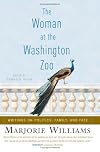
The Woman at the Washington Zoo: Writings on Politics, Family, and Fate
by Marjorie Williams
On This Page
Description
Marjorie Williams knew Washington from top to bottom. Beloved for her sharp analysis, elegant prose and exceptional ability to intuit character, Williams wrote political profiles for the Washington Post and Vanity Fair that came to be considered the final word on the capital's most powerful figures. Her accounts of playing ping-pong with Richard Darman, of Barbara Bush's stepmother quaking with fear at the mere thought of angering the First Lady, and of Bill Clinton angrily telling Al Gore show more why he failed to win the presidency -- to name just three treasures collected here -- open a window on a seldom-glimpsed human reality behind Washington's determinedly blank façade. Williams also penned a weekly column for the Post's op-ed page and epistolary book reviews for the online magazine Slate. Her essays for these and other publications tackled subjects ranging from politics to parenthood. During the last years of her life, she wrote about her own mortality as she battled liver cancer, using this harrowing experience to illuminate larger points about the nature of power and the randomness of life. Marjorie Williams was a woman in a man's town, an outsider reporting on the political elite. She was, like the narrator in Randall Jarrell's classic poem, "The Woman at the Washington Zoo," an observer of a strange and exotic culture. This splendid collection -- at once insightful, funny and sad -- digs into the psyche of the nation's capital, revealing not only the hidden selves of the people that run it, but the messy lives that the rest of us lead. show lessTags
Recommendations


Member Reviews
An excellent collection of the works of the late Marjorie Williams, lovingly curated by her husband, Tim Noah. Williams was a favorite commentator of mine in the late 90's and I was deeply saddened by news of her death in 2005 at the age of 46. I bought this not long after it came out after hearing an NPR interview with Noah. It has been sitting on my shelf since, and I had all but given up on reading it since I thought the majority of the book would be so dated. I was wrong.
Noah has split the book into three parts, profiles of DC power-brokers, columns on politics, parenting, and other matters, and Williams short and utterly perfect memoir of dying in what should have been the middle of her life and leaving behind a family that show more desperately needed her. I read this book over the course of 9 months, dipping in and out, and leaving it on the shelf for weeks at a time. I think it is the right way to read it. The political profiles and columns are mostly excellent, but simply not intended to be read one after the next. For me at least, the shortest part of the book by far, the cancer memoir, was a single evening's read. I could not pull myself away and it affected me deeply. It is important reading not only for those facing illness, but those who have or will walk that road with someone else. I learned a lot from Williams' frankness. This is subject matter that will never go out of date. The other parts though, also proved timely.
Just as the sexual assault allegations arose against the latest addition to the Supreme Court I was coincidentally reading the columns in this book that focused on the Clarence Thomas hearings. I am old enough to clearly remember those hearings, I was a young lawyer by that time and I was obsessed, but time changes the way we think about these things. These columns were like the Trump ice bucket challenge (except not funny and no one benefits.) It was shocking to see Chuck Grassley and Orrin Hatch once again celebrate sexual misconduct with no movement forward. In fact this iteration was possibly more blatantly misogynist, than 1991. Amazing. As Stormy Daniels elbowed her way into the awareness of Americans I was reading a piece where Williams railed about American feminists giving Bill Clinton a pass as evidence of his serial sexual misconduct piled up. Some of those same feminists have shouted about DJT's grab em by the pussy mentality, but gave a pass to a President (hell any supervisor) who got blow jobs from his 22 year old intern with his wife and daughter essentially down the hall. (I include myself in this group of feminists, and I feel chastened.) A few weeks later when Hillary said Bill's blowjobs were not an abuse of power (they were) these columns written in the 90's still hit hard. There are other examples of the how timely these pieces proved to be, but these spring to mind.
This was close to a 5-star for me, but the second section -- the columns -- included a little chunk of stuff (mostly from Slate) not up to the caliber of the rest of the book and it pulled it down a little. Let's say 4.25 and leave it at that. Recommended for those interested in seeing how modern history repeats itself, and how a smart and able commentator can help us understand the world better and to those who just appreciate freaking great writing. show less
Noah has split the book into three parts, profiles of DC power-brokers, columns on politics, parenting, and other matters, and Williams short and utterly perfect memoir of dying in what should have been the middle of her life and leaving behind a family that show more desperately needed her. I read this book over the course of 9 months, dipping in and out, and leaving it on the shelf for weeks at a time. I think it is the right way to read it. The political profiles and columns are mostly excellent, but simply not intended to be read one after the next. For me at least, the shortest part of the book by far, the cancer memoir, was a single evening's read. I could not pull myself away and it affected me deeply. It is important reading not only for those facing illness, but those who have or will walk that road with someone else. I learned a lot from Williams' frankness. This is subject matter that will never go out of date. The other parts though, also proved timely.
Just as the sexual assault allegations arose against the latest addition to the Supreme Court I was coincidentally reading the columns in this book that focused on the Clarence Thomas hearings. I am old enough to clearly remember those hearings, I was a young lawyer by that time and I was obsessed, but time changes the way we think about these things. These columns were like the Trump ice bucket challenge (except not funny and no one benefits.) It was shocking to see Chuck Grassley and Orrin Hatch once again celebrate sexual misconduct with no movement forward. In fact this iteration was possibly more blatantly misogynist, than 1991. Amazing. As Stormy Daniels elbowed her way into the awareness of Americans I was reading a piece where Williams railed about American feminists giving Bill Clinton a pass as evidence of his serial sexual misconduct piled up. Some of those same feminists have shouted about DJT's grab em by the pussy mentality, but gave a pass to a President (hell any supervisor) who got blow jobs from his 22 year old intern with his wife and daughter essentially down the hall. (I include myself in this group of feminists, and I feel chastened.) A few weeks later when Hillary said Bill's blowjobs were not an abuse of power (they were) these columns written in the 90's still hit hard. There are other examples of the how timely these pieces proved to be, but these spring to mind.
This was close to a 5-star for me, but the second section -- the columns -- included a little chunk of stuff (mostly from Slate) not up to the caliber of the rest of the book and it pulled it down a little. Let's say 4.25 and leave it at that. Recommended for those interested in seeing how modern history repeats itself, and how a smart and able commentator can help us understand the world better and to those who just appreciate freaking great writing. show less
Williams was a very good writer, incisive and aware. I was less enamored of her personality analyses of staffers from defunct administrations but entirely riveted by her brutally honest account of her struggle with lethal liver cancer. The agony of contemplating one's own death when one's children are still very young is recorded here in searing words of fire tempered by the grace and wit she ultimately brought to bear on her life.
The essays in this terrific collection cover the political scene of the 1990s, women’s issues, family life, and Marjorie Williams’s battle with the liver cancer that took her life in January 2005.
In many ways, reading these essays was like stepping into a time warp. Williams wrote most of the political essays here before 9/11, so terrorism and the War in Iraq don’t come up. Williams carefully observes her subjects and interviews people who have known them for years to get the fullest story possible. The portraits are often fascinating—and surprising. I never would have suspected that people were afraid of Barbara Bush, but, according to Williams, they were.
Williams expresses a clear point of view in her essays, although she’s show more not predictably partisan. She makes it clear that she’s a Democrat, but she’s ready to praise and criticize people on both sides of the political spectrum. Her essay on the feminist reaction to Bill Clinton’s affair with Monica Lewinsky is particularly interesting. Many of the essays are written as reactions to specific books or news stories that are long forgotten, but the issues they explore still resonate. Of course, illness and death are always with us, and Williams’s account of her diagnosis with cancer and her final essays on her final days are both frank and frightening.
I’m a big fan of essays, and I enjoyed reading this book very much. I’m not sure it would be the best introduction to this kind of writing for those who aren’t at least a little familiar with politics of the 1990s, since the profiles comprise close to half of the book, and many of the names come up again in the other sections. But if that doesn’t put you off, and if you enjoy literary journalism, this is a great collection.
See my complete review at my blog. show less
In many ways, reading these essays was like stepping into a time warp. Williams wrote most of the political essays here before 9/11, so terrorism and the War in Iraq don’t come up. Williams carefully observes her subjects and interviews people who have known them for years to get the fullest story possible. The portraits are often fascinating—and surprising. I never would have suspected that people were afraid of Barbara Bush, but, according to Williams, they were.
Williams expresses a clear point of view in her essays, although she’s show more not predictably partisan. She makes it clear that she’s a Democrat, but she’s ready to praise and criticize people on both sides of the political spectrum. Her essay on the feminist reaction to Bill Clinton’s affair with Monica Lewinsky is particularly interesting. Many of the essays are written as reactions to specific books or news stories that are long forgotten, but the issues they explore still resonate. Of course, illness and death are always with us, and Williams’s account of her diagnosis with cancer and her final essays on her final days are both frank and frightening.
I’m a big fan of essays, and I enjoyed reading this book very much. I’m not sure it would be the best introduction to this kind of writing for those who aren’t at least a little familiar with politics of the 1990s, since the profiles comprise close to half of the book, and many of the names come up again in the other sections. But if that doesn’t put you off, and if you enjoy literary journalism, this is a great collection.
See my complete review at my blog. show less
I have very mixed feelings about this book. The first part is a badly dated collection of portraits of political figures from the 90's. Marjorie Williams understood that Washington really is like a Jane Austen novel; a small place filled with hierarchical manoeverings, fierce emotions hidden beneath enforced conformity, etc, and no one was safe from her pen. Unfortunately she offers more snark than insight in her writings (though her viscious take-down of Barbara Bush and her trenchant observations of the Gore/Clinton "marriage" both caused quite a stir when they first came out and are still worth reading today). I strongly disagree with her husband's view that "The Alchemist", left unpublished at her death, is her best work in this show more vein; to my mind this unsparing flogging of her mother shows Marjorie at her worst; a pitiless lack of compassion and terrible writing "I chose my father's sun rather than my mother's moon" that should have been left in a drawer where it was found.
The second part of the book, her unfinished cancer memoir "Struck by Lightning", however, is brilliant. Living with cancer and raising small children just meant that you needed to eat more pancakes, she writes, and so she does, describing the details of her cancer treatments and life with her family. "The Halloween of my Dreams", the last thing she published, is a look-death-in-the-eye coming to terms that she will not live to see her children grow up. I confess I cried when I read it, and it is still something I occasionally take down and re-read today. show less
The second part of the book, her unfinished cancer memoir "Struck by Lightning", however, is brilliant. Living with cancer and raising small children just meant that you needed to eat more pancakes, she writes, and so she does, describing the details of her cancer treatments and life with her family. "The Halloween of my Dreams", the last thing she published, is a look-death-in-the-eye coming to terms that she will not live to see her children grow up. I confess I cried when I read it, and it is still something I occasionally take down and re-read today. show less
I have very mixed feelings about this book. The first part is a badly dated collection of portraits of political figures from the 90's. Marjorie Williams understood that Washington really is like a Jane Austen novel; a small place filled with hierarchical manoeverings, fierce emotions hidden beneath enforced conformity, etc, and no one was safe from her pen. Unfortunately she offers more snark than insight in her writings (though her viscious take-down of Barbara Bush and her trenchant observations of the Gore/Clinton "marriage" both caused quite a stir when they first came out and are still worth reading today). I strongly disagree with her husband's view that "The Alchemist", left unpublished at her death, is her best work in this show more vein; to my mind this unsparing flogging of her mother shows Marjorie at her worst; a pitiless lack of compassion and terrible writing "I chose my father's sun rather than my mother's moon" that should have been left in a drawer where it was found.The second part of the book, her unfinished cancer memoir "Struck by Lightning", however, is brilliant. Living with cancer and raising small children just meant that you needed to eat more pancakes, she writes, and so she does, describing the details of her cancer treatments and life with her family. "The Halloween of my Dreams", the last thing she published, is a look-death-in-the-eye coming to terms that she will not live to see her children grow up. I confess I cried when I read it, and it is still something I occasionally take down and re-read today. show less
I have very mixed feelings about this book. The first part is a badly dated collection of portraits of political figures from the 90's. Marjorie Williams understood that Washington really is like a Jane Austen novel; a small place filled with hierarchical manoeverings, fierce emotions hidden beneath enforced conformity, etc, and no one was safe from her pen. Unfortunately she offers more snark than insight in her writings (though her viscious take-down of Barbara Bush and her trenchant observations of the Gore/Clinton "marriage" both caused quite a stir when they first came out and are still worth reading today). I strongly disagree with her husband's view that "The Alchemist", left unpublished at her death, is her best work in this show more vein; to my mind this unsparing flogging of her mother shows Marjorie at her worst; a pitiless lack of compassion and terrible writing "I chose my father's sun rather than my mother's moon" that should have been left in a drawer where it was found.The second part of the book, her unfinished cancer memoir "Struck by Lightning", however, is brilliant. Living with cancer and raising small children just meant that you needed to eat more pancakes, she writes, and so she does, describing the details of her cancer treatments and life with her family. "The Halloween of my Dreams", the last thing she published, is a look-death-in-the-eye coming to terms that she will not live to see her children grow up. I confess I cried when I read it, and it is still something I occasionally take down and re-read today. show less
Marjorie Williams was a writer for publications such as The Washington Post, Vanity Fair and Slate. She was also a daughter, wife and mother. It is both of these sides of her being – the political writer and the personal life – that shine through in this collection of essays, brought together by her husband after her death from cancer in 2005.
The book is organised into three sections. The first includes some of her articles on political entities of their day – Gore and Clinton, Barbara Bush. These were the least rewarding for this read: while the writing was good, and pulled no punches, I couldn’t really engage with the topics. However, this changed when I started reading the second section, which is includes political essays, show more but the politics of the personal – the politics of feminism, the politics of families, of marriage, of being a mother. Williams had a clear-eyed way of writing, where she could examine her own life without hubris, without victimizing, just acknowledgement.
The third section, while the most harrowing, was amazing. Here Williams writes about her diagnosis of cancer and her life afterwards. Despite the fact she writes about how this affects her as a mother, it is not sentimental. Nor does it attempt to make Williams look brave, or clever, or as an example of how to live with cancer. It is just the honest writings of a woman trying to live her life once it is turned upside down. And it is this writing that is most inspirational and revealing. So many writers who make a living revealing themselves and their families in an attempt to look smart, or simply to gain a readership, should be made to read this book and see the error of their ways. It is only a shame that she is not with us to continue providing an example on how can use one’s life to examine the bigger issues in a thoughtful, non-hubristic way. show less
The book is organised into three sections. The first includes some of her articles on political entities of their day – Gore and Clinton, Barbara Bush. These were the least rewarding for this read: while the writing was good, and pulled no punches, I couldn’t really engage with the topics. However, this changed when I started reading the second section, which is includes political essays, show more but the politics of the personal – the politics of feminism, the politics of families, of marriage, of being a mother. Williams had a clear-eyed way of writing, where she could examine her own life without hubris, without victimizing, just acknowledgement.
The third section, while the most harrowing, was amazing. Here Williams writes about her diagnosis of cancer and her life afterwards. Despite the fact she writes about how this affects her as a mother, it is not sentimental. Nor does it attempt to make Williams look brave, or clever, or as an example of how to live with cancer. It is just the honest writings of a woman trying to live her life once it is turned upside down. And it is this writing that is most inspirational and revealing. So many writers who make a living revealing themselves and their families in an attempt to look smart, or simply to gain a readership, should be made to read this book and see the error of their ways. It is only a shame that she is not with us to continue providing an example on how can use one’s life to examine the bigger issues in a thoughtful, non-hubristic way. show less
Members
- Recently Added By
Author Information
2+ Works 475 Members
Awards and Honors
Common Knowledge
- Original publication date
- 2005
Classifications
- Genres
- Nonfiction, General Nonfiction, Biography & Memoir, History
- DDC/MDS
- 975.3041 — History & geography History of North America Southeastern United States (South Atlantic states) District Of Columbia
- LCC
- F201 .W55 — Local History of the United States, Canada and Latin America United States local history District of Columbia. Washington
- BISAC
Statistics
- Members
- 418
- Popularity
- 73,683
- Reviews
- 13
- Rating
- (3.89)
- Languages
- English
- Media
- Paper, Ebook
- ISBNs
- 4
- ASINs
- 3