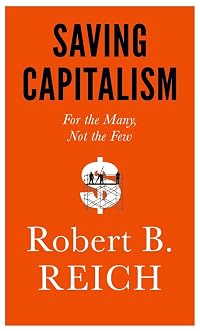
Saving Capitalism: For the Many, Not the Few
by Robert B. Reich
On This Page
Description
Outlines how the American economic system is failing, with increasing income inequality and a shrinking middle class, and reveals how a market designed for broad prosperity can reverse the trend toward diminished opportunity. --PublisherTags
Recommendations






Member Reviews
This is a critically important book for a few reasons.
First, it exposes the meaninglessness of the “free market” vs. government intervention debate by showing that the market cannot exist in the first place without the laws, rules, contracts, and enforcement mechanisms that government creates. The relevant debate, therefore, is not “less government” or “more regulation” but who exactly stands to benefit or lose under the current arrangements.
The free market simply doesn’t exist; government and business are locked in a complex relationship full of tradeoffs. But we never get to debate the tradeoffs because anything the market does is seen as fair despite the fact that we decide how the market operates.
When capitalism is show more evaluated in this way, we see that the game is structured to favor the wealthy—leading to a concentration of wealth and political influence at the top. Reich offers a plethora of examples and statistics to demonstrate how our laws, regulations, contracts, and enforcement mechanisms disproportionately favor moneyed interests. This is all supported with statistics that clearly show a widening income gap, greater concentration of wealth in the top 1 percent, and CEO pay that has increased 930 percent since 1978—with some CEOs making 300 times the salary of the average worker.
The author presents several additional examples of pre-distributions of wealth from the bottom to the top. For example, the big banks get bailed out but homeowners burdened with mortgages and students loaded with debt cannot similarly utilize bankruptcy protection to offload their own debts.
I was also surprised to hear that how low the US ranks among advanced nations in the inequality of educational funding; in other words, rich kids get more money and better education while poor kids get drastically less. This is simply not the case in other parts of the world with different funding mechanisms that ensure a more equal educational experience for kids, irrespective of socioeconomic class, so as not to perpetuate poverty and class divisions.
While all of this is quite depressing and often infuriating, this is not a pessimistic book. The author is optimistic about our ability to save capitalism, as he cites several historical examples of how capitalism has been tested in the past and how we were able to implement corrective policies. For example, after the Great Depression, the New Deal established greater rights and protections for workers.
So how do we save capitalism from crippling inequality that reduces overall demand and consumer spending? The author mentions several ideas such as overturning the Citizens United decision, getting big money out of politics, universal basic income, maximum wages or limits on CEO pay, and reinventing the corporation as a for-benefit operation rather than as a for-profit (being accountable to all stakeholders, including employees, rather than solely to shareholders). Whether or not we take any of this advice remains to be seen. show less
First, it exposes the meaninglessness of the “free market” vs. government intervention debate by showing that the market cannot exist in the first place without the laws, rules, contracts, and enforcement mechanisms that government creates. The relevant debate, therefore, is not “less government” or “more regulation” but who exactly stands to benefit or lose under the current arrangements.
The free market simply doesn’t exist; government and business are locked in a complex relationship full of tradeoffs. But we never get to debate the tradeoffs because anything the market does is seen as fair despite the fact that we decide how the market operates.
When capitalism is show more evaluated in this way, we see that the game is structured to favor the wealthy—leading to a concentration of wealth and political influence at the top. Reich offers a plethora of examples and statistics to demonstrate how our laws, regulations, contracts, and enforcement mechanisms disproportionately favor moneyed interests. This is all supported with statistics that clearly show a widening income gap, greater concentration of wealth in the top 1 percent, and CEO pay that has increased 930 percent since 1978—with some CEOs making 300 times the salary of the average worker.
The author presents several additional examples of pre-distributions of wealth from the bottom to the top. For example, the big banks get bailed out but homeowners burdened with mortgages and students loaded with debt cannot similarly utilize bankruptcy protection to offload their own debts.
I was also surprised to hear that how low the US ranks among advanced nations in the inequality of educational funding; in other words, rich kids get more money and better education while poor kids get drastically less. This is simply not the case in other parts of the world with different funding mechanisms that ensure a more equal educational experience for kids, irrespective of socioeconomic class, so as not to perpetuate poverty and class divisions.
While all of this is quite depressing and often infuriating, this is not a pessimistic book. The author is optimistic about our ability to save capitalism, as he cites several historical examples of how capitalism has been tested in the past and how we were able to implement corrective policies. For example, after the Great Depression, the New Deal established greater rights and protections for workers.
So how do we save capitalism from crippling inequality that reduces overall demand and consumer spending? The author mentions several ideas such as overturning the Citizens United decision, getting big money out of politics, universal basic income, maximum wages or limits on CEO pay, and reinventing the corporation as a for-benefit operation rather than as a for-profit (being accountable to all stakeholders, including employees, rather than solely to shareholders). Whether or not we take any of this advice remains to be seen. show less
If you're one of the 1%, don't read this book. For those of you in the other 99%, it's a must read.
The middle class is going away and all we have to do to ensure it's demise.. is nothing. Corporations, CEO's, Wall Street, the big banks, they'll only be too happy to continue to have all the advantages of an economic, political and judicial system that has tipped so far in their favor that "overall, CEO pay climbed 937 percent between 1978 and 2013, while the pay of the typical worker rose just 10.2 percent." Not only that, but "between 2000 and 2013, the real average hourly wages of young college graduates declined." Read that last sentence again - we're not talking about giving hand-outs to bums here. This is about fixing a system that show more has become so corrupt that America is in real danger of falling into oligarchy. Witness the Koch brothers and their $1 billion war chest that is funding their preferred candidates in the present election cycle.
Fortunately there is still time to take back what has been lost. The current corrupt system of crony capitalism isn't the way things have to stay. Mr Reich lays out in part three of his book how and why things can change. Reversal of Citizens United, resurrection of Glass-Steagall, rejection of the Trans-Pacific Partnership are all essential to getting this country back on track, where profits are reflected in wage and benefit increases and not just in CEO salaries and share prices. Reich advocates a return to Stakeholder Capitalism "that takes into account the interests of workers, the community, and the environment, as well as shareholders," as opposed to Shareholder Capitalism which only benefits the investment bankers and venture capitalists and features "flat or declining wages, growing economic insecurity, outsourced jobs, abandoned communities, soaring CEO pay, a myopic focus on quarterly earnings, and a financial sector akin to a casino."
Something's gotta change, and reading Saving Capitalism is a good place to start. Then you can start following Robert Reich on Facebook and start paying attention to your local candidates and their stances, and just where their campaign contributions are coming from. It's not about Republican or Democrat anymore, it's about taking back our country. show less
The middle class is going away and all we have to do to ensure it's demise.. is nothing. Corporations, CEO's, Wall Street, the big banks, they'll only be too happy to continue to have all the advantages of an economic, political and judicial system that has tipped so far in their favor that "overall, CEO pay climbed 937 percent between 1978 and 2013, while the pay of the typical worker rose just 10.2 percent." Not only that, but "between 2000 and 2013, the real average hourly wages of young college graduates declined." Read that last sentence again - we're not talking about giving hand-outs to bums here. This is about fixing a system that show more has become so corrupt that America is in real danger of falling into oligarchy. Witness the Koch brothers and their $1 billion war chest that is funding their preferred candidates in the present election cycle.
Fortunately there is still time to take back what has been lost. The current corrupt system of crony capitalism isn't the way things have to stay. Mr Reich lays out in part three of his book how and why things can change. Reversal of Citizens United, resurrection of Glass-Steagall, rejection of the Trans-Pacific Partnership are all essential to getting this country back on track, where profits are reflected in wage and benefit increases and not just in CEO salaries and share prices. Reich advocates a return to Stakeholder Capitalism "that takes into account the interests of workers, the community, and the environment, as well as shareholders," as opposed to Shareholder Capitalism which only benefits the investment bankers and venture capitalists and features "flat or declining wages, growing economic insecurity, outsourced jobs, abandoned communities, soaring CEO pay, a myopic focus on quarterly earnings, and a financial sector akin to a casino."
Something's gotta change, and reading Saving Capitalism is a good place to start. Then you can start following Robert Reich on Facebook and start paying attention to your local candidates and their stances, and just where their campaign contributions are coming from. It's not about Republican or Democrat anymore, it's about taking back our country. show less
There is an old adage, 'With great power comes great responsibility', and Reich argues that large corporations, banks, and Wall Street have neglected this duty in exchange for short-term personal gain. Two key points he comes back to throughout this book are that the dollar value of one's assets is not a measure of their worth, and that there is no such thing as a 'free' market. Beyond that, he shows how our political system has been rigged to favor the wealthy, and he highlights some of the key policy decisions over the last forty years that have helped create the excessive wealth and political influence enjoyed by ultra-rich in America today. He convincingly argues why this situation is unsustainable and provides rational suggestions show more for public policy changes that can help correct it. What more could you want? I highly recommend this one and hope politicians, pundits, and investment bankers carefully consider what he says. Who knows? They may begin to act responsibly. show less
I just read a similar book by a British author. I have to say that beyond what I expected, more optimism (I think they put something in the water in the US), this book is way more interesting and features fewer angry lizard people accusations and is more about the mechanics of political power. It merits an extra star even if only for the optimism. It's nice to read people who are optimistic because they're full of ideas rather than resentment.
Outstanding! Reich is clear, concise. Missing is the ad nauseam partisan blame game and overly technical terminology that discourages the layman reader. He clearly presents the dysfunction, gives profound examples, and finally proposes great food for thought on how to make this system work... for all. A must read!
This is an important and thorough look at the economic aspect of what is wrong in America today- and since many of our other ills spring from the economics, it speaks to areas not explicitly addressed as well.
If you are at all interested in how we got into this mess- and some similar historical situations- read this.
In brief: it is not the "free market" vs the "government"; the market would not even exist without the legal enforcement of the government. The problem is that as wealth is accumulated by an ever-shrinking number of people, they are thus able to disproportionately affect the laws that cover the market... and so can rig it so that they keep siphoning off more and more.
Now, this is not sustainable in the long run- but they show more don't care, and the rest of us have little ability to affect these matters.
Reich tries to offer some hope...but I don't really see it, at least not until things collapse in a devastating way, which is inevitable unless things change. show less
If you are at all interested in how we got into this mess- and some similar historical situations- read this.
In brief: it is not the "free market" vs the "government"; the market would not even exist without the legal enforcement of the government. The problem is that as wealth is accumulated by an ever-shrinking number of people, they are thus able to disproportionately affect the laws that cover the market... and so can rig it so that they keep siphoning off more and more.
Now, this is not sustainable in the long run- but they show more don't care, and the rest of us have little ability to affect these matters.
Reich tries to offer some hope...but I don't really see it, at least not until things collapse in a devastating way, which is inevitable unless things change. show less
Abandoned it at 25%. The big ideas are understandable. I got bogged down in much of the explanations and the book is due back at the library soon. I skimmed through the rest of it and think I got the gist. The decision is not between "free market" or more government, but it is about good enforced laws concerning the market. The laws are currently tilted to increase the wealth of the wealthy at the expense of the 99%. Those who benefit from those laws have the power to influence lawmakers. In order to tilt the laws the other way, the 99% need to work together rather than bicker over what does not matter. This seems to be the agenda of Bernie Sanders and Elizabeth Warren.
Members
- Recently Added By
Lists

False prophets
9 works; 1 member
Author Information

25+ Works 4,500 Members
Robert B. Reich was born in Scranton, Pennsylvania on June 24, 1946. He received a B.A. from Dartmouth College in 1968, a M.A. from Oxford University in 1970, and a J.D. from Yale University. Reich was an assistant to the Solicitor General in the U.S. Department of Justice from 1974 to 1976. He directed the policy planning staff of the Federal show more Trade Commission from 1976 to 1981 and taught on the faculty of Harvard University's John F. Kennedy School of Government from 1981 to 1992. He served as the 22nd Secretary of Labor from 1993 to 1997 under President Bill Clinton. He became the University Professor and the Maurice B. Hexter Professor of Social and Economic Policy at Brandies University in 1997. He is currently the Chancellor's Professor of Public Policy at the Goldman School of Public Policy at the University of California, Berkeley. Reich has written numerous books including Locked in the Cabinet; Reason: Why Liberals Will Win the Battle for America; Supercapitalism: The Transformation of Business, Democracy, and Everyday Life; Aftershock: The Next Economy and America's Future; Saving Capitalism: For the Many, Not the Few; and The Common Good. In 2003, he was awarded the Vaclev Havel Foundation Prize for his pioneering work in economic and social thought. (Bowker Author Biography) show less
Classifications
- Genres
- Economics, Nonfiction, General Nonfiction, Politics and Government, Business
- DDC/MDS
- 330.973 — Society, government, & culture Economics Jobs & Careers Economic geography and history North America United States
- LCC
- HB501 .R359 — Social sciences Economic theory. Demography Economic theory. Demography Capital. Capitalism
- BISAC
Statistics
- Members
- 583
- Popularity
- 50,482
- Reviews
- 11
- Rating
- (4.17)
- Languages
- English, German, Italian
- Media
- Paper, Audiobook, Ebook
- ISBNs
- 16
- ASINs
- 5