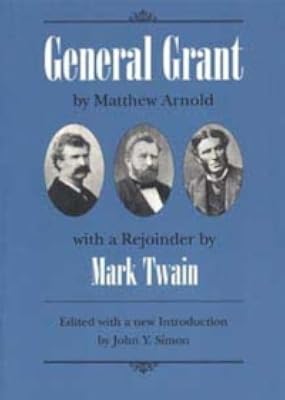
General Grant
by Matthew Arnold
On This Page
Description
The editor has placed the dispute between Arnold and Twain in its historical perspective. The volume is especially significant because it adds a new dimension to Grant; it places him in relation to the literary men of that era.Robert A. Waller, Civil War HistoryGeneral Grant by Matthew Arnold with a Rejoinder by Mark Twain presents conflicting essays and cultures. Matthew Arnold's 1886 essay on Grant praised the general and his posthumously published Memoirs, but to many Americans its tone show more seemed patronizing of their hero and country. Grant's friend and personal benefactor, Mark Twain, delivered a caustic rejoinder to the Army and Navy Club of Connecticut in April 1887. Thus Arnold became a pet prejudice of Twain's and may have served as an inspiration for A Connecticut Yankee in King Arthur's Court.In this volume, Twain's rejoinder is published in a correct text for the first time since the Hartford Courant printed his speech. show lessTags
Members
- Recently Added By
Author Information

223+ Works 3,793 Members
Matthew Arnold, a noted poet, critic, and philosopher, was born in England on December 24, 1822 and educated at Oxford University. In 1851, he was appointed inspector of schools, a position he held until 1880. Arnold also served as a professor of poetry at Oxford, during which time he delivered many lectures that ultimately became essays. Arnold show more is considered a quintessential proponent of Victorian ideals. He argued for higher standards in literature and education and extolled classic virtues of manners, impersonality and unanimity. After writing several works of poetry, Arnold turned to criticism, authoring such works as On Translating Homer, Culture and Anarchy, and Essays in Criticism. In these and other works, he criticized the populace, especially the middle class, whom he branded as "philistines" for their degrading values. He greatly influenced both British and American criticism. In later life, he turned to religion. In works such as Literature and Dogma and God and the Bible, he explains his conservative philosophy and attempts to interpret the Bible as literature. Arnold died from heart failure on April 15, 1888 in Liverpool, England. (Bowker Author Biography) show less
Classifications
- Genres
- History, Nonfiction, Biography & Memoir, Politics and Government
- DDC/MDS
- 973.8 — History & geography History of North America United States The Gilded Age, Reconstruction, Spanish American War (1865-1901)
- LCC
- E672 .A3 .A76 — History of the United States United States Late nineteenth century, 1865-1900 Grant's administrations, 1869-1877
- BISAC
Statistics
- Members
- 9
- Popularity
- 2,308,736
- Languages
- English
- Media
- Paper, Ebook
- ISBNs
- 3