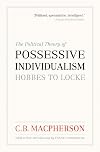
The Political Theory of Possessive Individualism: Hobbes to Locke
by C. B. Macpherson
On This Page
Description
This seminal work by political philosopher C.B. Macpherson was first published by the Clarendon Press in 1962, and remains of key importance to the study of liberal-democratic theory half-a-century later. In it, Macpherson argues that the chief difficulty of the notion of individualism thatunderpins classical liberalism lies in what he calls its "possessive quality" - "its conception of the individual as essentially the proprietor of his own person or capacities, owing nothing to society for show more them." Under such a conception, the essence of humanity becomes freedom from dependence on thewills of others; society is little more than a system of economic relations; and political society becomes a means of safeguarding private property and the system of economic relations rooted in property.As the New Statesman declared: "It is rare for a book to change the intellectual landscape. It is even more unusual for this to happen when the subject is one that has been thoroughly investigated by generations of historians. . . . Until the appearance of Professor Macpherson's book, it seemedunlikely that anything radically new could be said about so well-worn a topic. The unexpected has happened, and the shock waves are still being absorbed."A new introduction by Frank Cunningham puts the work in a twenty-first-century context. show lessTags
Recommendations






Member Reviews
Macpherson's analysis of Hobbes and Locke is quite brilliant. The middle part of the book is more uneven; I found the chapter on the Levellers a bit tedious, though still interesting both in itself as well as in this context. It gets a lot more intriguing when he writes about Harrington, a theorist I didn't know much about, and this was as great an introduction to him as I could have wished for. Macpherson goes to the root of the underlying assumptions behind the seeming inconsistencies in Hobbes, Harrington and Locke, and shows very convincingly how their theories nevertheless for the most part hold together in view of the emerging market society - and market morality - of the 17th century. --- We here go from Hobbes to Locke and back show more again... - As Macpherson puts it towards the end of the book: "Hobbes, as amended by Locke in the matter of the self-perpetuating sovereign... provided the main structure for English liberal theory." show less
An odd blend of the irrelevance, tedium and brilliance. MacPherson's general approach to early modern political theorists is spot on: they all describe the social conditions of their time, but claim that they're describing human nature. His attention to detail is impressive, and his readings of Locke and Hobbes are compelling, if more than a bit tendentious. The irrelevance of the book is twofold: first, the chapters on Harrington and the Levellers can only be of concern to people who study the early modern period. That's a pretty minor form of irrelevance, of course, since it's relevant to some people. The problematic irrelevance is MacPherson's use of the language of class. No doubt when he was writing it looked likely that the show more proletariat was forming itself into a cohesive political body that would be able to undermine the 'possessive individualism' that he accurately and brilliantly describes. But... not so much. The proletariat is off buying Michael Buble albums and drinking Bud Lite, and it's not clear it was ever going to do anything else. The new proletariat (which journalists now call 'developing markets,' just to make it absolutely clear that those people have nothing going for them except their slowly thickening wallets) seems pretty keen to join in.
That would just be a sad historical irony, except that it undermines MacPherson's larger argument: that the development of class consciousness undermines the legitimacy of liberal democracies. Habermas later produced a slightly more accurate argument: the legitimacy of liberal democracies is no longer, if it ever was, reliant on freedoms or equalities. It's reliant on economic strength. The mid century liberal democracies lost legitimacy when the economy crashed in the seventies. Today's liberal democracies are losing legitimacy too. That's the way it's going to be for the foreseeable future: we'll never feel 'obliged' to our governments. We might re-elect them if they fill our fat mouths with ever-blander produce, but we're not obliged to obey them in any way. We're just paying them back for that wonderbread. Thanks, congressman. Have another term.
So it would be fatuous to write a 'philosophical' theory of political obligation today, except, of course, people keep doing it. The strangest thing about MacPherson is surely the way he holds to both a rigorous materialism (Hobbes essentially had it right, now if only we could have Hobbes plus socialism instead of Hobbes plus monarchy...) and a bizarre idealism (the main problem of states is not putting enough white bread on the table, but ensuring that they have a philosophical theory of their own legitimacy). Good-oh. Hope that works out for you! show less
That would just be a sad historical irony, except that it undermines MacPherson's larger argument: that the development of class consciousness undermines the legitimacy of liberal democracies. Habermas later produced a slightly more accurate argument: the legitimacy of liberal democracies is no longer, if it ever was, reliant on freedoms or equalities. It's reliant on economic strength. The mid century liberal democracies lost legitimacy when the economy crashed in the seventies. Today's liberal democracies are losing legitimacy too. That's the way it's going to be for the foreseeable future: we'll never feel 'obliged' to our governments. We might re-elect them if they fill our fat mouths with ever-blander produce, but we're not obliged to obey them in any way. We're just paying them back for that wonderbread. Thanks, congressman. Have another term.
So it would be fatuous to write a 'philosophical' theory of political obligation today, except, of course, people keep doing it. The strangest thing about MacPherson is surely the way he holds to both a rigorous materialism (Hobbes essentially had it right, now if only we could have Hobbes plus socialism instead of Hobbes plus monarchy...) and a bizarre idealism (the main problem of states is not putting enough white bread on the table, but ensuring that they have a philosophical theory of their own legitimacy). Good-oh. Hope that works out for you! show less
The classic and controversial survey of individualist liberalism in its early days, this book provokes more than thought. But thought is enough.
I have many times wishes to write a similar survey of "possessive collectivism."
I have many times wishes to write a similar survey of "possessive collectivism."
Ratings
Members
- Recently Added By
Lists

Books in the Bibliography of The Dawn of Everything by Graeber & Wengrow
478 works; 2 members
Author Information

17+ Works 872 Members
C.B. Macpherson was professor of political economy at the University of Toronto from 1935 to 1982. His other books include Democratic Theory (1973) and The Life and Times of Liberal Democracy (1977). He died in 1987.
Awards and Honors
Awards
Series
Belongs to Publisher Series
Common Knowledge
- Canonical title
- The Political Theory of Possessive Individualism: Hobbes to Locke
- Original publication date
- 1962
Classifications
- Genres
- Philosophy, Politics and Government, Nonfiction, General Nonfiction, History
- DDC/MDS
- 320.15 — Society, government, & culture Political science Types of Government The State Nature, entity, concept of the state
- LCC
- JC153 .M2 — Political Science Political theory Political theory. The state. Theories of the state Modern state
- BISAC
Statistics
- Members
- 312
- Popularity
- 102,641
- Reviews
- 4
- Rating
- (3.67)
- Languages
- 5 — English, French, German, Italian, Spanish
- Media
- Paper, Ebook
- ISBNs
- 11
- ASINs
- 9