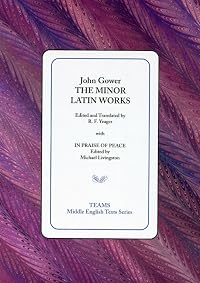
The Minor Latin Works: In Praise of Peace (Middle English Texts)
by John Gower
On This Page
Description
Gower's achievement in writing substantially in all three primary languages of his time-Anglo-French, English, and Latin-was a source of pride to others and, undoubtedly, to him too: into the final years of his life he continued to produce poetry in all three languages. Certainly there is reason to know these poems for the light they shed on the intense partisanship and events of great moment surrounding the usurpation 1399-1400. It was during these parlous times that Gower composed most of show more the poems included here. All are important documents historically; but they are also poems admirable equally for their skill and craft. In Praise of Peace is in the same position as the shorter Latin works edited and translated in this volume: ignored, neglected, reduced, or relegated to the dusty realm of footnotes. But there is far more at work in this complex poem, as Gower's verse deftly weaves in and out of the historical, political, social, and religious contexts and controversies of its day. In tone, In Praise of Peace is, if not triumphant, determinedly optimistic. In this light, we might view the poem as a coda to Gower's long career, restating and reinvigorating his famously moral principles about just rule of self and society. show lessTags
Members
- Recently Added By
Author Information

25+ Works 406 Members
Best known as "moral Gower," as he is called by his friend Chaucer in the dedication of Troilus and Criseyde, Gower composed "balades" in the French fashion as well as three long poems, representing the trilingual status of the cultural and political elite of late fourteenth-century England. Mirour de l'Homme (Mirror of Man) (c.1376--78), a show more mammoth French poem of some 30,000 lines, deals with the seven deadly sins. Vox Clamantis (Voice of One Crying) (c.1379--81), in Latin, is a prophetic attack on contemporary political and social abuses in response to the Peasants' Revolt of 1381. Gower's lengthy and occasionally dreary Middle English poem Confessio Amantis (Lover's Confession) (1390), portions of which influenced Chaucer, is set as an allegorical confession of the poet-lover to Genius, the priest of Venus. In 34,000 lines, he retells several classical love stories illustrating cupidity and the other deadly sins. (Bowker Author Biography) show less
Series
Belongs to Publisher Series
Classifications
- Genres
- Fiction and Literature, Poetry, Music
- DDC/MDS
- 871.04 — Literature & rhetoric Latin & Italic literatures Latin poetry Latin poets 1350–
- LCC
- PA8520 .G74 .A2 — Language and Literature Greek language and literature. Latin language and literature Medieval and modern Latin literature Individual authors
- BISAC
Statistics
- Members
- 8
- Popularity
- 2,312,273
- Languages
- English
- Media
- Paper, Ebook
- ISBNs
- 2