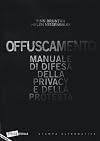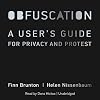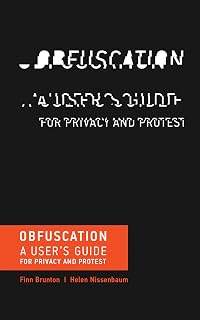
Obfuscation: a user's guide for privacy and protest
by Finn Brunton, Helen Nissenbaum
On This Page
Description
With Obfuscation, Finn Brunton and Helen Nissenbaum mean to start a revolution. They are calling us not to the barricades but to our computers, offering us ways to fight today's pervasive digital surveillance -- the collection of our data by governments, corporations, advertisers, and hackers. To the toolkit of privacy protecting techniques and projects, they propose adding obfuscation: the deliberate use of ambiguous, confusing, or misleading information to interfere with surveillance and show more data collection projects. Brunton and Nissenbaum provide tools and a rationale for evasion, noncompliance, refusal, even sabotage -- especially for average users, those of us not in a position to opt out or exert control over data about ourselves. Obfuscation will teach users to push back, software developers to keep their user data safe, and policy makers to gather data without misusing it.Brunton and Nissenbaum present a guide to the forms and formats that obfuscation has taken and explain how to craft its implementation to suit the goal and the adversary. They describe a series of historical and contemporary examples, including radar chaff deployed by World War II pilots, Twitter bots that hobbled the social media strategy of popular protest movements, and software that can camouflage users' search queries and stymie online advertising. They go on to consider obfuscation in more general terms, discussing why obfuscation is necessary, whether it is justified, how it works, and how it can be integrated with other privacy practices and technologies. show lessTags
Recommendations
























Member Reviews
This was disappointing.
This book has two parts. The first part (chapter 1 and 2) is an introduction to obfuscation and has lots of examples. It's a great introduction, a mind-expanding survey of the design space for obfuscation techniques. Unfortunately, that's where the practical bit ends. With part two, the book devolves into armchair-theorising about the ethics and ontology of obfuscation.
Chapter 3 says some interesting things about information asymmetries. The authors quote Anthony Gidden's idea of manufactured risk to state that surveillance doesn't just reduce risk, it also exports it. For example, data collection by credit agencies may protect us from one class of risks (insurance at lower premiums), but create another class of show more risks (hacking of collected data, sharing without consent, so on). Further, data collection usually reduces risk for the many at the expense of increased risk for the few (and this increased risk is distributed differently along different socio-economic axes, mostly affecting the already marginalised). The authors also mention James C Scott's book Weapons of the Weak on peasant resistance against asymmetric power relations and promises that this book continues in the same vein to show how obfuscation can be a tool of protest against information-asymmetric relationships of power (it hardly does, and I really wish it did).
The main takeaways of chapter 4 were ethical guiding principles for applying obfuscation; they make the utilitarian argument ("blocking a data flow is unethical only when the data flow is ethically required"), the contextual integrity argument ("inappropriate flow of information/ legitimate use of obfuscation is normative") and the individualist argument ("how much privacy should the individual have to sacrifice for the common good?"). Nothing novel or ground-breaking.
Chapter 5 has six similar-sounding goals obfuscation achieves and four obvious questions to ask yourself if you're designing an obfuscation system. There are some practical titbits here and there in this book and but it largely fails to deliver on the promise of being a "user's guide". It's more of a "philosopher's guide" than anything else. show less
This book has two parts. The first part (chapter 1 and 2) is an introduction to obfuscation and has lots of examples. It's a great introduction, a mind-expanding survey of the design space for obfuscation techniques. Unfortunately, that's where the practical bit ends. With part two, the book devolves into armchair-theorising about the ethics and ontology of obfuscation.
Chapter 3 says some interesting things about information asymmetries. The authors quote Anthony Gidden's idea of manufactured risk to state that surveillance doesn't just reduce risk, it also exports it. For example, data collection by credit agencies may protect us from one class of risks (insurance at lower premiums), but create another class of show more risks (hacking of collected data, sharing without consent, so on). Further, data collection usually reduces risk for the many at the expense of increased risk for the few (and this increased risk is distributed differently along different socio-economic axes, mostly affecting the already marginalised). The authors also mention James C Scott's book Weapons of the Weak on peasant resistance against asymmetric power relations and promises that this book continues in the same vein to show how obfuscation can be a tool of protest against information-asymmetric relationships of power (it hardly does, and I really wish it did).
The main takeaways of chapter 4 were ethical guiding principles for applying obfuscation; they make the utilitarian argument ("blocking a data flow is unethical only when the data flow is ethically required"), the contextual integrity argument ("inappropriate flow of information/ legitimate use of obfuscation is normative") and the individualist argument ("how much privacy should the individual have to sacrifice for the common good?"). Nothing novel or ground-breaking.
Chapter 5 has six similar-sounding goals obfuscation achieves and four obvious questions to ask yourself if you're designing an obfuscation system. There are some practical titbits here and there in this book and but it largely fails to deliver on the promise of being a "user's guide". It's more of a "philosopher's guide" than anything else. show less
This little book seriously analyzes the necessity, ethics, and efficacy of "the deliberate addition of ambiguous, confusing, or misleading information to interfere with surveillance and data collection." "Obfuscation", in other words, here refers to one class of privacy-reclamation methods that can be used by people with little power, including customers/users of large companies/agencies that treat them like factory-farm animals. But why oh why can't there be laws that ban all the privacy-abusing practices of the companies/agencies in the first place?
Title obfuscates the contents. Not a guide. Should be titled: the politics and ethics of obfuscation. Interesting arguments but completely irrelevant to absolutely everyone except academics.
The book a collection of starting points for understanding and making use of obfuscation.
It is split into two parts - an analysis of the possible applications of obfuscation and obfuscation as a strategy for privacy protection; the ethical issues obfuscation raises and salient questions to ask of any obfuscation project. The authors took care to emphasize that in addition to privacy, it is not a replacement for one or all of the tools which we already rely on.
There is no simple solution to the problem of privacy, because privacy itself is a solution to societal challenges that are in constant movement.
It is split into two parts - an analysis of the possible applications of obfuscation and obfuscation as a strategy for privacy protection; the ethical issues obfuscation raises and salient questions to ask of any obfuscation project. The authors took care to emphasize that in addition to privacy, it is not a replacement for one or all of the tools which we already rely on.
There is no simple solution to the problem of privacy, because privacy itself is a solution to societal challenges that are in constant movement.
Où le sage cache-t-il une feuille? Dans la forêt. Mais s'il n'y a pas de forêt, que fait-il? il fait pousser une forêt pour la cacher.
Ratings
Members
- Recently Added By
Lists

Books in the Bibliography of Digital Lethargy by Tung-Hui Hu
151 works; 3 members
Author Information
3 Works 279 Members
Finn Brunton is associate professor in the Department of Media, Culture, and Communication at New York University. He is the author of Spam: A Shadow History of the Internet.
5 Works 270 Members
Some Editions
Common Knowledge
- Canonical title
- Obfuscation: a user's guide for privacy and protest
- Original publication date
- 2015-09-04
Classifications
- Genres
- Nonfiction, Technology, Politics and Government, General Nonfiction
- DDC/MDS
- 323.4 — Society, government, & culture Political science Civil Rights & Liberties/ Human Rights The state and the individual
- LCC
- JC596.2 .U5 .B78 — Political Science Political theory Political theory. The state. Theories of the state Purpose, functions, and relations of the state
- BISAC
Statistics
- Members
- 125
- Popularity
- 261,114
- Reviews
- 6
- Rating
- (3.77)
- Languages
- English, French, Italian
- Media
- Paper, Audiobook, Ebook
- ISBNs
- 11
- ASINs
- 2