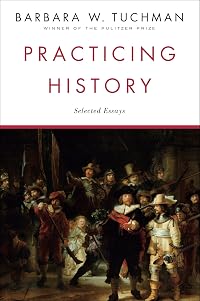
Practicing History: Selected Essays
by Barbara Tuchman
On This Page
Description
Master historian Barbara W. Tuchman looks at history in a unique way and draws lessons from what she sees. This accessible introduction to the subject of history offers striking insights into America's past and present, trenchant observations on the international scene, and thoughtful pieces on the historian's role. Here is a splendid body of work, the story of a lifetime spent "practicing history."Tags
Recommendations
















Member Reviews
Tuchman was an amazing historian and narrative writer. Her books on the First World War alone are classics. In some of her early chapters here, on history as a process and discipline, she shines. She adds some wonderful articles from her career that shine. "Perdicaris Alive or Raisuli Dead" is a classic of narrative history. (And the inspiration for the great, but historically mangled movie The Wind and the Lion.) However, her FDR-style liberalism, bordering on an extreme naïveté towards Soviet and Maoist communism. She trashes the Vietnam project under LBJ, but then twice as much vitriol toward Nixon. Several article/chapters excoriate Nixon for Watergate, leading to her suggestion for a executive panel of presidents. Her one show more counterfactual, what-if, history outing here, "If Mao Had Come to Washington," assumes Mao was a normal fellow you could do business with, undermined by dumb Americans who unflinchingly and ignorantly hate socialism/communism. It undermines her, and she betrays her own admonition to make historical hypotheses, when the history should speak for itself. Like a good twentieth-century liberal, she totally misconstrues (p. 265) the Second Amendment and skips over the whole part about it being a "right of the people." But, I digress.... The first section of the book, "Craft," should be assigned to history students in grad school as a counterweight to the postmodernist/lit-crit ideas that unfortunately permeate the academy. The chapter on biography as history, especially, as credentialed historians often anathematize biography as "not really history" and leave it to popularizers who are often journalists. show less
Barbara Tuchman, historian and author of The Guns of August and A Distant Mirror, is a darn good writer. Practicing History: Selected Essays (1981) collects articles and speeches from throughout her career with a focus on the art of writing history.
Tuchman has a lot to say about written history. Defying the academics that call her a popular historian, she states that good history must be readable. Tuchman adheres to a "don't tell me, show me" principle as well by finding appropriate quotes and incidents that illustrate what a country may be feeling on the brink of war or a general's attitude toward failure. Tuchman feels that a narrative must be constructed from the historical events. This requires being selective as opposed to show more comprehensive to avoid overwhelming the writing with trivial details. She particularly opposes efforts to quantify history or making it a science, the human being an unquantifiable variable. She makes her biases known, because she believes it is better to reveal them than to pretend to be objective. Most importantly, one cannot begin a historical work with a thesis in mind. The thesis is revealed through research and writing.
Tuchman believes strongly in using primary sources for her research, turning her nose up at the suggestion that good history must contain long lists of references to previous historians' work. Even if the primary sources are flawed -- whether they be self-aggrandizing journals or surprisingly unobservant of great historical movement -- they still reveal much about the people and their times. Building on the use of primary resources, Tuchman likes to travel to the places where the subject of her research took place, getting a feel for events from the landscape.
Like Wordsworth who described poetry as "emotion recollected in tranquility," Tuchman believes that distance in time is necessary to good history. Even a comprehensive historical account needs a cutoff date to avoid the errors that come from not having an historical perspective. Perhaps that is why her essays on contemporary Israel read like chamber of commerce booster pieces. That flaw aside, Tuchman's commentary on current events in essays from the 1930's-1970's tend to be as insightful and well-written as her historical work. Her prescient and accurate evaluation of the war in Vietnam is particularly well-done, and eerily appropriate to current events. She also has an interesting proposal to replace the President with a six-person council to balance out the corruption of executive privilege.
For anyone interested in writing history or just reading good history, I recommend this book.
Favorite Passages
"The writer of history, I believe, has a number of duties vis-à-vis the reader, if he wants to keep him reading. The first is to distill. He must do the preliminary work for the reader, assemble the information, make sense of it, select the essential, discard the irrelevant -- above all, discard the irrelevant -- and put the rest together so that it forms a developing dramatic narrative. Narrative, it has been said is the lifeblood of history. To offer a mass of undigested facts, of names not identified and places not located, is no use to the reader and is simple laziness on the part of the author, or pedantry to show how much he has read. To discard the unnecessary requires courage and also extra work . . . The historian is continually being beguiled down fascinating byways and sidetracks. But the art of writing -- the test of the artists -- is to resist the beguilement and cleave to the subject." -- From "In Search of History," p. 17-18.
What he means, I suppose, it that past events cannot exist independently of the historian because without the historian we would know nothing about them; in short, that the unrecorded past is none other than our old friend, the tree in the primeval forest which fell where there was no one to hear the sound of the crash. If there was no ear, was there a sound.
I refuse to be frightened by that conundrum because it asks the wrong question. The point is not whether the fall of the tree made a noise but whether it made a mark on the forest. If it left a space that le in the sun on a hithero shade-grown species, or if it killed a dominant animal and shifted rule of the pack to one of different characteristics, or if it fell across the pat of animals and caused some small change in their habitual course from which larger changes followed, then the fall made history whether anyone heard it or not.
I therefore declare myself a firm believer in the 'preposterous fallacy' of historical facts existing independently of the historian." -- From "When Does History Happen?" p. 26.
Nothing that Wilson said about the danger to democracy could not have bee said all along. For that cause we could have gone to war six months or a year or two earlier, with incalculable effect on history. Except for the proof of hostility in the resumed submarine campaign and the Zimmerman telegram, our cause would have been as valid, but we would have been fighting a preventive war -- to prevent a victory by German militarism with its potential danger to our way of life -- not a war of no choice. Instead, we waited for the overt acts of hostility which brought the war to us.
The experience was repeated in World War II. Prior to Pearl Harbor the threat of Nazism to democracy and the evidence of Japanese hostility to us was sufficiently plain, on a policy level, to make a case for preventive war. But it was not that plain to the American people, and we did not fight until we were attacked.
In our our wars since then the assumption of responsibility for the direction, even the policing, of world affairs has been almost too eager -- as eager as was formerly reluctant. In what our leaders believe to be a far-sighted apprehension of future danger, and before our own shore or tangible interests have been touched, we launch ourselves on military adventure half a world away with the result that the country, as distinct from the government, does not feel itself fighting in self-defense. . .
Two kinds of war, acquisitive and preventive, make hard explaining and the last more than the first. Although the first might be considered less moral, so far human experience abstract morality has not notably determined the conduct of states and a good, justifiable reason like need, or irredentism, or 'manifest destiny,' can always be found for taking territory . . . But it is never possible to prove a preventive war to have been necessary, for no one can ever tell what would have happened without it." -- From "How We Entered World War I," p. 171.
"Basic to the conduct of foreign policy is that problem basic to all policy: how to apply wisdom to government. If wisdom in government eludes us, perhaps courage could substitute -- the moral courage to terminate mistakes." -- From "If Mao Had Come to Washington," p. 207.
"To me it is comforting rather than otherwise to feel that history is determined by the illogical human record and not by large immutable scientific laws beyond our power to deflect.
I know very little (a euphemism for 'nothing') about laboratory science, but I have the impression that conclusions are supposed to be logical; that is, from a given set of circumstances a predictable result should follow. The trouble is that in human behavior and history it is impossible to isolate or repeat a given set of circumstances. Complex human acts cannot be either reproduced or deliberately initiated -- or counted upon like phenomena of nature. The sun comes up every day. Tides are so obedient to schedule that a timetable for them can be printed like that for trains, though more reliable. In fact, tides and trains sharply illustrate my point: One depends on the moon and is certain; the other depends on man and is uncertain.
In the absence of dependable recurring circumstance, too much confidence cannot be placed on the lessons of history." -- From "Is History a Guide to the Future?" p. 249.
"That is why the defunct principle that a nation should go to war only in self-defense is a sound one. That nation that abides by it will havea better case with its own citizens and certainly with history. No could misunderstand Pearl Harbor or have difficulty explaining or defining the need for a response. War which spends lives is too serious a business to do without definition. It requires definition -- and declaration. No citizen, I believe, whether military or civilian, should be required to stake his life for what some uncertain men in Washington think is a good idea in gamesmanship or deterrence or containment or whatever is the governing idea of the moment." -- From "Generalship," p. 284. show less
Tuchman has a lot to say about written history. Defying the academics that call her a popular historian, she states that good history must be readable. Tuchman adheres to a "don't tell me, show me" principle as well by finding appropriate quotes and incidents that illustrate what a country may be feeling on the brink of war or a general's attitude toward failure. Tuchman feels that a narrative must be constructed from the historical events. This requires being selective as opposed to show more comprehensive to avoid overwhelming the writing with trivial details. She particularly opposes efforts to quantify history or making it a science, the human being an unquantifiable variable. She makes her biases known, because she believes it is better to reveal them than to pretend to be objective. Most importantly, one cannot begin a historical work with a thesis in mind. The thesis is revealed through research and writing.
Tuchman believes strongly in using primary sources for her research, turning her nose up at the suggestion that good history must contain long lists of references to previous historians' work. Even if the primary sources are flawed -- whether they be self-aggrandizing journals or surprisingly unobservant of great historical movement -- they still reveal much about the people and their times. Building on the use of primary resources, Tuchman likes to travel to the places where the subject of her research took place, getting a feel for events from the landscape.
Like Wordsworth who described poetry as "emotion recollected in tranquility," Tuchman believes that distance in time is necessary to good history. Even a comprehensive historical account needs a cutoff date to avoid the errors that come from not having an historical perspective. Perhaps that is why her essays on contemporary Israel read like chamber of commerce booster pieces. That flaw aside, Tuchman's commentary on current events in essays from the 1930's-1970's tend to be as insightful and well-written as her historical work. Her prescient and accurate evaluation of the war in Vietnam is particularly well-done, and eerily appropriate to current events. She also has an interesting proposal to replace the President with a six-person council to balance out the corruption of executive privilege.
For anyone interested in writing history or just reading good history, I recommend this book.
Favorite Passages
"The writer of history, I believe, has a number of duties vis-à-vis the reader, if he wants to keep him reading. The first is to distill. He must do the preliminary work for the reader, assemble the information, make sense of it, select the essential, discard the irrelevant -- above all, discard the irrelevant -- and put the rest together so that it forms a developing dramatic narrative. Narrative, it has been said is the lifeblood of history. To offer a mass of undigested facts, of names not identified and places not located, is no use to the reader and is simple laziness on the part of the author, or pedantry to show how much he has read. To discard the unnecessary requires courage and also extra work . . . The historian is continually being beguiled down fascinating byways and sidetracks. But the art of writing -- the test of the artists -- is to resist the beguilement and cleave to the subject." -- From "In Search of History," p. 17-18.
What he means, I suppose, it that past events cannot exist independently of the historian because without the historian we would know nothing about them; in short, that the unrecorded past is none other than our old friend, the tree in the primeval forest which fell where there was no one to hear the sound of the crash. If there was no ear, was there a sound.
I refuse to be frightened by that conundrum because it asks the wrong question. The point is not whether the fall of the tree made a noise but whether it made a mark on the forest. If it left a space that le in the sun on a hithero shade-grown species, or if it killed a dominant animal and shifted rule of the pack to one of different characteristics, or if it fell across the pat of animals and caused some small change in their habitual course from which larger changes followed, then the fall made history whether anyone heard it or not.
I therefore declare myself a firm believer in the 'preposterous fallacy' of historical facts existing independently of the historian." -- From "When Does History Happen?" p. 26.
Nothing that Wilson said about the danger to democracy could not have bee said all along. For that cause we could have gone to war six months or a year or two earlier, with incalculable effect on history. Except for the proof of hostility in the resumed submarine campaign and the Zimmerman telegram, our cause would have been as valid, but we would have been fighting a preventive war -- to prevent a victory by German militarism with its potential danger to our way of life -- not a war of no choice. Instead, we waited for the overt acts of hostility which brought the war to us.
The experience was repeated in World War II. Prior to Pearl Harbor the threat of Nazism to democracy and the evidence of Japanese hostility to us was sufficiently plain, on a policy level, to make a case for preventive war. But it was not that plain to the American people, and we did not fight until we were attacked.
In our our wars since then the assumption of responsibility for the direction, even the policing, of world affairs has been almost too eager -- as eager as was formerly reluctant. In what our leaders believe to be a far-sighted apprehension of future danger, and before our own shore or tangible interests have been touched, we launch ourselves on military adventure half a world away with the result that the country, as distinct from the government, does not feel itself fighting in self-defense. . .
Two kinds of war, acquisitive and preventive, make hard explaining and the last more than the first. Although the first might be considered less moral, so far human experience abstract morality has not notably determined the conduct of states and a good, justifiable reason like need, or irredentism, or 'manifest destiny,' can always be found for taking territory . . . But it is never possible to prove a preventive war to have been necessary, for no one can ever tell what would have happened without it." -- From "How We Entered World War I," p. 171.
"Basic to the conduct of foreign policy is that problem basic to all policy: how to apply wisdom to government. If wisdom in government eludes us, perhaps courage could substitute -- the moral courage to terminate mistakes." -- From "If Mao Had Come to Washington," p. 207.
"To me it is comforting rather than otherwise to feel that history is determined by the illogical human record and not by large immutable scientific laws beyond our power to deflect.
I know very little (a euphemism for 'nothing') about laboratory science, but I have the impression that conclusions are supposed to be logical; that is, from a given set of circumstances a predictable result should follow. The trouble is that in human behavior and history it is impossible to isolate or repeat a given set of circumstances. Complex human acts cannot be either reproduced or deliberately initiated -- or counted upon like phenomena of nature. The sun comes up every day. Tides are so obedient to schedule that a timetable for them can be printed like that for trains, though more reliable. In fact, tides and trains sharply illustrate my point: One depends on the moon and is certain; the other depends on man and is uncertain.
In the absence of dependable recurring circumstance, too much confidence cannot be placed on the lessons of history." -- From "Is History a Guide to the Future?" p. 249.
"That is why the defunct principle that a nation should go to war only in self-defense is a sound one. That nation that abides by it will havea better case with its own citizens and certainly with history. No could misunderstand Pearl Harbor or have difficulty explaining or defining the need for a response. War which spends lives is too serious a business to do without definition. It requires definition -- and declaration. No citizen, I believe, whether military or civilian, should be required to stake his life for what some uncertain men in Washington think is a good idea in gamesmanship or deterrence or containment or whatever is the governing idea of the moment." -- From "Generalship," p. 284. show less
This collection of essays is divided into three parts. The first and in my view the best part, based mostly upon speeches, deals with "the craft" of the historian. It offers both insights into her research and writing process and a vigorous defense of history as literature. She justly highlights the importance and her mission of communicating about history with the general public. Thus, she nicely undermines the charge of many academic historians who did not like the intrusion of a non-expert stealing all the(ir?) glory and profiting from their work. What use, however, are their findings if nobody but the anointed knows about them?
The second part "the yield" collects various book reviews and articles, some standing the test of time, show more some showing their age. The third part "learning from history" is about politics, Nixon and the Vietnam War. Ideas that led to "The March of Folly", a book which has regained relevance (I wished more people had read it before 2003.).
Tuchman is a child of privilege, her grandfather being US ambassador, her uncle US secretary of treasury. Her father owned the magazine on which she was a staff reporter. Her writing is at its best when she writes about the spleens and foibles of her class. This makes The Proud Tower, the Guns of August, the Zimmermann Telegram and Stilwell so vivid. In this collection, she expands and escapes her traditional topics - which reveals, at times, a lack of empathy for others less privileged, others different from her. To me, these essays show a prissy and self-absorbed person (light-years away from the humanity of a Studs Terkel). I love her writing, her personality not so much. show less
The second part "the yield" collects various book reviews and articles, some standing the test of time, show more some showing their age. The third part "learning from history" is about politics, Nixon and the Vietnam War. Ideas that led to "The March of Folly", a book which has regained relevance (I wished more people had read it before 2003.).
Tuchman is a child of privilege, her grandfather being US ambassador, her uncle US secretary of treasury. Her father owned the magazine on which she was a staff reporter. Her writing is at its best when she writes about the spleens and foibles of her class. This makes The Proud Tower, the Guns of August, the Zimmermann Telegram and Stilwell so vivid. In this collection, she expands and escapes her traditional topics - which reveals, at times, a lack of empathy for others less privileged, others different from her. To me, these essays show a prissy and self-absorbed person (light-years away from the humanity of a Studs Terkel). I love her writing, her personality not so much. show less
Unlike Nero Wolfe of West Thirty Fifth Street by William Baring-Gould, which I believe should be read after completing the Rex Stout mysteries, Practicing History should be read before Tuchman's other books. The first part of Practicing History, "The Craft," is Tuchman's way of explaining how she wrote her books without giving too much away. She makes it possible to look forward to reading The March of Folly and Proud Tower with anticipation.
The second part of Practicing History, called "The Yield" presents various topics from different articles she has written over the years (Japan, the Spanish Civil War, Woodrow Wilson and the Six-Day War in the middle east). The third and final part of Practicing History includes editorials on the show more Vietnam War, Watergate and how we can learn from history if one would only listen. We have a hard time doing that as a nation. Why start now?
Tuchman always writes with sharp wit and humor. Practicing History is no different and does not disappoint. show less
The second part of Practicing History, called "The Yield" presents various topics from different articles she has written over the years (Japan, the Spanish Civil War, Woodrow Wilson and the Six-Day War in the middle east). The third and final part of Practicing History includes editorials on the show more Vietnam War, Watergate and how we can learn from history if one would only listen. We have a hard time doing that as a nation. Why start now?
Tuchman always writes with sharp wit and humor. Practicing History is no different and does not disappoint. show less
I read Tuchman’s books in high school and had vague memories of them. She’s really into telling coherent stories, but mostly what I got from this essay collection was: wow, she was pretty racist. I especially liked how the Japanese (“Orientals”) were congenitally incapable of negotiating fairly because they refused to accept facts, whereas Israelis were so successful because they refused to accept facts.
Excellent collection of speeches and essays by Barbara Tuchman, a superb writer who was able to bring history to life. Her works read like novels -- but with documentation that only a historian can appreciate. This collection gives insight into this remarkable writer.
If you're interested in writing history -- or just interested in how historians work -- this is a wonderful essay collection. Although Tuchman worked in the era of index cards, not laptops, she makes digging through archives and reading barely legible manuscripts sound like enthralling work.
Members
- Recently Added By
Author Information

28+ Works 29,784 Members
Barbara W. Tuchman achieved prominence as a historian with The Zimmermann Telegram, and international fame with The Guns of August--a huge bestseller and winner of the Pulitzer Prize. There followed other successes, including The Proud Tower, Stilwell and the American Experience in China (also awarded the Pulitzer Prize), A Distant Mirror, The show more March of Folly, and The First Salute. show less
Awards and Honors
Distinctions
Common Knowledge
- Original title
- Practicing history
- Original publication date
- 1981
- First words
- History began to exert its fascination upon me when I was about six, through the medium of the Twins series by Lucy Fitch Perkins.
- Last words
- (Click to show. Warning: May contain spoilers.)But if the great question, whether it is still possible to reconcile democracy with social order and individual liberty, is to find a positive answer, it will be here.
- Canonical DDC/MDS
- 907.2
- Canonical LCC
- D13 .T83 1982
Classifications
Statistics
- Members
- 1,061
- Popularity
- 24,191
- Reviews
- 15
- Rating
- (3.89)
- Languages
- Dutch, English, German, Portuguese
- Media
- Paper, Audiobook, Ebook
- ISBNs
- 22
- UPCs
- 1
- ASINs
- 10