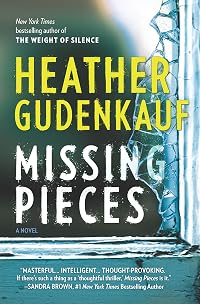
Missing Pieces
by Heather Gudenkauf
On This Page
Description
Sarah Quinlan's husband, Jack, has been haunted for decades by the untimely death of his mother when he was just a teenager, her body found in the cellar of their family farm, the circumstances a mystery. The case rocked the small farm town of Penny Gate, Iowa, where Jack was raised, and for years Jack avoided returning home. But when his beloved aunt Julia is in an accident, hospitalized in a coma, Jack and Sarah are forced to confront the past that they have long evaded. Upon arriving in show more Penny Gate, Sarah and Jack are welcomed by the family Jack left behind all those years ago--barely a trace of the wounds that had once devastated them all. But as facts about Julia's accident begin to surface, Sarah realizes that nothing about the Quinlans is what it seems. Caught in a flurry of unanswered questions, Sarah dives deep into the puzzling rabbit hole of Jack's past. But the farther in she climbs, the harder it is for her to get out. And soon she is faced with a deadly truth she may not be prepared for. show lessTags
Recommendations


Member Reviews
I agree with the title of this novel: there are missing pieces. Unfortunately, what is missing are the elements of a good mystery: a believable plot, convincing characters, and suspense.
Sarah and Jack Quinlan have been married for twenty years. They return to Penny Gate, Iowa, when Jack’s Aunt Julia (who raised him after the death of his mother Lydia) is injured in a fall. It turns out that Aunt Julia’s fall is similar to that which resulted in the death of Jack’s mother, a death which was ruled a homicide. Sarah learns about the details of this death only now and discovers that her husband has also withheld many other facts about his past. She starts investigating her mother-in-law’s murder and unravels more family secrets, show more ones which begin eroding her trust in Jack.
Character development is weak. Sarah and Jack have been married for two decades, but their relationship is very shallow. Their conversations sound like ones acquaintances would have. And Sarah’s feelings for her husband change so quickly that it seems that their marriage never had a solid foundation. Sarah is jealous of a girlfriend Jack had when he was a teenager? Many of her statements and actions are just illogical and indicate a lack of intelligence. For instance, she asks someone for help and then when that person tries to be discreet in public about aiding her, Sarah is “still baffled by her odd behavior”? She orders a Bloody Mary though “vodka always gave her a headache”? Sarah has to be told that Jack couldn’t have pushed his aunt down the stairs: “’You and Jack weren’t even in town when Julia was hurt. There was no way he could have done it.’”? And to this statement, she sits “back in her chair, dumbfounded [and says] ‘Oh, my God, you’re right’”?! This is not the type of comment expected from someone who was once a “hard-news reporter, the kind that traveled all over the work . . . covering major international news stories”! Sarah claims to have “journalistic instinct” but it never seems to work. She receives strange emails and just dismisses them?
Sarah is not the only person whose behaviour is unrealistic. An employee of the police department agrees to help her though they have met only once? And that person is willing to risk losing her job? And that abettor takes a box containing an entire case file, “’the one file that the sheriff keeps in his office’” and tells Sarah she can have it for a day or two? And why would that employee include a Walkman so Sarah can listen to the enclosed tapes, when there are transcripts of the tapes?
There are comments made that make no sense. Sarah believes that the murder investigation into Lydia’s murder is closed (though no one has been charged or convicted). The sheriff tells her, “’the case isn’t officially closed, just suspended’” but later Sarah twice mentions that “the case is closed.” Then the sheriff says, “Officially, the Lydia Tierney murder investigation is closed” only to say, a few pages later, “Now I have two active murder cases to investigate.’” The reader’s head should be left spinning.
The plotting is amateurish. There is no real suspense since any astute reader will identify the murderer virtually from the beginning: there is really only one person who could be guilty. The attempts to create suspense are so obvious and unconvincing. Sarah leaves her car keys and cell phone in her car which is parked in the middle of nowhere and then she panics when two men in a truck stop to ask if she has car problems?
Clumsiness is used to advance plot. Sarah stumbles on steps and thereby discovers blood spots. Her purse catches the edge of a desk and, conveniently, a file which contains vital information flutters to the floor. Later her elbow shatters some glass jars. What a klutz! And even Sarah’s sister-in-law is as clumsy, knocking over a vase of flowers set on a windowsill in Julia’s hospital room; she manages to knock it over though she is described as being close to Julia’s bed, not the windowsill.
Then there is the focus on unnecessary details. For instance, why is there so much emphasis on how decrepit the hospital in Penny Gate is? “The hospital was clean but dated. Institutional-green walls were lined with faded Impressionist prints and the carpet was worn and thin.” And “Sarah’s eyes followed [the nurses] down the depressingly dim corridor. She noticed on the ceiling that a brown spot had bloomed against the white plaster and rainwater dripped rhythmically into a large bucket below. She imagined mold and mildew festering behind the walls.” And “The old elevator creaked and groaned and was excruciatingly slow in its descent . . . The elevator finally arrived at their floor and the doors opened to an empty, quiet hallway. It was cold and eerie . . . ” And “The stairwell was windowless and weakly lit by dusty fluorescent bulbs. Cobwebs swung precariously in the corner where drab cement blocks met the ceiling . . . ”
The identity of the murderer is not a surprise but the motive for Lydia’s killing is not believable. Actually, many of the killer’s actions are illogical. Why would a murderer email “creepy” messages which could help identify him/her? Would a killer really leave evidence at a crime scene as “’just my little inside joke’”?
And there are other things that make no sense. How can a person claim to have seen Sarah “’snooping around Jack’s old room, looking in drawers’” when that person was not in the house, much less in the room? Then why does Sarah look for a “shoe box with Jack’s name written on it” in her brother-in-law’s house when she saw it in Uncle Hal’s house? How can she claim the box was “removed” when it hadn’t been in her brother-in-law’s house in the first place?! A woman who dismisses an old love as “a weak little boy” will then argue that they “belong together”?! An advice columnist would receive “overtly violent” letters? People keep old farm tools in a bathroom? A reporter would be repeatedly told “Don’t ask the questions if you don’t want the answers”? I could go on and on.
Obviously, some major editing is required. I had not heard of this writer and so was surprised to learn that she is a “bestselling author.” Perhaps the many issues with this book are due to the fact that I read an advanced reading copy?
Note: I received an ARC of this book from the publisher via NetGalley.
Please check out my reader's blog (http://schatjesshelves.blogspot.ca/) and follow me on Twitter (@DCYakabuski). show less
Sarah and Jack Quinlan have been married for twenty years. They return to Penny Gate, Iowa, when Jack’s Aunt Julia (who raised him after the death of his mother Lydia) is injured in a fall. It turns out that Aunt Julia’s fall is similar to that which resulted in the death of Jack’s mother, a death which was ruled a homicide. Sarah learns about the details of this death only now and discovers that her husband has also withheld many other facts about his past. She starts investigating her mother-in-law’s murder and unravels more family secrets, show more ones which begin eroding her trust in Jack.
Character development is weak. Sarah and Jack have been married for two decades, but their relationship is very shallow. Their conversations sound like ones acquaintances would have. And Sarah’s feelings for her husband change so quickly that it seems that their marriage never had a solid foundation. Sarah is jealous of a girlfriend Jack had when he was a teenager? Many of her statements and actions are just illogical and indicate a lack of intelligence. For instance, she asks someone for help and then when that person tries to be discreet in public about aiding her, Sarah is “still baffled by her odd behavior”? She orders a Bloody Mary though “vodka always gave her a headache”? Sarah has to be told that Jack couldn’t have pushed his aunt down the stairs: “’You and Jack weren’t even in town when Julia was hurt. There was no way he could have done it.’”? And to this statement, she sits “back in her chair, dumbfounded [and says] ‘Oh, my God, you’re right’”?! This is not the type of comment expected from someone who was once a “hard-news reporter, the kind that traveled all over the work . . . covering major international news stories”! Sarah claims to have “journalistic instinct” but it never seems to work. She receives strange emails and just dismisses them?
Sarah is not the only person whose behaviour is unrealistic. An employee of the police department agrees to help her though they have met only once? And that person is willing to risk losing her job? And that abettor takes a box containing an entire case file, “’the one file that the sheriff keeps in his office’” and tells Sarah she can have it for a day or two? And why would that employee include a Walkman so Sarah can listen to the enclosed tapes, when there are transcripts of the tapes?
There are comments made that make no sense. Sarah believes that the murder investigation into Lydia’s murder is closed (though no one has been charged or convicted). The sheriff tells her, “’the case isn’t officially closed, just suspended’” but later Sarah twice mentions that “the case is closed.” Then the sheriff says, “Officially, the Lydia Tierney murder investigation is closed” only to say, a few pages later, “Now I have two active murder cases to investigate.’” The reader’s head should be left spinning.
The plotting is amateurish. There is no real suspense since any astute reader will identify the murderer virtually from the beginning: there is really only one person who could be guilty. The attempts to create suspense are so obvious and unconvincing. Sarah leaves her car keys and cell phone in her car which is parked in the middle of nowhere and then she panics when two men in a truck stop to ask if she has car problems?
Clumsiness is used to advance plot. Sarah stumbles on steps and thereby discovers blood spots. Her purse catches the edge of a desk and, conveniently, a file which contains vital information flutters to the floor. Later her elbow shatters some glass jars. What a klutz! And even Sarah’s sister-in-law is as clumsy, knocking over a vase of flowers set on a windowsill in Julia’s hospital room; she manages to knock it over though she is described as being close to Julia’s bed, not the windowsill.
Then there is the focus on unnecessary details. For instance, why is there so much emphasis on how decrepit the hospital in Penny Gate is? “The hospital was clean but dated. Institutional-green walls were lined with faded Impressionist prints and the carpet was worn and thin.” And “Sarah’s eyes followed [the nurses] down the depressingly dim corridor. She noticed on the ceiling that a brown spot had bloomed against the white plaster and rainwater dripped rhythmically into a large bucket below. She imagined mold and mildew festering behind the walls.” And “The old elevator creaked and groaned and was excruciatingly slow in its descent . . . The elevator finally arrived at their floor and the doors opened to an empty, quiet hallway. It was cold and eerie . . . ” And “The stairwell was windowless and weakly lit by dusty fluorescent bulbs. Cobwebs swung precariously in the corner where drab cement blocks met the ceiling . . . ”
The identity of the murderer is not a surprise but the motive for Lydia’s killing is not believable. Actually, many of the killer’s actions are illogical. Why would a murderer email “creepy” messages which could help identify him/her? Would a killer really leave evidence at a crime scene as “’just my little inside joke’”?
And there are other things that make no sense. How can a person claim to have seen Sarah “’snooping around Jack’s old room, looking in drawers’” when that person was not in the house, much less in the room? Then why does Sarah look for a “shoe box with Jack’s name written on it” in her brother-in-law’s house when she saw it in Uncle Hal’s house? How can she claim the box was “removed” when it hadn’t been in her brother-in-law’s house in the first place?! A woman who dismisses an old love as “a weak little boy” will then argue that they “belong together”?! An advice columnist would receive “overtly violent” letters? People keep old farm tools in a bathroom? A reporter would be repeatedly told “Don’t ask the questions if you don’t want the answers”? I could go on and on.
Obviously, some major editing is required. I had not heard of this writer and so was surprised to learn that she is a “bestselling author.” Perhaps the many issues with this book are due to the fact that I read an advanced reading copy?
Note: I received an ARC of this book from the publisher via NetGalley.
Please check out my reader's blog (http://schatjesshelves.blogspot.ca/) and follow me on Twitter (@DCYakabuski). show less
When is a mystery not a mystery?
Is it when you can work out the killer in the first third of the book and (rarely) doubt that you're wrong?
Or is it when you're always several steps ahead of the main investigative character, rendering much of their hypothesising redundant?
Maybe it's when you aren't convinced by the final reveal?
The last two certainly applied in my reading of 'Missing Pieces'; the first should have applied, if I were paying sufficient attention.
-- What's it about? --
Twenty years ago Lydia Quinlan was brutally murdered in her own home. The murderer was never found.
When Julia Quinlan suffers a bad fall and ends up in hospital, her nephew, Jack, returns to Penny Falls with his wife, Sarah. Jack has barely set foot in the show more town since his mother's murder and has refused to discuss his past with Sarah.
Sarah is intrigued by the opportunity to learn more about her husband's past, but when Julia dies and a murder investigation engulfs the Quinlan family she realises someone is prepared to kill to keep what happened to Lydia a secret.
Can Sarah solve the mystery before the killer silences her?
-- What's it like? --
Easy to read but ultimately unconvincing.
The start is promising: we witness the beginning of the attack on Lydia, then shift forward in time and are stunned to learn Sarah believes Lydia and her husband died together in a car accident. Why does she think this? What's going on?
Gudenkauf aims to sustain this level of drama and uncertainty throughout the novel as Sarah is wrong footed at every turn by discovering deeply worrying truths her husband had omitted to mention. To add to the tension, Sarah begins receiving strange messages via her agony aunt alter-ego email address. Throughout it all, Jack refuses to acknowledge that his lies have caused a potentially deadly rift in their marriage. Then again, that may be because they seem like strangers to begin with.
Sarah and Jack are meant to have been married for twenty years and have two teenage girls together, but there is no sense of intimacy between them and it takes surprisingly little for Sarah to begin to suspect her husband of murder. Yes, he lied to her, but as a former journalist and current agony aunt I would have expected her to be more sympathetic to his reasons for lying and more considerate of his bereavement. (Let's experiment: can you think of any reason why someone might not want to talk about the brutal death of their mother that ended their childhood? Hmm?)
Instead her attempts at support are limited to shouting, "Jack, are you ok?" through the bathroom door at him while he vomits audibly. She can hear him being sick so...probably not? Then she avoids him as much as possible while: threatening to go home by herself, getting jealous of his ex-girlfriend and speculating with a woman considered a gossip about whether or not her husband is a murderer. I bet he's glad he took her with him.
Though equally, why did he take her with him? He must have realised his lies would come undone, as he hadn't given his family any instructions regarding hiding the truth from Sarah, let alone found a way to keep the whole town quiet. If he wanted to keep his secrets, he needed to find an excuse to leave her at home. If she insisted on coming with her, he needed to be honest upfront.
Except, I suppose, he couldn't, because then it wouldn't be plausible to speculate about him being The Murderer and the plot would take a hit. Instead, the credibility of the plot / characterisation takes a hit. Does he seriously think Sarah will sleepwalk through Iowa without asking a single potentially difficult question about his past? Has he forgotten that his wife used to be a serious journalist?
Although if he has, that's not altogether surprising, as Sarah seems to have forgotten it too, despite getting support from one of her colleagues. I would expect a journalist to be more on the ball and quicker to piece together what's going on. Instead, when all is revealed the murderer taunts her that, "It took you long enough to put the pieces together, Sarah." A chapter or so later and Sarah herself reflects, "Some investigative reporter I am." Indeed.
-- Final thoughts --
This is very easy to read and I was curious to find out what happened to Lydia and to Julia. I like that there is closure: you learn why and who and how and the epilogue gives a glimpse into the future (in which everything seems rather easily resolved). The clues that exist support the ending, though I could query the killer (I can't reveal why without also revealing who it is so will not add anything else here) and I think this would suit a reader who likes a sporting chance at solving the crime themselves.
I could see what was happening far more easily than Sarah (if you read the prologue with sufficient attention then it's quite clear who must be responsible from the limited pool of suspects Gudenkauf introduces), which was a little frustrating at times as I wanted her to be quicker to make certain connections, but perhaps this is an unfair criticism which simply shows I have read too many crime fiction novels to be easily surprised!
Most frustratingly of all, I felt the story lacked credibility. Sarah gains an awful lot of information from one source that is astonishingly easy to manipulate - but even this doesn't actually help her solve the crime. Instead, a killer who has managed to stay perfectly hidden until now chooses to send her deranged "clues" (which Sarah initially ignores) and then engages in a confrontation which brings about closure but which wasn't actually required (for various reasons). I can only assume the killer had more faith in Sarah's investigative skills than I did.
Could Sarah really have gained the help she did? Actually, maybe. It's a small town; the first murder rocked them, the second murder has stunned them and everyone is desperate to see justice served. I think, ultimately, this was maybe just a little too 'cosy' for my crime tastes (yes, despite featuring quite a brutal murder!).
I really loved the premise of this, the idea of hidden secrets and double lives promised by the press release. Gudenkauf wrote this story because she was fascinated by the idea of people leading hidden lives that their families and friends had no idea about. Unfortunately, while I was sufficiently engaged with the storyline to read the whole book, I felt the execution was a little lacking. Arguably, the murderer was simply insane, rather than leading a true double life, and this story is more about family tensions than double lives. show less
Is it when you can work out the killer in the first third of the book and (rarely) doubt that you're wrong?
Or is it when you're always several steps ahead of the main investigative character, rendering much of their hypothesising redundant?
Maybe it's when you aren't convinced by the final reveal?
The last two certainly applied in my reading of 'Missing Pieces'; the first should have applied, if I were paying sufficient attention.
-- What's it about? --
Twenty years ago Lydia Quinlan was brutally murdered in her own home. The murderer was never found.
When Julia Quinlan suffers a bad fall and ends up in hospital, her nephew, Jack, returns to Penny Falls with his wife, Sarah. Jack has barely set foot in the show more town since his mother's murder and has refused to discuss his past with Sarah.
Sarah is intrigued by the opportunity to learn more about her husband's past, but when Julia dies and a murder investigation engulfs the Quinlan family she realises someone is prepared to kill to keep what happened to Lydia a secret.
Can Sarah solve the mystery before the killer silences her?
-- What's it like? --
Easy to read but ultimately unconvincing.
The start is promising: we witness the beginning of the attack on Lydia, then shift forward in time and are stunned to learn Sarah believes Lydia and her husband died together in a car accident. Why does she think this? What's going on?
Gudenkauf aims to sustain this level of drama and uncertainty throughout the novel as Sarah is wrong footed at every turn by discovering deeply worrying truths her husband had omitted to mention. To add to the tension, Sarah begins receiving strange messages via her agony aunt alter-ego email address. Throughout it all, Jack refuses to acknowledge that his lies have caused a potentially deadly rift in their marriage. Then again, that may be because they seem like strangers to begin with.
Sarah and Jack are meant to have been married for twenty years and have two teenage girls together, but there is no sense of intimacy between them and it takes surprisingly little for Sarah to begin to suspect her husband of murder. Yes, he lied to her, but as a former journalist and current agony aunt I would have expected her to be more sympathetic to his reasons for lying and more considerate of his bereavement. (Let's experiment: can you think of any reason why someone might not want to talk about the brutal death of their mother that ended their childhood? Hmm?)
Instead her attempts at support are limited to shouting, "Jack, are you ok?" through the bathroom door at him while he vomits audibly. She can hear him being sick so...probably not? Then she avoids him as much as possible while: threatening to go home by herself, getting jealous of his ex-girlfriend and speculating with a woman considered a gossip about whether or not her husband is a murderer. I bet he's glad he took her with him.
Though equally, why did he take her with him? He must have realised his lies would come undone, as he hadn't given his family any instructions regarding hiding the truth from Sarah, let alone found a way to keep the whole town quiet. If he wanted to keep his secrets, he needed to find an excuse to leave her at home. If she insisted on coming with her, he needed to be honest upfront.
Except, I suppose, he couldn't, because then it wouldn't be plausible to speculate about him being The Murderer and the plot would take a hit. Instead, the credibility of the plot / characterisation takes a hit. Does he seriously think Sarah will sleepwalk through Iowa without asking a single potentially difficult question about his past? Has he forgotten that his wife used to be a serious journalist?
Although if he has, that's not altogether surprising, as Sarah seems to have forgotten it too, despite getting support from one of her colleagues. I would expect a journalist to be more on the ball and quicker to piece together what's going on. Instead, when all is revealed the murderer taunts her that, "It took you long enough to put the pieces together, Sarah." A chapter or so later and Sarah herself reflects, "Some investigative reporter I am." Indeed.
-- Final thoughts --
This is very easy to read and I was curious to find out what happened to Lydia and to Julia. I like that there is closure: you learn why and who and how and the epilogue gives a glimpse into the future (in which everything seems rather easily resolved). The clues that exist support the ending, though I could query the killer (I can't reveal why without also revealing who it is so will not add anything else here) and I think this would suit a reader who likes a sporting chance at solving the crime themselves.
I could see what was happening far more easily than Sarah (if you read the prologue with sufficient attention then it's quite clear who must be responsible from the limited pool of suspects Gudenkauf introduces), which was a little frustrating at times as I wanted her to be quicker to make certain connections, but perhaps this is an unfair criticism which simply shows I have read too many crime fiction novels to be easily surprised!
Most frustratingly of all, I felt the story lacked credibility. Sarah gains an awful lot of information from one source that is astonishingly easy to manipulate - but even this doesn't actually help her solve the crime. Instead, a killer who has managed to stay perfectly hidden until now chooses to send her deranged "clues" (which Sarah initially ignores) and then engages in a confrontation which brings about closure but which wasn't actually required (for various reasons). I can only assume the killer had more faith in Sarah's investigative skills than I did.
Could Sarah really have gained the help she did? Actually, maybe. It's a small town; the first murder rocked them, the second murder has stunned them and everyone is desperate to see justice served. I think, ultimately, this was maybe just a little too 'cosy' for my crime tastes (yes, despite featuring quite a brutal murder!).
I really loved the premise of this, the idea of hidden secrets and double lives promised by the press release. Gudenkauf wrote this story because she was fascinated by the idea of people leading hidden lives that their families and friends had no idea about. Unfortunately, while I was sufficiently engaged with the storyline to read the whole book, I felt the execution was a little lacking. Arguably, the murderer was simply insane, rather than leading a true double life, and this story is more about family tensions than double lives. show less
This is a nice solid thriller. Sarah falls back into her journalistic investigative skills when her family becomes threatened with the spectre of murder; she also finds out all sorts of unsavoury secrets about her husband. Suspicion abounds.
I was much more wrapped into the story than I initially thought I would be. The tight-knit family and village make a great backdrop for intertwined stories. I enjoyed Sarah's and Margaret's pluckiness as well as Sheriff Gilmore's steadfast presence. The ending didn't seem believable - I won't get into spoilers but there might have been more realistic to tie in all the loose ends. Otherwise, an enjoyable read.
I was much more wrapped into the story than I initially thought I would be. The tight-knit family and village make a great backdrop for intertwined stories. I enjoyed Sarah's and Margaret's pluckiness as well as Sheriff Gilmore's steadfast presence. The ending didn't seem believable - I won't get into spoilers but there might have been more realistic to tie in all the loose ends. Otherwise, an enjoyable read.
I received [b: Missing Pieces |25785334|Missing Pieces|Heather Gudenkauf|https://d.gr-assets.com/books/1444135108s/25785334.jpg|45636096] by [a: Heather Gudenkauf|2875124|Heather Gudenkauf|https://d.gr-assets.com/authors/1383946596p2/2875124.jpg] as an uncorrected ARC e-book via NetGalley in exchange for an honest review.
Once I opened "Missing Pieces", I could not get it out of my mind. Usually I absorb novels, but this one deserved careful reading.
It has been two days since the end, and it is still there, working its magic that good writing does.
Jack Quinlan, pried back to a home and family history that he once escaped. Sarah, his wife, never questioned Jack's background, until they land back in Penny Gate.
There she questions show more everything he has ever told her. Who is Jack Quinlan, husband and father of their two young adult daughters? What is he capable of?
The Quinlans came for one tragic event, and soon there are a string of mysteries that chill the reader to the bone.
The mystery lover will appreciate no easy guesses when it comes to who done it, and who will survive?
I look forward to more from Heather Gudenkauf, as a matter of fact I just purchased "Little Lies." She is an excellent writer. show less
Once I opened "Missing Pieces", I could not get it out of my mind. Usually I absorb novels, but this one deserved careful reading.
It has been two days since the end, and it is still there, working its magic that good writing does.
Jack Quinlan, pried back to a home and family history that he once escaped. Sarah, his wife, never questioned Jack's background, until they land back in Penny Gate.
There she questions show more everything he has ever told her. Who is Jack Quinlan, husband and father of their two young adult daughters? What is he capable of?
The Quinlans came for one tragic event, and soon there are a string of mysteries that chill the reader to the bone.
The mystery lover will appreciate no easy guesses when it comes to who done it, and who will survive?
I look forward to more from Heather Gudenkauf, as a matter of fact I just purchased "Little Lies." She is an excellent writer. show less
Sarah Quinlan's husband, Jack, returns to the place he grew up because his beloved aunt Julia has is in a coma at the hospital after falling down the stairs. While at Penny Gate Jack is taken back to a time when his mother was found dead in the cellar of their family farm, a time he did not tell Sarah about. As Sarah begins to learn the truth about what happened to Julia and about what happened surrounding the death of Jack's mother, she realizes that something is not quite right within the Quinlan clan.
When I realized this was the same author that wrote "These Things Hidden" (which I hated) I wasn't expecting anything overly good. But I was pleasantly surprised. It was a page-turner that kept me guessing. The characters were show more three-dimensional. I liked the setting. And the plot was way more believable than "These Things Hidden" show less
When I realized this was the same author that wrote "These Things Hidden" (which I hated) I wasn't expecting anything overly good. But I was pleasantly surprised. It was a page-turner that kept me guessing. The characters were show more three-dimensional. I liked the setting. And the plot was way more believable than "These Things Hidden" show less
In Heather Gudenkauf's newest release, Missing Pieces, Sarah Quinlan grows suspicious of her husband Jack after learning he has been lying about his past for the last twenty years.
As soon as Jack gets the news that his beloved Aunt Julia has been gravely injured in a fall, he and Sarah make a hurried trip to his rural hometown in Iowa. It does not take long for Jack's carefully constructed past to come tumbling down when his sister Amy makes cryptic comments about their family home, where their cousin Dean and his wife Celia now reside. Pressing her husband for answers, Sarah quickly learns that Jack's parents did not die in a car crash as he has long professed. She is stunned to discover his mother, Lydia, was bludgeoned to death in show more the cellar of their farmhouse when Jack was fifteen years old and that his long missing father John remains the prime suspect in her murder. When Julia unexpectedly succumbs to her injuries, the Quinlan family falls under suspicion when Sheriff Verne Gilmore announces she was the victim of foul play.
Sarah's shock and distress over Jack's lies is understandable as is her search for answers, but her immediate suspicions about him make it difficult to like her. Given the circumstances with his aunt's precarious health, it is little wonder he has the desire or energy to rehash his sordid past. Jack's downplaying of old relationships is definitely cause for concern but Sarah's resulting jealousy seems misplaced.
Sarah does not give Jack the benefit of the doubt upon learning he deliberately mislead her about his past nor does she give him much of a chance to explain his reasons for his deception. Instead, with each new discovery, she grows convinced he killed his mother and although there is no way he is responsible for his aunt’s initial injuries, she cannot help but wonder if he had a hand in her death as well.
Turning to an unlikely source for help, Sarah manages to get the police reports from his mother's murder. As she listens to his police interviews and reads the witness statements, a troubling picture soon emerges about fifteen year old Jack and she becomes certain he is responsible for Lydia's death. This quick indictment of her husband clouds Sarah's judgment and gives her tunnel vision during her amateur investigation of both murders.
Events unfold at a breakneck speed and there is a strong sense of urgency to discover the truth as Sarah tries to piece together the truth about what happened to Jack's mother and his Aunt Julia. Sheriff Gilmore's primary concern is finding Julia's killer and although certain he has the right person in custody, he continues searching for evidence. He eventually makes a shocking discovery that casts doubt on his theory about Lydia's death but whether this has any bearing on his current investigation remains unclear. When Sarah finally understands the meaning behind a puzzling series of e-mails, she is certain she has uncovered the motive for the murders, but only time will tell if her supposition is correct.
Despite a few improbable plot points and a somewhat unsympathetic lead protagonist, Missing Pieces is an intriguing mystery that is quite riveting. Heather Gudenkauf cleverly conceals the both the motive for the murders and the killer's identity right up until the novel's dramatic conclusion. All in all, a suspense-laden novel that fans of the genre will enjoy. show less
As soon as Jack gets the news that his beloved Aunt Julia has been gravely injured in a fall, he and Sarah make a hurried trip to his rural hometown in Iowa. It does not take long for Jack's carefully constructed past to come tumbling down when his sister Amy makes cryptic comments about their family home, where their cousin Dean and his wife Celia now reside. Pressing her husband for answers, Sarah quickly learns that Jack's parents did not die in a car crash as he has long professed. She is stunned to discover his mother, Lydia, was bludgeoned to death in show more the cellar of their farmhouse when Jack was fifteen years old and that his long missing father John remains the prime suspect in her murder. When Julia unexpectedly succumbs to her injuries, the Quinlan family falls under suspicion when Sheriff Verne Gilmore announces she was the victim of foul play.
Sarah's shock and distress over Jack's lies is understandable as is her search for answers, but her immediate suspicions about him make it difficult to like her. Given the circumstances with his aunt's precarious health, it is little wonder he has the desire or energy to rehash his sordid past. Jack's downplaying of old relationships is definitely cause for concern but Sarah's resulting jealousy seems misplaced.
Sarah does not give Jack the benefit of the doubt upon learning he deliberately mislead her about his past nor does she give him much of a chance to explain his reasons for his deception. Instead, with each new discovery, she grows convinced he killed his mother and although there is no way he is responsible for his aunt’s initial injuries, she cannot help but wonder if he had a hand in her death as well.
Turning to an unlikely source for help, Sarah manages to get the police reports from his mother's murder. As she listens to his police interviews and reads the witness statements, a troubling picture soon emerges about fifteen year old Jack and she becomes certain he is responsible for Lydia's death. This quick indictment of her husband clouds Sarah's judgment and gives her tunnel vision during her amateur investigation of both murders.
Events unfold at a breakneck speed and there is a strong sense of urgency to discover the truth as Sarah tries to piece together the truth about what happened to Jack's mother and his Aunt Julia. Sheriff Gilmore's primary concern is finding Julia's killer and although certain he has the right person in custody, he continues searching for evidence. He eventually makes a shocking discovery that casts doubt on his theory about Lydia's death but whether this has any bearing on his current investigation remains unclear. When Sarah finally understands the meaning behind a puzzling series of e-mails, she is certain she has uncovered the motive for the murders, but only time will tell if her supposition is correct.
Despite a few improbable plot points and a somewhat unsympathetic lead protagonist, Missing Pieces is an intriguing mystery that is quite riveting. Heather Gudenkauf cleverly conceals the both the motive for the murders and the killer's identity right up until the novel's dramatic conclusion. All in all, a suspense-laden novel that fans of the genre will enjoy. show less
Jack and Sarah Quinlan are racing to get to Jack's Aunt Julia (who raised Jack and his sister, Amy, as her own children after their parents died tragically in an accident)'s side at the hospital after she fell down a flight of stairs. Jack had not been back to his hometown (Penny Gate, IA) in over 20 years and has since met, married, and started a family with Sarah in Montana. However, Penny As Amy warned Sarah in the book about Penny Gate, "people who stay around here too long either die or go crazy".
The more information that Sarah comes across about her husband's childhood, the more questions she develops. The more questions that she asks, the more dangerous the town becomes. With more bodies piling up, Jack and Sarah are forced to show more stay in Penny Gate until the police complete the investigation. The longer they stay there, the closer they get to the killer.
I had hoped for much more from this mystery book, especially after hearing so many great things about Heather Gudenkauf's other writings. However, this book lacked character development, activity, and depth. There were several chapters where the only "action" taking place was that she was digging into her husband's past and finding more about than he even knew himself. Instead of communicating this with her husband of 20 years, she avoids him (many times in a very immature fashion) both in person as well as avoids his calls and texts. However, when she tries to get in contact with her husband Jack, she gets angry that he does not answer her texts. Furthermore, the whole reason why Jack and Sarah are in town is for Jack's aunt being in the hospital in critical condition. However, a majority of the book is about how Sarah is hurt and upset because Jack never told her details of an event that happened before he even met her. Granted, it is a major event, but I felt that she blew it way out of proportion. Lastly, the jealousy that Sarah feels in regards to Jack and Celia, seemed out of place. I would have thought someone who had been married to her husband for 20 years would not be intimidated by the appearance of another woman. Particularly a woman who is the wife of Jack's cousin, even if Jack and Celia dated when they were in high school. It seemed to be too focused on jealousy of Celia's appearance. For example: "Sarah saw Celia with new eyes now that she knew she and Jack were once an item. She was beautiful. Slim and fit. Her black curls were pulled back from her face and she was perfectly put together in sharply creased khakis and a neatly pressed blouse. Sarah looked down and was dismayed to see that her long-sleeve T-shirt and jeans were hopelessly rumpled from being stored in her suitcase".
In conclusion, I would have liked this book better if the main character had a better personality and if her husband had a stronger presence. Personally, I found her to be repulsively hypocritical, narcissistic, and immature. It did not help that the narrative was first-person in Sarah's voice which exacerbated her aforementioned characteristics. On the other hand, I did enjoy that I did not figure out the killer until he/she was revealed.
For those who may be sensitive, there are themes of violence, domestic violence, mild language, and drug use.
Please note: a copy of this book was generously provided by the publisher via NetGalley in exchange for an honest review. show less
The more information that Sarah comes across about her husband's childhood, the more questions she develops. The more questions that she asks, the more dangerous the town becomes. With more bodies piling up, Jack and Sarah are forced to show more stay in Penny Gate until the police complete the investigation. The longer they stay there, the closer they get to the killer.
I had hoped for much more from this mystery book, especially after hearing so many great things about Heather Gudenkauf's other writings. However, this book lacked character development, activity, and depth. There were several chapters where the only "action" taking place was that she was digging into her husband's past and finding more about than he even knew himself. Instead of communicating this with her husband of 20 years, she avoids him (many times in a very immature fashion) both in person as well as avoids his calls and texts. However, when she tries to get in contact with her husband Jack, she gets angry that he does not answer her texts. Furthermore, the whole reason why Jack and Sarah are in town is for Jack's aunt being in the hospital in critical condition. However, a majority of the book is about how Sarah is hurt and upset because Jack never told her details of an event that happened before he even met her. Granted, it is a major event, but I felt that she blew it way out of proportion. Lastly, the jealousy that Sarah feels in regards to Jack and Celia, seemed out of place. I would have thought someone who had been married to her husband for 20 years would not be intimidated by the appearance of another woman. Particularly a woman who is the wife of Jack's cousin, even if Jack and Celia dated when they were in high school. It seemed to be too focused on jealousy of Celia's appearance. For example: "Sarah saw Celia with new eyes now that she knew she and Jack were once an item. She was beautiful. Slim and fit. Her black curls were pulled back from her face and she was perfectly put together in sharply creased khakis and a neatly pressed blouse. Sarah looked down and was dismayed to see that her long-sleeve T-shirt and jeans were hopelessly rumpled from being stored in her suitcase".
In conclusion, I would have liked this book better if the main character had a better personality and if her husband had a stronger presence. Personally, I found her to be repulsively hypocritical, narcissistic, and immature. It did not help that the narrative was first-person in Sarah's voice which exacerbated her aforementioned characteristics. On the other hand, I did enjoy that I did not figure out the killer until he/she was revealed.
For those who may be sensitive, there are themes of violence, domestic violence, mild language, and drug use.
Please note: a copy of this book was generously provided by the publisher via NetGalley in exchange for an honest review. show less
Members
- Recently Added By
Author Information

16+ Works 7,879 Members
Heather Gudenkauf is an Edgar Award nominated, New York Times and USA Today bestselling author. She lives in Iowa with her husband and children. In her free time she enjoys spending time with her family, reading, and running. (Bowker Author Biography)
Some Editions
Work Relationships
Is abridged in
Common Knowledge
- Original publication date
- 2016
- People/Characters
- Sarah Quinlan; Jack Quinlan; Julia Quinlan
- Important places
- Montana, USA
- Dedication
- For Marianne Merola - my agent, mentor and friend-
there since the beginning of this amazing journey - First words
- Prologue: Lydia gazed absentmindedly outside the kitchen window, the bright May sunshine glinting off the dew-glazed sweet-potato vine that cascaded from the window box just beyond the screen.
- Last words
- (Click to show. Warning: May contain spoilers.)"You haven't lost us," she whispered. "We're right here."
Classifications
Statistics
- Members
- 456
- Popularity
- 67,149
- Reviews
- 38
- Rating
- (3.54)
- Languages
- English, Portuguese
- Media
- Paper, Audiobook, Ebook
- ISBNs
- 21
- ASINs
- 4