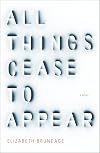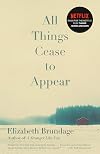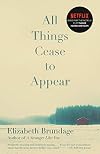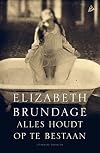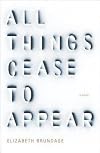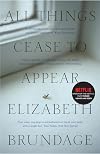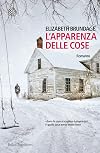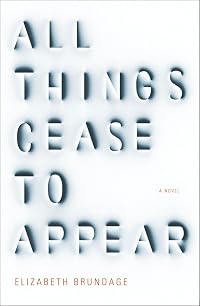
All Things Cease to Appear
by Elizabeth Brundage
On This Page
Description
A dark, riveting, beautifully written book--by "a brilliant novelist," according to Richard Bausch--that combines noir and the gothic in a story about two families entwined in their own unhappiness, with, at its heart, a gruesome and unsolved murderLate one winter afternoon in upstate New York, George Clare comes home to find his wife killed and their three-year-old daughter alone--for how many hours?--in her room across the hall. He had recently, begrudgingly, taken a position at a nearby show more private college (far too expensive for local kids to attend) teaching art history, and moved his family into a tight-knit, impoverished town that has lately been discovered by wealthy outsiders in search of a rural idyll.
George is of course the immediate suspect--the question of his guilt echoing in a story shot through with secrets both personal and professional. While his parents rescue him from suspicion, a persistent cop is stymied at every turn in proving Clare a heartless murderer. And three teenage brothers (orphaned by tragic circumstances) find themselves entangled in this mystery, not least because the Clares had moved into their childhood home, a once-thriving dairy farm. The pall of death is ongoing, and relentless; behind one crime there are others, and more than twenty years will pass before a hard kind of justice is finally served.
A rich and complex portrait of a psychopath and a marriage, this is also an astute study of the various taints that can scar very different families, and even an entire community. Elizabeth Brundage is an essential talent who has given us a true modern classic.
From the Hardcover edition.. show less
Tags
Recommendations

Member Reviews
Consider All Things Cease To Appear a work of literary merit that happens to begin with a murder suspect ruminating on Emerson and an ax in the skull of the protagonist. In other words, author Elizabeth Brundage eludes the general classification of a novel into Genre Fiction or Literary Fiction.
Genre Fiction usually gets divided into romance, horror, mystery, et cetera and then subdivided into cross genres and further complicated taxa. Literary Fiction is both difficult and easy to classify because it resides in the category of books with no category. Literary Fiction is for sale in the section of your book store where the fog never lifts, it’s shelve hanging unfastened between the land and sky. Is All Things Cease To Appear a show more mystery/thriller, a romantic/horror, or a literary fictive with genre elements? Here, context serves as an inside-out metaphor for the content, the imaginary hinterland Brundage creates.
The setting is Chosen, New York, an insular working-class town. George and Catherine Clare, intellectuals from the city, have moved to a house on a foreclosed dairy farm, also the site of the previous family’s tragic self-destruction. While George attends his new position as professor of art history at a nearby college, Catherine forgoes her career in art restoration to become restorian of the spooky, decaying property. She hires the teenage Hale brothers, a sad but bighearted trio, to repaint the exteriors, although she is unaware the house was last the Hale’s home until they were orphaned by their father’s violence and mother’s murder?/suicide.
George Clare teaches study in the Hudson River School of landscape painters, specifically George Innes, whose nineteenth century works were intended to be both observably captivating and spiritually experiential. Meanwhile Catherine Clare is experiencing her own metaphysical shift. She relies on the Hale boys and other new local friendships to navigate passage through her collapsing marriage and creeping ennui. George turns out to be a character perpetrating frauds, betrayals, and violent acts with sociopathic artifice, which culminates in his becoming the prime suspect in Catherine’s gruesome murder.
In it’s breadth, All Things tells the concentric history of two abused mothers who meet similar tragic fate in the same house at different times. Like any good novel, the story is rich in comparative elements, but referring to Brundage’s elements as ordinary pairings and opposites seems inadequate. Counterpoint might be a closer descriptive (Catherine plays Chopin on piano!), in the sense of independent melodies composed into one harmonic texture: Catherine is the abused mistress of the house, but the ghost of her lost predecessor, Ella Hale, continues to traverse the creaky stairs; the Hale boys still consider the house their property, and yet they are dispossessed from it; the Clares and the Hales are two families at different times appearing, concentrating, and disappearing.
These contrapuntals reflect the novel’s central philosophical platform: reality is a place where morals and meaning are uncertain concepts; time is an ebbing and disappearing focal point; life is a composition of light and darkness- like an Innes landscape that balances land and sky into a vague frontier where all things blend until ceasing to appear. Brundage performs context and content in counterpoint as genre motifs are blended with literary themes and superb prose. In this scene Eddy Hale, working outside Catherine’s house, is both a de facto permanent occupant and a frequent voyeur looking in from the outside:
“Maybe she’d come out to hang the wash. He’d watch her back, her arms reaching up, her elbows as knobby as a garden snail’s. Across the fields that had been his grandfather’s and his great grandfather’s before that, the wind spoke to him. Wait, it said… Now Catherine’s daughter was sleeping in his old room. He wouldn’t tell her. He wouldn’t tell her what had gone on in that house, how his father would come after them, turning over chairs and tables, how his mother would cry up in her room or sometimes sit in one place shaking just a little, like somebody who was scared.”
I suppose genre readers could find themselves disappointed to be led into a four hundred page murder mystery that neither provides a competent detective nor concludes with certainty about who is guilty. It is a risk for Brundage to write a beautiful novel wherein beauty and love depend on the unseen, and the success of heroes and demise of villains depends entirely on implication. As Brundage writes- in fog certain things, certain colors become important. Like Innes’s intention that observers of his paintings would have their souls see what their eyes could not, Brundage shows readers that the division of genre and literary fiction is, like lateral time and universal logic, mere optical illusion. show less
Genre Fiction usually gets divided into romance, horror, mystery, et cetera and then subdivided into cross genres and further complicated taxa. Literary Fiction is both difficult and easy to classify because it resides in the category of books with no category. Literary Fiction is for sale in the section of your book store where the fog never lifts, it’s shelve hanging unfastened between the land and sky. Is All Things Cease To Appear a show more mystery/thriller, a romantic/horror, or a literary fictive with genre elements? Here, context serves as an inside-out metaphor for the content, the imaginary hinterland Brundage creates.
The setting is Chosen, New York, an insular working-class town. George and Catherine Clare, intellectuals from the city, have moved to a house on a foreclosed dairy farm, also the site of the previous family’s tragic self-destruction. While George attends his new position as professor of art history at a nearby college, Catherine forgoes her career in art restoration to become restorian of the spooky, decaying property. She hires the teenage Hale brothers, a sad but bighearted trio, to repaint the exteriors, although she is unaware the house was last the Hale’s home until they were orphaned by their father’s violence and mother’s murder?/suicide.
George Clare teaches study in the Hudson River School of landscape painters, specifically George Innes, whose nineteenth century works were intended to be both observably captivating and spiritually experiential. Meanwhile Catherine Clare is experiencing her own metaphysical shift. She relies on the Hale boys and other new local friendships to navigate passage through her collapsing marriage and creeping ennui. George turns out to be a character perpetrating frauds, betrayals, and violent acts with sociopathic artifice, which culminates in his becoming the prime suspect in Catherine’s gruesome murder.
In it’s breadth, All Things tells the concentric history of two abused mothers who meet similar tragic fate in the same house at different times. Like any good novel, the story is rich in comparative elements, but referring to Brundage’s elements as ordinary pairings and opposites seems inadequate. Counterpoint might be a closer descriptive (Catherine plays Chopin on piano!), in the sense of independent melodies composed into one harmonic texture: Catherine is the abused mistress of the house, but the ghost of her lost predecessor, Ella Hale, continues to traverse the creaky stairs; the Hale boys still consider the house their property, and yet they are dispossessed from it; the Clares and the Hales are two families at different times appearing, concentrating, and disappearing.
These contrapuntals reflect the novel’s central philosophical platform: reality is a place where morals and meaning are uncertain concepts; time is an ebbing and disappearing focal point; life is a composition of light and darkness- like an Innes landscape that balances land and sky into a vague frontier where all things blend until ceasing to appear. Brundage performs context and content in counterpoint as genre motifs are blended with literary themes and superb prose. In this scene Eddy Hale, working outside Catherine’s house, is both a de facto permanent occupant and a frequent voyeur looking in from the outside:
“Maybe she’d come out to hang the wash. He’d watch her back, her arms reaching up, her elbows as knobby as a garden snail’s. Across the fields that had been his grandfather’s and his great grandfather’s before that, the wind spoke to him. Wait, it said… Now Catherine’s daughter was sleeping in his old room. He wouldn’t tell her. He wouldn’t tell her what had gone on in that house, how his father would come after them, turning over chairs and tables, how his mother would cry up in her room or sometimes sit in one place shaking just a little, like somebody who was scared.”
I suppose genre readers could find themselves disappointed to be led into a four hundred page murder mystery that neither provides a competent detective nor concludes with certainty about who is guilty. It is a risk for Brundage to write a beautiful novel wherein beauty and love depend on the unseen, and the success of heroes and demise of villains depends entirely on implication. As Brundage writes- in fog certain things, certain colors become important. Like Innes’s intention that observers of his paintings would have their souls see what their eyes could not, Brundage shows readers that the division of genre and literary fiction is, like lateral time and universal logic, mere optical illusion. show less
I read ALL THINGS CEASE TO APPEAR because I heard that Netflix based a movie on it ("Things Heard and Seen"). Now I think I will be disappointed in whatever Netflix did with it because it couldn’t possibly be as wonderful as this book.
Right away the novel lets you know that Catherine Clare has been murdered in her home, her four-year-old daughter, Frannie, was there at the time of the murder and for hours after, and her husband, George, may have done it. Flashbacks make up most of the rest of the book. Was George, in fact, guilty? Is he a sociopath, maybe a serial killer, or did he just cheat on his wife?
I heard that the movie concentrates on supernatural happenings in the old farmhouse where Catherine, George, and Frannie lived much show more more than the novel does. Maybe that's why their titles differ. But throughout the flashbacks in ALL THINGS CEASE TO APPEAR, Catherine did suspect that the ghost of the woman who had previously lived there was in the same room with her.
My impression of the novel is that characterization, especially of George but also of Catherine, his colleagues, and their neighbors in the small town of Chosen, far exceeds the supernatural in importance. You’ll learn more and more about each but especially about George as the book continues. And the more you learn, the worse you’ll feel about him.
Although I loved this book, I still say that the author was inconsiderate not to include quotation marks. show less
Right away the novel lets you know that Catherine Clare has been murdered in her home, her four-year-old daughter, Frannie, was there at the time of the murder and for hours after, and her husband, George, may have done it. Flashbacks make up most of the rest of the book. Was George, in fact, guilty? Is he a sociopath, maybe a serial killer, or did he just cheat on his wife?
I heard that the movie concentrates on supernatural happenings in the old farmhouse where Catherine, George, and Frannie lived much show more more than the novel does. Maybe that's why their titles differ. But throughout the flashbacks in ALL THINGS CEASE TO APPEAR, Catherine did suspect that the ghost of the woman who had previously lived there was in the same room with her.
My impression of the novel is that characterization, especially of George but also of Catherine, his colleagues, and their neighbors in the small town of Chosen, far exceeds the supernatural in importance. You’ll learn more and more about each but especially about George as the book continues. And the more you learn, the worse you’ll feel about him.
Although I loved this book, I still say that the author was inconsiderate not to include quotation marks. show less
The Publisher Says: A dark, riveting, beautifully written book—by “a brilliant novelist” according to Richard Bausch—that combines noir and the gothic in a story about two families entwined in their own unhappiness, with, at its heart, a gruesome and unsolved murder.
Late one winter afternoon in upstate New York, George Clare comes home to find his wife killed and their three-year-old daughter alone—for how many hours?—in her room across the hall. He had recently, begrudgingly, taken a position at a nearby private college (far too expensive for local kids to attend) teaching art history, and moved his family into a tight-knit, impoverished town that has lately been discovered by wealthy outsiders in search of a rural show more idyll.
George is of course the immediate suspect—the question of his guilt echoing in a story shot through with secrets both personal and professional. While his parents rescue him from suspicion, a persistent cop is stymied at every turn in proving Clare a heartless murderer. And three teenage brothers (orphaned by tragic circumstances) find themselves entangled in this mystery, not least because the Clares had moved into their childhood home, a once-thriving dairy farm. The pall of death is ongoing, and relentless; behind one crime there are others, and more than twenty years will pass before a hard kind of justice is finally served.
A rich and complex portrait of a psychopath and a marriage, this is also an astute study of the various taints that can scar very different families, and even an entire community. Elizabeth Brundage is an essential talent who has given us a true modern classic.
I RECEIVED AN ARC FROM THE PUBLISHER. THANK YOU.
My Review: A domestic thriller, and a darn unsuspenseful one. There is, as we're all aware, a long tradition in fiction and in fact of men who kill their wives for what seem to outsiders as heartbreakingly trivial reasons. This is one of those stories. It's not in the least mysterious that the murderer is the murderer. It's the reason I didn't give the book more stars.
I gave it as many as I did because Author Brundage writes about how the people in a small, gentrifying community deal with the end of their safety net of decent jobs and affordable housing. The influx of yuppies from the nearby rich-kids' college who just are not like them at all adds stress to the community. The families who figure in the murder case are tied together by their state of limbo. No one ever is charged for the crime. Although, I remind you, there's really just no doubt at all in the experienced reader's mind who did the crime.
Anyway. The way the author slowly, slowly brings the beginnings of justice to the town's unresolved wounds makes it a worthwhile read. show less
Late one winter afternoon in upstate New York, George Clare comes home to find his wife killed and their three-year-old daughter alone—for how many hours?—in her room across the hall. He had recently, begrudgingly, taken a position at a nearby private college (far too expensive for local kids to attend) teaching art history, and moved his family into a tight-knit, impoverished town that has lately been discovered by wealthy outsiders in search of a rural show more idyll.
George is of course the immediate suspect—the question of his guilt echoing in a story shot through with secrets both personal and professional. While his parents rescue him from suspicion, a persistent cop is stymied at every turn in proving Clare a heartless murderer. And three teenage brothers (orphaned by tragic circumstances) find themselves entangled in this mystery, not least because the Clares had moved into their childhood home, a once-thriving dairy farm. The pall of death is ongoing, and relentless; behind one crime there are others, and more than twenty years will pass before a hard kind of justice is finally served.
A rich and complex portrait of a psychopath and a marriage, this is also an astute study of the various taints that can scar very different families, and even an entire community. Elizabeth Brundage is an essential talent who has given us a true modern classic.
I RECEIVED AN ARC FROM THE PUBLISHER. THANK YOU.
My Review: A domestic thriller, and a darn unsuspenseful one. There is, as we're all aware, a long tradition in fiction and in fact of men who kill their wives for what seem to outsiders as heartbreakingly trivial reasons. This is one of those stories. It's not in the least mysterious that the murderer is the murderer. It's the reason I didn't give the book more stars.
I gave it as many as I did because Author Brundage writes about how the people in a small, gentrifying community deal with the end of their safety net of decent jobs and affordable housing. The influx of yuppies from the nearby rich-kids' college who just are not like them at all adds stress to the community. The families who figure in the murder case are tied together by their state of limbo. No one ever is charged for the crime. Although, I remind you, there's really just no doubt at all in the experienced reader's mind who did the crime.
Anyway. The way the author slowly, slowly brings the beginnings of justice to the town's unresolved wounds makes it a worthwhile read. show less
It's part murder mystery and part ghost story. It is also a close look at how guilt from the past affects the present and the future...and how what we often want is not what we sometimes get. We learn early on in the story that it’s not only houses that can be haunted...but people also. The novel asks so many questions that can't always be answered without lots of thought such as how well can we really know anyone? Is there even such a thing as evil? Does the spirit or energy last and thrive after death? And maybe the most important...how do we ever heal from violence and loss? It's a read that can only be described as riveting and absorbing.
ALL THINGS CEASE TO APPEAR - ELIZABETH BRUNDAGE *****
Pratītyasamutpāda
I don’t know if the title of this book is a known saying or epithet, it isn’t credited as such but it brought to mind the pragmatic Sanskrit concept of ‘Pratītyasamutpāda’.
And it was a pleasure to read this book, no, it was more than that, it was a privilege. A beautifully constructed story that luxuriated in the depths of its language. Some perceptive metaphors and observations that make you think ‘Yes, that’s it, exactly’, as you read it. A novel where you savour every word, for every word fulfils its role in this story. Ms. Brundart’s words are characters too.
This is a multi layered fiction; on the surface it tells a chilling, thrilling, show more unsettling tale of families in a small town, an octopus novel with its tentacles delving richly into the psychological, the spiritual, the supernatural, sometimes gothic, sometimes contemporary, moving between time periods. And it’s also an eloquent piece of prose writing where words and phrases can lift and inspire you as only a good writer can do.
The characters are keenly observed and developed, brought to life as we are encouraged to both loathe and empathise and our emotions are manipulated almost but with the assurance that what we are feeling is just how we should feel. The writer seems to be able to get under the skin of all, particularly the women in the novel, despite their difference in age and personality. They are all three dimensional.
In some ways it is a book without a conclusion but paradoxically the conclusion was always there right from the beginning. The plot is almost clear from the start but in a curious way the plot is secondary to the other aspects of the novel, another character, as it were, satisfying its role in this story.
I am tempted to put aside other commitments and seek out all of Elizabeth Brundage’s other work for she is a new writer to me.
But I’ve waxed lyrical about this book long enough. Long enough, I hope, for you to seriously consider reading it. show less
Pratītyasamutpāda
I don’t know if the title of this book is a known saying or epithet, it isn’t credited as such but it brought to mind the pragmatic Sanskrit concept of ‘Pratītyasamutpāda’.
And it was a pleasure to read this book, no, it was more than that, it was a privilege. A beautifully constructed story that luxuriated in the depths of its language. Some perceptive metaphors and observations that make you think ‘Yes, that’s it, exactly’, as you read it. A novel where you savour every word, for every word fulfils its role in this story. Ms. Brundart’s words are characters too.
This is a multi layered fiction; on the surface it tells a chilling, thrilling, show more unsettling tale of families in a small town, an octopus novel with its tentacles delving richly into the psychological, the spiritual, the supernatural, sometimes gothic, sometimes contemporary, moving between time periods. And it’s also an eloquent piece of prose writing where words and phrases can lift and inspire you as only a good writer can do.
The characters are keenly observed and developed, brought to life as we are encouraged to both loathe and empathise and our emotions are manipulated almost but with the assurance that what we are feeling is just how we should feel. The writer seems to be able to get under the skin of all, particularly the women in the novel, despite their difference in age and personality. They are all three dimensional.
In some ways it is a book without a conclusion but paradoxically the conclusion was always there right from the beginning. The plot is almost clear from the start but in a curious way the plot is secondary to the other aspects of the novel, another character, as it were, satisfying its role in this story.
I am tempted to put aside other commitments and seek out all of Elizabeth Brundage’s other work for she is a new writer to me.
But I’ve waxed lyrical about this book long enough. Long enough, I hope, for you to seriously consider reading it. show less
As far as being thrilling and absorbing - 5 stars. I was really captivated by the story and the different perspectives each character offered. However, this is one of these books where the ending really killed it for me. It came to such a whimper of an ending that I was a little mad. I wanted justice - or in lieu of justice, some kind of statement. The way the novel turned out honestly seemed a little lazy. Thoroughly enjoyed it - couldn't put it down in fact - until the last small portion of the book.
One wonders if Elizabeth Brundage did a close reading of the “Diagnostic and Statistical Manual of Mental Disorders (DSMMD)” section on antisocial personality disorders prior to creating George Clare, the protagonist of her novel, ALL THINGS CEASE TO APPEAR. With George, she hits just about all of the classical psychopathic traits as they are described in the DSMMD. He has a charming and disarming personality; is highly manipulative; easily gains trust; can mimic normal human emotions, despite actually being unable to feel them; has little regard for laws or social mores; and especially is prone to act violently. She does a masterful job of demonstrating what people with this disorder are like and especially how their personalities show more impact their loved ones. In fact, it is not difficult to occasionally pause while reading about George, his family and friends to realize that you may have actually known one or more people with this affliction in your own life. Although most psychopaths are not serial killers, the converse may be true.
Brundage’s narrative touches on several genres, including murder mystery, domestic drama, police procedural and even a little bit of ghost story. This variety notwithstanding, the most compelling element in the novel by far is the character study of a psychopath. Brundage uses multiple points of view, time shifts and characterizations throughout to slowly reveal George’s depravity after opening with the brutal ax murder of his wife, Catherine. In a way, the reader gets to know George’s true nature much like one gets to know psychopaths in real life—slowly and almost by accident.
George and Catherine Clare move to the rural community of Chosen, NY along with their three-year-old daughter Franny. George has been hired by the local college to teach art history. They acquire the Hale dairy farm at a foreclosure auction. The farm presents a dark mood to the narrative because it is rundown, abandoned, and possibly haunted by its previous owners who committed suicide there. The Hale’s three sons are still attracted to the place and thus play minor roles in the plot.
Although Brundage’s portrait of George is complex and engaging, her plot tends to meander and develop slowly. Moreover, her characterizations of Catherine, Franny and the most of the citizens of Chosen are favorable with little complexity. Even George’s young mistress, Willis, comes across as a troubled yet principled woman. Alternatively, all of the big city types—George’s parents and Willis’ lawyer father—are depicted as flawed, self-involved and greedy people. The concluding chapters are unfortunate and probably unnecessary. They are epigraphic, aimed at clarifying life’s messiness but give the story a regrettable fairy tale quality. show less
Brundage’s narrative touches on several genres, including murder mystery, domestic drama, police procedural and even a little bit of ghost story. This variety notwithstanding, the most compelling element in the novel by far is the character study of a psychopath. Brundage uses multiple points of view, time shifts and characterizations throughout to slowly reveal George’s depravity after opening with the brutal ax murder of his wife, Catherine. In a way, the reader gets to know George’s true nature much like one gets to know psychopaths in real life—slowly and almost by accident.
George and Catherine Clare move to the rural community of Chosen, NY along with their three-year-old daughter Franny. George has been hired by the local college to teach art history. They acquire the Hale dairy farm at a foreclosure auction. The farm presents a dark mood to the narrative because it is rundown, abandoned, and possibly haunted by its previous owners who committed suicide there. The Hale’s three sons are still attracted to the place and thus play minor roles in the plot.
Although Brundage’s portrait of George is complex and engaging, her plot tends to meander and develop slowly. Moreover, her characterizations of Catherine, Franny and the most of the citizens of Chosen are favorable with little complexity. Even George’s young mistress, Willis, comes across as a troubled yet principled woman. Alternatively, all of the big city types—George’s parents and Willis’ lawyer father—are depicted as flawed, self-involved and greedy people. The concluding chapters are unfortunate and probably unnecessary. They are epigraphic, aimed at clarifying life’s messiness but give the story a regrettable fairy tale quality. show less
Members
- Recently Added By
Published Reviews
...as much as anything, this is a character sketch: of a marriage, a sociopath, a family destroyed by the economy, the things we do for love — all finely drawn within the confined environment of a creaking old farmhouse on a homestead in a town far, far away.... All of the [characters] are sympathetic and suspicious in equal measure, a result of Brundage’s ability to peel away the show more onionskin layers of emotion that define any relationship. As the clues accumulate and the killer is revealed, the truth becomes both horrifying and inevitable. In the end, justice is done and redemption found, though not as one might expect, which makes the book all the more satisfying. show less
added by Lemeritus
A book as lyrically written, frequently shocking and immensely moving as Elizabeth Brundage’s “All Things Cease to Appear” transcends categorization. Is the book a “police procedural”? In part. A “gothic mystery”? Incidentally. A novel of “psychological suspense”? In spades. A chilling case-study of a serial soul-killer? A “Spoon River”-style panorama of small-town life show more in upstate New York in the late 1970s? A parable of good and evil informed by the theological notions of the 18th-century Swedish mystic Emanuel Swedenborg? Yes, yes and yes. It was, perhaps, for such extraordinary books that the term “literary thriller” was coined. show less
added by Lemeritus
ALL THINGS CEASE TO APPEAR is an expertly crafted thriller, with vivid, dramatic set pieces (a car chase on a dark country road; an ominous nighttime boat ride) that seem ready for the big-screen treatment. But it’s also a skilled and intelligent work of literary fiction.... ALL THINGS CEASE TO APPEAR is as insightful as it is suspenseful. Brundage’s thoughtful exploration of how people show more find themselves trapped in lives that don’t seem quite their own won’t satisfy all readers, especially those looking for a more traditional thriller. But those as interested in unraveling the mysteries of the human heart as they are in figuring out whodunit won’t be able to put this book down. show less
added by Lemeritus
Lists

Books Read in 2016
4,666 works; 199 members

Books Read in 2017
4,249 works; 130 members

International Dublin Literary Award Longlist 2018
22 works; 2 members

Ghost Stories That Thrill Us
256 works; 115 members
Author Information

10 Works 2,329 Members
Some Editions
Awards and Honors
Awards
Distinctions
Notable Lists
Common Knowledge
- Canonical title
- All Things Cease to Appear
- Original title
- All Things Cease to Appear
- Original publication date
- 2016-03-08
- People/Characters
- George Clare; Catherine Clare; Franny Clare; Justine Sokolov; Mary Lawton; Eddy Hale (show all 9); Willis Howell; Cole Hale; Wade Hale
- Important places
- Chosen, New York, USA
- Related movies
- Things Heard and Seen (2021)
- Epigraph
- ...she who burns with youth and knows no fixed lot, is bound in spells of law to one she loathes. -William Blake, Visions of the Daughters of Albion
Beauty is finite; the sublime is infinite. -Immanuel Kant
Beneath those stars is a universe of gliding monsters. -Herman Melville - Dedication
- for Joan and Dorothy
- First words
- This is the Hale farm.
- Quotations
- Cole tried to pull them apart, but once they got going you couldn’t stop them, and he started to cry a little, and it felt stupid and good so he cried some more and it made them stop, and they got up off the ground and came... (show all) over to him and tried to steady him and waited for him to calm down.
It wasn’t like you could just jump off the side of the earth and disappear. You had to figure out how to go on. That’s all you could do.
It was the simplest thing to do, loving someone, only it was the hardest thing, too, because it hurt.
People never said what they really meant and it always caused more trouble than it was worth. Eddy thought it was a defining characteristic of human beings. You didn’t find that kind of thing with animals. Sometimes, late a... (show all)t night, when it was very quiet, he’d imagine that all the words people never said, the true and honest ones, slipped out of their mouths and danced around wickedly over their stupid, sleeping forms.
It was just another part of the big fairy tale of America. If you wanted to see a real farm you’d have drunk, broke farmers and hungry animals worried for their lives. You’d have bitter wives and snot-nosed kids and old p... (show all)eople broke down from giving their hearts and souls to the land.
The day had been like a kind of music, a song you hear once and remember imperfectly and never hear again.
People don’t really want the truth. He looked up at her. They don’t want to be free, either.
The accused, as ordinary and evil as the best kind of drug.
There was no disguise for real love, she thought, and suddenly understood all that she did not have. - Last words
- (Click to show. Warning: May contain spoilers.)It will end.
- Canonical DDC/MDS
- 813.6
- Canonical LCC
- PS3602.R84
Classifications
Statistics
- Members
- 668
- Popularity
- 43,151
- Reviews
- 39
- Rating
- (3.73)
- Languages
- Dutch, English, French, Italian
- Media
- Paper, Audiobook, Ebook
- ISBNs
- 22
- ASINs
- 8