Everglades
by Jean Craighead George
On This Page
Description
Describes the Florida Everglades, the evolution of this unique area, and the impact humans have had on its once-abundant life forms.Tags
Recommendations








Member Reviews
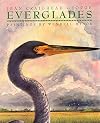
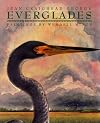
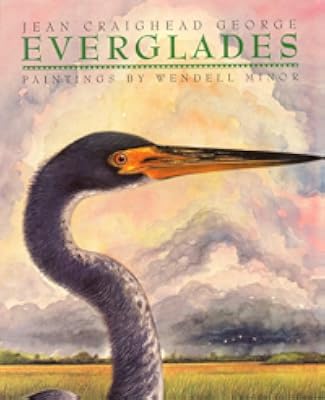
This informational picture book caught my attention primarily because of the cover, which features a beautiful painting of a Great Blue Heron. I've become very interested in birds over the last couple of years. When I lived in Virginia, I woke up each morning to the chatter of a family of Northern Cardinals, and on occasion, a Pileated Woodpecker, going to town on one of several pine trees in our back yard. I watched these birds closely and felt like I really got to know some of them. When we moved to Louisiana, it was sad to say goodbye -- that is until I encountered some of the birds that were waiting for me down here, like the Great Blue Heron. This is a VERY roundabout way of saying, sometimes a striking cover is all it takes to show more pick up a book -- and I'm very glad that I picked this one up.
Through beautiful paintings and masterfully crafted sentences, "Everglades" tells the story of Florida's tropical wetlands region, from its fertile beginnings to its currently imperiled state. Focusing on the ecosystem’s scientific and anthropological evolution, the book paints a vivid picture of how the area has changed over time. The setting for the story is a Native American man paddling a group of children down the river in a canoe and explaining what they are seeing -- and can no longer see. By the end of the book, the tone shifts to one of conservation, and ultimately, a call to action for the youth to save the Everglades. The message is very convincing after the book’s survey of the area's diminishing wild and plant life.
From the perspective of an English teacher, I think this book is a wonderful example of "saying a lot, with a little." I think the book also could be used as a figurative language mentor text. Consider these gorgeous examples:
* "It was a slow river that gleamed like quicksilver"
* "When the winds blew, the saw grass clattered like a trillion swords"
* "A plentitude of orchids bloomed and turned the island trees into colorful cathedral windows)
Overall, I loved this book. The paintings alone are worth the price of admission, but I was pleased to discover that, as a whole, the book as well-written, message driven, and packed with interesting information. show less
Through beautiful paintings and masterfully crafted sentences, "Everglades" tells the story of Florida's tropical wetlands region, from its fertile beginnings to its currently imperiled state. Focusing on the ecosystem’s scientific and anthropological evolution, the book paints a vivid picture of how the area has changed over time. The setting for the story is a Native American man paddling a group of children down the river in a canoe and explaining what they are seeing -- and can no longer see. By the end of the book, the tone shifts to one of conservation, and ultimately, a call to action for the youth to save the Everglades. The message is very convincing after the book’s survey of the area's diminishing wild and plant life.
From the perspective of an English teacher, I think this book is a wonderful example of "saying a lot, with a little." I think the book also could be used as a figurative language mentor text. Consider these gorgeous examples:
* "It was a slow river that gleamed like quicksilver"
* "When the winds blew, the saw grass clattered like a trillion swords"
* "A plentitude of orchids bloomed and turned the island trees into colorful cathedral windows)
Overall, I loved this book. The paintings alone are worth the price of admission, but I was pleased to discover that, as a whole, the book as well-written, message driven, and packed with interesting information. show less
The details in this book are amazing. It tells of the history of the Florida Everglades as well as giving the reader insight about what goes on there. The story is told through a tour, on a boat, with some kids and a man. The storyteller is paddling a boat through the Everglades and tells about the amazing things they see. I like that the author chose to have someone tell the story to children because my students would be able to connect to it more. The illustrations are so detailed and look like real pictures which are so awesome to look at. I think anyone would enjoy this book.
An indiginous story teller poles a boat through the Florida everglades, and tell the children with him the story of the river and the creatures who live nearby. Pictures are breathtaking, and history is woven through the tale.
Everglades by Jean Craighead George, is an informational text about the Everglades in Florida. The author immediately brings you into the story by inviting you into the scene of a tour guide telling the story of the Everglades to a group of children as they float along the river. Facts of the everglades are shared in story form beginning with the formation of the land itself, from sand to rock to land, to the people who overtook the land, hindering its beauty. Large paintings by Wendell Moinor depicting images of the text fill the pages. Throughout the journey of the story children ask the story teller questions that perhaps the reader may ask. It is an informative and easy to follow book that a young reader can easily place themselves show more in. A good read along and read aloud. show less
A lyrical creation tale of the Florida Everglades with stunning landscapes by Wendell Minor.Supports the Common Core State Standards
Summary: Describes the Florida Everglades, the evolution of this unique area, and the impact humans have had on its once-abundant life forms.
- Medha Engineer
From Publishers Weekly
Newbery Medalist George presents a haunting plea for the preservation of endangered ecosystems, a plea strengthened by Minor's majestic paintings. Poling a canoe through the Everglades, a man tells his five young passengers a story. Beginning with "the age of the Seashells," the narrator shows the children how the spillover from Lake Okeechobee became "a slow river that gleamed like quicksilver"; and how the "saw grass clattered like a trillion swords" when the wind blew. As he describes "all things large and small that make the Earth beautiful," full-spread show more art depicts the river's history, while medallions top text pages with symbols of the vanishing Everglades. When the storyteller details the wanton destruction of this habitat, the dispirited children request "a happy story." He then tells of how "five children and a storyteller poled into the Everglades" and "eventually the children grew up and ran the Earth." With her narrative skill and expertise as a naturalist, George adroitly avoids didacticism. A particularly persuasive environmental work. Ages 6-9.
Copyright 1995 Reed Business Information, Inc. --This text refers to an out of print or unavailable edition of this title.
From School Library Journal
Grade 2-5?An Indian storyteller poles five children through the Everglades in his dugout, and in language as lush as the land of which he speaks, he tells them the story of the river of grass. He speaks with reverence, beginning eons ago, when there was only the sun and the sea, taking the story through the formation of land rich with lakes and rivers. His words, brimming with metaphor and simile, describe an abundant web of plant and animal life, thriving in "a living kaleidoscope of color and beauty." Minor's paintings, alive with color and detail, open a panoramic door into this idyllic past. The storyteller continues, describing the various peoples who passed through or lived gracefully in this place. So, the children wonder as they look around them, what happened to all that you describe? Now his statements are stark as he describes how hunters, collectors, and finally developers pushed native species to the brink of extinction, or beyond. The listening children soberly ask for a happier tale and their guide describes a future in which they are in control. The story and the art create a mystical tale that flows from a serene start to a powerful conclusion. With the magic of Lynne Cherry's The Great Kapok Tree (Harcourt, 1990) and the strength of Chief Seattle's words in Brother Eagle, Sister Sky (Dial, 1991), this is a plea for conservation and a story eloquently told.?Susan Oliver, Tampa-Hillsborough County Public Library System
Copyright 1995 Reed Business Information, Inc. --This text refers to an out of print or unavailable edition of this title. show less
- Medha Engineer
From Publishers Weekly
Newbery Medalist George presents a haunting plea for the preservation of endangered ecosystems, a plea strengthened by Minor's majestic paintings. Poling a canoe through the Everglades, a man tells his five young passengers a story. Beginning with "the age of the Seashells," the narrator shows the children how the spillover from Lake Okeechobee became "a slow river that gleamed like quicksilver"; and how the "saw grass clattered like a trillion swords" when the wind blew. As he describes "all things large and small that make the Earth beautiful," full-spread show more art depicts the river's history, while medallions top text pages with symbols of the vanishing Everglades. When the storyteller details the wanton destruction of this habitat, the dispirited children request "a happy story." He then tells of how "five children and a storyteller poled into the Everglades" and "eventually the children grew up and ran the Earth." With her narrative skill and expertise as a naturalist, George adroitly avoids didacticism. A particularly persuasive environmental work. Ages 6-9.
Copyright 1995 Reed Business Information, Inc. --This text refers to an out of print or unavailable edition of this title.
From School Library Journal
Grade 2-5?An Indian storyteller poles five children through the Everglades in his dugout, and in language as lush as the land of which he speaks, he tells them the story of the river of grass. He speaks with reverence, beginning eons ago, when there was only the sun and the sea, taking the story through the formation of land rich with lakes and rivers. His words, brimming with metaphor and simile, describe an abundant web of plant and animal life, thriving in "a living kaleidoscope of color and beauty." Minor's paintings, alive with color and detail, open a panoramic door into this idyllic past. The storyteller continues, describing the various peoples who passed through or lived gracefully in this place. So, the children wonder as they look around them, what happened to all that you describe? Now his statements are stark as he describes how hunters, collectors, and finally developers pushed native species to the brink of extinction, or beyond. The listening children soberly ask for a happier tale and their guide describes a future in which they are in control. The story and the art create a mystical tale that flows from a serene start to a powerful conclusion. With the magic of Lynne Cherry's The Great Kapok Tree (Harcourt, 1990) and the strength of Chief Seattle's words in Brother Eagle, Sister Sky (Dial, 1991), this is a plea for conservation and a story eloquently told.?Susan Oliver, Tampa-Hillsborough County Public Library System
Copyright 1995 Reed Business Information, Inc. --This text refers to an out of print or unavailable edition of this title. show less
Ratings
Members
- Recently Added By
Author Information

167+ Works 56,847 Members
Jean Craighead George was born on July 2, 1919 in Washington, D.C. She received degrees in English and science from Pennsylvania State University. She began her career as a reporter for the International News Service. In the 1940s she was a member of the White House press corps for The Washington Post. During her lifetime, she wrote over 100 show more novels including My Side of the Mountain, which was a 1960 Newbery Honor Book, On the Far Side of the Mountain, Julie of the Wolves, which won the Newbery Medal, Julie, and Julie's Wolf Pack. She also wrote two guides to cooking with wild foods and an autobiography entitled Journey Inward. In 1991, she became the first winner of the School Library Media Section of the New York Library Association's Knickerbocker Award for Juvenile Literature. She died on May 15, 2012 at the age of 92. (Bowker Author Biography) show less
All Editions
Awards and Honors
Classifications
Statistics
- Members
- 388
- Popularity
- 80,198
- Reviews
- 6
- Rating
- (3.90)
- Languages
- English
- Media
- Paper
- ISBNs
- 7
- ASINs
- 2