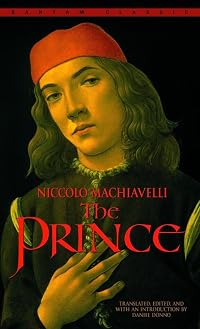
The Prince, and Selected Discourses [Bantam Matrix]
by Niccolò Machiavelli
On This Page
Description
A treatise on leadership written in sixteenth century Italy.Tags
Recommendations











Member Reviews
Machiavelli's beautiful little treatise was an act of patriotism to the despairing Italy, not to mention a sort of present for the Medici in Machiavelli's hopes for job opportunity. I find it is a most interesting and enjoyable, if not down right delightful read. I'm 100% positive America's Left and Right (or, more precisely the power that creates the illusion of a Left and Right) practice Machiavellian tactics day in and day out. This manual has a notoriously famous list of readers that you could probably guess. I hope the rebellion that is being born will not need to use Machiavelli's political tactics, but to overcome the current powers, it may well be a necessary evil. Enjoy, be sure that your leaders did and that they have quite show more handsomely prospered from Niccolo! show less
This book is rather Machiavellian, and there is a reason why that word has become part of our language. I knew what the word meant before I started reading this book, and this book really illustrates how that word has come to be part of our language.
Machiavelli is not evil, nor does he encourage princes to be evil. However, he does wisely caution that sometimes a prince will need to resort to cruelty or other tactics that one would consider underhanded, to preserve his state and also to ensure the greater good of the people he rules over.
He observes that while a prince may want to act kindly (being generous, showing mercy, keeping his word to his allies, and so on) these might actually end up harming him in the long run - if he is show more generous in the beginning his generosity will be taken for granted, same for mercy, and his allies may not always be trustworthy. Nasty as it sounds, Machiavelli is actually right - sometimes you just have to watch out for your own skin or be eaten alive. show less
Machiavelli is not evil, nor does he encourage princes to be evil. However, he does wisely caution that sometimes a prince will need to resort to cruelty or other tactics that one would consider underhanded, to preserve his state and also to ensure the greater good of the people he rules over.
He observes that while a prince may want to act kindly (being generous, showing mercy, keeping his word to his allies, and so on) these might actually end up harming him in the long run - if he is show more generous in the beginning his generosity will be taken for granted, same for mercy, and his allies may not always be trustworthy. Nasty as it sounds, Machiavelli is actually right - sometimes you just have to watch out for your own skin or be eaten alive. show less
Clothed in the indignation of a dearth of ethics, Machiavelli's great masterpiece was met with contempt by his contemporaries, horrified by the preponderances of this political idealist.
Coining the idea that the "ends may justify the means," Machiavelli proposes that rulers should not be restrained by the bounds civilians posess hindering their actions. According to Machiavelli, rulers have the wherewithal to determine the best course of action for their constituents. Correspondingly the ruler should seek to be both loved and feared by their populous but always in the presence of clear thought and cool logic endowed with the desire to benefit their people through the best course of action available. Ultimately, the Prince should have show more the final say on matters choosing based on his personal digression, not the often muddled yearns of the populous.
Political idealists of today's era recognize the sacrifices necessary to provide for the people. They recognize, as Machiavelli did in the dawn of the 16th Century, that executives cannot afford to be restricted by blind morality, compromising the well-being of their people.
However many people claim that Machiavelli's work is too harsh, too obdurate, leaving supposedly infallible executives in control of a suppressed and subservient people. In response, Machiavelli does not openly welcome immorality. Far from it. Machiavelli offers the ability to rulers to choose an immoral action in the exhaustion of every other alternative. Only then do the ends justify the means.
The Prince's only flaw is that it was written by Machiavelli as a plea for a position in the Medici regime of 16th Century Florence. The Prince was a means to an end for Machiavelli written with an air of obsequiousness commending the glories of Medici in the hopes of a return to politics.
Machiavelli writes a well-thought out political treatise documenting escapes out of the political conundrums that befuddle even the most able and adroit rulers. Machiavelli's message resounds with increasing clarity as the problems facing modern executives grow increasingly cryptic. show less
Coining the idea that the "ends may justify the means," Machiavelli proposes that rulers should not be restrained by the bounds civilians posess hindering their actions. According to Machiavelli, rulers have the wherewithal to determine the best course of action for their constituents. Correspondingly the ruler should seek to be both loved and feared by their populous but always in the presence of clear thought and cool logic endowed with the desire to benefit their people through the best course of action available. Ultimately, the Prince should have show more the final say on matters choosing based on his personal digression, not the often muddled yearns of the populous.
Political idealists of today's era recognize the sacrifices necessary to provide for the people. They recognize, as Machiavelli did in the dawn of the 16th Century, that executives cannot afford to be restricted by blind morality, compromising the well-being of their people.
However many people claim that Machiavelli's work is too harsh, too obdurate, leaving supposedly infallible executives in control of a suppressed and subservient people. In response, Machiavelli does not openly welcome immorality. Far from it. Machiavelli offers the ability to rulers to choose an immoral action in the exhaustion of every other alternative. Only then do the ends justify the means.
The Prince's only flaw is that it was written by Machiavelli as a plea for a position in the Medici regime of 16th Century Florence. The Prince was a means to an end for Machiavelli written with an air of obsequiousness commending the glories of Medici in the hopes of a return to politics.
Machiavelli writes a well-thought out political treatise documenting escapes out of the political conundrums that befuddle even the most able and adroit rulers. Machiavelli's message resounds with increasing clarity as the problems facing modern executives grow increasingly cryptic. show less
Worth reading if only to understand how some people are able to view power sans morality. Not very prescriptive for real life, but an interesting classic work none the less.
Interesting book - always portrayed as a bloody, gory story about an individual, it is in fact more of a textbook for the aspiring prince (written as a missive to the Medicis who had been returned to power in Florence, by Machiavelli, who was hoping to regain a position himself in their court). It refers rather bluntly to certain acts which would be required of anyone in such a position - such as elimination of threats and their families - but not in any graphic manner. It is a dispassionate treatment, but fascinating for all that.
Six out of ten.
Typically described as a guidebook for politicians, it's insight into people and groups does make some of the lessons quite applicable to everyday life, for example dealing with workmates or family or to help understand exactly what the PM's latest communication was meant to achieve. Honestly, however, the chapters on keeping mercenaries loyal is of little benefit to anyone.
The Prince is essentially a job application. Macciavelli scared me.
Members
- Recently Added By
Lists

essential pol.phil
17 works; 1 member

Western Canon
24 works; 1 member
Author Information

450+ Works 43,043 Members
Niccolo Machiavelli was born on May 3, 1469 in Florence, Italy. He was a political philosopher, statesman, and court advisor. Starting out as a clerk, he quickly rose in the ranks because he understood balance of power issues involved in many of his diplomatic missions. His political pursuits quickly ended after he was imprisoned by the Medici show more family. He is best known for The Prince, his guide to power attainment and cutthroat leadership. He also wrote poetry and plays, including a comedy named Mandragola. He died on June 21, 1527 at the age of 58. (Bowker Author Biography) show less
All Editions
Work Relationships
Contains
Common Knowledge
- Canonical title
- The Prince, and Selected Discourses [Bantam Matrix]
- Original publication date
- 1532
- First words
- To the Magnificent Lorenzo Di Piero De' Medici:
Those who strive to obtain the good graces of a prince are
accustomed to come before him with such things as they hold most
precious, or in which the... (show all)y see him take most delight; whence one
often sees horses, arms, cloth of gold, precious stones, and
similar ornaments presented to princes, worthy of their greatness. - Last words
- (Click to show. Warning: May contain spoilers.)As in his life he was inferior neither to Philip of Macedon, the father of Alexander, nor to Scipio of Rome, so he died in the same year of his age as they did, and he would doubtless have excelled both of them had Fortune decreed that he should be born, not in Lucca, but in Macedonia or Rome.
- Original language
- Italian
Classifications
Statistics
- Members
- 2,737
- Popularity
- 6,736
- Reviews
- 13
- Rating
- (3.72)
- Languages
- English, Latin
- Media
- Paper, Ebook
- ISBNs
- 1
- UPCs
- 2
- ASINs
- 6