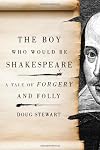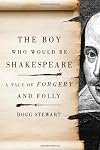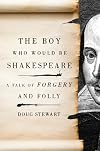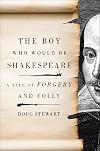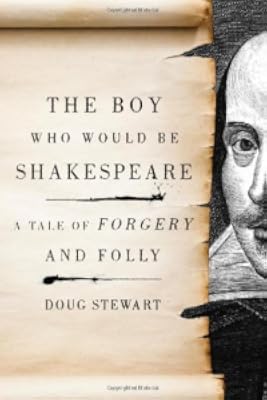
The Boy Who Would Be Shakespeare: A Tale of Forgery and Folly
by Doug Stewart
On This Page
Description
The true story of how a quiet, unremarkable, nineteen-year-old clerk almost pulled off the greatest literary hoax of all time.Tags
Recommendations






Member Reviews
Doug Stewart's The Boy Who Would be Shakespeare: A Tale of Forgery and Folly (Da Capo Press, 2010) is a delightfully-written account of William Henry Ireland's Shakespeare forgeries designed for the general reader. Stewart captures the facts of the case well, offering a full chronology of the hoax as well as a good account of the context surrounding the events in question.
Young William Henry Ireland, wanted to prove himself to the world, but most of all to his overbearing and dismissive father, who didn't believe he would ever amount to much. To please his Shakespeare-obsessed parent, Ireland began forging documents written or signed by William Shakespeare, creating a cover story in the process (he was getting them, he said, from a show more gentleman of his acquaintance who'd sworn him to secrecy). Samuel Ireland was thrilled, and greedily accepted everything his son brought to him (like others, he apparently never suspected young William Henry capable of such deception). The forger was careful in his technique (at least in terms of materials; many slips in orthography would later prove his undoing), but the demands of his father led him further and further into the morass of deceit he created for himself.
Eventually, the jig was up. William Henry claimed to have unearthed a wholly new Shakespeare play, Vortigern and Rowena, which his father arranged to have produced at London's Drury Lane Theatre (owned by Richard Brinsley Sheridan). Just before the play opened, scholarly critic Edmond Malone issued a book-length attack on the Shakespeare manuscripts (which Ireland's father had published), declaring them utter frauds. The play's first performance was also its last. But Samuel Ireland refused to believe his son's soon-proffered confession - he simply couldn't understand that his son the blockhead might have deceived him (and many others) for so long.
While Ireland awaits a full-length biography, and while there are more in-depth scholarly treatments of his forgeries, this is a suitable introduction. Stewart relies perhaps too much on Ireland's own confessions (sometimes contradictory versions of which appeared in 1796, 1805, and 1832), and the lack of in-text notes and a full bibliography is to be lamented. There must be more to be gleaned from the Samuel Ireland papers at the British Library or the materials in the Donald and Mary Hyde collection (now at Harvard). But as a starting point for explorations of this fascinating young man and his forgeries, Stewart's book is satisfactory. It sent me off to my shelf-full of books about the controversy more than once, and its overall message about the forgeries (that people are happy to see what they wish to see) is right on target. Some things, as they say, never change.
http://philobiblos.blogspot.com/2010/04/book-review-boy-who-would-be.html show less
Young William Henry Ireland, wanted to prove himself to the world, but most of all to his overbearing and dismissive father, who didn't believe he would ever amount to much. To please his Shakespeare-obsessed parent, Ireland began forging documents written or signed by William Shakespeare, creating a cover story in the process (he was getting them, he said, from a show more gentleman of his acquaintance who'd sworn him to secrecy). Samuel Ireland was thrilled, and greedily accepted everything his son brought to him (like others, he apparently never suspected young William Henry capable of such deception). The forger was careful in his technique (at least in terms of materials; many slips in orthography would later prove his undoing), but the demands of his father led him further and further into the morass of deceit he created for himself.
Eventually, the jig was up. William Henry claimed to have unearthed a wholly new Shakespeare play, Vortigern and Rowena, which his father arranged to have produced at London's Drury Lane Theatre (owned by Richard Brinsley Sheridan). Just before the play opened, scholarly critic Edmond Malone issued a book-length attack on the Shakespeare manuscripts (which Ireland's father had published), declaring them utter frauds. The play's first performance was also its last. But Samuel Ireland refused to believe his son's soon-proffered confession - he simply couldn't understand that his son the blockhead might have deceived him (and many others) for so long.
While Ireland awaits a full-length biography, and while there are more in-depth scholarly treatments of his forgeries, this is a suitable introduction. Stewart relies perhaps too much on Ireland's own confessions (sometimes contradictory versions of which appeared in 1796, 1805, and 1832), and the lack of in-text notes and a full bibliography is to be lamented. There must be more to be gleaned from the Samuel Ireland papers at the British Library or the materials in the Donald and Mary Hyde collection (now at Harvard). But as a starting point for explorations of this fascinating young man and his forgeries, Stewart's book is satisfactory. It sent me off to my shelf-full of books about the controversy more than once, and its overall message about the forgeries (that people are happy to see what they wish to see) is right on target. Some things, as they say, never change.
http://philobiblos.blogspot.com/2010/04/book-review-boy-who-would-be.html show less
I will admit right off that I am a huge fan of Shakespeare. Somewhat surprisingly, beyond reading and seeing many of his plays and having several monologues memorized (I used to compete when I was in high school), I actually know very little about Shakespeare or Shakespearean scholarship. So, when I discovered that Da Capo Press was offering The Boy Who Would Be Shakespeare: A Tale of Forgery and Folly by Doug Stewart for review, it immediately caught my interest and I requested a copy. The Boy Who Would Be Shakespeare is about a forgery incident that occurred in London in 1795 which I had never even heard about before. Granted, it seems as though familiarity with the case is much more common in United Kingdom than it is in the United show more States. Published in 2010, Stewart's book is one of the most recent works chronicling the events surrounding William-Henry Ireland's forgeries.
In 1795, nineteen-year-old William-Henry Ireland presented to his father a document written by none other than William Shakespeare. He claimed to have discovered it in a trunk he was going through while working as a law clerk. In actuality, he had forged the document himself. To William-Henry's initial delight, his father, a collector of such things, took the item to be authentic. What started as a sort of practical joke quickly turned into something more as William-Henry took advantage of the Shakespeare-mania prevailing in England at the time. He "found" more and more documents relating to Shakespeare: love-letters, receipts, deeds, original drafts and manuscripts, sketches, and perhaps most impressive of all, a previously unknown play. Ireland's audacity seemed to know no bounds even when he realized he was digging and increasingly deeper hole for himself. But for a year and a half, people were willing to suspend their disbelief in the hopes that the discoveries were true.
Although The Boy Who Would Be Shakespeare quite often seemed tangential, one thing that Stewart did very well was to put the events into context. In addition to exploring William-Henry's family situation, he also explores the state of Shakespearean lore in England at the time and why so many people were willing to accept Ireland's forgeries as authentic. Also interesting was how Ireland actually carried out his forgeries, paying very close attention to some details, such as using appropriately selected paper and inks, while at the same time he made blatant errors which could easily be refuted. It was really more luck than skill that allowed him to get away with his scheme for as long as he did. But even after he confessed there were very few people who actually completely believed him--some wanted to hold onto the illusion that the Shakespeare papers were real while others who were convinced they were fake simply didn't think William-Henry was capable of pulling off the stunt, at least not on his own.
The Boy Who Would Be Shakespeare is an easy and short read and although not particularly dry the book will most likely appeal to those interested in Shakespeare or forgery. Stewart works as a freelance journalist and he brings that writing style to his book, making the subject very approachable to those with a passing interest and more serious readers alike. Unfortunately, beyond a brief "note on sources" at the end of the book, Stewart provides few in-text notes or citations, although the index included is very useful. The note also hints at and implies that there may be varying interpretations of the events described in The Boy Who Would Be Shakespeare but these are not thoroughly addressed. However, and granted that I am no expert on the subject, I think that Stewart's book makes for a very nice and accessible introduction.
Experiments in Reading show less
In 1795, nineteen-year-old William-Henry Ireland presented to his father a document written by none other than William Shakespeare. He claimed to have discovered it in a trunk he was going through while working as a law clerk. In actuality, he had forged the document himself. To William-Henry's initial delight, his father, a collector of such things, took the item to be authentic. What started as a sort of practical joke quickly turned into something more as William-Henry took advantage of the Shakespeare-mania prevailing in England at the time. He "found" more and more documents relating to Shakespeare: love-letters, receipts, deeds, original drafts and manuscripts, sketches, and perhaps most impressive of all, a previously unknown play. Ireland's audacity seemed to know no bounds even when he realized he was digging and increasingly deeper hole for himself. But for a year and a half, people were willing to suspend their disbelief in the hopes that the discoveries were true.
Although The Boy Who Would Be Shakespeare quite often seemed tangential, one thing that Stewart did very well was to put the events into context. In addition to exploring William-Henry's family situation, he also explores the state of Shakespearean lore in England at the time and why so many people were willing to accept Ireland's forgeries as authentic. Also interesting was how Ireland actually carried out his forgeries, paying very close attention to some details, such as using appropriately selected paper and inks, while at the same time he made blatant errors which could easily be refuted. It was really more luck than skill that allowed him to get away with his scheme for as long as he did. But even after he confessed there were very few people who actually completely believed him--some wanted to hold onto the illusion that the Shakespeare papers were real while others who were convinced they were fake simply didn't think William-Henry was capable of pulling off the stunt, at least not on his own.
The Boy Who Would Be Shakespeare is an easy and short read and although not particularly dry the book will most likely appeal to those interested in Shakespeare or forgery. Stewart works as a freelance journalist and he brings that writing style to his book, making the subject very approachable to those with a passing interest and more serious readers alike. Unfortunately, beyond a brief "note on sources" at the end of the book, Stewart provides few in-text notes or citations, although the index included is very useful. The note also hints at and implies that there may be varying interpretations of the events described in The Boy Who Would Be Shakespeare but these are not thoroughly addressed. However, and granted that I am no expert on the subject, I think that Stewart's book makes for a very nice and accessible introduction.
Experiments in Reading show less
Fascinating study of how a young forger "became" Shakespeare.
This father was nuts.
Ratings
Members
- Recently Added By
Lists

Literary Forgeries
212 works; 4 members
Author Information
1+ Work 68 Members
Common Knowledge
- Original publication date
- 2010
- People/Characters
- William Henry Ireland
- Dedication
- For Coco
- First words
- In the winter of 1795, a poorly educated nineteen-year-old clerk named William-Henry Ireland stood petrified in his family's London study as two men in powdered wigs interrogated him.
- Last words
- (Click to show. Warning: May contain spoilers.)But he could console himself with knowing that once, for a glorious year and a half, he had been William Shakespeare.
Classifications
- Genres
- Poetry, Literature Studies and Criticism, Fiction and Literature, Biography & Memoir
- DDC/MDS
- 822.33 — Literature & rhetoric English & Old English literatures English drama 1558-1625 Elizabethan period William Shakespeare
- LCC
- PR2950 .S74 — Language and Literature English English Literature English renaissance (1500-1640)
- BISAC
Statistics
- Members
- 69
- Popularity
- 454,784
- Reviews
- 4
- Rating
- (3.47)
- Languages
- English
- Media
- Paper, Ebook
- ISBNs
- 2
- ASINs
- 2