On This Page
Description
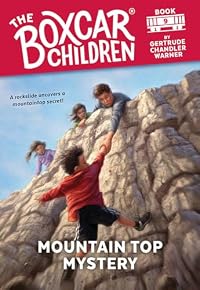
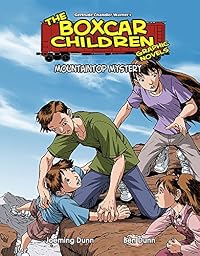
The Aldens climb a mountain and find a mystery! The hike up Old Flat Top was only supposed to take a day, but a dangerous rockslide changes everything to reveal a hidden cave that just may hold a legendary treasure!.
Tags
Recommendations










Member Reviews
I remembered loving the few Boxcar Children books in my local library when I was young. I think I mostly enamored of children being able to survive on their own without parents.
This book is very disappointing. The first part isn't too bad, but once they meet the old Indian woman it turned into a paternalistic fairy tale. To be expected from a 1964 publication.
Lovan lived to age 90 managing on her own, but once she mentioned a concern about the land being bought out by a logging company, Mr Alden decides to buy it himself. He condescendingly says he'll allow her to live there the rest of her life (which at age 90 won't be impossibly long), but he is already considering it "my woodlot" (p.50). We never get a chance to hear Lovan mention show more her obligation to be a caretaker of the land and protector of the waters. (I know there are wetlands because she gets the sweetgrass for her baskets from a "swamp" (p.51). Mr Alden acknowledges that the government forgets its promises to the Indians (p.44), but he does not mention that a treaty between two nations is more than a promise, it is a legal obligation.
On the basis of this brief meeting, Lovan implores Mr Alden to be a co-owner of the bank account from the sale of a family treasure.
Both Native people in the book state repeatedly that they are the last of their tribe. And Mr Alden is glad that children (presumably white) learn how to do Indian crafts "or we'll lose all the beautiful things that nobody can make as well as the Indian" (p.84) as if there will soon be no more Indians. That perpetrates a common misperception that there are no more Indians when, in fact, they are still here and (now that it is no longer illegal) bringing their cultural practices out of hiding. This is a point that parents or teachers should reinforce with any child who has bothered to read this book.
Other bothersome details: Even tho we assume Mr Alden is an intelligent businessman, he pays no heed to the warnings of local people that a storm is coming. Lovan states she left her family because they called her "stuck up" for liking to learn to read and write. It is more likely that a family would be supportive of a child who can learn a skill that would be useful in dealing with the whites, or that their main reason for not wanting her to go to school was because the Indian Schools in those days were focused on wiping out all traces of their culture from the students. It is not historically accurate for Lovan to state she was allowed to teach students "the good things of Indian life." (p.84) When David is found, he says he had only gone to school for sporadic weeks, yet by the end of the book he is gung-ho on attending school. He feels "for the first time in a long, long time" that he "had a home and someone to care about him." (p.108) Yet he is now still considered a boy and was raised by his grandmother and remembers the stories and the language she taught him. Mr Alden thinks that David looking you "straight in the eyes" (p.118) is a sign of his later well-being, but this is not necessarily a trait of that tribe and only shows that David is following white customs.
On a positive side, we do see David and Lovan initiating a leave -taking without using the words "good-bye," which are typically replaced with some form of "until we meet again" by the indigenous peoples on this continent. show less
This book is very disappointing. The first part isn't too bad, but once they meet the old Indian woman it turned into a paternalistic fairy tale. To be expected from a 1964 publication.
Lovan lived to age 90 managing on her own, but once she mentioned a concern about the land being bought out by a logging company, Mr Alden decides to buy it himself. He condescendingly says he'll allow her to live there the rest of her life (which at age 90 won't be impossibly long), but he is already considering it "my woodlot" (p.50). We never get a chance to hear Lovan mention show more her obligation to be a caretaker of the land and protector of the waters. (I know there are wetlands because she gets the sweetgrass for her baskets from a "swamp" (p.51). Mr Alden acknowledges that the government forgets its promises to the Indians (p.44), but he does not mention that a treaty between two nations is more than a promise, it is a legal obligation.
On the basis of this brief meeting, Lovan implores Mr Alden to be a co-owner of the bank account from the sale of a family treasure.
Both Native people in the book state repeatedly that they are the last of their tribe. And Mr Alden is glad that children (presumably white) learn how to do Indian crafts "or we'll lose all the beautiful things that nobody can make as well as the Indian" (p.84) as if there will soon be no more Indians. That perpetrates a common misperception that there are no more Indians when, in fact, they are still here and (now that it is no longer illegal) bringing their cultural practices out of hiding. This is a point that parents or teachers should reinforce with any child who has bothered to read this book.
Other bothersome details: Even tho we assume Mr Alden is an intelligent businessman, he pays no heed to the warnings of local people that a storm is coming. Lovan states she left her family because they called her "stuck up" for liking to learn to read and write. It is more likely that a family would be supportive of a child who can learn a skill that would be useful in dealing with the whites, or that their main reason for not wanting her to go to school was because the Indian Schools in those days were focused on wiping out all traces of their culture from the students. It is not historically accurate for Lovan to state she was allowed to teach students "the good things of Indian life." (p.84) When David is found, he says he had only gone to school for sporadic weeks, yet by the end of the book he is gung-ho on attending school. He feels "for the first time in a long, long time" that he "had a home and someone to care about him." (p.108) Yet he is now still considered a boy and was raised by his grandmother and remembers the stories and the language she taught him. Mr Alden thinks that David looking you "straight in the eyes" (p.118) is a sign of his later well-being, but this is not necessarily a trait of that tribe and only shows that David is following white customs.
On a positive side, we do see David and Lovan initiating a leave -taking without using the words "good-bye," which are typically replaced with some form of "until we meet again" by the indigenous peoples on this continent. show less
It's kind of strange that after half a dozen books of being on their own, we now have several in a row that always have Grandfather and other adults watching over them, even as they get older and (hopefully) wiser.
That being said, the (easy mode) mountain climbing is pretty neat, getting stranded is actually pretty good from a survival perspective, and finding and exploring caves is something I've always found cool--even if the Aldens don't actually do much of that part.
On the other hand, when you hear that there's an old Indian woman living alone because she wants to, you don't just go drop in unannounced and when you find out she's worried about losing your land... Grandfather just out and buys it? Sure it's ostensibly for a good show more cause, but that is really not a good way to teach people to solve problems...
Overall, it's a fine enough book, but probably among the weaker of the series so far. show less
That being said, the (easy mode) mountain climbing is pretty neat, getting stranded is actually pretty good from a survival perspective, and finding and exploring caves is something I've always found cool--even if the Aldens don't actually do much of that part.
On the other hand, when you hear that there's an old Indian woman living alone because she wants to, you don't just go drop in unannounced and when you find out she's worried about losing your land... Grandfather just out and buys it? Sure it's ostensibly for a good show more cause, but that is really not a good way to teach people to solve problems...
Overall, it's a fine enough book, but probably among the weaker of the series so far. show less
A rockslide strands the Aldens on a mountain! But being stuck on Old Flat Top isn't all bad. As the children wait for rescue, they discover that a secret cave has opened up--one that just might hold legendary treasure!
I reread this book as research for a writing project, and although it probably only deserves one star, I had to bump it up to two stars for nostalgia's sake.
When Henry, Jessie, Violet and Benny go on a hike to the Old Flat Top, there is an accident. There was only one way down, and the first step broke! But when Benny accidentally slips, he opens an entrance to a cave. The last indian of the tribe tells them that her grandfather's grandpa hid some treasure in a cave. This book will be perfect for people who love mysteries and loves surprises.
love this series
Book 9 of 159
Members
- Recently Added By
Lists

1960s
281 works; 16 members
Author Information

390+ Works 119,803 Members
Gertrude Chandler Warner was born in Putnam, Connecticut on April 16, 1890. Due to her poor health, she never finished high school and studied with a tutor. During World War I, a shortage of teachers prompted the local school board to hire her to teach first grade, a position she held for over 30 years. She wrote the first Boxcar book in 1924, show more while home recuperating from an illness, but the version most people are familiar with was originally published in 1942. The Alden children became so popular that she wrote 19 adventures about them including Surprise Island, Mystery Ranch, and Snowbound Mystery. She died at age 89 August 29, 1979, but the Boxcar Children are still being written about by a team of writers faithful to her vision. (Bowker Author Biography) show less
All Editions
Series


Work Relationships
Is contained in
Has the adaptation
Common Knowledge
- Canonical title
- Mountain Top Mystery
- Original publication date
- 1964
- People/Characters
- Benny Alden; Henry Alden; Jessie Alden; Violet Alden
- First words
- It was a fine warm day in early summer.
- Last words
- (Click to show. Warning: May contain spoilers.)Anyway, whatever we do will be another story, huh, Gramps?
- Disambiguation notice
- ISBNs 0807552941 / 1616415223 / 1616411236 / 1306242444 / 1451725825
are for the graphic versions of the book.
Classifications
Statistics
- Members
- 2,652
- Popularity
- 6,988
- Reviews
- 10
- Rating
- (3.71)
- Languages
- English
- Media
- Paper, Audiobook, Ebook
- ISBNs
- 21
- ASINs
- 22