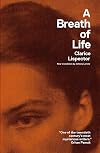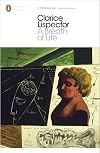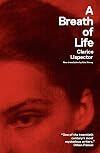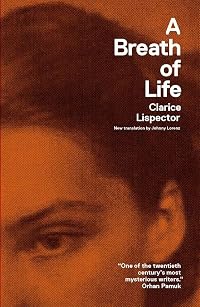
A Breath of Life
by Clarice Lispector
On This Page
Description
"A mystical mediation on creation and death in which a man (a thinly disguised Clarice Lispector) infuses the "breath of life" into his creation [and] forms a dialogue between the god-like author and the speaking, breathing, dying creature herself: Angela Pralini"--Page 4 of cover.Tags
Recommendations








Member Reviews
I am enamoured. Clarice Lispector's language sparkles with depth and her philosophical assertions leave me breathless. This book is incomplete, published after her death, which makes the book's obsession, even love, of death so much more significant. But perhaps the most obvious focus of the book was its central theme of writing, creation and existence as a created being (out of words?). There is a lot of talk about signification, and the author in the book communicates with his own literary creation/character. It's writing about writing. Writing as creation and understanding its philosophy in parallel with our own existence. She is a genius.
Clarice Lispector finished this (if she did finish it) while dying of ovarian cancer. Killed by that which can give life. (Which is bullshit essentialism I guess, but it's hard not to imagine the metaphor occurred to her in a book about death and creation.)
In the beginning was the Word. So in A Breath of Life she creates a nameless male author who creates a female character named Ângela, who, The Author tells us, is a lousy writer and will never finish a book, but will be useful to him to investigate the big questions of, y'know, life the universe and everything. Ângela, of course, doesn't know she's fictional, and goes about storming language and thought itself, looking for permanence, looking for clarity, looking for essence in the show more face of fleeting time, impending death.
The whole book reads like a lopsided dialogue; The Author makes his grumpy analyses; Ângela her breathless (sorry) freewheelins on God; The Author tells us (or whoever is supposed to be reading him) that she's stupide, a typical woman, with neither the wits nor the endurance to understand and communicate; she just works to ecstatically be, unafraid and clear.
I won't say this is my favourite Lispector. Whether unfinished or not, it's fragmentary by design, occasionally frustratingly vague. Maybe if I'd read this before Stream of Life I wouldn't feel like I'd read some of this before. But in a sense, I guess that's the point; the novel doesn't so much put a full stop on a life, a career, as disseminate it and open it up, in that magnificent finale, find Grace. Even if I don't believe in that, I do believe in this book. show less
In the beginning was the Word. So in A Breath of Life she creates a nameless male author who creates a female character named Ângela, who, The Author tells us, is a lousy writer and will never finish a book, but will be useful to him to investigate the big questions of, y'know, life the universe and everything. Ângela, of course, doesn't know she's fictional, and goes about storming language and thought itself, looking for permanence, looking for clarity, looking for essence in the show more face of fleeting time, impending death.
The whole book reads like a lopsided dialogue; The Author makes his grumpy analyses; Ângela her breathless (sorry) freewheelins on God; The Author tells us (or whoever is supposed to be reading him) that she's stupide, a typical woman, with neither the wits nor the endurance to understand and communicate; she just works to ecstatically be, unafraid and clear.
I won't say this is my favourite Lispector. Whether unfinished or not, it's fragmentary by design, occasionally frustratingly vague. Maybe if I'd read this before Stream of Life I wouldn't feel like I'd read some of this before. But in a sense, I guess that's the point; the novel doesn't so much put a full stop on a life, a career, as disseminate it and open it up, in that magnificent finale, find Grace. Even if I don't believe in that, I do believe in this book. show less
Reading Clarice Lispector is experiencing the deepest notes of a violin while being a surrealistic painting in the likes of Leonara Carrington or Remedios Varo - external reality bends, objects overlap, flicker and dissipates leaving behind a shifting aura of your innermost animal self.
It is an unmatchable mystical experience.
This particular work is her last and incomplete. It was posthumously complied by her friend and published. The narrative follows a conversation between an Author and his creation - Angela. They are two sides of the same coin. The Author is bound by the shackles of civil society and socialization. Angela is free but wants to be freer. This freedom propels her into the unknown but also taunts her for all that she show more wouldn't understand or explore.
The conversation is haphazard. It is all over the place. It jumps topics. And the is less of a back and forth and more two simultaneous monologues or Angela's monologue with the Author's commentary.
I read most of it in one sitting, it is not very long, but it does have a psychedelic, trippy effect on me, which I have also felt with all her other works that I have read. Solid 5/5. show less
It is an unmatchable mystical experience.
This particular work is her last and incomplete. It was posthumously complied by her friend and published. The narrative follows a conversation between an Author and his creation - Angela. They are two sides of the same coin. The Author is bound by the shackles of civil society and socialization. Angela is free but wants to be freer. This freedom propels her into the unknown but also taunts her for all that she show more wouldn't understand or explore.
The conversation is haphazard. It is all over the place. It jumps topics. And the is less of a back and forth and more two simultaneous monologues or Angela's monologue with the Author's commentary.
I read most of it in one sitting, it is not very long, but it does have a psychedelic, trippy effect on me, which I have also felt with all her other works that I have read. Solid 5/5. show less
An unnamed male author creates a female character, Angela Pralini, to act as a vessel for his thoughts. The two sets of dialogues soon become conjoined; the myriad reflections on writing, identity, and anxiety become a discourse the two share, proving that a fictionalization of oneself—for an artist—is akin to living if only through someone else.
Lispector's fragmentary style, which is wonderfully done in The Passion According to G.H., is here even more fragmentary and a bit less contained for that. A Breath of Life remained unfinished at her death, and this shows itself at various points in the text. With that said, it is still a chilling and searing meditation on writing, and on how the writer needs his or her characters more so show more than his or her readers. show less
Lispector's fragmentary style, which is wonderfully done in The Passion According to G.H., is here even more fragmentary and a bit less contained for that. A Breath of Life remained unfinished at her death, and this shows itself at various points in the text. With that said, it is still a chilling and searing meditation on writing, and on how the writer needs his or her characters more so show more than his or her readers. show less
Given the circumstances surrounding this book and its publication, I'm wary of rating it 5 stars. It's an 'unfinished' novel, edited without the input of the author. This could be an interesting process, were it something planned and approved by the author. But as it is, it seems this novel is only partially the author's (albeit a large percentage hers).
The word 'novel' is only loosely appropriate for a book like this. It reads more like a play, with two established voices sharing the stage. Whatever it is, it can certainly be considered 'experimental'. Lispector uses her narrator (apparently a man) and the creation of this narrator, Angela Pralini to winnow away at the idea and reality of death. The personalities of both the narrator show more and his creation Angela overlap in such a way that the book often feels like a constantly-shifting container inside which liquid whimsy is moving from one character to the other and back. The personality of Angela moves from morose to jovial, while the narrator plays the foil in each case.
The idea of 'being' is posed through the creation of a character that, despite the inevitable death of the narrator, is not subject to mortality. This, however, does not keep Angela from deep considerations of the mortality that surrounds her. She offers brief studies of different objects around her, and each is incredibly beautiful.
This book is not something to be read simply once. After reading it once, I feel both a confusion for what I missed and an eagerness to continue sifting for the gems that are inside. The language is poetic to the point that it can't simply be read like the 'novel' that it pretends to be. show less
The word 'novel' is only loosely appropriate for a book like this. It reads more like a play, with two established voices sharing the stage. Whatever it is, it can certainly be considered 'experimental'. Lispector uses her narrator (apparently a man) and the creation of this narrator, Angela Pralini to winnow away at the idea and reality of death. The personalities of both the narrator show more and his creation Angela overlap in such a way that the book often feels like a constantly-shifting container inside which liquid whimsy is moving from one character to the other and back. The personality of Angela moves from morose to jovial, while the narrator plays the foil in each case.
The idea of 'being' is posed through the creation of a character that, despite the inevitable death of the narrator, is not subject to mortality. This, however, does not keep Angela from deep considerations of the mortality that surrounds her. She offers brief studies of different objects around her, and each is incredibly beautiful.
This book is not something to be read simply once. After reading it once, I feel both a confusion for what I missed and an eagerness to continue sifting for the gems that are inside. The language is poetic to the point that it can't simply be read like the 'novel' that it pretends to be. show less
I am going to exercise caution, and out of respect for others faith and strong beliefs I will refrain from commenting too strongly on what I have just finished reading here. It is obvious to me that Clarice Lispector thought a great deal about her own death and dying. The book is highly meditative. It also felt quite Catholic to me, and I have no idea whether Lispector was Catholic or not. I myself was raised a Lutheran which frankly ended badly for me. I am also a recovering alcoholic and drug addict who has so far successfully practiced the twelve steps of Alcoholics Anonymous and turned my will over to a "power greater than myself" over twenty-six years ago on a Easter Sunday. I was also visited at bedside back then by the Christian show more savior called Jesus Christ. At that time for me the visit was real and my faith in this version of God helped me to abstain from the drugs that were destroying my body. I stayed away long enough in which to get a new life, to patch up and make amends to the many people I made suffer, and to engage my heart's desire, knowing that I would and could sustain this momentum for life if I kept my nose to the ground. But the mind is a powerful thing that can imagine realities that may not exist anywhere else in the world outside of the person believing them. And it takes what it takes. Every person's pain threshold is their very own and not to be judged by assholes such as myself who might think they know better than anybody else. There are many of those among us. For the record I no longer believe in much of anything these days except treating others as I wish to be treated. We all believe in something and I believe I am completely finished when I die. I do hope I will have added something to the quality of life throughout the entire process and duration of my artistic life.
This last book of Clarice Lispector read hollow to me. In a way, I wish it would have felt more desperate. As much as she must have felt at the time it did not transcend for me on to the page. But I am looking forward to reading a bit more of her plot-driven work, and will always attempt while reading her to see the world through Lispector vision, but I am not promising that I actually will. show less
This last book of Clarice Lispector read hollow to me. In a way, I wish it would have felt more desperate. As much as she must have felt at the time it did not transcend for me on to the page. But I am looking forward to reading a bit more of her plot-driven work, and will always attempt while reading her to see the world through Lispector vision, but I am not promising that I actually will. show less
La dialéctica entre El Autor y Ángela la disfrute bastante. Algunas de las reflexiones de ambos también. Este es el segundo libro que leo de esta autora y se me hizo un poco más difícil de disfrutar de a rachas.
Members
- Recently Added By
Lists

Latin American Literature
50 works; 11 members
Author Information

151+ Works 12,883 Members
Clarice Lispector was born in the Ukraine and was taken to Brazil as a young child. She was a law student, editor, translator, and newswriter, who traveled widely, spending eight years in the United States. "Family Ties" (1960) is a collection of short stories revealing Lispector's existentialist view of life and demonstrating that even family show more ties and social relationships are temporary. Although tied to each other and to the outside world, the characters are finally totally alone and separate. Lispector received praise from American critics for "The Apple in the Dark" (1967), a novel about a guilt-ridden man's search for the ultimate knowledge (Eve's apple), which he believes will bring him hope. Lispector's books are being translated into various languages in Europe, especially in France, where the critic Helene Cixous is one of her great admirers and a promoter of her works. (Bowker Author Biography) show less
Some Editions
Common Knowledge
- Canonical title
- A Breath of Life
- Original title
- Um Sopro de Vida
- Original publication date
- 1978
- Original language
- Brazilian Portuguese
Classifications
- Genres
- Fiction and Literature, General Fiction
- DDC/MDS
- 869.3 — Literature & rhetoric Spanish Literature Literatures of Portuguese and Galician languages Portuguese fiction
- LCC
- PQ9697 .L585 .S613 — Language and Literature French, Italian, Spanish and Portuguese literatures Portuguese literature Provincial, local, colonial, etc. Brazil
- BISAC
Statistics
- Members
- 415
- Popularity
- 74,640
- Reviews
- 8
- Rating
- (4.06)
- Languages
- 8 — Catalan, English, Finnish, French, Italian, Portuguese (Portugal), Spanish, Swedish
- Media
- Paper, Ebook
- ISBNs
- 24
- ASINs
- 8