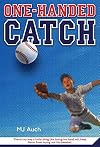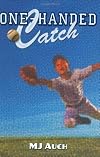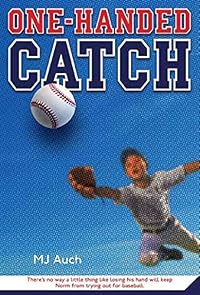
One-Handed Catch
by M. J. Auch
On This Page
Description
After losing his hand in an accident in his father's butcher shop in 1946, sixth-grader Norman uses hard work and humor to learn to live with his disability and to succeed at baseball, art, and other activities.Tags
Recommendations








Member Reviews
Narrated by Ryan Sparkes and cast. This story covers a year in Norm's life starting when he loses his hand in his father's meat grinder through the one-year anniversary of the accident, a day when he helps pitch a baseball game. The scene describing the accident isn't gruesome but readers may squirm at the idea. Norm doesn't let too much get him down, but he does experience frustration, as when his mother insists he start learning to do for himself, or his father and best friend Leon aren't supportive of Norm's efforts to overcome his injury. And occasionally there are tears and anger. Norm, however, continues to work hard at the things that are important to him, including finding a way to catch and hit in baseball.
The audio show more presentation is delightful. The boy reading for Norm brings in a boyish, gee-whiz spirit and even better, his voice is changing so you occasionally hear his voice crack which only adds to the appeal and authenticity of the story. Swing music interludes between chapters set the 1940s atmosphere. An interview with the author and her husband who is the inspiration for Norm closes the audio. show less
The audio show more presentation is delightful. The boy reading for Norm brings in a boyish, gee-whiz spirit and even better, his voice is changing so you occasionally hear his voice crack which only adds to the appeal and authenticity of the story. Swing music interludes between chapters set the 1940s atmosphere. An interview with the author and her husband who is the inspiration for Norm closes the audio. show less
Norm has lost his hand in a meat grinder accident. Now he's faced with the overwhelming task of putting his life back together as he struggles to relearn all those things that used to be so easy. Is it possible to tie shoelaces with one hand? He'd better learn unless, as Norm's tough-love mother says, he wants her tagging along to tie his laces when they come undone. Think of it as a puzzle! Figure it out! As far as she's concerned, Norm's not going to get any special treatment. There are so many things to figure out: how to pitch, bat, and catch so he can play his beloved baseball; how to play an instrument in the school band; how to tie knots for the Boy Scout Jamboree. Norm's story is sad, funny, and inspiring but never overly show more sentimental as he stubbornly refuses to let anything stop him. A home run of a story inspired by the life of the author's husband who lost his left hand and went on to excel at sports and to become a graphic artist and illustrator. show less
What would life be like with only one hand? That's exactly what eleven-year-old Norm finds out when he loses his left hand in an accident at his family's store. It's July 4, 1946. World War II has ended, and life is getting back to normal. But for Norm, the pressing question now is whether he will ever be able to play baseball again, or be an artist. It's up to Norm to find the strength to get beyond this roadblock and move on with his life.
Set against the quickening pace of life after wartime constraints, this inspiring novel is about an optimist who overcomes his misfortune with discipline and humor--and fulfills his dreams in ways no one could have expected.
Set against the quickening pace of life after wartime constraints, this inspiring novel is about an optimist who overcomes his misfortune with discipline and humor--and fulfills his dreams in ways no one could have expected.
I liked this sweet story about determination in the face of adversity. I came to care about Norm and admire him as he moved through the year in his life after an accident that resulted in his hand being amputated. His mom and dad handled the accident really differently, with his mom refusing to give him any special treatment and asking others do the same. An afterward by the author shares that this story was inspired by her husband losing his hand in a similar manner when he was young.
My seventh Bluebonnet and my seventh book of realistic fiction, with sad, sad characters living sad, sad lives. I thought Bluebonnets were supposed to be a nice cross-section of genres….One-Handed Catch is my favorite Bluebonnet, nevertheless. Norm wants to be either an artist or a baseball player, but his hopes are dashed when he cuts off his hand in a meat-grinder accident. Norm’s mother doesn’t let his handicap serve as a crutch, however, and Norm learns to do everything he once did easily with two hands using his one hand. Norm struggled not only with relearning tasks, but he also had to deal with people’s stares and rude comments. I liked Norm’s gumption. A good story.
Norm has dreamed of becoming a great baseball player since he could throw a ball. An accident with his dad's meat grinder quickly makes that dream much more difficult to achieve - but not impossible.
Told in a way that only an 11-year-old boy could, humor is abundant. His father guiltily indulges him, but his mother refuses to let anything change. Because of them, Norm is pushed into believing that he really could continue to live his life and plan his dreams in the same way he did before - it will just take a little creativity and a great attitude.
Told in a way that only an 11-year-old boy could, humor is abundant. His father guiltily indulges him, but his mother refuses to let anything change. Because of them, Norm is pushed into believing that he really could continue to live his life and plan his dreams in the same way he did before - it will just take a little creativity and a great attitude.
Norm plans to set of fireworks with his best friend Leon on the fourth of July, but instead he ends up losing a hand in the the meat grinder of his father's store. The book, which is based on the author's husband's childhood, chronicles the following year of Norm's life as he gets used to life with only one hand. The tone of the book is believable, neither too heavy with obstacles or cruelty nor too light as it is clear Norm practices long hours to do what he could before and does struggle with stares and name calling. Throughout there are humorous interactions between Norm and Leon, as well as historical detail that nicely set the story after WWII. Norm eventually excels at baseball and the book closes with an exciting game. Some show more readers may be disappointed that the book does not feature more action packed games. Still, a good addition to juvenile collections. show less
Members
- Recently Added By
Author Information

40 Works 5,683 Members
As a child, Mary Jane Auch loved books and read constantly. Her interest in drawing began as a child and continued through high school. She went on to become an art major at Skidmore College. After graduation, Auch went for New York City, but after a year of designing prints for men's pajamas, she decided she wanted to do something more meaningful show more with her life. She enrolled in the Occupational Therapy program at Columbia University, and worked for some years in a children's hospital near Hartford, Connecticut. Eventually, Auch began illustrating for Pennywhistle Press, a national children's newspaper, which led to an interest in illustrating children's books. In the summer of 1984, Auch took a week-long children's writing conference on Cape Cod. Auch finally knew that she wanted to a writer when an instructor told her that sometimes artists find they can paint better pictures with words. She began sending manuscripts to publishers, writing four novels before she sold the first one. She then sold a second book to another publisher the same week. She continued writing books for older kids, abandoning her dream of illustrating for a while. After writing nine books, she wrote and illustrated The Easter Egg Farm, and has done both ever since. (Bowker Author Biography) show less
5 Works 642 Members
Some Editions
Awards and Honors
Awards
Classifications
Statistics
- Members
- 376
- Popularity
- 83,011
- Reviews
- 15
- Rating
- (4.29)
- Languages
- English
- Media
- Paper, Audiobook
- ISBNs
- 14
- ASINs
- 2