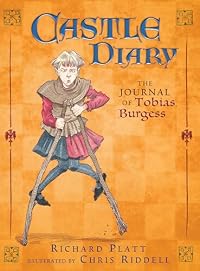
On This Page
Description
As a page in his uncle's castle in thirteenth-century England, eleven-year-old Tobias records in his journal his experiences learning how to hunt, play games of skill, and behave in noble society. Includes notes on noblemen, castles, and feudalism.Tags
Recommendations














Member Reviews
Opening in January of 1285, this work of picture-book historical fiction chronicles one year in the life of Tobias Burgess, a knight's son who sets out for his uncle's castle, there to become a page. Presented as a diary, the story here follows Toby as he learns what life in a castle is like, and becomes accustomed to his new duties, from waiting upon his aunt, Lady Elizabeth, to studying Latin with the Chaplain. There are adventures as well, as he goes on his first hunt, sees his first jousting tournament, befriends a poacher, and participates in a great feast for a visiting earl. When Christmas comes, he learns that his father is coming to take him home for a visit. The book closes with a detailed afterword giving more information show more about Toby's time...
British author Richard Platt has penned four of these historical diaries, one of which, Egyptian Diary: The Journal of Nakht, so impressed me that I decided to seek out the others. Castle Diary: The Journal of Tobias Burgess, Page was every bit as informative and entertaining as that other volume, and appears to be the first of the four titles published. It pairs an engrossing story of a young boy who finds himself in a new situation, and must struggle to find his feet, with detailed and immensely entertaining illustrations from artist Chris Riddell, whose many illustrative projects include Paul Stewart's middle-grade fantasy series, The Edge Chronicles. I liked the mix of fictional and non-fictional elements here, with enough of a story to make this entertainment, and enough information to make it educational. I'd recommend it to middle-grade readers who enjoy historical fiction, or are interested in medieval castles and knights. It would make an excellent additional text in a study unit on the medieval period in European history. show less
British author Richard Platt has penned four of these historical diaries, one of which, Egyptian Diary: The Journal of Nakht, so impressed me that I decided to seek out the others. Castle Diary: The Journal of Tobias Burgess, Page was every bit as informative and entertaining as that other volume, and appears to be the first of the four titles published. It pairs an engrossing story of a young boy who finds himself in a new situation, and must struggle to find his feet, with detailed and immensely entertaining illustrations from artist Chris Riddell, whose many illustrative projects include Paul Stewart's middle-grade fantasy series, The Edge Chronicles. I liked the mix of fictional and non-fictional elements here, with enough of a story to make this entertainment, and enough information to make it educational. I'd recommend it to middle-grade readers who enjoy historical fiction, or are interested in medieval castles and knights. It would make an excellent additional text in a study unit on the medieval period in European history. show less
I would not have enjoyed this except for Riddell's art; the characters came alive. Otherwise, I guess I'm too jaded, have read too much, to feel like I need to learn more about this time. But it was an LFL find, so I tried it. Now I see that there are companion stories... I'll check if any of those cover a setting that I'm more interested in.
Castle Diary, The Journal of Tobias Burgess, Page is a story of a boy name Tobias who lives his life in a castle that is owned by his uncle. He is his aunt's page which means he has to be there whenever she calls and needs him to do something for her. The story tells about all of the things that Tobias encounters and sees, including seeing his friend captured for a crime and put in a basement. The story is just one year in his life and starts on January 10th when he first comes to the castle and goes until December 27th when his father arrives to take him home.
I like this book because it is set up like a diary. In this way, the reader can go from day to day with Tobias and see what his life was like in the castle.
This book could be used show more to show how other children lived in different parts of the world in different times. Children sometimes get the idea that everyone lives the same way they do. show less
I like this book because it is set up like a diary. In this way, the reader can go from day to day with Tobias and see what his life was like in the castle.
This book could be used show more to show how other children lived in different parts of the world in different times. Children sometimes get the idea that everyone lives the same way they do. show less
This book illustrates what life was like in the 13th century if you lived in a castle. After Tobias (Toby) Burgess is sent to live with his uncle he starts to keep a journal of his daily life. He records everything during his life as a page in the medieval castle. He talks about tournaments, cooking, cleaning toilets, and much more. It is full of his accomplishments and set backs.
I read this book with one of my classes at school. They loved the unusual set up of the book. It is written as a journal so it was easy to use in small blocks of time. We rotated through the class reading all of the journal entries. We had a lot of fun with this book.
I would use this to emphasize story elements such as main character, setting, point of view, show more and so on. I could also use other subject areas during different point of the story. I could introduce or emphasize the water cycle during the time Toby is talking about lack of rain. I would show the children a map a of Europe and some of the main bodies of water around it. Last but not lease they could design and build a castle using shoe boxes, tissue boxes, paper towel and toilet paper roles. show less
I read this book with one of my classes at school. They loved the unusual set up of the book. It is written as a journal so it was easy to use in small blocks of time. We rotated through the class reading all of the journal entries. We had a lot of fun with this book.
I would use this to emphasize story elements such as main character, setting, point of view, show more and so on. I could also use other subject areas during different point of the story. I could introduce or emphasize the water cycle during the time Toby is talking about lack of rain. I would show the children a map a of Europe and some of the main bodies of water around it. Last but not lease they could design and build a castle using shoe boxes, tissue boxes, paper towel and toilet paper roles. show less
This book is about a farmer boy named Tobias Burgress as he moves to the castle and settles in with the way they do things there. He does archery, and also plays with the other boys there. At one point, he missed and hit a sparrow, which he got a small bite of.
I liked this bok because it tells it in a first person point of veiw, and is also enjoyable with him missing, and also playing around with the other pages. It is also very informative, telling you the ranks of the castle, and also some festivals and other things that happen in them.
I liked this bok because it tells it in a first person point of veiw, and is also enjoyable with him missing, and also playing around with the other pages. It is also very informative, telling you the ranks of the castle, and also some festivals and other things that happen in them.
Toby is eleven and as he can read and write and is of semi-noble birth, he is taken to his aunt’s castle to train as a page. Here he witnesses day to day life in the castle – the jousts, the feasts and the fate of a poacher called David – will he be hanged? Toby also has to suffer the torments of his teacher when he has done something wrong – like scribbling notes in class! Great illustrations and a section at the back about medieval history and castle life.p.24 Mark and Toby have to put their fingers in the pillory (See picture) for talking in class
YZTR2LII
Members
- Recently Added By
Lists

Sonlight Books
1,487 works; 25 members

The Story of the World: History for the Classical Child: Activity Book Two
415 works; 2 members

At the Library
217 works; 1 member
Author Information

150+ Works 11,497 Members
Richard Platt has written more than 30 books, and he has been a children's author since 1992
All Editions
Awards and Honors
Series

Common Knowledge
- Original publication date
- 1999
- People/Characters
- Tobias Burgess
Classifications
Statistics
- Members
- 1,275
- Popularity
- 19,051
- Reviews
- 9
- Rating
- (3.81)
- Languages
- 7 — Danish, Dutch, English, French, German, Spanish, Swedish
- Media
- Paper, Ebook
- ISBNs
- 24
- UPCs
- 1
- ASINs
- 4