
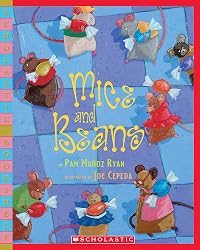
Mice and Beans
by Pam Muñoz Ryan
On This Page
Description
In this rhythmic cumulative tale Rosa Maria spends the week getting ready for her granddaughter's birthday party and trying to avoid attracting mice--unaware that the mice in her walls are preparing for a party of their own.Tags
Recommendations












Member Reviews
Rosa María prepares for her granddaughter Catalina's seventh birthday celebration in this amusing picture-book from author Pam Muñoz Ryan and illustrator Joe Cepeda. Checklist in hand, she creates the delicious food, purchases the necessary gift and piñata with candy, and makes the house ready. Every day, finding the mousetraps she has set are missing, she sets a new one, thinking she forgot the day before. But then, when she does forget something - to put the candy in the piñata - she finds that it has been done for her. Could it be that she has remembered her own mother's saying - "When there's room in the heart, there's room in the house, except for a mouse" - incorrectly...?
A sweet story about a loving grandmother and family show more matriarch and her preparations for a large family gathering, Mice and Beans pairs an entertaining text and bright, colorful illustrations. The text is mostly in English, with a smattering of Spanish words that are glossed at the rear. The contrast between the story, which is told from Rosa María's perspective, and the artwork, which depicts the mice that live in her house, and observe everything she does, creates a humorous reading experience, and the conclusion, in which she decides that there is room in her house for some murine residents, is heartwarming. That said, although I do appreciate the message here about generosity and tolerance, a part of my adult self simply couldn't stomach the idea of accepting mice (or any other rodent) being around one's food. Perhaps this is because I live in an area overrun by the little things. I'm all for anthropomorphic mouse (and even rat) tales, but this one was a little uncomfortable. Leaving that aside, it is a sweet grandmother story, and is one I would recommend (with the caveat that if you find the idea of mice around your food unappealing, you might want to give it a miss) to readers looking for picture-books featuring Mexican-American families, birthdays, and family get-togethers. show less
A sweet story about a loving grandmother and family show more matriarch and her preparations for a large family gathering, Mice and Beans pairs an entertaining text and bright, colorful illustrations. The text is mostly in English, with a smattering of Spanish words that are glossed at the rear. The contrast between the story, which is told from Rosa María's perspective, and the artwork, which depicts the mice that live in her house, and observe everything she does, creates a humorous reading experience, and the conclusion, in which she decides that there is room in her house for some murine residents, is heartwarming. That said, although I do appreciate the message here about generosity and tolerance, a part of my adult self simply couldn't stomach the idea of accepting mice (or any other rodent) being around one's food. Perhaps this is because I live in an area overrun by the little things. I'm all for anthropomorphic mouse (and even rat) tales, but this one was a little uncomfortable. Leaving that aside, it is a sweet grandmother story, and is one I would recommend (with the caveat that if you find the idea of mice around your food unappealing, you might want to give it a miss) to readers looking for picture-books featuring Mexican-American families, birthdays, and family get-togethers. show less
This sweet picture book by Pam Munoz Ryan is about a grandmother planning a party for her grandchild's seventh birthday. All week long, Rosa Maria prepares for the party and makes food for it. Her big concern is about mice, so each night she puts out a mousetrap but the next day is always gone. In the end, the mice come through for Rosa Maria to make her a party a success and she rewards them with some leftovers and stops putting out mousetraps.
The text of the book is simple for young readers but without being reductive. It is also peppered here and there with Spanish words, making it a great read for bilingual classrooms or home. (There is a pronunciation guide and glossary at the back of the book for any readers who need help, but show more context clues should be sufficient for most of the words and phrases.) It's a nice story about the joy of being with family, giving being better than receiving, and sharing and working with others. Granted, the mice being okay in a kitchen suggestion is a perhaps not the best lesson, but otherwise this story is both entertaining and provides a teachable moment for many values. The illustrations are lively and colorful as well as serving to provide dramatic irony as the reader can see the mice squirreling off Rosa Maria's things while the text only mentions her confusion when things are missing. The book also includes a recipe for Rosa Maria's rice and beans, which is an additional multicultural treat. show less
The text of the book is simple for young readers but without being reductive. It is also peppered here and there with Spanish words, making it a great read for bilingual classrooms or home. (There is a pronunciation guide and glossary at the back of the book for any readers who need help, but show more context clues should be sufficient for most of the words and phrases.) It's a nice story about the joy of being with family, giving being better than receiving, and sharing and working with others. Granted, the mice being okay in a kitchen suggestion is a perhaps not the best lesson, but otherwise this story is both entertaining and provides a teachable moment for many values. The illustrations are lively and colorful as well as serving to provide dramatic irony as the reader can see the mice squirreling off Rosa Maria's things while the text only mentions her confusion when things are missing. The book also includes a recipe for Rosa Maria's rice and beans, which is an additional multicultural treat. show less
Rosa María is preparing for her granddaughters Catalina’s birthday party in one week. As the week goes by, she prepares different things for the party and notices each day that she is missing items, each time she says “No importa” meaning “it doesn’t matter” and continues with her list. As the book progresses, we see that the mice are taking the missing items and then we also see them fill the piñata which is the last item on the list. On the day of the party, Rosa sees that the piñata is full even though she didn’t fill it seeing the mice did it and remembers what her mom said “When there’s room in the heart, there’s room in the house EVEN for a mouse”.
This book does a great job at having fun with the pictures, show more which contributes to the story as the plot continues through the pictures. The use of color is amazing as well, without being too much for children. The fact that the illustrations are done in pastels is surprising because it has such detail. The story itself is so wonderful because it truly gives you the experience of latino/a families’ celebrations. The point of view is from a 3rd person which children will love because they can see everything going on.
Personally, I love this book! To begin with, the author does a great job of incorporating Spanish words within the book and explains them to the children reading. She also has a saying for the main character, which is great because Latino’s do have a lot of sayings and includes this without having an explanation for it. The overall theme is great of course, by saying that even something as “meaningless” or unliked as a mouse still is important. The overall presentation of this book is lovely and I can relate to it a lot because it makes me think about my family.
I would use this book to teach word choice because the author does a great job of incorporating spanish words to readers in a fun way. Students will think about their own sayings and add it to their texts. Voice is a great idea to use this book too because the characters are so funny and really stand out from the book. show less
This book does a great job at having fun with the pictures, show more which contributes to the story as the plot continues through the pictures. The use of color is amazing as well, without being too much for children. The fact that the illustrations are done in pastels is surprising because it has such detail. The story itself is so wonderful because it truly gives you the experience of latino/a families’ celebrations. The point of view is from a 3rd person which children will love because they can see everything going on.
Personally, I love this book! To begin with, the author does a great job of incorporating Spanish words within the book and explains them to the children reading. She also has a saying for the main character, which is great because Latino’s do have a lot of sayings and includes this without having an explanation for it. The overall theme is great of course, by saying that even something as “meaningless” or unliked as a mouse still is important. The overall presentation of this book is lovely and I can relate to it a lot because it makes me think about my family.
I would use this book to teach word choice because the author does a great job of incorporating spanish words to readers in a fun way. Students will think about their own sayings and add it to their texts. Voice is a great idea to use this book too because the characters are so funny and really stand out from the book. show less
This book has quickly become a favorite in my family. This was a happy find!
Rosa Maria is planning a birthday party for her granddaughter, Catalina. The story takes you through the days of the week as she plans and prepares for the party. Rosa Maria attends to every little detail, but is a bit forgetful and some things get by her. In fact, she forgets one big important thing on her to-do list that threatens to ruin Catalina’s birthday party. However, she had a little help from some friends—the mice living in her house! At first she believed that “When there’s room in the heart, there’s room in the house, except for a mouse.” But by the end of the book she realizes that she remembered her mother’s words of wisdom show more incorrectly. It should have been “When there’s room in the heart, there’s room in the house, EVEN for a mouse.” The mice help her by filling the piñata with the dulces when she forgets, thus saving the party. Rosa Maria figures it out and is thankful for the help.
This is a wonderful story about opening up your heart and home and creating an unlikely alliance. I think this book works best with small children to learn the lesson of how to be helpful and gracious. It also gives small children a little mystery along the way because the pictures tell more of the story than the words. So children would have to look at the pictures to see what more is happening to put the story together. Children definitely get more from this story the more times it is read and looked at. show less
Rosa Maria is planning a birthday party for her granddaughter, Catalina. The story takes you through the days of the week as she plans and prepares for the party. Rosa Maria attends to every little detail, but is a bit forgetful and some things get by her. In fact, she forgets one big important thing on her to-do list that threatens to ruin Catalina’s birthday party. However, she had a little help from some friends—the mice living in her house! At first she believed that “When there’s room in the heart, there’s room in the house, except for a mouse.” But by the end of the book she realizes that she remembered her mother’s words of wisdom show more incorrectly. It should have been “When there’s room in the heart, there’s room in the house, EVEN for a mouse.” The mice help her by filling the piñata with the dulces when she forgets, thus saving the party. Rosa Maria figures it out and is thankful for the help.
This is a wonderful story about opening up your heart and home and creating an unlikely alliance. I think this book works best with small children to learn the lesson of how to be helpful and gracious. It also gives small children a little mystery along the way because the pictures tell more of the story than the words. So children would have to look at the pictures to see what more is happening to put the story together. Children definitely get more from this story the more times it is read and looked at. show less
I absolutely love this book! I actually used it as a read aloud for my placement in a 2nd grade classroom and the kids loved it! Within this book, there are a few Spanish words and phrases that are mixed into the English text. I think that the inclusion of these words is extremely important and significant because it allows the students to hear another language alongside their native language of English. Also, it allows them to work on their inference and context clue skills because they can use the surrounding text to make inferences of what the Spanish phrase or word means! However, if in case the students don’t quite comprehend the word based on those skills it is always imperative to know what the words and phrases mean (as the show more teacher)! In addition to knowing what the Spanish words and phrases mean, the teacher should try their best to pronounce them as best as they can! From my personal experience, I tried my best to speak the Spanish words and phrases while doing the read-aloud and all of the students genuinely liked the book and how they could learn some words in a new language! And if you happen to mispronounce a few of the words or phrases, a 2nd grader who happens to be a fluent Spanish speaker can help you out!
Another reason why I really enjoyed this book is the illustrations and organization of the text. The vibrant colors along with the textures of the characters and setting really allow the reader/audience to become interested and involved in the story. The bolded words within the text also keep the reader/audience engaged with the storyline because the teacher (during a read aloud) can put more emphasis on those words as well as ask questions to the reader/audience. Overall, I really loved this book and I definitely plan on using it once I have my own classroom! show less
Another reason why I really enjoyed this book is the illustrations and organization of the text. The vibrant colors along with the textures of the characters and setting really allow the reader/audience to become interested and involved in the story. The bolded words within the text also keep the reader/audience engaged with the storyline because the teacher (during a read aloud) can put more emphasis on those words as well as ask questions to the reader/audience. Overall, I really loved this book and I definitely plan on using it once I have my own classroom! show less
In Ryan’s Mice and Beans, a grandmother is busy planning a party for her granddaughter while trying to prevent any mice from “ruining” the grand event. The extensive process and behind the scenes planning reveals how significant family events and people are in the [Latino] culture and how they are highly valued.
I was glad to have had the chance to read this book by Pam Munoz Ryan. I had read Esperanza Rising for my Lit Circle book so it was a nice shift in writing style and imagery to see from her. Mice and Beans is an extremely humorous and lively book. The illustrations are brightly colored and very expressive. The reader gets a sense of the hectic-ness of the story and is able to become engaged with it as well. The amount of show more activity and movement with the pictures is not only aesthetically pleasing, but contributes a great amount to how the book is read. show less
I was glad to have had the chance to read this book by Pam Munoz Ryan. I had read Esperanza Rising for my Lit Circle book so it was a nice shift in writing style and imagery to see from her. Mice and Beans is an extremely humorous and lively book. The illustrations are brightly colored and very expressive. The reader gets a sense of the hectic-ness of the story and is able to become engaged with it as well. The amount of show more activity and movement with the pictures is not only aesthetically pleasing, but contributes a great amount to how the book is read. show less
This book would be great for diversity education. It introduces the importance of family, food, and a fullness of love and heart in the Spanish culture. This book is fun and would entertain children easily. The mice are captivating and keeps you wondering about their mischief the whole way through.
Members
- Recently Added By
Author Information

63+ Works 37,104 Members
Author Pam Muñoz Ryan was born in Bakersfield, California on December 25, 1951. She received a B. A. in child development and a M. A. in education from San Diego State University. Before becoming a full-time author, she worked as a bilingual Head Start teacher and as an early childhood program administrator. At first, she wrote adult books about show more child development, but soon switched to writing children's books. She has written over twenty-five picture books, novels, and nonfiction books for young readers. The novel Esperanza Rising, winner of the Pura Belpre Medal, the Jane Addams Peace Award, an ALA Top Ten Best Book for Young Adults, and the Americas Award Honor Book, is based on her own grandmother's immigration from Mexico to California. Riding Freedom has also won many awards including the national Willa Cather Award and the California Young Reader Medal. When Marian Sang, a picture book about singer Marian Anderson, won numerous awards including the ALA Sibert Honor and NCTE's Orbis Pictus Award. In 2015 her title Echo made The New York Times Best Seller List. She also won a Kirkus Prize in the children's literature category with her title 'Echo'. (Bowker Author Biography) show less
All Editions
Awards and Honors
Awards
Distinctions
Common Knowledge
- Canonical title
- Mice and Beans
Classifications
Statistics
- Members
- 1,200
- Popularity
- 20,662
- Reviews
- 31
- Rating
- (4.10)
- Languages
- English, Spanish
- Media
- Paper
- ISBNs
- 14
- ASINs
- 1