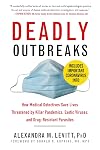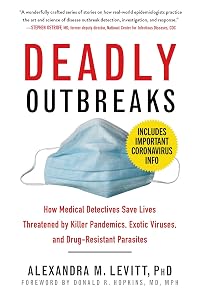
Deadly Outbreaks: How Medical Detectives Save Lives Threatened by Killer Pandemics, Exotic Viruses, and Drug-Resistant Parasites
by Alexandra M. Levitt
On This Page
Description
Despite advances in health care, infectious microbes continue to be a formidable adversary to scientists and doctors. Vaccines and antibiotics, the mainstays of modern medicine, have not been able to conquer infectious microbes because of their amazing ability to adapt, evolve, and spread to new places. Terrorism aside, one of the greatest dangers from infectious disease we face today is from a massive outbreak of drug-resistant microbes. Deadly Outbreaks recounts the scientific adventures show more of a special group of intrepid individuals who investigate these outbreaks around the world and figure out how to stop them. Part homicide detective, part physician, these medical investigators must view the problem from every angle, exhausting every possible source of contamination. Any data gathered in the field must be stripped of human sorrows and carefully analyzed into hard statistics. -- Jacket. show lessTags
Recommendations















Member Reviews
As the subtitle suggests, Deadly Outbreaks is all about medical mysteries. For suspicious cases where multiple patients die or fall ill and the reason is unknown, epidemiologists are often called in to help determine the cause. Some of these investigations are retrospective, but many require clever deduction to take place quickly in order to prevent more people from becoming sick.
The true stories included in Deadly Outbreaks were all interesting and all very different. Although the first story gave away the ending too early, all of the others had me reading quickly to find out what happened next. I am extremely interested in the intersection of biology and math, so the clever way epidemiologists used the data to solve problems and save show more lives made this my kind of book. However, some flaws in the writing kept this from being the riveting narrative non-fiction story it had the potential to be.
Two things in particular struck me as off about the writing but I did have an ARC so it’s possible these will be fixed before the book goes to print. In my copy, the tone of the book was very clinical. When we learned about the people involved in each case, the sections introducing them made me feel like someone was reading a resume at me. A few personal details were thrown in, but even these just felt factual. There were also too many details. For instance, the first case wrap-up includes a listing of which borough in NYC the patients were from. Information like this was far less interesting than the main story and slowed the pace of the whole book.
The science was the other big problem. In some cases, many scientific details were thrown in that even as someone in science, I didn’t find interesting (the size of a particular gene, for example). Often these asides weren’t explained well enough that someone without a science background would get anything out of them. These bits were really asides, so if you have no science background you could easily read this book and skip them without being confused. They didn’t, however, serve a useful purpose. Although I’ve spent a while on the bad bits, I don’t mean to suggest this wasn’t an enjoyable read. The stories were so interesting, they basically speak for themselves, so if you have an interest in medical mysteries, this is a book I’d recommend.
This review first published on Doing Dewey. show less
The true stories included in Deadly Outbreaks were all interesting and all very different. Although the first story gave away the ending too early, all of the others had me reading quickly to find out what happened next. I am extremely interested in the intersection of biology and math, so the clever way epidemiologists used the data to solve problems and save show more lives made this my kind of book. However, some flaws in the writing kept this from being the riveting narrative non-fiction story it had the potential to be.
Two things in particular struck me as off about the writing but I did have an ARC so it’s possible these will be fixed before the book goes to print. In my copy, the tone of the book was very clinical. When we learned about the people involved in each case, the sections introducing them made me feel like someone was reading a resume at me. A few personal details were thrown in, but even these just felt factual. There were also too many details. For instance, the first case wrap-up includes a listing of which borough in NYC the patients were from. Information like this was far less interesting than the main story and slowed the pace of the whole book.
The science was the other big problem. In some cases, many scientific details were thrown in that even as someone in science, I didn’t find interesting (the size of a particular gene, for example). Often these asides weren’t explained well enough that someone without a science background would get anything out of them. These bits were really asides, so if you have no science background you could easily read this book and skip them without being confused. They didn’t, however, serve a useful purpose. Although I’ve spent a while on the bad bits, I don’t mean to suggest this wasn’t an enjoyable read. The stories were so interesting, they basically speak for themselves, so if you have an interest in medical mysteries, this is a book I’d recommend.
This review first published on Doing Dewey. show less
The cases reported in this book are fascinating, and it really sheds light on the diversity of things that public health deals with.
The writing, however, is rather dry and a number of basic concepts are repeated in each case description as if the reader had not been exposed to them before. The book reads rather like a collection of magazine articles. Despite this, it is well worth reading and a good jumping off point for exploring public health medicine.
The audio version of this book suffers from a very bad narrator. The reader has a flat, robotic tone and unnatural cadence. There was no attempt to edit out extraneous acronyms, which, though useful in a printed version are simply painfully repetitive and even confusing in an audio show more version. Mispronunciation of scientific terms was about average, and could be forgiven were not the other deficiencies so annoying.
Worth reading, annoying to listen to. show less
The writing, however, is rather dry and a number of basic concepts are repeated in each case description as if the reader had not been exposed to them before. The book reads rather like a collection of magazine articles. Despite this, it is well worth reading and a good jumping off point for exploring public health medicine.
The audio version of this book suffers from a very bad narrator. The reader has a flat, robotic tone and unnatural cadence. There was no attempt to edit out extraneous acronyms, which, though useful in a printed version are simply painfully repetitive and even confusing in an audio show more version. Mispronunciation of scientific terms was about average, and could be forgiven were not the other deficiencies so annoying.
Worth reading, annoying to listen to. show less
Besides a tour through some of the classic cases solved by epidemiologists, this is your chance to learn the difference between influenza, coronaviruses, and hantaviruses. Maybe you need to know this.
Ratings
Members
- Recently Added By
Author Information
1 Work 91 Members
Alexandra M. Levitt, PhD, is an alumna of the NYU School of Medicine. She joined the Centers for Disease Control and Prevention (CDC) in 1995. There she has prepared policy reports on global health, bioterrorism, and pandemic influenza, and drafted critical case studies of large and unusual outbreak responses. Dr. Levitt resides in Brooklyn, New show more York. show less
Common Knowledge
- Original publication date
- 2013
Classifications
- Genres
- Nonfiction, General Nonfiction, Science & Nature, History
- DDC/MDS
- 614.5 — Applied science & technology Medicine & health Epidemics, Poisons, Alternative Medicine Incidence of and public measures to prevent specific diseases and kinds of diseases
- LCC
- RA643 .L43 — Medicine Public aspects of medicine Public aspects of medicine Public health. Hygiene. Preventive medicine Disease (Communicable and noninfectious) and public
- BISAC
Statistics
- Members
- 91
- Popularity
- 352,925
- Reviews
- 3
- Rating
- (3.58)
- Languages
- English
- Media
- Paper, Ebook
- ISBNs
- 4
- ASINs
- 2