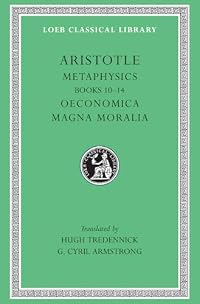
Metaphysics, books 10-14; Magna Moralia; Economics
by Aristotle
On This Page
Description
Nearly all the works Aristotle (384-322 BCE) prepared for publication are lost; the priceless ones extant are lecture-materials, notes, and memoranda (some are spurious). They can be categorized as practical; logical; physical; metaphysical; on art; other; fragments.Tags
Recommendations

Member Reviews
Aristotle was born at Stagirus in 384 BCE, was the son of Nicomachus, a physician, and Phaestis. He studied under Plato at Athens and taught there (367–347); subsequently he spent three years at the court of a former pupil, Hermeias, in Asia Minor and at this time married Pythias, one of Hermeias's relations. After some time at Mitylene, in 343–2 he was appointed by King Philip of Macedon to be tutor of his teen-aged son Alexander. After Philip's death in 336, Aristotle became head of his own school (of 'Peripatetics'), the Lyceum at Athens. Because of anti-Macedonian feeling there after Alexander's death in 323, he withdrew to Chalcis in Euboea, where he died in 322.
Nearly all the works Aristotle prepared for publication are lost; show more the priceless ones extant are lecture-materials, notes, and memoranda (some are spurious). Great Ethics (Magna Moralia) is included in this volume. Economics (on the good of the family) is included here as well. Finally, part of the Metaphysics, on being as being, is included here as well.
The Loeb Classical Library edition of Aristotle is in twenty-three volumes.
Aristotle states in a rare discussion on race that black and white people are the same and equal in the Metaphysics. Oeconomica discusses both micro- and macroeconomics. The basis of the economy is the family. Magna Moralia is disputably associated with Aristotle. show less
Nearly all the works Aristotle prepared for publication are lost; show more the priceless ones extant are lecture-materials, notes, and memoranda (some are spurious). Great Ethics (Magna Moralia) is included in this volume. Economics (on the good of the family) is included here as well. Finally, part of the Metaphysics, on being as being, is included here as well.
The Loeb Classical Library edition of Aristotle is in twenty-three volumes.
Aristotle states in a rare discussion on race that black and white people are the same and equal in the Metaphysics. Oeconomica discusses both micro- and macroeconomics. The basis of the economy is the family. Magna Moralia is disputably associated with Aristotle. show less
Ratings
Members
- Recently Added By
Author Information

2,085+ Works 57,184 Members
Some Editions
Series
Belongs to Publisher Series
Common Knowledge
- Canonical title
- Metaphysics, books 10-14; Magna Moralia; Economics
- Original title
- Aristotle in Twenty-Three Volumes, XVIII : Metaphysics, Books X-XIV ; Oeconomica ; Magna Moralia
Classifications
Statistics
- Members
- 152
- Popularity
- 214,723
- Reviews
- 1
- Rating
- (4.40)
- Languages
- English, Greek (Ancient)
- Media
- Paper
- ISBNs
- 2
- ASINs
- 5