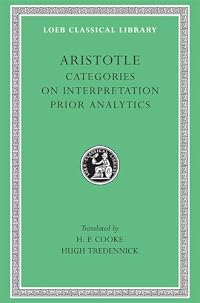
Categories; On Interpretation; Prior Analytics
by Aristotle
On This Page
Description
Nearly all the works Aristotle (384-322 BCE) prepared for publication are lost; the priceless ones extant are lecture-materials, notes, and memoranda (some are spurious). They can be categorized as practical; logical; physical; metaphysical; on art; other; fragments.Tags
Recommendations

































Member Reviews
My original plan with this collection of books (i.e., Categories, On Interpretation, Prior Analytics, Posterior Analytics, Topics, and Sophistical Refutations), collectively known as the Organon, was to read the Topics in preparation for reading On Rhetoric. However, jumping in at Topics proved very difficult because of its reliance on the previous books.
Categories deals with classifying the world as it is experienced. It is rooted in language (i.e., how we talk about or can talk about the world) and it is essentially taxonomic. Things are:
- “Predicated of” = something that is true of a particular entity but is not part of that entity (e.g., tree is predicated of the tree in my yard)
- “Not predicated of” = something that is show more specific and unique, a specific instances (e.g., the tree in my yard)
- “Present in” = a quality that is “accidental” or in a thing but it not essential, it could be removed and it would still be that thing (e.g., “leafed” is present in the tree in my yard, but is accidental to its designation as the tree in my yard)
- “Not present in” = a quality that is “not accidental” meaning that it must be there for the thing to be what it is (e.g., “tree-ness” has to be in the tree in my yard for it to be a tree)
The terminology is very confusing and I was starting to regret not having started with Metaphysics. However, once these terms are clear, they form the basis of all that is to follow.
Prior Analytics is all about understanding demonstration (creation of knowledge) through the use of propositions (assertions of truth or falsity) that are made up of premises and terms (p.45). Here we are introduced to the idea of a “syllogism," which is "a sentence in which certain things being laid down, something else different from the premises necessarily results, in consequence of their existence” (p.45). Surely you have heard the one about all men being mortal, Socrates being a man, making Socrates mortal. This is the book where that comes from. There is a whole taxonomy of syllogistic forms from the basis to the advanced. We can thank some medieval logicians for developing a systems of mnemonic devices for remembering the forms that is (to me) of no help whatsoever. Regardless, the careful and systematic examination of syllogistic forms is enlightening in that it shows exactly how these logical form to interlock and create solid logical foundations, even if just for simple/categorical propositions.
Posterior Analytics describes syllogism resulting in demonstration (i.e., understanding) that follow from certain premises. This is different from rhetoric, which builds from uncertain claims and argues through examples (p.133)
Syllogisms build on prior knowledge (p.133) and although our senses only allow us to develop information singularly, one instance at a time, we seek to know what is universal, the “first principles” (p.134) upon which all knowledge is based and that serves as the common link between individual instances.
Syllogisms allow first principles to result, logically and necessarily, in the individual instances. And in this way, you can recognize some of the problems and arguments about inductive scientific reasoning that were present in discussions of scientific method.
This book is famously concerned with arguments “that a thing is, why it is, if it is, what it is” (p.171).
Topics are about arguments from the common places (topoi). The focus of the treatise is on how to work on enthymemes (arguments from uncertain or probably propositions) (p.192). Whereas in previous books we had first principles from which to orient other propositions, the topics concern arguments from examples and from what is probable but not certain. It is the basis of rhetoric -- rhetoric of all fields, which works toward understanding or discovering their own topoi that replace the axiomatic knowledge derivable from first principles.
Unlike demonstrative claims, those argued through enthymeme do not obtain truth value from their own rights but must be achieved through persuasion (p.192). They proceed inductively, through examples, which is better for persuasion (p.200)
Four common places (p.200):
- Identifying propositions about a thing
- Defining terms
- Identifying how things differ
- Identifying how things are similar
The books in Topics proceed through various ways of constructing and interrogating propositions, terms, similarities and differences, and conclusions. The provide strategies for arguing as convincingly as possible (achievable with clear and precise language, above all).
Finally, and briefly, the Sophistical Refutations is a very critical look at argumentative strategies taken up by sophists. Aristotle calls out some by name and finds fault with their arguments in terms of the system that he has belabored over the course of the book so far. You will recognize in this discussion the foundation of many of the logical fallacies that are still learned today.
I can't honestly say that I enjoyed the book. It was, in a word, tedious. And it is only out of sheer stubbornness that I continued plodding through at times. Nevertheless, I can offer a tentative recommendation on the following conditions:
- you want to understand the basics of categorical logic
- you have the time and patience to map out the various forms, steps, and missteps of logical argumentation
- you don't mind puzzling through the scant examples given and the supplying some of your own to solidify your understanding of the terms
- you don't mind a fair bit of repetition.
It's a lot of conditions but the payoff is pretty big. To readers who are familiar with scientific method, elementary logic, syllogisms, logical fallacies, enthymemes, and arguments from uncertainty and probability, you will find that the books in this collection are the very origins of those ideas and practices. If you ever had any doubt that Aristotle was a big influence on modern thought, you won't after this collection. show less
Categories deals with classifying the world as it is experienced. It is rooted in language (i.e., how we talk about or can talk about the world) and it is essentially taxonomic. Things are:
- “Predicated of” = something that is true of a particular entity but is not part of that entity (e.g., tree is predicated of the tree in my yard)
- “Not predicated of” = something that is show more specific and unique, a specific instances (e.g., the tree in my yard)
- “Present in” = a quality that is “accidental” or in a thing but it not essential, it could be removed and it would still be that thing (e.g., “leafed” is present in the tree in my yard, but is accidental to its designation as the tree in my yard)
- “Not present in” = a quality that is “not accidental” meaning that it must be there for the thing to be what it is (e.g., “tree-ness” has to be in the tree in my yard for it to be a tree)
The terminology is very confusing and I was starting to regret not having started with Metaphysics. However, once these terms are clear, they form the basis of all that is to follow.
Prior Analytics is all about understanding demonstration (creation of knowledge) through the use of propositions (assertions of truth or falsity) that are made up of premises and terms (p.45). Here we are introduced to the idea of a “syllogism," which is "a sentence in which certain things being laid down, something else different from the premises necessarily results, in consequence of their existence” (p.45). Surely you have heard the one about all men being mortal, Socrates being a man, making Socrates mortal. This is the book where that comes from. There is a whole taxonomy of syllogistic forms from the basis to the advanced. We can thank some medieval logicians for developing a systems of mnemonic devices for remembering the forms that is (to me) of no help whatsoever. Regardless, the careful and systematic examination of syllogistic forms is enlightening in that it shows exactly how these logical form to interlock and create solid logical foundations, even if just for simple/categorical propositions.
Posterior Analytics describes syllogism resulting in demonstration (i.e., understanding) that follow from certain premises. This is different from rhetoric, which builds from uncertain claims and argues through examples (p.133)
Syllogisms build on prior knowledge (p.133) and although our senses only allow us to develop information singularly, one instance at a time, we seek to know what is universal, the “first principles” (p.134) upon which all knowledge is based and that serves as the common link between individual instances.
Syllogisms allow first principles to result, logically and necessarily, in the individual instances. And in this way, you can recognize some of the problems and arguments about inductive scientific reasoning that were present in discussions of scientific method.
This book is famously concerned with arguments “that a thing is, why it is, if it is, what it is” (p.171).
Topics are about arguments from the common places (topoi). The focus of the treatise is on how to work on enthymemes (arguments from uncertain or probably propositions) (p.192). Whereas in previous books we had first principles from which to orient other propositions, the topics concern arguments from examples and from what is probable but not certain. It is the basis of rhetoric -- rhetoric of all fields, which works toward understanding or discovering their own topoi that replace the axiomatic knowledge derivable from first principles.
Unlike demonstrative claims, those argued through enthymeme do not obtain truth value from their own rights but must be achieved through persuasion (p.192). They proceed inductively, through examples, which is better for persuasion (p.200)
Four common places (p.200):
- Identifying propositions about a thing
- Defining terms
- Identifying how things differ
- Identifying how things are similar
The books in Topics proceed through various ways of constructing and interrogating propositions, terms, similarities and differences, and conclusions. The provide strategies for arguing as convincingly as possible (achievable with clear and precise language, above all).
Finally, and briefly, the Sophistical Refutations is a very critical look at argumentative strategies taken up by sophists. Aristotle calls out some by name and finds fault with their arguments in terms of the system that he has belabored over the course of the book so far. You will recognize in this discussion the foundation of many of the logical fallacies that are still learned today.
I can't honestly say that I enjoyed the book. It was, in a word, tedious. And it is only out of sheer stubbornness that I continued plodding through at times. Nevertheless, I can offer a tentative recommendation on the following conditions:
- you want to understand the basics of categorical logic
- you have the time and patience to map out the various forms, steps, and missteps of logical argumentation
- you don't mind puzzling through the scant examples given and the supplying some of your own to solidify your understanding of the terms
- you don't mind a fair bit of repetition.
It's a lot of conditions but the payoff is pretty big. To readers who are familiar with scientific method, elementary logic, syllogisms, logical fallacies, enthymemes, and arguments from uncertainty and probability, you will find that the books in this collection are the very origins of those ideas and practices. If you ever had any doubt that Aristotle was a big influence on modern thought, you won't after this collection. show less
Ratings
Members
- Recently Added By
Author Information

2,085+ Works 57,184 Members
Some Editions
Series
Belongs to Publisher Series
Common Knowledge
- Canonical title
- Categories; On Interpretation; Prior Analytics
- Original publication date
- 1938
- Original language
- Greek (Ancient) (Ancient)
Classifications
Statistics
- Members
- 213
- Popularity
- 151,914
- Reviews
- 1
- Rating
- (3.94)
- Languages
- English, Greek (Ancient)
- Media
- Paper, Ebook
- ISBNs
- 4
- ASINs
- 1