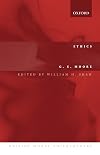
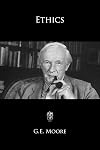
Ethics
by G. E. Moore
On This Page
Description
Short but philosophically rich, and written with impressive precision and intellectual candour, 'Ethics' is a minor classic which repays careful study. This edition includes Moore's essay 'The Nature of Moral Philosophy' as well as editorial notes, an introduction, and a guide to further reading.Tags
Recommendations



























Member Reviews
This is a short book on Ethics, in which the author discusses several views of ethics, arguments against them, and defenses against some of the arguments that are defensible. I found very little to disagree with, and the book covers most of the important areas, such as free-will, utilitarianism, intrinsic value, right and wrong, and objective moral judgments.
Moore is very clear in the way that he rigorously defines what he is trying to say, and what he doesn't mean, so that the reader only has themselves to blame if they don't understand. I don't think that that there was anything in this book that should be thought of as controversial, with all the issues of ethics that are really left still open labelled as such. This of course, show more includes a lot of important things, but not as many as some might think, with several misconceptions being well kicked down.
It is a shame that this is a short book, but this does make it terrific introduction piece of modern ethics. There are books which deal with the individual topics raised here in more detail, but this one makes a good overview, and has a lot of sense in it, and good arguments. show less
Moore is very clear in the way that he rigorously defines what he is trying to say, and what he doesn't mean, so that the reader only has themselves to blame if they don't understand. I don't think that that there was anything in this book that should be thought of as controversial, with all the issues of ethics that are really left still open labelled as such. This of course, show more includes a lot of important things, but not as many as some might think, with several misconceptions being well kicked down.
It is a shame that this is a short book, but this does make it terrific introduction piece of modern ethics. There are books which deal with the individual topics raised here in more detail, but this one makes a good overview, and has a lot of sense in it, and good arguments. show less
Asking ethical questions is very difficult because clarity is required for clear answers, and clarifying the questions one posed is an extremely difficult task. This observation is true also for other philosophical fields where one retreats to the college dictum: "The answer to the question is conditioned by the terms of the question." While that may seem self-evident upon reflection, a surprising number of well-educated moderns working in critical ethical areas seem to stumble clumsily over these simple caveats.
Ratings
Members
- Recently Added By
Author Information

25+ Works 1,410 Members
George Edward Moore was one of the giants in the formation of analytic philosophy in the English-speaking world. During most of his professional life, he was affiliated with Cambridge University---as a student and as a fellow at Trinity College, from 1892 to 1896 and from 1898 to 1904, respectively; as a university lecturer from 1911 to 1925; as a show more professor of mental philosophy and logic from 1925 until his retirement in 1939. Moore's philosophical contributions touch on three areas: philosophical method, moral philosophy, and theory of knowledge. His philosophical method is exhibited in his unrelenting effort to discover and elucidate the meanings of philosophical concepts and in his appeal to common sense. This method is evident in his work in ethics and epistemology. Principia Ethica (1903) established him as the foremost critic of ethical naturalism; his conceptions of goodness as an indefinable quality and of intrinsic value as organic unity were influential not only in philosophical circles but also among the artists and writers of the Bloomsbury group. Moore's work in epistemology was expressed in a large number of articles distinguished for their nicety of analysis. They span six decades, revealing a thinker who moved out of idealism into realism and then moved back and forth among the varieties of realism on such questions as the status of sense data, that is, whether they exist, and if they exist, whether they are physical parts of things or are mental representations only. (Bowker Author Biography) show less
Some Editions
Series
Belongs to Publisher Series
Common Knowledge
- Canonical title
- Ethics
- Original publication date
- 1912
Classifications
Statistics
- Members
- 177
- Popularity
- 185,409
- Reviews
- 2
- Rating
- (3.75)
- Languages
- 6 — English, Finnish, German, Italian, Polish, Spanish
- Media
- Paper, Ebook
- ISBNs
- 22
- ASINs
- 16