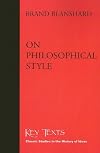
On Philosophical Style
by Brand Blanshard
40 Members (4.67)
On This Page
Description
Originally given in 1953 as the Adamson Lecture at Manchester University, On Philosophical Style has become the classic presentation of the thesis that profundity and clarity are not opposed philosophical virtues but rather required companions. Blanshard begins with the question: Why is it that philosophers of great perception sometimes confess a failure to comprehend certain of their colleagues? He ends with the assertion "that the problem of style is not a problem of words and sentences show more merely, but of being the right kind of mine." In between, there is much offered, in fine style and short compass, for those who write and read philosophy. "In these few pages, Professor Blanshard has said the last word on style in philosophy. The reader is expertly conducted on a tour of inspection of all relevant areas, in and out of philosophy proper." - Virgil C. Aldrich, The Journal of Philosophy show lessTags
Recommendations














































Member Reviews
Members
- Recently Added By
Author Information

17+ Works 251 Members
Born in Fredericksburg, Ohio, the son of a minister, Brand Blanshard was an American philosopher who studied at Oxford University as a Rhodes scholar. The Oxford method of education and the philosophical school of idealism or rationalism that flourished there during the period around World War I profoundly influenced his career as a teacher and show more philosopher in the United States. He received a B.A. from the University of Michigan (1914), an M.A. from Columbia University (1918), and Harvard University (1921). Blanshard taught at Swarthmore College for twenty years (1925-1945) before becoming Chair of the department of philosophy at Yale University. His two-volume work The Nature of Thought (1939) is a critical survey of the theories of mind and knowledge that prevailed during the first half of the twentieth century and is also a constructive argument for the nature of reason as sovereign. Blanshard is widely known for his coherence theory of truth, that is, truth is apprehended as a whole or gestalt, rather than piecemeal. In his Gifford lectures at St. Andrews and his Carus lectures before the American Philosophical Association, Blanshard argued against what he considered the detractors of reason, moral relativism, noncognitivism, existentialism, and analytic philosophy in its various forms. Blanshard published these lectures in expanded and revised form in a trilogy on reason. Blanshard died in 1987. (Bowker Author Biography) show less
Series
Belongs to Publisher Series
Classifications
Statistics
- Members
- 40
- Popularity
- 732,903
- Rating
- (4.67)
- Languages
- English
- Media
- Paper
- ISBNs
- 3
- ASINs
- 2