On This Page
Description
Every eight seconds someone in this country turns 50, an age at which even baby boomers can no longer put off becoming fiscally responsible and planning for the future. For everyone who finds that thought daunting (and that's an awful lot of us), Charles R. Schwab, America's most trusted figure in financial services, is here to outline the simple steps we should take to evaluate what we have, determine what we'll need, and put our money to work to make our future one of reward instead of show more worry. In the same upbeat, user-friendly style that made Charles Schwab's "Guide to Financial Independence" a bestseller, "You're Fifty- Now What?" offers a mix of clear and workable advice, simple worksheets, and a healthy dose of encouragement. In addition to learning how to accumulate and grow their money, readers will even find help with estate planning and charitable giving. His message is that the goal is not just financial security, but financial peace of mind. The way to get there is not by being a spectator, but a participant. It doesn't take special talent or advanced degrees; it just takes attention and a little time. With baby-boomers living longer and spending more time in retirement, the need is clear. Charles Schwab's "You're Fifty- Now What?" is the perfect place to get started. show lessTags
Recommendations

























Member Reviews
I had somewhat mixed reactions to this book. In some areas, the book is almost passive-aggressive in its tone, with a great deal of false modesty. In other areas, the book has a great deal of insight into its subject matter, which was the development of US diplomacy over an extended period of time. With, it should be noted, a great deal of confusion. There is a slightly annoying tendency for Kennan to engage in I-told-you-so discussions, and I think I ought to read Acheson's memoirs to get a better balance. Interestingly, Kennan is nearly dismissive of one of his most famous works, the "X" article which dealt with the containment of post-war Stalinist Russia (and which Kennan is at pains to say should have only been applicable to that show more concept, and not others). I also don't think much of Kennan's poetry, as well. Still undecided as to whether to recommend. show less
If you care about America how can you not read this book? and having read it how can you fail to see Kennan as anything but a friendly, but no less perceptive, critic of what America is and how our actions in the world at large define what we become?
Kennan thinks clearly and writes in a style that is a pleasure to read. The period covered includes his time in the State Department up to his departure for academia. For an understanding of the US response to the problem of Soviet Russia, this book is essential.
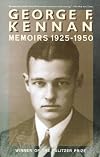
943 Memoirs 1925-1950, by George F. Kennan (read 16 Feb 1968) (Pulitzer Biography prize for 1968) (National Book Award nonfiction prize for 1968) This book started intriguingly, but then turned sour as Kennan became plaintive and ego-centered.
$30. first edition.
香港大學歷史系
Jul 2, 2025Chinese, traditional
Ratings
Members
- Recently Added By
Lists

Books in the Bibliography of The Cold War by John Lewis Gaddis
192 works; 1 member
Author Information

37+ Works 3,171 Members
George F. Kennan, February 16, 1904 - March 17, 2005 George Kennan was born Feb. 16, 1904, in Milwaukee, Wisconsin. He attended Saint John's Military Academy and then Princeton University, graduating in 1926 and entering the diplomatic corps. He travelled to Genoa in 1927, and in 1929 was assigned as third secretary attached to all of the Baltic show more Republics. In 1933, he went to Moscow with Ambassador William Bullitt, where he remained until 1937. He then spent a year in the U. S., a year in Prague, and then went to the U. S. Embassy in Berlin where he helped to develop a peace settlement. Kennan was in Berlin when Nazi Germany declared war on the U. S., and was interned for several months, before finally returning to the States in May of 1942. During the war, he represented the U. S. in Portugal, and was part of the delegation to the European Advisory Commission. In 1944 he returned to the embassy in Moscow. In April 1947, after returning to the States, Kennan became chairman of the Policy Planning Staff at the State Department. It was there that he penned an anonymous article, titled "The Sources of Soviet Conduct" but better known as the "X article", in the July 1947 Foreign Affairs, which advocated a containment policy. He is considered to have been the "architect" of the Cold War. Kennan was appointed Ambassador to the Soviet Union in 1952, but was recalled in October after a diplomatic incident in Berlin where he compared the Soviet Union to Nazi Germany. Kennan retired from the Foreign Service in 1953, and joined the Institute for Advanced Study in Princeton, where he remained until retirement. During that time he also served as Ambassador to the USSR and to Yugoslavia for a short time. Kennan has continued to write and lecture on foreign policy and the Soviet Union into the '90s. In 1981 he was awarded the Albert Einstein Peace Prize for his efforts to improve U.S.-Soviet relations. He also won the Pulitzer Prize twice, initially in 1957 for Russia Leaves the War: Soviet-American Relations, 1917-192O, and then again in 1968 for Memoirs. At age 85, he received the Medal of Freedom. George F. Kennan died on March 17, 2005 at the age of 101. (Bowker Author Biography) George F. Kennan has won both the Pulitzer Prize and the National Book Award. He is professor emeritus at the Institute for Advanced Study in Princeton, New Jersey. (Publisher Provided) show less
Awards and Honors
Distinctions
Series

Common Knowledge
- Canonical title
- Memoirs 1925-1950
- Original publication date
- 1967
- People/Characters
- George Kennan
- Important places
- Berlin, Germany; Germany; USA; USSR
- Dedication
- This book is dedicated to my four children
Grace
Joan Elisabeth
Christopher James and
Wendy Antonia
in the hope that, whatever other uses it may serve, it will help them to understand something of the strivings... (show all), bewilderments, failures, and achievements in which their father has been involved - First words
- There are, of course, great variations in people's capacity to remember consciously their early youth.
- Last words
- (Click to show. Warning: May contain spoilers.)There, another environment, more kindly and receptive to whatever it was that I had to offer, and a new life, also not without its complications but with greater possibilities for creative expression than any I had ever know, awaited me. [Chapter 20]
(Click to show. Warning: May contain spoilers.)A vain, fussy, and ignorant ambassador is capable of breaking its back, and of doing lasting (if not readily apparent) damage to the fabric of Russian-American relations. [Annex D] - Original language
- English
- Disambiguation notice
- Full contents listed in Community tab.
Classifications
- Genres
- Nonfiction, Biography & Memoir, History, General Nonfiction, Politics and Government
- DDC/MDS
- 327.73 — Society, government, & culture Political science International Relations: Spies North America United States
- LCC
- E748 .K374 .A3 — History of the United States United States Twentieth century General Biography
- BISAC
Statistics
- Members
- 401
- Popularity
- 77,359
- Reviews
- 6
- Rating
- (4.18)
- Languages
- English, German
- Media
- Paper, Ebook
- ISBNs
- 4
- ASINs
- 16