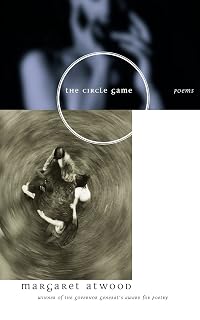
The Circle Game
by Margaret Atwood
On This Page
Description
The appearance of Margaret Atwood's first major collection of poetry marked the beginning of a truly outstanding career in Canadian and international letters. The voice in these poems is as witty, vulnerable, direct, and incisive as we've come to know in later works, such as Power Politics, Bodily Harm, and Alias Grace. Atwood writes compassionately about the risks of love in a technological age, and the quest for identity in a universe that cannot quite be trusted. Containing many of show more Atwood's best and most famous poems, The Circle Game won the 1966 Governor General's Award for Poetry and rapidly attained an international reputation as a classic of modern poetry. This beautiful edition of The Circle Game contains the complete collection, with an introduction by Sherrill E. Grace of the University of British Columbia.. show less
Tags
Recommendations





















Member Reviews
I have such a huge crush on Margaret Atwood. It’s not exactly original, Atwood being Canada’s first lady of letters, but there you are. I’ve never claimed to be original.
The Circle Game is Atwood’s first major collection of poetry and it is vintage work. It captures everything that I like about Atwood’s writing: the precision of the words, the sense of hollowness and sadness, the stark beauty. Atwood is never sentimental but always thoughtful. What I also like is that even though it’s over thirty years old, The Circle Game reads like cutting edge poetry.
My favourite poems include “This Is A Photograph of Me”, “Into My Ravines”, “A Meal”, “Camera”, “Letters, Towards And Away”.
In a collection of poetry not show more every poem is a wower, and this is also true of The Circle Game. But the number of memorable poems far exceeds the number of forgettable poems. show less
The Circle Game is Atwood’s first major collection of poetry and it is vintage work. It captures everything that I like about Atwood’s writing: the precision of the words, the sense of hollowness and sadness, the stark beauty. Atwood is never sentimental but always thoughtful. What I also like is that even though it’s over thirty years old, The Circle Game reads like cutting edge poetry.
My favourite poems include “This Is A Photograph of Me”, “Into My Ravines”, “A Meal”, “Camera”, “Letters, Towards And Away”.
In a collection of poetry not show more every poem is a wower, and this is also true of The Circle Game. But the number of memorable poems far exceeds the number of forgettable poems. show less
Published in 1964, this is Margaret Atwood's first commercially-published poetry collection. Her first, DOUBLE PERSEPHONE, was self-published in 1961. CIRCLE GAME explores womanhood, colonialism and indigenous peoples, environmentalism, and many other topics. The titular poem has seven parts, but Part 1 concerns a group of children who have joined hands and are going round-and-round in a circle, in a "ring around the rosie" fashion. They are singularly focused on their game, ignoring the natural world that is all around them - the grass underfoot, a nearby lake, etc. Through this, Atwood is using this game as a metaphor for modernization and its devastating impacts on the Earth's environment. The children feature in many of the other show more parts, and Part 7 circles back to the initial game. She continues the circle as a metaphor for the propulsion of society away from connection. She ends the poem with -
"I want to break
these bones, your prisoning rhythms
(winter,
summer)
all the glass cases,
erase all maps,
crack the protecting
eggshell of your turning
singing children:
I want the circle
broken." show less
"I want to break
these bones, your prisoning rhythms
(winter,
summer)
all the glass cases,
erase all maps,
crack the protecting
eggshell of your turning
singing children:
I want the circle
broken." show less
still good after 30 years
I first read The Circle Game when I was 16 or 17. It was a quiet day in the bookstore and I had finished all the cleaning and shelving for the day. As was my habit, I wandered the isles looking for hidden treats and inspiration. The thin little volume was almost lost amidst the larger Bukowskis Ferlingettis and Spicers. What I found within would go a long way toward teaching me that Atwood wasn't only what was forced upon kids in school. She wrote with wit, cleverness, sadness, thoughtfulness, hope and wonder, among others. I was excited and quickly tucked the slim text away for safe keeping.
I first read The Circle Game when I was 16 or 17. It was a quiet day in the bookstore and I had finished all the cleaning and shelving for the day. As was my habit, I wandered the isles looking for hidden treats and inspiration. The thin little volume was almost lost amidst the larger Bukowskis Ferlingettis and Spicers. What I found within would go a long way toward teaching me that Atwood wasn't only what was forced upon kids in school. She wrote with wit, cleverness, sadness, thoughtfulness, hope and wonder, among others. I was excited and quickly tucked the slim text away for safe keeping.
I want to understand poetry. I want to enjoy poetry so I buy books of poetry and wade through a morass of words only few of which penetrate my skull. I have found poetry that speaks to me, that does not bore me, that gives me some perspective on the world of poetry. This book of poetry is not obscure but the writer's thoughts and perspectives are not mine so I am not touched...I do not want to copy any of the poems into my commonplace book. The poems are easy to read, a little sad and bleak to my eyes, very Canadian in vision. Purchased in 1978...why did I keep it..because it was Margaret Atwood and I wanted to give her another chance. I prefer many of her books of prose
Reread in 2018 - giving it another chance because I am older and my show more life has changed. I come to the conclusion that I have not changed as much as I thought. show less
Reread in 2018 - giving it another chance because I am older and my show more life has changed. I come to the conclusion that I have not changed as much as I thought. show less
This Book of poetry is wonderful.
It contains a slow motion atrophy and recovery that is hard to describe. The whole book seems to work on it`s own time.
Notable is that the book can be taken as a whole. It is not simply a conglomeration of poems; the poems together tell a story, and certain themes are recurring throughout (such as the colours white, black, and green) which only make sense when the book is taken as a whole.
Life will make more sense after you read this.
It contains a slow motion atrophy and recovery that is hard to describe. The whole book seems to work on it`s own time.
Notable is that the book can be taken as a whole. It is not simply a conglomeration of poems; the poems together tell a story, and certain themes are recurring throughout (such as the colours white, black, and green) which only make sense when the book is taken as a whole.
Life will make more sense after you read this.
This collection of poetry is a slow pace written work with Deep understanding and author used symbolism throughout poetry and one can enjoy. i can only describe as overly detached/observational work if you want solace and peace, read with this when alone or before sleep to grasp the understanding of the poetry.
I really enjoyed the title poem. There were also several that were about travelling west by train, across the prairies into the mountains. I think then there’s one set perhaps in a Stanley Park in Vancouver, amongst the totem poles.I don't expect everyone to like traditional poetry like I do, and I am also quite picky which is probably why I'm not super satisfied with this. Her poetry has substance to it, while most modern show more poetry these days seems to be lacking this aspect.
#Poetry #Canada #Fiction #Classics
#CanadianLiterature #Literature
#Womens #20thCentury #Feminism
#ShortStories show less
I really enjoyed the title poem. There were also several that were about travelling west by train, across the prairies into the mountains. I think then there’s one set perhaps in a Stanley Park in Vancouver, amongst the totem poles.I don't expect everyone to like traditional poetry like I do, and I am also quite picky which is probably why I'm not super satisfied with this. Her poetry has substance to it, while most modern show more poetry these days seems to be lacking this aspect.
#Poetry #Canada #Fiction #Classics
#CanadianLiterature #Literature
#Womens #20thCentury #Feminism
#ShortStories show less
Ratings
Members
- Recently Added By
Author Information

287+ Works 199,355 Members
Margaret Atwood was born on November 18, 1939 in Ottawa, Canada. She received a B.A. from Victoria College, University of Toronto in 1961 and an M.A. from Radcliff College in 1962. Her first book of verse, Double Persephone, was published in 1961 and was awarded the E. J. Pratt Medal. She has published numerous books of poetry, novels, story show more collections, critical work, juvenile work, and radio and teleplays. Her works include The Journals of Susanna Moodie, Power Politics, Cat's Eye, The Robber Bride, Morning in the Buried House, the MaddAdam trilogy, and The Heart Goes Last. She has won numerous awards including the Prince of Asturias Award for Literature, the Booker Prize in 2000 for The Blind Assassin, the Giller Prize and the Premio Mondello for Alias Grace, and the Governor General's Award in 1966 for The Circle Game and in 1986 for The Handmaid's Tale, which also won the very first Arthur C. Clarke Award in 1987. She won the PEN Pinter prize in 2016 for her political activism. She was awarded the 2016 PEN Pinter Prize for the outstanding literary merit of her body of work. (Bowker Author Biography) show less
Awards and Honors
Awards
Common Knowledge
- Canonical title
- The Circle Game
- Original publication date
- 1964
Classifications
Statistics
- Members
- 231
- Popularity
- 141,305
- Reviews
- 6
- Rating
- (4.01)
- Languages
- English
- Media
- Paper, Ebook
- ISBNs
- 10
- ASINs
- 5