On This Page
Description
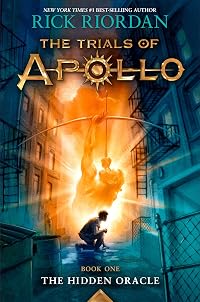
After angering his father Zeus, the god Apollo is cast down from Olympus. He must learn to survive in the modern world until he can somehow find a way to regain Zeus's favor.Tags
Recommendations


Member Reviews
I’m just going to say it. I have never given a Rick Riordan book less than 5 teacups or stars in my entire life. He has been one of my favourite authors since I picked up The Lightning Thief when I was thirteen. I’ve never read books that are so action-packed, hilarious, and genuinely fun. I thoroughly enjoyed this new series debut, and I would highly, highly, HIGHLY recommend it! However, I would strongly encourage you to read Percy Jackson and the Olympians and The Heroes of Olympus before diving into this one. I know that sounds like a huge commitment, but trust me, you won’t regret it! These books are absolutely fantastic, and to grow with, love and appreciate this world and these characters to the fullest I think everyone show more should start at the very beginning (it’s a very good place to start 😉)
I’m so glad that Riordan is not finished writing about our friends at Camp Half Blood and Camp Jupiter! I thought with his new Magnus Chase and the Gods of Asgard series, we had left our Big Seven behind, but of course good ol’ Rick wasn’t going to let us down. In The Hidden Oracle, we join the god, Apollo, who has been turned into a sixteen year old boy as punishment for his son’s involvement in the war that took place in The Heroes of Olympus. In order to return to his rightful place on Mount Olympus, Apollo must undergo many trials, and needless to say adventure and hilarity ensues from page one!
In my opinion, Apollo was definitely one of the funnier gods we met in Percy Jackson and the Olympians. With his sun chariot, obsession with haiku, and his “totally rad” attitude, he made for some major comic relief in the early series. It was interesting to read this book from his perspective because we still had that hilarious aspect of his character, but we were also able to see one of the gods as more than just a one dimensional parody, which I find the gods in Riordan’s series tend to be. At first I didn’t know how I felt about this because I liked having the gods be these funny, pompous, and somewhat oblivious characters. Although we did get that side of Apollo, the line seemed to blur between his godly personality and that of the demigod perspective we get from characters like Percy Jackson or Leo Valdez. Sometimes I found myself thinking that his voice sounded too much like a demigod and didn’t seem to match the immortal god Apollo. However, Apollo does comment that his fears and thoughts are oddly human and probably an aspect of his punishment. In seeing things through this perspective, Apollo has definitely grown into a much more complex character than we first met a couple of series ago.
And of course, you can’t go wrong with the haiku chapter titles. I laughed out loud at the beginning of every chapter! Here were a few of my favourites:
You’ve got to be kid– / Well, crud, what just happened there? / I ran out of syl–
Up in my business / Always burning Oracles / Romans gonna hate
It takes a Village / People to protect your mind / “Y.M.C.A.” Yeah
The Hidden Oracle was one of the best books I read this year and I’m so excited to see where this series goes! I always know that I’m in for a good time whenever I pick up a Rick Riordan read:) After this, I’m sure I’ll be picking up Magnus Chase and the Gods of Asgard pretty soon! show less
I’m so glad that Riordan is not finished writing about our friends at Camp Half Blood and Camp Jupiter! I thought with his new Magnus Chase and the Gods of Asgard series, we had left our Big Seven behind, but of course good ol’ Rick wasn’t going to let us down. In The Hidden Oracle, we join the god, Apollo, who has been turned into a sixteen year old boy as punishment for his son’s involvement in the war that took place in The Heroes of Olympus. In order to return to his rightful place on Mount Olympus, Apollo must undergo many trials, and needless to say adventure and hilarity ensues from page one!
In my opinion, Apollo was definitely one of the funnier gods we met in Percy Jackson and the Olympians. With his sun chariot, obsession with haiku, and his “totally rad” attitude, he made for some major comic relief in the early series. It was interesting to read this book from his perspective because we still had that hilarious aspect of his character, but we were also able to see one of the gods as more than just a one dimensional parody, which I find the gods in Riordan’s series tend to be. At first I didn’t know how I felt about this because I liked having the gods be these funny, pompous, and somewhat oblivious characters. Although we did get that side of Apollo, the line seemed to blur between his godly personality and that of the demigod perspective we get from characters like Percy Jackson or Leo Valdez. Sometimes I found myself thinking that his voice sounded too much like a demigod and didn’t seem to match the immortal god Apollo. However, Apollo does comment that his fears and thoughts are oddly human and probably an aspect of his punishment. In seeing things through this perspective, Apollo has definitely grown into a much more complex character than we first met a couple of series ago.
And of course, you can’t go wrong with the haiku chapter titles. I laughed out loud at the beginning of every chapter! Here were a few of my favourites:
You’ve got to be kid– / Well, crud, what just happened there? / I ran out of syl–
Up in my business / Always burning Oracles / Romans gonna hate
It takes a Village / People to protect your mind / “Y.M.C.A.” Yeah
The Hidden Oracle was one of the best books I read this year and I’m so excited to see where this series goes! I always know that I’m in for a good time whenever I pick up a Rick Riordan read:) After this, I’m sure I’ll be picking up Magnus Chase and the Gods of Asgard pretty soon! show less
May 25th 2016: Perfection
August 16th 2021: This still holds up. I love Meg and Apollo's platonic relationship and banter. A retelling of a mortal Apollo completing harrowing trials is such an amazing concept for a book series and I love the little cameos of our favorite demigods (without them taking the spotlight off of our new main characters).I also teared up a bit at this one. Meg didn't have Medusa's head to kill off her abusive step-father like Percy did. I didn't see the signs the first time through, but the foreshadowing is definitely there if you know to look for it which is true-to-life too. You can't always spot abuse of your friends and family, especially if you're not vigilant.
August 16th 2021: This still holds up. I love Meg and Apollo's platonic relationship and banter. A retelling of a mortal Apollo completing harrowing trials is such an amazing concept for a book series and I love the little cameos of our favorite demigods (without them taking the spotlight off of our new main characters).
What Fun! I love this new series about Apollo losing his "godliness" and being made human where he has to prove to Zeus that he deserves to be made a god again. Apollo is now a 16 year old with "acne and flab" which makes him thoroughly disgusted with his makeover. Having been the god of healing, prophecy, and music, Apollo is having difficulty accepting the fact that he can't even heal his own acne let alone help others. Apollo is rescued from a mugging by a feral demi-god, Meg, and together they find Percy Jackson who helps them to get to Camp Half-blood. There, Apollo finds that several of the demi-gods are missing and the Oracles are not functioning. Apollo with Meg's help must find a way to save the missing Oracles so that show more prophecies are available again.
This book was a great with the characterization of Apollo being a self-centered egotistical teenager who believes that Zeus, his father, just doesn't understand him and how important he is as a god. It appears that Apollo will have to prove himself by performing some heroic deeds before his father stops punishing him.
For a lover of Percy Jackson and mythology this series looks like a winner to me! show less
This book was a great with the characterization of Apollo being a self-centered egotistical teenager who believes that Zeus, his father, just doesn't understand him and how important he is as a god. It appears that Apollo will have to prove himself by performing some heroic deeds before his father stops punishing him.
For a lover of Percy Jackson and mythology this series looks like a winner to me! show less
I enjoyed this book a lot more than Rick Riordan's previous series (perhaps except for Percy Jackson and the Olympians).
So many of his other stories focussed on demigods, their unhappiness (what an understatement) with their arrogant godly parents, and some epic quest with a hell lot of fighting.
This story didn't have an epic quest (in comparison to Heroes of Olympus), and its prophecy didn't even arrive until nearing the end. It had just enough plot and action to keep me excited, but what fascinated me more was the vast amount of human interaction that was explored through the eyes of a god.
We see Apollo (great choice of character in my opinion) at his most vulnerable state. First, his difficult adjustment to becoming a mortal. I show more can't tell you how many times I was torn between cringing and laughing and wanting someone to punch him in his - ha! - divine face whenever he so honestly believed everyone loved him.
Then, the highlight of The Hidden Oracle: Apollo's gradual acceptance of his state, coming to understand his mistakes, and more importantly, his desire and attempts to make amends with his children and with Meg.
This is a character-driven story. And I thought it was beautiful how he grew, not as a better god or a better mortal, but as a person with his own fears and regrets, desires and hopes. His voice isn't lost as well - his personality shines through the humour, the horrible haikus and his love for music and archery that defined him as we knew him from the previous series.
There were a few small misgivings I had about it, and it has quite a number of references to the previous series, such as the reappearances of past characters and plot, but if you're looking for a fun, yet touching story to read, I definitely recommend The Hidden Oracle. show less
So many of his other stories focussed on demigods, their unhappiness (what an understatement) with their arrogant godly parents, and some epic quest with a hell lot of fighting.
This story didn't have an epic quest (in comparison to Heroes of Olympus), and its prophecy didn't even arrive until nearing the end. It had just enough plot and action to keep me excited, but what fascinated me more was the vast amount of human interaction that was explored through the eyes of a god.
We see Apollo (great choice of character in my opinion) at his most vulnerable state. First, his difficult adjustment to becoming a mortal. I show more can't tell you how many times I was torn between cringing and laughing and wanting someone to punch him in his - ha! - divine face whenever he so honestly believed everyone loved him.
Then, the highlight of The Hidden Oracle: Apollo's gradual acceptance of his state, coming to understand his mistakes, and more importantly, his desire and attempts to make amends with his children and with Meg.
This is a character-driven story. And I thought it was beautiful how he grew, not as a better god or a better mortal, but as a person with his own fears and regrets, desires and hopes. His voice isn't lost as well - his personality shines through the humour, the horrible haikus and his love for music and archery that defined him as we knew him from the previous series.
There were a few small misgivings I had about it, and it has quite a number of references to the previous series, such as the reappearances of past characters and plot, but if you're looking for a fun, yet touching story to read, I definitely recommend The Hidden Oracle. show less
Zeus needs someone to blame for the war with the giants, and his eye falls on Apollo. How do you punish a god? You make him mortal, of course. Apollo the scrawny teenager falls to earth in a New York City back alley, and immediately is set upon by thugs, then falls in with a young demigod who has some secrets she's not telling. Apollo wants nothing more than to regain his godly status, but how? He's got a sinking suspicion that it has to do with the Oracle of Delphi, which has been retaken by an old enemy of his. And, speaking of old enemies, some shadowy figures from the distant past seem to be making a bid for world domination. In fact, they may have been behind all of the troubles the demigods have faced thus far...
Just when I think show more Riordan has pretty much run through his source material, he manages to twist in a different direction and set off on a new course. Apollo's perspective is a lot of fun to read, what with the overweening egotism and all -- Riordan does make him somewhat sympathetic by the end of the book. And I'm intrigued by the new bad guys.
I didn't think this book was quite as action-packed as Riordan's other stuff, but it was doing a lot of work to set up the series. It was nice to go back to Camp Halfblood for a bit, and to see some old friends. I wouldn't recommend this as a starting point for readers new to Riordan, but fans of Percy Jackson should certainly take notice. show less
Just when I think show more Riordan has pretty much run through his source material, he manages to twist in a different direction and set off on a new course. Apollo's perspective is a lot of fun to read, what with the overweening egotism and all -- Riordan does make him somewhat sympathetic by the end of the book. And I'm intrigued by the new bad guys.
I didn't think this book was quite as action-packed as Riordan's other stuff, but it was doing a lot of work to set up the series. It was nice to go back to Camp Halfblood for a bit, and to see some old friends. I wouldn't recommend this as a starting point for readers new to Riordan, but fans of Percy Jackson should certainly take notice. show less
Summary: Apollo has been made mortal and kicked out of Olympus before, but this time, it really stings. To start out with, he landed in garbage. He's stuck in the body of a pudgy, acne-ridden 16-year-old named Lester Papadopoulos. He's lost his godly powers of music, archery, and healing. Most of his memory of the six months since Gaea's battle with the gods is missing. He's bound to serve Meg McCaffrey, an annoying demigod street urchin with a penchant for throwing fruit. And when he finally makes his way to Camp Half-Blood in search of answers (and as much as he hates to admit it, help), he finds that things there are pretty dire as well. Campers have been mysteriously disappearing, the Oracle isn't working, so they have no prophecies show more to guide them, communication is down, and Apollo can hear strange whisperings in the trees. Even though he's only mortal, can Apollo and the demigods figure out what's going on in time to stop it from destroying everything, including Apollo's chances of reclaiming his godhood?
Review: Rick Riordan's books are somewhat hard to review, as a) there's a lot of them, and b) they're pretty consistently good. This book, the start of a new series (but also a continuation of the larger Percy Jackson / Heroes of Olympus series), was just as exciting and fast-paced and clever about the blending of mythology with the modern world as Riordan's books always are. But I didn't like it quite as much as normal, since Apollo is not nearly as appealing a main character as Percy Jackson or Jason or Annabeth or Leo or Nico or any of the other demigods, and this book is entirely from his first-person point-of-view. Apollo, even in mortal form, is arrogant, demanding, and blithely unaware of his own faults, and while I get that that is both the joke and part of his character arc, the joke got old pretty quickly. The fish-out-of-water storyline was pretty standard, although it was interesting seeing Apollo interact with his demigod children, given that he is now their same age (and powerless, as well.) There was some impressive ret-conning involved in the plot of this series's Big Bad (or at least I suspect it was ret-conning; maybe Riordan planned it in advance, but if not, it's done pretty seamlessly.) I also quite liked Meg (and her "pet" demon, Peaches), and am interested to see where Riordan takes her character in future books. And since Apollo has gotten over himself to some extent by the end of this volume, hopefully I'll find him a little less annoying in the next book in the series (which of course I will be reading.) 4 out of 5 stars.
Recommendation: Although it's technically the first book in new series, it really doesn't do a lot of explanation about demigods / Camp Half-Blood / what happened in previous books / who any of these characters are, so I think it's best read after the two preceding series (which are good fun anyways). It's starting a new storyline six months later, so you don't need the details of the previous books fresh in your mind, but I do think you need some of the background that this one doesn't provide. show less
Review: Rick Riordan's books are somewhat hard to review, as a) there's a lot of them, and b) they're pretty consistently good. This book, the start of a new series (but also a continuation of the larger Percy Jackson / Heroes of Olympus series), was just as exciting and fast-paced and clever about the blending of mythology with the modern world as Riordan's books always are. But I didn't like it quite as much as normal, since Apollo is not nearly as appealing a main character as Percy Jackson or Jason or Annabeth or Leo or Nico or any of the other demigods, and this book is entirely from his first-person point-of-view. Apollo, even in mortal form, is arrogant, demanding, and blithely unaware of his own faults, and while I get that that is both the joke and part of his character arc, the joke got old pretty quickly. The fish-out-of-water storyline was pretty standard, although it was interesting seeing Apollo interact with his demigod children, given that he is now their same age (and powerless, as well.) There was some impressive ret-conning involved in the plot of this series's Big Bad (or at least I suspect it was ret-conning; maybe Riordan planned it in advance, but if not, it's done pretty seamlessly.) I also quite liked Meg (and her "pet" demon, Peaches), and am interested to see where Riordan takes her character in future books. And since Apollo has gotten over himself to some extent by the end of this volume, hopefully I'll find him a little less annoying in the next book in the series (which of course I will be reading.) 4 out of 5 stars.
Recommendation: Although it's technically the first book in new series, it really doesn't do a lot of explanation about demigods / Camp Half-Blood / what happened in previous books / who any of these characters are, so I think it's best read after the two preceding series (which are good fun anyways). It's starting a new storyline six months later, so you don't need the details of the previous books fresh in your mind, but I do think you need some of the background that this one doesn't provide. show less
4.5 Stars
Apollo has displeased his father, Zeus, and has been cast down from Olympus as punishment. He lands unceremoniously in a dumpster in Manhattan. He is distressed to learn he has been stripped of his godly powers and is forced to live on earth as a pimply teenage boy.
A young demigod, Meg, rescues him from hoodlums and claims his service. However, Apollo has ruffled a few feathers over his four thousand years and he heads to Camp Half Blood, the home of Greek demigods on earth, to seek protection from his enemies.
Upon arrival he learns that demigods are mysteriously disappearing. Apollo stays to help in hopes that his victory will see him reinstated as a god of Olympus.
This book is truly a triumph of a comic genius. Riordan’s show more imagining of Apollo as vain and egotistical creates hilarious dialogue between the resplendent 'God of Poetry' and Earth's mere mortals. The tone of the book can be best summarised with the following excerpt:
‘Horrors!’ I cried. ‘Is that – Is that acne?’
Immortal gods do not get acne. It is one of our inalienable rights. Yet I leaned closer to the glass and saw that my skin was indeed a scarred landscape of whiteheads and pustules.
I balled my fists and wailed to the cruel sky, ‘Zeus, what have I done to deserve this?’
Riordan’s clever haiku chapter headings are also hugely entertaining. I thoroughly recommend this book for adventure lovers from ages 10 and up (I am 40 something and laughed like a hyena throughout). show less
Apollo has displeased his father, Zeus, and has been cast down from Olympus as punishment. He lands unceremoniously in a dumpster in Manhattan. He is distressed to learn he has been stripped of his godly powers and is forced to live on earth as a pimply teenage boy.
A young demigod, Meg, rescues him from hoodlums and claims his service. However, Apollo has ruffled a few feathers over his four thousand years and he heads to Camp Half Blood, the home of Greek demigods on earth, to seek protection from his enemies.
Upon arrival he learns that demigods are mysteriously disappearing. Apollo stays to help in hopes that his victory will see him reinstated as a god of Olympus.
This book is truly a triumph of a comic genius. Riordan’s show more imagining of Apollo as vain and egotistical creates hilarious dialogue between the resplendent 'God of Poetry' and Earth's mere mortals. The tone of the book can be best summarised with the following excerpt:
‘Horrors!’ I cried. ‘Is that – Is that acne?’
Immortal gods do not get acne. It is one of our inalienable rights. Yet I leaned closer to the glass and saw that my skin was indeed a scarred landscape of whiteheads and pustules.
I balled my fists and wailed to the cruel sky, ‘Zeus, what have I done to deserve this?’
Riordan’s clever haiku chapter headings are also hugely entertaining. I thoroughly recommend this book for adventure lovers from ages 10 and up (I am 40 something and laughed like a hyena throughout). show less
Members
- Recently Added By
Lists

Top Five Books of 2017
757 works; 231 members

Books Read in 2016
4,666 works; 199 members

Reliably Good Series
45 works; 2 members

al.vick-series
381 works; 2 members

Books Read in 2016
110 works; 1 member

Read in 2024
23 works; 1 member

Kindle Action/Adventure - Junior and Teenage Re-Read
247 works; 1 member
Talk Discussions
Past Discussions
The new Trials of Apollo book by Rick Riordan coming out May 3rd!!! in Book talk (June 2018)
Author Information

256+ Works 338,155 Members
Rick Riordan was born on June 5, 1964, in San Antonio, Texas. After graduating from the University of Texas at Austin with a double major in English and history, he taught in public and private middle schools for many years. He writes several children's series including Percy Jackson and the Olympians, The Kane Chronicles, and The Heroes of show more Olympus, Magnus Chase and the Gods of Asgard, and The Trials of Apollo. He also writes the Tres Navarre mystery series for adults. He has won Edgar, Anthony, and Shamus Awards for his mystery novels. . (Bowker Author Biography) show less
Some Editions
Awards and Honors
Awards
Series

Work Relationships
Common Knowledge
- Canonical title
- The Hidden Oracle
- Original title
- The Hidden Oracle
- Original publication date
- 2016-05-03
- People/Characters
- Apollo; Percy Jackson; Meg McCaffrey; Nico di Angelo; Will Solace; Chiron (show all 45); Leo Valdez; Calypso; Rachel Elizabeth Dare; Austin Lake; Kayla Knowles; Nero; Germani; Nosoi; Myrmekes; Mikey; Cade; Python; Leo Valdez; Paolo Montes; Harley; Chiron; Palikos; Peaches; Chiara Benvenuti; Malcolm Pace; Billie Ng; Sherman Yang; Ellis Wakefield; Miranda Gardiner; Connor Stoll; Holly Victor; Laurel Victor; Cecil Markowitz; Damien White; Julia Feingold; Alice Miyazawa; Sally Jackson; Festus; Woodrow; Nyssa Barrera; Peleus; Seymour; Rhea; Mrs. O'Leary
- Important places
- Mt. Olympus, Greece; New York, New York, USA; Grove of Dodona; Manhattan, New York, New York, USA; Camp Half-Blood, Long Island, USA; Apollo Cabin, Camp Half-Blood (show all 7); Triumvirate Holdings
- Epigraph
- Hoodlums punch my face
I would smite them if I could
Mortality blows - Dedication
- To the Muse Calliope
This is long overdue. Please don't hurt me. - First words
- My name is Apollo. I used to be a god.
- Last words
- (Click to show. Warning: May contain spoilers.)Together, the three of us walked toward the sounds of laughter, music, and a warm, crackling fire.
- Original language
- English
- Canonical DDC/MDS
- 813.6
- Canonical LCC
- PZ7.R4829
Classifications
Statistics
- Members
- 6,942
- Popularity
- 1,717
- Reviews
- 101
- Rating
- (4.05)
- Languages
- 15 — Chinese, Czech, Dutch, English, Finnish, French, German, Hungarian, Italian, Norwegian (Bokmål), Polish, Portuguese, Spanish, Swedish, Turkish
- Media
- Paper, Audiobook, Ebook
- ISBNs
- 80
- ASINs
- 17