On This Page
Description
"From the moment Richard K. Morgan's dazzling debut, Altered Carbon, burst onto the scene, it was clear that a distinctive new voice had arrived to shake up science fiction. His subsequent novels--including the sequels Broken Angels and Woken Furies--confirmed him as a master of hard-boiled futuristic thrillers. Now Morgan returns to the world of SF noir with a riveting tale of crime, corruption, and deadly crisis on a planet teetering close to the edge. On a Mars where ruthless commercial show more interests violently collide with a homegrown independence movement, as Earth-based overlords battle for profits and power, Hakan Veil is an ex-corporate enforcer equipped with military-grade body tech that's made him a human killing machine. But he's had enough of the turbulent red planet, and all he wants is a ticket back home--which is just what he's offered by the Earth Oversight organization, in exchange for being the bodyguard for an EO investigator. It's a beyond-easy gig for a heavy hitter like Veil . . . until it isn't. When Veil's charge, Madison Madekwe, starts looking into the mysterious disappearance of a lottery winner, she stirs up a hornets' nest of intrigue and murder. And the deeper Veil is drawn into the dangerous game being played, the more long-buried secrets claw their way to the Martian surface. Now it's the expert assassin on the wrong end of a lethal weapon--as Veil stands targeted by powerful enemies hellbent on taking him down, by any means necessary"-- show lessTags
Recommendations


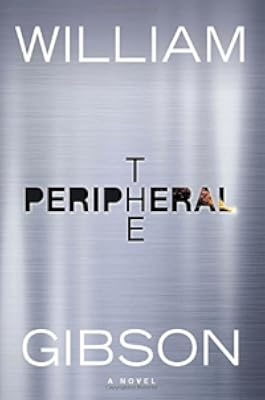
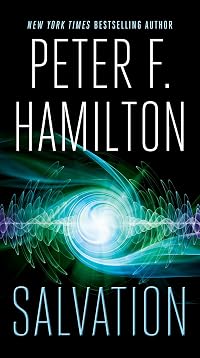
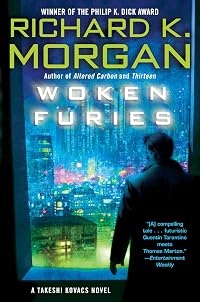
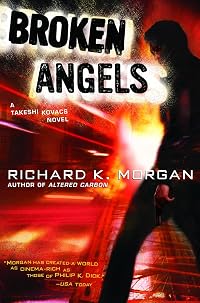










Member Reviews
Do not forsake me, oh my darling ... [return][return]Yes, ladies and gentlemen, we are on the High Frontier. Home to noble, if ever so slightly flawed lawmen who have been stripped of badge and six-gun, and exiled to a one-horse town in the middle of nowhere, to pick up light work breaking heads for whoever pays best. Home to canny saloon owners with a hotline to all the local intel, chisel-jawed cattle barons who are determined to fence in the open range, and dance hall girls with hearts of gold. Home to lucrative opportunity, and limitless freedom -- at a price. Ultimate destination for the discarded, society's deluded and the dreamers who have big plans and no legal way to make them happen. [return][return]Yes, boys and girls, we are show more on Mars. Deadwood in space.[return][return]Richard K. Morgan unleashes his signature mayhem, and almost balletically choreographed sex and violence, in a classic Western-inspired narrative set on Mars about 300 years* after humanity established its first settlements on the Red Planet. The dream of terraforming, and rendering Mars into Earth II, has been abandoned, but huge areas such as the Mariner Valley and the Hellas impact crater have been encased in a bubble of atmosphere, allowing the development of towns and cities, home-grown industries and organized crime. Mars has been settled long enough that there are second- and third-generation native Martians -- people who have never seen an ocean, and never felt rain, who don't know what a kangaroo is and have perhaps seen a dog once, in the town zoo. But Mars is also the dumping ground for Earth's unwanted masses, a new Botany Bay -- this mix of Mars-born on the make, convict labor, indentured servants, the chancers who have used up most of their nine lives sets up a deadly brew of desperation, resentment, exploitation, and the siren call of one big break.[return] [return]Because this is Richard K. Morgan, the scene-setting, social construction, and ambient technology is clever and challenging, and feels very real and lived-in -- Morgan's superpower is the ability to not only come up with intriguing future technology, but to think it all through carefully (and sometimes movingly). He works out how that technology affects the society in which it is used, well beyond the point where a lesser author would shrug and say "that'll do"... In a Morgan novel, you see how technology changes people, and how people figure out tweaks to use the technology to their advantage, in ways that the designers never imagined. [return][return]Morgan isn't a great believer in exposition, or info-dumps -- which is good, because his worlds are completely immersive experiences from the get-go. But it makes demands on you as a reader, as you try to process complicated personal and political situations, baffling future technology, and throw away references to the history and geography (or should I say areography) of Mars. you could easily read 100 pages or so before you are entirely sure who's doing what to whom, and why ... and what the heck is a "lamina," and a "'branegel," and why is everyone wearing sunglasses all the time? Stick with it, because it's well worth the effort. [return][return]I have a couple of relatively minor reservations. I think Morgan stretches it out a little overlong, so that the resolution, when it comes (and oh, yes, it comes ...) feels a bit like anti-climax. As if there has to be some resolution, and it might as well be that. There are several Big Reveals at the end, and I'd sort of seen them all coming. But I have seen a lot of Westerns, thanks to my husband, and I know never, never, ever trust the sweet, upstanding, sexy school-marm type, who rides into town and seems to offer Our Hero a taste of civilization and an escape from his exile. For she is Bad News ... [return][return]And I wish someone had talked Morgan out of his infatuation with "interesting" verbs. No one "smears" a smile. No one "gusts" -- they "say." This is especially disappointing because, Morgan really does, otherwise, write so very well.[return][return]*300 Martian years = approximately 150 Earth years, btw ... show less
Brutal and twisty. Three weeks later, I’m left thinking I liked it, but in the way one likes junk food or quick and dirty sex (which no doubt comes to mind because the lead takes time out for some lurid escapades). There were times I thought it was a little long, but I didn’t actually mind, because I am on board for Mars post-colonization dystopias. Occasionally I felt a bit of pastiche coming through: the ‘Swirl’ is mentioned in much the same way Amos from the Expanse talks about the ‘Churn.’ There’s a lovely and vivid sea metaphor throughout, reminding me of Watt’s [b:Starfish|66479|Starfish (Rifters, #1)|Peter show more Watts|https://i.gr-assets.com/images/S/compressed.photo.goodreads.com/books/1388530597l/66479._SY75_.jpg|2489444], although Lovecraftian might be an even better reference, and of course, of course, Blade Runner.
“Nighttime towns and transit stations glimmered across the valley floor like phosphorescent deep-sea life-forms, bulking corpuscular, trailing the whip-thin antenna appendages of roads before they faded to dark where the traffic petered out and the lighting systems went to sleep in response. Four hundred kilometers beyond it all, Bradbury was a lurid monster medusa oozing up over the line of the horizon.”
Such excellent writing there. There’s a lot of those moments scattered throughout.
But returning to the setting: are these homages, cultural touchpoints or merely assumption of an already-created universe, much like a hermit-crab assuming a new shell? Hard to say. But it is the kind of feeling that keeps me from thinking excellence.
The lead is pure Takeshi Kovacs, a bio-engineered, hibernation-dependent person optimized for exploratory space flight:
“You want snake-swift situational reflexes, amped-up risk assessment intelligence, full-on fight/flight biochemistry? Fine—but for those options, you’re going to pay a stiff price in antisocial tendency.”
Hakan Veil has been fired and grounded on Mars, he’s bitter, and when he is tapped to be a bodyguard for a woman on the Earth Oversight team, he takes it for the opportunity to earn a pricey return ticket to Earth. There’s a lot of players in this story, and it’s worth noting that a significant proportion are women. The characters, per Morgan usual, are almost universally complicated, full of mixed messages and motivations. Morgan walks a tricky line here–his lead is quite obviously socially impaired and tends to interact in terms of the misogynist classic fuckability-meter. Perhaps Morgan adequately compensates with some very descriptive, female-focused sex? That aside, one of the most intriguing ongoing interactions is with the no-nonsense head of a specialized police department who is as honest as the Martian year is long.
“This woman invited nothing and projected nothing beyond the simple message Listen up, motherfuckers, I’m only going to say this once.”
Morgan goes into detail with the world-building, with the politics that have built up over decades: the festering resentment of a territory toward the long reach of a former homeland, the cheap capitalism, the criminal elements, the international colonial competition, the water and air economies. He tries hard to blend it all together, but I’m not quite sure it works. It’s complicated, to be sure, and I appreciate that. But do we really see the shades of the complexity, or are we fed just enough so we can be appropriately shocked at the plot twists? I feel it was the later, but that’s where a re-read could help me.
“Contrary to all the Mars First rhetoric you hear, COLIN isn’t like a pack of hyenas or a feeding frenzy of sharks or whatever this month’s highly colored predator analogy might be—it’s more like a crown-of-thorns starfish, creeping up on its prey at glacial pace, then vomiting out its stomach to envelop and digest it entire.”
World-building is very in media res, which I’m absolutely okay with, but the voice of the lead is ironic and prejudicial, so it always skews toward editorial commentary versus explanatory. Again, wondering if cultural shorthand is standing in for the reader here. The upshot is that the significance doesn’t hit the feels as hard as it could, even when the reader is hit with an emotional summation. The distance of the narrator ends up bleeding into the reader.
“People don’t want to believe shit like this, they’ll shrug it off if they can. Marstech, the idea of Marstech—hell, even the idea of Mars—makes them feel good, and that’s all that counts. It’s thin air, all of it. But back on Earth people breathe it like it was real, and they won’t let you take that away from them.”
I’m not unhappy to own a kindle copy, because I feel like this is one that I could enjoy even more on re-read. Absolutely on part with Morgan’s other works, so if you are familiar with his style and enjoy it, you shouldn’t be disappointed.
“Eyes on the door ahead, and the long dark path to going home.”
My review has all the book linky-links because Too Much Effort here.
https://clsiewert.wordpress.com/2022/03/09/thin-air-by-richard-morgan-not-very-t... show less
“Nighttime towns and transit stations glimmered across the valley floor like phosphorescent deep-sea life-forms, bulking corpuscular, trailing the whip-thin antenna appendages of roads before they faded to dark where the traffic petered out and the lighting systems went to sleep in response. Four hundred kilometers beyond it all, Bradbury was a lurid monster medusa oozing up over the line of the horizon.”
Such excellent writing there. There’s a lot of those moments scattered throughout.
But returning to the setting: are these homages, cultural touchpoints or merely assumption of an already-created universe, much like a hermit-crab assuming a new shell? Hard to say. But it is the kind of feeling that keeps me from thinking excellence.
The lead is pure Takeshi Kovacs, a bio-engineered, hibernation-dependent person optimized for exploratory space flight:
“You want snake-swift situational reflexes, amped-up risk assessment intelligence, full-on fight/flight biochemistry? Fine—but for those options, you’re going to pay a stiff price in antisocial tendency.”
Hakan Veil has been fired and grounded on Mars, he’s bitter, and when he is tapped to be a bodyguard for a woman on the Earth Oversight team, he takes it for the opportunity to earn a pricey return ticket to Earth. There’s a lot of players in this story, and it’s worth noting that a significant proportion are women. The characters, per Morgan usual, are almost universally complicated, full of mixed messages and motivations. Morgan walks a tricky line here–his lead is quite obviously socially impaired and tends to interact in terms of the misogynist classic fuckability-meter. Perhaps Morgan adequately compensates with some very descriptive, female-focused sex? That aside, one of the most intriguing ongoing interactions is with the no-nonsense head of a specialized police department who is as honest as the Martian year is long.
“This woman invited nothing and projected nothing beyond the simple message Listen up, motherfuckers, I’m only going to say this once.”
Morgan goes into detail with the world-building, with the politics that have built up over decades: the festering resentment of a territory toward the long reach of a former homeland, the cheap capitalism, the criminal elements, the international colonial competition, the water and air economies. He tries hard to blend it all together, but I’m not quite sure it works. It’s complicated, to be sure, and I appreciate that. But do we really see the shades of the complexity, or are we fed just enough so we can be appropriately shocked at the plot twists? I feel it was the later, but that’s where a re-read could help me.
“Contrary to all the Mars First rhetoric you hear, COLIN isn’t like a pack of hyenas or a feeding frenzy of sharks or whatever this month’s highly colored predator analogy might be—it’s more like a crown-of-thorns starfish, creeping up on its prey at glacial pace, then vomiting out its stomach to envelop and digest it entire.”
World-building is very in media res, which I’m absolutely okay with, but the voice of the lead is ironic and prejudicial, so it always skews toward editorial commentary versus explanatory. Again, wondering if cultural shorthand is standing in for the reader here. The upshot is that the significance doesn’t hit the feels as hard as it could, even when the reader is hit with an emotional summation. The distance of the narrator ends up bleeding into the reader.
“People don’t want to believe shit like this, they’ll shrug it off if they can. Marstech, the idea of Marstech—hell, even the idea of Mars—makes them feel good, and that’s all that counts. It’s thin air, all of it. But back on Earth people breathe it like it was real, and they won’t let you take that away from them.”
I’m not unhappy to own a kindle copy, because I feel like this is one that I could enjoy even more on re-read. Absolutely on part with Morgan’s other works, so if you are familiar with his style and enjoy it, you shouldn’t be disappointed.
“Eyes on the door ahead, and the long dark path to going home.”
My review has all the book linky-links because Too Much Effort here.
https://clsiewert.wordpress.com/2022/03/09/thin-air-by-richard-morgan-not-very-t... show less
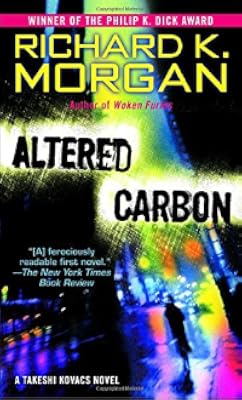
Wow! To be fair, I have been looking forward to reading more Morgan since the devouring the trilogy that started with Altered Carbon. Wasn't quite sure I wanted to go the fantasy route with him, but his SF?
It's an automatic Hell Yes. I'm a big fan of Cyberpunk and Noir fiction and this has all the same great features (if less technologically advanced) as Altered Carbon. Think Noir disgraced military turned gumshoe but put him firmly on a Mars surrounded by corruption, nasty corporate tricks, and a military takeover in the wings.
In other words, the situation is ripe for a TON of bloodshed. :)
And fortunately, as we go through some pretty awesome plotting, mystery, reversals, I can safely say I had a TON of fun. It WAS a bit cliche with show more the dames, but let's face it... it IS Noir. And they were not cardboard cutouts at all. Sex sells. Violence, too. This book knows its market. :)
I LOVE the military upgrades. Do computers normally have this much humor? ;)
Cyberpunk rules!!! Morgan is one of my favorites and I think I need to get on the rest of his catalog. :) I'm so glad I finally got to this! What a treat! show less
It's an automatic Hell Yes. I'm a big fan of Cyberpunk and Noir fiction and this has all the same great features (if less technologically advanced) as Altered Carbon. Think Noir disgraced military turned gumshoe but put him firmly on a Mars surrounded by corruption, nasty corporate tricks, and a military takeover in the wings.
In other words, the situation is ripe for a TON of bloodshed. :)
And fortunately, as we go through some pretty awesome plotting, mystery, reversals, I can safely say I had a TON of fun. It WAS a bit cliche with show more the dames, but let's face it... it IS Noir. And they were not cardboard cutouts at all. Sex sells. Violence, too. This book knows its market. :)
I LOVE the military upgrades. Do computers normally have this much humor? ;)
Cyberpunk rules!!! Morgan is one of my favorites and I think I need to get on the rest of his catalog. :) I'm so glad I finally got to this! What a treat! show less
Fast and furious, ultra violent, smart, some pretty graphic sex. I had enjoyed the Altered Carbon series, and this is more of the same. But that is also a problem- it is merely more of the same. It was fun to read, but also had the feeling of a formula money maker rather than a new interesting novel.
My reading history with Richard Morgan’s books is somewhat… troubled, since I remember reading first his cyberpunk novel Black Man (a.k.a. Thirteen) - which by the way is set in the same universe as Thin Air: I enjoyed the story of anti-hero genetically enhanced super-soldier Carl Marsalis, so when Morgan published his first fantasy novel The Steel Remains I was curious to see how he would fare in the genre, but while I did not dislike the story and the characters, I was put off by the author’s excessive propensity for goriness and profanity which seemed to be there only for their shock value, rather than for narrative purposes. When Morgan’s more famous novel, Altered Carbon, was recently adapted for the small screen it did not show more manage to conquer me, even though many online comments tended to indicate that the book was far better. So, even though the synopsis for Thin Air sounded intriguing, I was a little hesitant in giving this author another chance: now that I have I’m glad to have “taken the plunge”, because his latest work shows a great deal of improvement both in writing and in characterization if compared with my previous reading experiences.
As I mentioned, there is a parallel between previously explored character Carl Marsalis and Thin Air’s protagonist Hakan Veil: they are both genetically engineered - but that’s all there is to it. Veil’s modifications started in his mother’s womb, when he was gifted with enhanced senses and reaction times, and an embedded AI circuitry named Osiris (Onboard Situational Insight and Resource Interface Support) which allows him to connect with other cybernetic systems and to hack them if needed, and which also works as an inner voice, often commenting sarcastically on his actions. Veil used to be an overrider in the employ of the security firm Blond Vaisutis: planted in suspended animation on ships, he would be awakened in case of emergency to solve - through bloody violence - any situation that might have developed on board. Used to, because a failed mission caused him to be fired from Blond Vaisutis, stripped of some of his enhancements and exiled to Mars, where he’s been eking out an uneasy life as hired muscle for various shady enterprises and crime syndicates.
The novel opens with Veil freshly awakened from his four-month hibernation period - something made necessary by his modifications - and quickly employed in the assassination of a small-time gangster, ordered by the head of a criminal syndicate. Arrested by the local police, he’s offered a way out working as the bodyguard of a high-ranking Earth official, part of a team who just landed on Mars to investigate the disappearance of one of the Lottery winners, whose prize is a ticket back to Earth. As Veil tries to fulfill his assignment, he and his charge travel all over the colony, from its most glamorous venues to the seediest quarters, and it soon becomes clear that the disappearance of the lottery winner is only the tip of a huge, convoluted iceberg made out of political maneuverings, corporate interests and shady dealings. And that a dark page of Mars’ grim history might be on the verge of repeating itself…
Hakan Veil is a very intriguing main character: on the surface he might simply look rude and cynical, and he is that of course, but there is a subtle veneer of world-weariness and self-mockery in his first person narrative which confers him an added depth that makes the reader feel invested in his story, one that moves at a breakneck speed with hardly any time for respite: the constant references to Veil’s “running hot” condition, which means he’s ready to mete out unstoppable violence and that he needs no sleep, make for a heightened pace that carries you throughout the novel knowing that new surprises and new dangers are lurking around the next corner.
Thin Air is a hard-boiled noir placed in a science fiction setting and the combination of these two apparently disparate elements creates a fascinating story in which Veil’s movements across the planet create a picture of the background with no need for lengthy info-dumps; it’s a narrative choice that drops the readers in the middle of things with little or no explanations and at times makes them feel a bit lost (or at least that was my impression), but if one trusts the author and goes with the flow, they will soon learn that the colony’s history is a troubled one, that the tug-of-war between the various corporations bent on mining the planet’s resources left the population in a constant state of near-rebellion, and that politicians and police forces are not always looking for the best interests of the citizens. The descriptions make it easy to picture the various settlements with something of a Blade Runner appearance, complete with some drizzling mist that should imitate real rain under the atmospheric dome covering the cities. And despite the underlying bleakness there are some flashes of truly poetic beauty:
Outside the sandstorm raged on, tall dancing plumes of fine-grade regolith driven past like the lost souls of some massive alien race in exodus.
Thin Air’s Mars feels real and believable and it also drives home the concept that humanity, no matter where it chooses to reside, will always take with it both the best and the worst of its nature - especially the worst, maybe. It’s probably a cynical point of view, and the fact that it’s filtered through the eyes of a cynically disillusioned character enhances this sensation, and yet there are a few rays of light here, particularly where some more positive characters enter the mix, that drive home the hope that humanity’s future, even through its turmoils, might not turn out to be absolutely bleak.
I’m glad I gave Richard Morgan’s work another chance, and this positive encounter might bring me to give the Altered Carbon series a look: I find that this cyberpunk dystopian background can be quite interesting… show less
As I mentioned, there is a parallel between previously explored character Carl Marsalis and Thin Air’s protagonist Hakan Veil: they are both genetically engineered - but that’s all there is to it. Veil’s modifications started in his mother’s womb, when he was gifted with enhanced senses and reaction times, and an embedded AI circuitry named Osiris (Onboard Situational Insight and Resource Interface Support) which allows him to connect with other cybernetic systems and to hack them if needed, and which also works as an inner voice, often commenting sarcastically on his actions. Veil used to be an overrider in the employ of the security firm Blond Vaisutis: planted in suspended animation on ships, he would be awakened in case of emergency to solve - through bloody violence - any situation that might have developed on board. Used to, because a failed mission caused him to be fired from Blond Vaisutis, stripped of some of his enhancements and exiled to Mars, where he’s been eking out an uneasy life as hired muscle for various shady enterprises and crime syndicates.
The novel opens with Veil freshly awakened from his four-month hibernation period - something made necessary by his modifications - and quickly employed in the assassination of a small-time gangster, ordered by the head of a criminal syndicate. Arrested by the local police, he’s offered a way out working as the bodyguard of a high-ranking Earth official, part of a team who just landed on Mars to investigate the disappearance of one of the Lottery winners, whose prize is a ticket back to Earth. As Veil tries to fulfill his assignment, he and his charge travel all over the colony, from its most glamorous venues to the seediest quarters, and it soon becomes clear that the disappearance of the lottery winner is only the tip of a huge, convoluted iceberg made out of political maneuverings, corporate interests and shady dealings. And that a dark page of Mars’ grim history might be on the verge of repeating itself…
Hakan Veil is a very intriguing main character: on the surface he might simply look rude and cynical, and he is that of course, but there is a subtle veneer of world-weariness and self-mockery in his first person narrative which confers him an added depth that makes the reader feel invested in his story, one that moves at a breakneck speed with hardly any time for respite: the constant references to Veil’s “running hot” condition, which means he’s ready to mete out unstoppable violence and that he needs no sleep, make for a heightened pace that carries you throughout the novel knowing that new surprises and new dangers are lurking around the next corner.
Thin Air is a hard-boiled noir placed in a science fiction setting and the combination of these two apparently disparate elements creates a fascinating story in which Veil’s movements across the planet create a picture of the background with no need for lengthy info-dumps; it’s a narrative choice that drops the readers in the middle of things with little or no explanations and at times makes them feel a bit lost (or at least that was my impression), but if one trusts the author and goes with the flow, they will soon learn that the colony’s history is a troubled one, that the tug-of-war between the various corporations bent on mining the planet’s resources left the population in a constant state of near-rebellion, and that politicians and police forces are not always looking for the best interests of the citizens. The descriptions make it easy to picture the various settlements with something of a Blade Runner appearance, complete with some drizzling mist that should imitate real rain under the atmospheric dome covering the cities. And despite the underlying bleakness there are some flashes of truly poetic beauty:
Outside the sandstorm raged on, tall dancing plumes of fine-grade regolith driven past like the lost souls of some massive alien race in exodus.
Thin Air’s Mars feels real and believable and it also drives home the concept that humanity, no matter where it chooses to reside, will always take with it both the best and the worst of its nature - especially the worst, maybe. It’s probably a cynical point of view, and the fact that it’s filtered through the eyes of a cynically disillusioned character enhances this sensation, and yet there are a few rays of light here, particularly where some more positive characters enter the mix, that drive home the hope that humanity’s future, even through its turmoils, might not turn out to be absolutely bleak.
I’m glad I gave Richard Morgan’s work another chance, and this positive encounter might bring me to give the Altered Carbon series a look: I find that this cyberpunk dystopian background can be quite interesting… show less
I just finished Richard K. Morgan’s latest release, Thin Air. It is gritty SciFi at its finest. Morgan seems to have leveled up in his writing, over already highly regarded and award-winning previous work. Every sentence is crafted with care. It is a Master Class of immersive third person point of view writing.
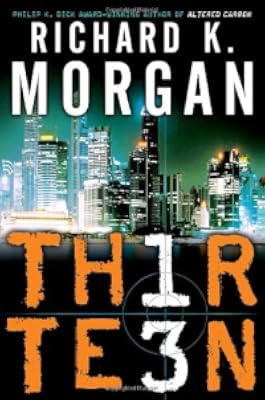
I listened to the audiobook version, which was read by Colin Mace, and for me, it was a perfect fit. Mace hit the ball out of the park and became the embodiment of Hakan Veil, the hi-tech ninja of the future and protagonist of what I hope is not a standalone novel. It is a new character and setting of sorts for Morgan. He alludes to his concept of the Mars colony and COLIN (Colony Initiative) in Thirteen, which I have started show more today. I just downloaded the audiobook.
This story had me riveted from the word go, and didn’t let go. It is the best science fiction I’ve read since Ancillary Justice, which won the Hugo. This work is certainly good enough to be in consideration, but it has very adult themes (read graphic sex.) Morgan has included this with intention and I hope it doesn’t take him out of the running.
There is so much to love about this novel. The characters are real and multifaceted. The description is immersive, but not overdone and the word choices are evocative and graphic, and fit perfectly with the landscape of Mars he has painted. Mars itself is a character all its own. It has a well-developed history and a depth that makes it feel authentic, albeit a true frontier and all that comes with that, 300ish years into a colony development that never quite materialized the way the original planners had envisioned. His simile and metaphor are based on these artifices of an old Martian colony and struck the perfect chord to bring the setting to life. The science parts of the fiction are the essence of cool and seemingly plausible, including the pseudoatmosphere of the lamina, a membrane of sorts that covers the dug out Gash, allowing for a localized breathable atmosphere. The prose is wonderful, especially considering that this is a hard-boiled genre fiction piece, great writing implanted within a ruthless noir fiction story.
Veil is a former Overrider. A last resort corporate security ninja, that is kept on ice in orbit, a sort of ‘break glass in case of emergency’ setup. He has been bred since childhood for this life, adding a backdrop that adds a little sympathy to a character who at times, seems to lack it entirely. He has the ability to stuff all of his humanity into a drawer and do what needs to be done, no matter how hard or how terrible it might be. “The ship must be saved at all costs.” However, something horrible happened on his watch involving important people that forced him out of that life and into one on Mars with no safety net. This is all back-story and is alluded to in snippets but never completely spelled out. There is a flashback scene of his childhood that is heart-wrenching and adds to the depth of his character, if not the empathy we might have for him. He is a hard man to like, but there are moments, glimpses of his wry humor and intelligence, and even warmth for those few that he feels real loyalty for that is enough for me to throw all-in with him. He’s not the world-weary protagonist with the heart of gold. His very nature drives him to violence, but he is smart enough to temper it all with a modicum of self-restraint . . . most of the time.
He has appetites and a real weakness for women that, if not a blind spot, is at least an extremely hazy area in his field of vision. His onboard AI even reminds him of these things over and over but he wants what he wants and does things his own way, damn the torpedoes. More often than not, though, Veil has an instinct to take the right course of action, even when I am wondering why he isn’t more interested in interrogating someone instead of killing them without a second thought. I came to trust his instincts, and figured he had seen enough of the slimy side of life that he knew what he could discard and what he needed to hold onto. He isn’t infallible, but has a knack for survival.
Morgan does a great job of taking an ultra-masculine killer, who is definitely self-absorbed, (who wouldn’t be if you were designed to spend months in hibernation or endless hours alone) and lends him a respect for women and the marginalized, giving them a dignity and power all their own, even if those powers may pale in the light of the deadly skills of the Overrider. All of the main characters have agency, whether they be a strip club dancer or a local cop or corporate thug.
The story is part western, part detective noir but is all parts violent and at times gory. It is generously gratuitive in both violence and explicit sex. The action rarely takes a breath, rocketing constantly forward and all over the settlement of the Gash, from its depths to its borderlands. It kept me guessing who the real bad guys were throughout the story and wondering who Veil could really trust.
The novel has a satisfying ending, that left me wanting more of Hakan Veil and more of the Martian colony that got interrupted for corporate profit. This book spoke to me like the AI incorporated into Veil’s nervous system. Morgan has become one of my favorite authors. I admire his skill as a wordsmith and his imagination. He has given me another high bar to reach for in my own prose. It has inspired me to redouble my efforts to finish the current project and to increase my word count. Go and get this book now! It is published in the US by Del Rey. show less
I listened to the audiobook version, which was read by Colin Mace, and for me, it was a perfect fit. Mace hit the ball out of the park and became the embodiment of Hakan Veil, the hi-tech ninja of the future and protagonist of what I hope is not a standalone novel. It is a new character and setting of sorts for Morgan. He alludes to his concept of the Mars colony and COLIN (Colony Initiative) in Thirteen, which I have started show more today. I just downloaded the audiobook.
This story had me riveted from the word go, and didn’t let go. It is the best science fiction I’ve read since Ancillary Justice, which won the Hugo. This work is certainly good enough to be in consideration, but it has very adult themes (read graphic sex.) Morgan has included this with intention and I hope it doesn’t take him out of the running.
There is so much to love about this novel. The characters are real and multifaceted. The description is immersive, but not overdone and the word choices are evocative and graphic, and fit perfectly with the landscape of Mars he has painted. Mars itself is a character all its own. It has a well-developed history and a depth that makes it feel authentic, albeit a true frontier and all that comes with that, 300ish years into a colony development that never quite materialized the way the original planners had envisioned. His simile and metaphor are based on these artifices of an old Martian colony and struck the perfect chord to bring the setting to life. The science parts of the fiction are the essence of cool and seemingly plausible, including the pseudoatmosphere of the lamina, a membrane of sorts that covers the dug out Gash, allowing for a localized breathable atmosphere. The prose is wonderful, especially considering that this is a hard-boiled genre fiction piece, great writing implanted within a ruthless noir fiction story.
Veil is a former Overrider. A last resort corporate security ninja, that is kept on ice in orbit, a sort of ‘break glass in case of emergency’ setup. He has been bred since childhood for this life, adding a backdrop that adds a little sympathy to a character who at times, seems to lack it entirely. He has the ability to stuff all of his humanity into a drawer and do what needs to be done, no matter how hard or how terrible it might be. “The ship must be saved at all costs.” However, something horrible happened on his watch involving important people that forced him out of that life and into one on Mars with no safety net. This is all back-story and is alluded to in snippets but never completely spelled out. There is a flashback scene of his childhood that is heart-wrenching and adds to the depth of his character, if not the empathy we might have for him. He is a hard man to like, but there are moments, glimpses of his wry humor and intelligence, and even warmth for those few that he feels real loyalty for that is enough for me to throw all-in with him. He’s not the world-weary protagonist with the heart of gold. His very nature drives him to violence, but he is smart enough to temper it all with a modicum of self-restraint . . . most of the time.
He has appetites and a real weakness for women that, if not a blind spot, is at least an extremely hazy area in his field of vision. His onboard AI even reminds him of these things over and over but he wants what he wants and does things his own way, damn the torpedoes. More often than not, though, Veil has an instinct to take the right course of action, even when I am wondering why he isn’t more interested in interrogating someone instead of killing them without a second thought. I came to trust his instincts, and figured he had seen enough of the slimy side of life that he knew what he could discard and what he needed to hold onto. He isn’t infallible, but has a knack for survival.
Morgan does a great job of taking an ultra-masculine killer, who is definitely self-absorbed, (who wouldn’t be if you were designed to spend months in hibernation or endless hours alone) and lends him a respect for women and the marginalized, giving them a dignity and power all their own, even if those powers may pale in the light of the deadly skills of the Overrider. All of the main characters have agency, whether they be a strip club dancer or a local cop or corporate thug.
The story is part western, part detective noir but is all parts violent and at times gory. It is generously gratuitive in both violence and explicit sex. The action rarely takes a breath, rocketing constantly forward and all over the settlement of the Gash, from its depths to its borderlands. It kept me guessing who the real bad guys were throughout the story and wondering who Veil could really trust.
The novel has a satisfying ending, that left me wanting more of Hakan Veil and more of the Martian colony that got interrupted for corporate profit. This book spoke to me like the AI incorporated into Veil’s nervous system. Morgan has become one of my favorite authors. I admire his skill as a wordsmith and his imagination. He has given me another high bar to reach for in my own prose. It has inspired me to redouble my efforts to finish the current project and to increase my word count. Go and get this book now! It is published in the US by Del Rey. show less
This book marks return of [a:Richard K. Morgan|16496|Richard K. Morgan|https://images.gr-assets.com/authors/1175224722p2/16496.jpg] back to hard-boiled SF action genre.
Book follows genetically enhanced enforcer Hakan Veil as he wakes up (after mandatory cryogenic sleep) and gets himself thrown into merciless everyday politics on Mars.
Technology and entire world setting describe world that is not set in Takeshi Kovacs timeline but several centuries before (Earth to Mars travel requires hibernation of passengers while in Takeshi Kovacs novels inter-system travel takes considerably less time - at least this is how I see it :)). Unlike Kovacs' universe, Hakan's universe is rather similar to our own - consumer society run by profit-margins show more of international conglomerates (you gotta love Veil's constant annoyance with advertisements), organized crime and mercenaries running rampant but still with strong presence of national armies and intelligence forces bent on old-fashioned territory control.
What I like in stories by Richard K. Morgan is that while he uses some weird words to describe everyday items and activities [not existing today] unlike Gibson he does not use this new vocabulary to purely bombard the reader - author describes what certain things do and perform as story progresses so you can visualize all of the fantastic futuristic technology and finally accept newly coined words as part of the story vocabulary (to the point when you hear 'geltech or 'gelbrain you know at least what is capable of and you move on with story). This helps readers immersion into story and setting tremendously. Book does not assume you are already familiar with any of the existing cyberpunk genre dictionary and this is great plus in my eyes.
Story contains everything that I came to expect from Richard K Morgan - cynical main character, in his own words "not so nice person" who kicks ass but in more than one occasion gets beaten almost to death, AI that acts as faithful but none the less deadly side-kick, pretty ladies that prove to be more deadly than expected but always end up in bed with main hero :) hard-core mercenaries and deadly futuristic weapons and tactics. Like in Kovacs' novels technology here is not "chrome only" - entire technology is mesh of hardware and biological modifications (I enjoyed how one of the Veil's friends, retired intelligence officer, decides on more cyborg-like look that makes him stand out of the crowd (very much like weird body choices for characters in [a:Gavin G. Smith|6572857|Gavin G. Smith|https://images.gr-assets.com/authors/1354680383p2/6572857.jpg] [b: Veteran (Veteran #1)|7298320|Veteran (Veteran, #1)|Gavin G. Smith|https://images.gr-assets.com/books/1328838641s/7298320.jpg|8649327] - if you haven't read this one do yourself a favor and read it)).
To go any further into story would be to spoil it, so I will stop here.
If you like SF, cyberpunk, fast paced action, detective story, military style shoot-outs, lots of twists and turns, main character that is not a super hero but highly capable person that is sometimes too smart for his own sake, investigations into and with criminal underground all set in the very very interesting world of Mars colony with very strained relations with the mother Earth don't look any further - this is book for you.
Highly recommended.
P.S.
I just saw that novel Black Man (or as it is also known Thirteen depending on the market) is set in the same universe as this novel. If you wander if you need to read that one first my answer is no - "Thin Air" is standalone novel.
Having said that I am currently looking for Thirteen :) You can never have enough cyberpunk action stories. show less
Book follows genetically enhanced enforcer Hakan Veil as he wakes up (after mandatory cryogenic sleep) and gets himself thrown into merciless everyday politics on Mars.
Technology and entire world setting describe world that is not set in Takeshi Kovacs timeline but several centuries before (Earth to Mars travel requires hibernation of passengers while in Takeshi Kovacs novels inter-system travel takes considerably less time - at least this is how I see it :)). Unlike Kovacs' universe, Hakan's universe is rather similar to our own - consumer society run by profit-margins show more of international conglomerates (you gotta love Veil's constant annoyance with advertisements), organized crime and mercenaries running rampant but still with strong presence of national armies and intelligence forces bent on old-fashioned territory control.
What I like in stories by Richard K. Morgan is that while he uses some weird words to describe everyday items and activities [not existing today] unlike Gibson he does not use this new vocabulary to purely bombard the reader - author describes what certain things do and perform as story progresses so you can visualize all of the fantastic futuristic technology and finally accept newly coined words as part of the story vocabulary (to the point when you hear 'geltech or 'gelbrain you know at least what is capable of and you move on with story). This helps readers immersion into story and setting tremendously. Book does not assume you are already familiar with any of the existing cyberpunk genre dictionary and this is great plus in my eyes.
Story contains everything that I came to expect from Richard K Morgan - cynical main character, in his own words "not so nice person" who kicks ass but in more than one occasion gets beaten almost to death, AI that acts as faithful but none the less deadly side-kick, pretty ladies that prove to be more deadly than expected but always end up in bed with main hero :) hard-core mercenaries and deadly futuristic weapons and tactics. Like in Kovacs' novels technology here is not "chrome only" - entire technology is mesh of hardware and biological modifications (I enjoyed how one of the Veil's friends, retired intelligence officer, decides on more cyborg-like look that makes him stand out of the crowd (very much like weird body choices for characters in [a:Gavin G. Smith|6572857|Gavin G. Smith|https://images.gr-assets.com/authors/1354680383p2/6572857.jpg] [b: Veteran (Veteran #1)|7298320|Veteran (Veteran, #1)|Gavin G. Smith|https://images.gr-assets.com/books/1328838641s/7298320.jpg|8649327] - if you haven't read this one do yourself a favor and read it)).
To go any further into story would be to spoil it, so I will stop here.
If you like SF, cyberpunk, fast paced action, detective story, military style shoot-outs, lots of twists and turns, main character that is not a super hero but highly capable person that is sometimes too smart for his own sake, investigations into and with criminal underground all set in the very very interesting world of Mars colony with very strained relations with the mother Earth don't look any further - this is book for you.
Highly recommended.
P.S.
I just saw that novel Black Man (or as it is also known Thirteen depending on the market) is set in the same universe as this novel. If you wander if you need to read that one first my answer is no - "Thin Air" is standalone novel.
Having said that I am currently looking for Thirteen :) You can never have enough cyberpunk action stories. show less
Members
- Recently Added By
Lists

Amazon best fictional genre picks monthly for 2018
418 works; 9 members
Author Information

42+ Works 21,418 Members
Some Editions
Awards and Honors
Distinctions
The Guardian Book of the Day (2018-10-26)
Series

Common Knowledge
- Canonical title
- Thin Air
- Original publication date
- 2018-10
- Epigraph
- [A]n imagined order is always in danger of collapse, because it depends on myths, and myths vanish once people stop believing in them. —YUVAL NOAH HARARI, SAPIENS
- Dedication
- In Memory of Gilbert Scott
Musician, Craftsman, Friend
His demons were some of the worst I've seen. But he fought them long and hard, he took the endless battle for granted, and he never once understood the depth of str... (show all)ength, courage, and determination he brought daily to the fight. In the time and space won in that fight he found a way to make beautiful things. - Publisher's editor
- Redfearn, Gillian; Groell, Anne Lesley
- Original language
- English
Classifications
Statistics
- Members
- 490
- Popularity
- 62,107
- Reviews
- 25
- Rating
- (3.87)
- Languages
- English, French, Korean
- Media
- Paper, Audiobook, Ebook
- ISBNs
- 15
- ASINs
- 7