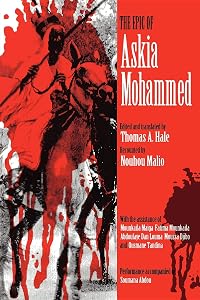
The Epic of Askia Mohammed (African Epic)
by Thomas A. Hale, Nouhou Malio
On This Page
Description
Askia Mohammed is the most famous leader in the history of the Songhay Empire, which reached its apogee during his reign in 1493-1528. Songhay, approximately halfway between the present-day cities of Timbuktu in Mali and Niamey in Niger, became a political force beginning in 1463, under the leadership of Sonni Ali Ber. By the time of his death in 1492, the foundation had been laid for the development under Askia Mohammed of a complex system of administration, a well-equipped army and navy, show more and a network of large government-owned farms. The present rendition of the epic was narrated by the griot (or jeseré) Nouhou Malio over two evenings in Saga, a small town on the Niger River, two miles downstream from Niamey. The text is a word-for-word translation from Nouhou Malio's oral performance. show lessTags
Recommendations












Member Reviews
The only work I could come up with by a Nigerien author (NOT Nigerian as the search engines were trying to "correct" it to) is this transcribed and translated oral epic about the Songhay Empire. It's pretty short for an epic--the tale itself takes up fewer than fifty pages--and the robust introduction, notes, and annotations make up about half the length of the slim volume.
The first half of the epic tells of the birth and rise to power of Mamar Kassaye, as Askia Mohammed is called in the text, the founder of the Askia dynasty of the Western African Songhay Empire.We start with Mamar's mother, Kassaye, conceiving via an encounter with a water spirit and hiding her son from the current ruler who was given a prophecy that one of Kassaye's show more children will grow up to kill him and become ruler; Mamar fulfills the prophecy, goes on pilgrimage to Mecca, has adventures, and founds a dynasty.
The second half deals with Mamar's descendants, and I have to admit I got kind of lost there. There's a long genealogy given before we get to any more action, and I had very little idea of who anyone was and why they were important. Having notes alongside the text rather than at the end of the book probably would have helped a great deal.
Despite my difficulty with the second half, I did enjoy the epic and hope it becomes more widely known. show less
The first half of the epic tells of the birth and rise to power of Mamar Kassaye, as Askia Mohammed is called in the text, the founder of the Askia dynasty of the Western African Songhay Empire.We start with Mamar's mother, Kassaye, conceiving via an encounter with a water spirit and hiding her son from the current ruler who was given a prophecy that one of Kassaye's show more children will grow up to kill him and become ruler; Mamar fulfills the prophecy, goes on pilgrimage to Mecca, has adventures, and founds a dynasty.
The second half deals with Mamar's descendants, and I have to admit I got kind of lost there. There's a long genealogy given before we get to any more action, and I had very little idea of who anyone was and why they were important. Having notes alongside the text rather than at the end of the book probably would have helped a great deal.
Despite my difficulty with the second half, I did enjoy the epic and hope it becomes more widely known. show less
Ratings
Members
- Recently Added By
Lists

Around the World in 80 Books
79 works; 4 members

Niger
15 works; 1 member
Author Information
6+ Works 99 Members
Thomas A. Hale is Edwin Erle Sparks Professor of African, French, and Comparative Literature and Head of the French Department at The Pennsylvania State University.
2 Works 43 Members
Awards and Honors
Notable Lists
Series
Belongs to Publisher Series
Work Relationships
Common Knowledge
- First words
- Mamar Kassaye, didn't the Songhay people narrate it to you?
- Last words
- (Click to show. Warning: May contain spoilers.)It is those people, the Gollé of Boubon, some went to the Kourfeye region, others scattered elsewhere.
- Original language
- Songhai
Classifications
- Genres
- Fiction and Literature, Literature Studies and Criticism, Poetry
- DDC/MDS
- 896.5 — Literature & rhetoric Literatures of other languages African literatures Nilotic, Nubian, Sudanic and Saharan languages
- LCC
- PL8685.9 .M36 .E5 — Language and Literature Languages and literatures of Eastern Asia, Africa, Oceania Languages of Eastern Asia, Africa, Oceania African languages and literature Special languages (alphabetically)
- BISAC
Statistics
- Members
- 39
- Popularity
- 750,789
- Reviews
- 1
- Rating
- (3.17)
- Languages
- English
- Media
- Paper
- ISBNs
- 2
- ASINs
- 1