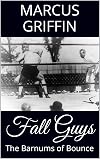
Fall Guys: The Barnums of Bounce
by Marcus Griffin
On This Page
Tags
Recommendations
Member Recommendations
Member Reviews
I have trouble putting into words just how much I enjoyed this book. One of the few I had been looking forward to reading for years that lived up to my own hype.
Written in 1937, 11 years before the founding of the National Wrestling Alliance, Marcus Griffin set out to inform the public about the secret goings on in the world of professional wrestling, during a time that in many parts of the U.S. wrestling was more popular than baseball, and certainly other new forms of entertainment like pro football, and ice hockey. I wasn't, however, a "Hey, look these guys are fooling you!" it was more of a sneak behind the curtain, "Hey, look how neat this is."
I find it fascinating that so many people, of which only 2% where "hip" to wrestling's show more pre-determined nature, attended so many matches. Most of these matches sound absolutely boring by today's standards, with hour+ of rolling around on the mat. I found particularly interesting the tales of how they kept it above board, yet underground at the same time. They forbid spectators betting on wrestling matches, something very strange for the time, particularly as this was how boxing was run. This let them avoid a riot when someone learned it was "fixed" as had happened in boxing. Griffin only reveals one story where they got ran out of town on a rail, and that was more because the bout was so short people felt they didn't get their money's worth.
I really liked the story of the Boston promoter who specifically did start a riot. After running a few shows with less than 100 fans, he went and paid to print 100,000 free passes to a show with 10,00 seats available, and when the papers ran the story about thousands just trying to get in the papers knew they had better start covering these shows because clearly everyone in town wanted to see the results, yet no one was printing them.
I was also surprised by how many times the athletes and promoters agreed ahead of time that particular matches would be "shooting matches" where the winning was not predetermined and actual grappling determined a winner, often for a championship, that would go one and be defended "kayfabe" for years thereafter. Along with that I still don't see how a government organization, a state's athletic commission, actually determined who the worlds heavyweight champion was, but it did shed light on all these Wikipedia articles I've read about how someone was recognized in one state as the champion and not another. Griffin doesn't really make clear how much the athletic commissions where in on it, but I think that was kind of his point.
Above all what I liked was Griffin's writing style. I don't have an estimate for how many different words and phrases he used "professional wrestler", like neckbender, mat hurdler, bonecrusher, etc., without ever actually saying pro wrestler or sports entertainer. The authentic old-timey-ness left a smile on my heart.
This was certainly written for its time, aimed at early 20th century wrestling fans, evident by limited descriptions of various characters in the wrestling world at the time. Certainly, any fan in a big city would know who these people where, but alas, very few did I have any clear understanding.
Personally, I'm going to buy a copy of the updated "annotated version" printed in the 2000s to my "Wishlist" to keep on my shelf and reference in any number of online wrestling flame wars that even my opponent will never read. I recommend anyone with even a cursory interest in pro wrestling to find a copy and read this. show less
Written in 1937, 11 years before the founding of the National Wrestling Alliance, Marcus Griffin set out to inform the public about the secret goings on in the world of professional wrestling, during a time that in many parts of the U.S. wrestling was more popular than baseball, and certainly other new forms of entertainment like pro football, and ice hockey. I wasn't, however, a "Hey, look these guys are fooling you!" it was more of a sneak behind the curtain, "Hey, look how neat this is."
I find it fascinating that so many people, of which only 2% where "hip" to wrestling's show more pre-determined nature, attended so many matches. Most of these matches sound absolutely boring by today's standards, with hour+ of rolling around on the mat. I found particularly interesting the tales of how they kept it above board, yet underground at the same time. They forbid spectators betting on wrestling matches, something very strange for the time, particularly as this was how boxing was run. This let them avoid a riot when someone learned it was "fixed" as had happened in boxing. Griffin only reveals one story where they got ran out of town on a rail, and that was more because the bout was so short people felt they didn't get their money's worth.
I really liked the story of the Boston promoter who specifically did start a riot. After running a few shows with less than 100 fans, he went and paid to print 100,000 free passes to a show with 10,00 seats available, and when the papers ran the story about thousands just trying to get in the papers knew they had better start covering these shows because clearly everyone in town wanted to see the results, yet no one was printing them.
I was also surprised by how many times the athletes and promoters agreed ahead of time that particular matches would be "shooting matches" where the winning was not predetermined and actual grappling determined a winner, often for a championship, that would go one and be defended "kayfabe" for years thereafter. Along with that I still don't see how a government organization, a state's athletic commission, actually determined who the worlds heavyweight champion was, but it did shed light on all these Wikipedia articles I've read about how someone was recognized in one state as the champion and not another. Griffin doesn't really make clear how much the athletic commissions where in on it, but I think that was kind of his point.
Above all what I liked was Griffin's writing style. I don't have an estimate for how many different words and phrases he used "professional wrestler", like neckbender, mat hurdler, bonecrusher, etc., without ever actually saying pro wrestler or sports entertainer. The authentic old-timey-ness left a smile on my heart.
This was certainly written for its time, aimed at early 20th century wrestling fans, evident by limited descriptions of various characters in the wrestling world at the time. Certainly, any fan in a big city would know who these people where, but alas, very few did I have any clear understanding.
Personally, I'm going to buy a copy of the updated "annotated version" printed in the 2000s to my "Wishlist" to keep on my shelf and reference in any number of online wrestling flame wars that even my opponent will never read. I recommend anyone with even a cursory interest in pro wrestling to find a copy and read this. show less
Members
- Recently Added By
Published Reviews
ThingScore 75
Falls Guys: The Barnums of Bounce by Marcus Griffin was released in 1937, making it one of the first widely-released books on professional wrestling. If you are interested in the history of the sport, it is a must-read and an important piece of literature on the topic. I would recommend, however, that you pick up the annotated version by Steve Yohe and Scott Teal, released in 2019. The two show more historians debunked many of the claims made in the book and gave a true sense of the history of the period. show less
added by fulner
Author Information
3 Works 22 Members
Common Knowledge
- Canonical title
- Fall Guys: The Barnums of Bounce
- Alternate titles
- Fall guys, The Barnums of Bounce; The Inside Story of the Wrestling Business, America's Most Profitable and Best Organized Professional Sport; Fall Guys; Fall guy : the barnum of bounce; Fall guy
- Original publication date
- 1937
- People/Characters
- Ed "Strangler" Lewis; George Hackenschmidt; Frank Gotch; Toots Mondt
- Important places
- Madison Square Garden, New York, New York, USA; New Jersey, USA; Philadelphia, Pennsylvania, USA; St. Louis, Missouri, USA; Houston, Texas, USA; New York, New York, USA (show all 7); Chicago, Illinois, USA
- Important events
- Hackenschmidt vs. Gotch
- First words
- You call it wrestling, they term it "working."
- Quotations
- [Wrestlers'] ring pirouetting not only indicate a more than slight cerebral selling and concussions, but without question prove to the mothers of the world that birth control should be vested in the Margaret Sangers of the Un... (show all)iverse.
It is not uncommon for a run of the mine neckbender to average one hundred and fifty dollars weekly over a period of twenty-five years. And because they wrestle so often and must be reasonable shape, matmen drop very little o... (show all)f this long green along Heart-break Boulevard.
Ninety-eight percent of those who pay their money to witness these gymnastic dramas and comedies believe it's on the level. - Last words
- (Click to show. Warning: May contain spoilers.)Au plaisir de vous revoir!
- Original language
- English
- Canonical DDC/MDS
- 796.81209
- Canonical LCC
- GV1195 .G852
Classifications
- Genres
- Nonfiction, Sports and Leisure
- DDC/MDS
- 796.81209 — Arts & recreation Recreation, sports, and performing arts Athletic and outdoor sports and games Wrestling / Martial Arts, Judo, Karate Martial arts Wrestling Biography And History
- LCC
- GV1195 .G852 — Geography, Anthropology and Recreation Recreation. Leisure Recreation. Leisure Sports Wrestling
Statistics
- Members
- 19
- Popularity
- 1,331,488
- Reviews
- 1
- Rating
- (5.00)
- Languages
- English
- Media
- Paper, Ebook
- ISBNs
- 1
- ASINs
- 2