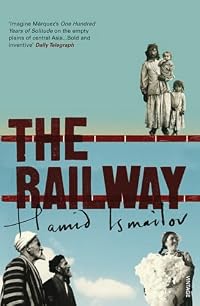
The Railway
by Hamid Ismailov
On This Page
Description
In the steppe near Tashkent they came upon a never-ending ladder with wooden rungs and iron rails and that stretched across the earth from horizon to horizon . Whistling and thundering, a snake-like wonder hurtled past them, packed both on the inside and on top with infidels shouting and waving their hands. "The End of the World!" thought both Mahmud-Hodja the Sunni and Djebral the Shiite.'Set mainly in Uzbekistan between 1900 and 1980, THE RAILWAY introduces to us the inhabitants of the show more small town of Gilas on the ancient Silk Route. Among those whose stories we hear are Mefody-Jurisprudence, the town's alcoholic intellectual; Father Ioann, a Russian priest; Kara-Musayev the Younger, the chief of police; and Umarali-Moneybags, the old moneylender. Their colourful lives offer a unique and comic picture of a little-known land populated by outgoing Mullahs, incoming Bolsheviks, and a plethora of Uzbeks, Russians, Persians, Jews, Koreans, Tatars and Gypsies. At the heart of both the town and the novel stands the railway station - a source of income and influence, and a connection to the greater world beyond the town. Rich and picaresque, THE RAILWAY is full of colour. Sophisticated yet with a naive delight in storytelling, it chronicles the dramatic changes felt throughout Central Asia in the early twentieth century. show lessTags
Recommendations







Member Reviews
A complicated novel, telling the intersecting but sometimes contradictory stories of a large group of characters in a small railway town north of Tashkent between about 1900 and 1980, interleaved with the story of an unnamed character just referred to as “the boy”. The stories are often ribald and usually involve at least a hint of magic realism, and the point of view is always that of a Muslim, Uzbek observer, looking with slight puzzlement at western civilisation and the Soviet project.
Ismailov says in an interview with the translator included as an afterword here that he wanted to contrast the regimented, hierarchical, Soviet way of looking at the world — obviously symbolised here by the railway — with the unprejudiced, show more fluid, Sufi-like gaze of the innocent boy. Ismailov takes no prisoners either in his social and political satire or in his brutally matter-of-fact descriptions of sex and violence, so this definitely isn’t for everyone, but it is a quite remarkable book, and often very funny indeed, even in places where you had rather it wasn’t… Certainly another one that invites a re-read to get the most out of it. show less
Ismailov says in an interview with the translator included as an afterword here that he wanted to contrast the regimented, hierarchical, Soviet way of looking at the world — obviously symbolised here by the railway — with the unprejudiced, show more fluid, Sufi-like gaze of the innocent boy. Ismailov takes no prisoners either in his social and political satire or in his brutally matter-of-fact descriptions of sex and violence, so this definitely isn’t for everyone, but it is a quite remarkable book, and often very funny indeed, even in places where you had rather it wasn’t… Certainly another one that invites a re-read to get the most out of it. show less
When this book was recommended to me, one of the words used was "sprawling". It's certainly an apt description of the novel. Broadly speaking, it centres around the fictional town of Gilas in modern day Uzbekistan, and particularly on one inhabitant, known only as "the boy".
The chapters generally focus on the personal stories of one or two of the town inhabitants or the boy's family, many of whom are fantastically named, like Ilyusha Oneandahalf (who had half an ear bitten off by a donkey when young) and Bolta-Lightning (the local electrician). Many of these histories are very folklore-esque: Ismailov has said that "there is nothing in The Railway that is not based on reality", and yet in the tradition of all good folk stories, there show more is plenty that is elaborated and exaggerated in the telling.
The book can sometimes feel frustratingly disparate, as if nothing is really locking together and all you're ever really being given are lots of snapshots. But the upshot of this is that you feel you're being given a picture of life in Soviet-ruled rural Uzbekistan, looking back to the nostalgic tales of the mighty warrior tribal leaders and wandering salesmen before "the Russian tsar suffered a revolution" and satirising the systems of government and those who try to run them and give them the run-around. However frustrating it can be that it's not always easy to work out why we're being told another story about yet more new characters, it's so easy to read (thanks to Robert Chandler's brilliant translation) and entertaining that it's difficult to put down. It's certainly a book that bears thought and re-reading, but it cannot be demeaned as a novel that's worth reading for its fun and sheer "exuberance", as Chandler refers to it in the introduction. But lurking underneath is a real commentary on the hardness and harshness of living through the twentieth century for those in central Asia, which makes reading it all the more rewarding. show less
The chapters generally focus on the personal stories of one or two of the town inhabitants or the boy's family, many of whom are fantastically named, like Ilyusha Oneandahalf (who had half an ear bitten off by a donkey when young) and Bolta-Lightning (the local electrician). Many of these histories are very folklore-esque: Ismailov has said that "there is nothing in The Railway that is not based on reality", and yet in the tradition of all good folk stories, there show more is plenty that is elaborated and exaggerated in the telling.
The book can sometimes feel frustratingly disparate, as if nothing is really locking together and all you're ever really being given are lots of snapshots. But the upshot of this is that you feel you're being given a picture of life in Soviet-ruled rural Uzbekistan, looking back to the nostalgic tales of the mighty warrior tribal leaders and wandering salesmen before "the Russian tsar suffered a revolution" and satirising the systems of government and those who try to run them and give them the run-around. However frustrating it can be that it's not always easy to work out why we're being told another story about yet more new characters, it's so easy to read (thanks to Robert Chandler's brilliant translation) and entertaining that it's difficult to put down. It's certainly a book that bears thought and re-reading, but it cannot be demeaned as a novel that's worth reading for its fun and sheer "exuberance", as Chandler refers to it in the introduction. But lurking underneath is a real commentary on the hardness and harshness of living through the twentieth century for those in central Asia, which makes reading it all the more rewarding. show less
I could not finish this book because the writing style bored me to tears. Each chapter is too short to qualify even as a very short story; instead, they are vignettes that often left me wondering "what's the point?" Perhaps if I had read further, these vignettes would have become interconnected, or the characters might have been developed in more depth. I guess I'll never know since I never made it past page 50.
Ratings
Members
- Recently Added By
Lists

Central Asia
59 works; 2 members

Books Read in 2018
4,360 works; 110 members

Top Five Books of 2024
795 works; 264 members
Author Information

13+ Works 523 Members
Some Editions
Awards and Honors
Common Knowledge
- Original title
- Железная дорога
- Original publication date
- 1997
- Important places*
- Oezbekistan
*Some information comes from Common Knowledge in other languages. Click "Edit" for more information.
Classifications
- Genres
- Fiction and Literature, General Fiction, Historical Fiction
- DDC/MDS
- 891.735 — Literature & rhetoric Asian Literature East Indo-European and Celtic literatures Russian and East Slavic languages Russian fiction 1991–
- LCC
- PL56.9 .I86 .R35 — Language and Literature Languages and literatures of Eastern Asia, Africa, Oceania Languages of Eastern Asia, Africa, Oceania Turkic languages
- BISAC
Statistics
- Members
- 121
- Popularity
- 268,505
- Reviews
- 4
- Rating
- (3.56)
- Languages
- English, French
- Media
- Paper, Ebook
- ISBNs
- 5
- ASINs
- 4