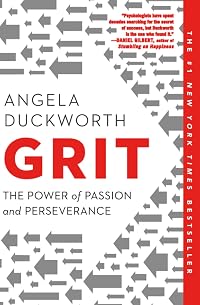
Grit: The Power of Passion and Perseverance
by Angela Duckworth
On This Page
Description
"In this must-read book for anyone striving to succeed, pioneering psychologist Angela Duckworth shows parents, educators, athletes, students, and business people--both seasoned and new--that the secret to outstanding achievement is not talent but a focused persistence called "grit." Why do some people succeed and others fail? Sharing new insights from her landmark research on grit, MacArthur "genius" Angela Duckworth explains why talent is hardly a guarantor of success. Rather, other show more factors can be even more crucial such as identifying our passions and following through on our commitments. Drawing on her own powerful story as the daughter of a scientist who frequently bemoaned her lack of smarts, Duckworth describes her winding path through teaching, business consulting, and neuroscience, which led to the hypothesis that what really drives success is not "genius" but a special blend of passion and long-term perseverance. As a professor at the University of Pennsylvania, Duckworth created her own "character lab" and set out to test her theory. Here, she takes readers into the field to visit teachers working in some of the toughest schools, cadets struggling through their first days at West Point, and young finalists in the National Spelling Bee. She also mines fascinating insights from history and shows what can be gleaned from modern experiments in peak performance. Finally, she shares what she's learned from interviewing dozens of high achievers--from JP Morgan CEO Jamie Dimon to the cartoon editor of The New Yorker to Seattle Seahawks Coach Pete Carroll. Winningly personal, insightful, and even life-changing, Grit is a book about what goes through your head when you fall down, and how that--not talent or luck--makes all the difference"-- show lessTags
Recommendations



Member Reviews
Generally, I agree with the Theory of Grit. I believe in (smart) hard work and grit is a way to choose to be better at something. I think the nature argument defines the range of what's possible and the nurture argument determines where we fall in that range. And therefore, grit is a combination of both nature and nurture. I do think the ability the grind away at something for a lengthy time, to persevere, is partly a matter of nature even though the opposite is what feels right.
Another point, the author's resume of high quality schools, awards, credentials and jobs almost undoes her grit argument entirely. It's like she's saying that, yes, grit is what counts but you need these other qualifiers first. It's a false assumption, but an show more impatient reader might not figure that out before giving up. show less
Another point, the author's resume of high quality schools, awards, credentials and jobs almost undoes her grit argument entirely. It's like she's saying that, yes, grit is what counts but you need these other qualifiers first. It's a false assumption, but an show more impatient reader might not figure that out before giving up. show less
★ ★ ★ ★ 1/2 (rounded up)
This originally appeared at The Irresponsible Reader.
---
...as much as talent counts, effort counts twice.
WHAT'S GRIT ABOUT?
I'm afraid I'd get lost in minuate or that I'd overcorrect and not give an adequate idea if I tried to give a thumbnail, so let me borrow from Duckworth's website:
pioneering psychologist Angela Duckworth shows anyone striving to succeed—be it parents, students, educators, athletes, or business people—that the secret to outstanding achievement is not talent but a special blend of passion and persistence she calls “grit.”
Why do some people succeed and others fail? Sharing new insights from her landmark research, Angela explains why talent is hardly a guarantor of success.
show more Angela has found that grit—a combination of passion and perseverance for a singularly important goal—is the hallmark of high achievers in every domain. She’s also found scientific evidence that grit can grow.
Angela gives a first-person account of her research with teachers working in some of the toughest schools, cadets struggling through their first days at West Point, and young finalists in the National Spelling Bee. She also mines fascinating insights from history and shows what can be gleaned from modern experiments in peak performance. Finally, she shares what she’s learned from interviewing dozens of high achievers—from JP Morgan Chase CEO Jamie Dimon to Seattle Seahawks Coach Pete Carroll.
It's a fascinating mix of psychological research, case studies and personal anecdotes. Duckworth structured this in such a way that not only it was informative and educational, it was enjoyable and motivational.
HOW ABOUT THE NARRATION?
I thought Duckworth herself was a great choice for narrators—she gives an energetic reading, that feels all the more authentic because it's based on her research and experiences*. She talks at one point about the work she put in to make her TED Talk more successful and probably carried over that work to this. In the end, it was one of the more compelling non-fiction narrations I can remember.
* Not that another narrator would've felt inauthentic...
SO, WHAT DID I THINK ABOUT GRIT?
I loved this—I was entertained, educated, and a little inspired. The subject was interesting, the approach challenging and didn't always give the answers you expected. Duckworth made it clear that with the right mindset and time, it was possible to increase your own grit and find a measure of success. It's not a one-size-fits-all solution, nor is it a promise of instant success. Just a reassurance that smart work can pay off.
I couldn't stop thinking of different friends/family members that I wanted to share insights from this with—I think one son, in particular, should be very happy that he was busy with school while I was listening to this so I didn't force him to listen along (it probably would have done him some good, but he probably wouldn't have appreciated it in the moment).
The associated PDF was a nice supplement to the audiobook (so I can see charts/graphs and whatnot). Still, I think I'm going to have to get a hold of the hard copy for easy reference (it's just easier to flip through to find something, or to use the index, than skipping through an audio file) and probably give out a copy or three. show less
This originally appeared at The Irresponsible Reader.
---
...as much as talent counts, effort counts twice.
WHAT'S GRIT ABOUT?
I'm afraid I'd get lost in minuate or that I'd overcorrect and not give an adequate idea if I tried to give a thumbnail, so let me borrow from Duckworth's website:
pioneering psychologist Angela Duckworth shows anyone striving to succeed—be it parents, students, educators, athletes, or business people—that the secret to outstanding achievement is not talent but a special blend of passion and persistence she calls “grit.”
Why do some people succeed and others fail? Sharing new insights from her landmark research, Angela explains why talent is hardly a guarantor of success.
show more Angela has found that grit—a combination of passion and perseverance for a singularly important goal—is the hallmark of high achievers in every domain. She’s also found scientific evidence that grit can grow.
Angela gives a first-person account of her research with teachers working in some of the toughest schools, cadets struggling through their first days at West Point, and young finalists in the National Spelling Bee. She also mines fascinating insights from history and shows what can be gleaned from modern experiments in peak performance. Finally, she shares what she’s learned from interviewing dozens of high achievers—from JP Morgan Chase CEO Jamie Dimon to Seattle Seahawks Coach Pete Carroll.
It's a fascinating mix of psychological research, case studies and personal anecdotes. Duckworth structured this in such a way that not only it was informative and educational, it was enjoyable and motivational.
HOW ABOUT THE NARRATION?
I thought Duckworth herself was a great choice for narrators—she gives an energetic reading, that feels all the more authentic because it's based on her research and experiences*. She talks at one point about the work she put in to make her TED Talk more successful and probably carried over that work to this. In the end, it was one of the more compelling non-fiction narrations I can remember.
* Not that another narrator would've felt inauthentic...
SO, WHAT DID I THINK ABOUT GRIT?
I loved this—I was entertained, educated, and a little inspired. The subject was interesting, the approach challenging and didn't always give the answers you expected. Duckworth made it clear that with the right mindset and time, it was possible to increase your own grit and find a measure of success. It's not a one-size-fits-all solution, nor is it a promise of instant success. Just a reassurance that smart work can pay off.
I couldn't stop thinking of different friends/family members that I wanted to share insights from this with—I think one son, in particular, should be very happy that he was busy with school while I was listening to this so I didn't force him to listen along (it probably would have done him some good, but he probably wouldn't have appreciated it in the moment).
The associated PDF was a nice supplement to the audiobook (so I can see charts/graphs and whatnot). Still, I think I'm going to have to get a hold of the hard copy for easy reference (it's just easier to flip through to find something, or to use the index, than skipping through an audio file) and probably give out a copy or three. show less
Hmm, what to say about author Angela Duckworth's book "Grit: The Power of Passion and Perseverance"...I think I can sum it up for myself at best as a three-lettered word: meh.
Who has grit and why, how do we get grit in our lives, and how can we raise/coach kids to have grit. These are the names of the chapters that make up the three parts to the book.
each section breaks down the exact same way: a statement of her hypothesis (which may take about a page or two), and then tens of pages of anecdote that supports her thoughts. Rinse and repeat.
Duckworth covers what grittiness is, is it just a stick-to-it attitude or is there more to it. Interest in your subject, deliberate practice, hope and belief, and more! Duckworth finishes with show more parenting for grit, if socio-economic status changes grit, and the Seattle Seahawks culture of grit (she seems to be a bit of a stan for Pete Carroll).
IN MY OPINION, nothing in here is very revelatory. She doesn't break any real new news...gritty people stick to it...gritty people have an interest in what they are doing...gritty people out last those without grit...gritty people put in more work...
what I did find interesting was her admission that the work is biased as she stated that "...I'm overlooking a whole population of grit paragons whose goals are purely selfish or, worse, directed at harming others." (p. 148) Well this throws her whole results right out the window as she admits that she only includes in her results the results of people that are pleasant to her. Not very scientific then is it and discolors everything she says that involves her research.
So if your research is iffy at best, and the rest of the book is anecdote to support your flawed research then I give this a big MEH for my thoughts on it. 2.5 stars and that is due to her ability to write well written, concise prose, which is not easy for everyone to do considering it is a work of non-fiction. show less
Who has grit and why, how do we get grit in our lives, and how can we raise/coach kids to have grit. These are the names of the chapters that make up the three parts to the book.
each section breaks down the exact same way: a statement of her hypothesis (which may take about a page or two), and then tens of pages of anecdote that supports her thoughts. Rinse and repeat.
Duckworth covers what grittiness is, is it just a stick-to-it attitude or is there more to it. Interest in your subject, deliberate practice, hope and belief, and more! Duckworth finishes with show more parenting for grit, if socio-economic status changes grit, and the Seattle Seahawks culture of grit (she seems to be a bit of a stan for Pete Carroll).
IN MY OPINION, nothing in here is very revelatory. She doesn't break any real new news...gritty people stick to it...gritty people have an interest in what they are doing...gritty people out last those without grit...gritty people put in more work...
what I did find interesting was her admission that the work is biased as she stated that "...I'm overlooking a whole population of grit paragons whose goals are purely selfish or, worse, directed at harming others." (p. 148) Well this throws her whole results right out the window as she admits that she only includes in her results the results of people that are pleasant to her. Not very scientific then is it and discolors everything she says that involves her research.
So if your research is iffy at best, and the rest of the book is anecdote to support your flawed research then I give this a big MEH for my thoughts on it. 2.5 stars and that is due to her ability to write well written, concise prose, which is not easy for everyone to do considering it is a work of non-fiction. show less
I'm always a little suspicious of pop psych books. As a social science student, I think the hype around the idea that come out books like this can overwhelm the rigors of normal replication and peer review methods. In this book, it does seem like the author is aware of current limitation in the theory as it is now and is very willing to work with other researchers in her field, which I really appreciate.
I also, in this case, don't really care if everything about the girt theory ends up being completely correct. I know that in order to learn, I must fail. To me, this is the most important part of grit. It's not about whether you have it, or how you can get more. This is the most crucial element to me because it is so contrary to how show more we've structured our society. I'm a college student right now and I'm in the honors college. I want to go to grad school some day. This means if I need to keep my GPA up if I want to graduate with high honors and get into a good grad school. There is not a lot of places I feel like I can fail in college. I need to be great right away to get the best grade I can. It is pretty well observed that I'm not the only student that feels that way. It is well document that the need to get a high GPA prevents students from taking risks and causes students to avoid harder or more challenging classes. I have tried to skirt around this by taking a different PE class every semester. I can fail in these classes. I can be bad at the sport at first and then see myself improve. As long as I show up and do the work, I will get an A. I don't know if this is necessarily the best way to conduct our other classes but I do know that the grading system in my PE class makes it much more likely that I will challenge myself and try something new.
I like the idea of grit because it encourages this failing to learn behavior. Maybe all the science isn't in yet, but I'll be interested me see how this theory will continue to develop. I hope that maybe someday the world will change to fit this model more and allow us more opportunities to fail without getting punished for taking that risk. show less
I also, in this case, don't really care if everything about the girt theory ends up being completely correct. I know that in order to learn, I must fail. To me, this is the most important part of grit. It's not about whether you have it, or how you can get more. This is the most crucial element to me because it is so contrary to how show more we've structured our society. I'm a college student right now and I'm in the honors college. I want to go to grad school some day. This means if I need to keep my GPA up if I want to graduate with high honors and get into a good grad school. There is not a lot of places I feel like I can fail in college. I need to be great right away to get the best grade I can. It is pretty well observed that I'm not the only student that feels that way. It is well document that the need to get a high GPA prevents students from taking risks and causes students to avoid harder or more challenging classes. I have tried to skirt around this by taking a different PE class every semester. I can fail in these classes. I can be bad at the sport at first and then see myself improve. As long as I show up and do the work, I will get an A. I don't know if this is necessarily the best way to conduct our other classes but I do know that the grading system in my PE class makes it much more likely that I will challenge myself and try something new.
I like the idea of grit because it encourages this failing to learn behavior. Maybe all the science isn't in yet, but I'll be interested me see how this theory will continue to develop. I hope that maybe someday the world will change to fit this model more and allow us more opportunities to fail without getting punished for taking that risk. show less
Grit is the term that Angela Duckworth gives to the qualities of resilience, perseverance and positivity that show a strong correlation to success. Of course she has not just come up with that idea, the evidence is hugely supportive and from a variety of different fields. Duckworth is a psychologist and her research is wide ranging, she draws on classic experiments with rats and dogs but also longitudinal studies of humans. In terms of evidencing her theories she looks at sports, politics, business and the military amongst others with copious examples and interviews.
This is all wrapped up in an eminently readable book, peppered with anecdotes and written in a very engaging style. Although the psychology is of the highest level, it is show more accessible and the message is really clear. As an educationalist I am really interested in Duckworth's message, resilience has become the buzzword recently and much has been made of Dweck's work on positive mindsets, here is a theory that combines these and takes them to another level. Application of Duckworth's ideas is already showing success in the KIPP schools in the USA and is easily transferable to the UK. This is a book which inspires. show less
This is all wrapped up in an eminently readable book, peppered with anecdotes and written in a very engaging style. Although the psychology is of the highest level, it is show more accessible and the message is really clear. As an educationalist I am really interested in Duckworth's message, resilience has become the buzzword recently and much has been made of Dweck's work on positive mindsets, here is a theory that combines these and takes them to another level. Application of Duckworth's ideas is already showing success in the KIPP schools in the USA and is easily transferable to the UK. This is a book which inspires. show less
I found Grit truly inspiring. As a middle-aged person still pursuing my "top-level/life-organizing goal," as the author would say, I found it tremendously motivating to read that people who are the best in their field require not only early purpose but a sustaining mindset. I remember thinking at 40, well, I've learned this journalism skill pretty well - now I want to do more with it. Angela Duckworth offers inspiration to keep going, even if her advice doesn't apply exclusively to mid-life readers. I thought the first seven chapters were a revelation. After that, the book became a little repetitive until the conclusion. As a mother of two teenage daughters, I intuited Duckworth's grit lessons from the earlier chapters before she got to show more the direct advice to parents. Still, this book was a lovely read, especially for a work that delivered so much science and research. Duckworth's personal stories are relatable ... although she is far too humble given what she's accomplished in life. show less
Seemingly, everybody has their own version of secrets of success. Angela Duckworth shares that and more in her psychological theory of achievement; only hers is backed by research study. She terms the common factor in success as “grit.” In this work, she shares a way of quantifying grit (called the Grit Scale) methods to develop it in people.
At the outset, she seeks to overthrow the idea that some people are just naturally more talented and therefore succeed more. Instead, she adopts a more nuanced view that passion and perseverance are developed over time by deliberate goal-directed effort. Then she writes about how parents, teachers, and coaches can develop grit in the young. In this theory, she provides an abundant amount of show more real-world stories of success that illustrate these principles – stories like triumphs and failures in professional football, of excellence in military education, and of everyday people inspired to overcome obstacles.
Duckworth even addresses the limitations of grit. She admits that there is more to life than just grit – such as happiness. (However, she still contends that grit and happiness have a positive correlation.) She talks about her own family – her parents and her children – and her desire to develop characteristics of grit in her children. She stops short of being a full-fledged Tiger Mom as she tries to curate independent choice-making skills in her children.
Obviously, stories of success are a large part of human culture. On a stroll through almost any bookstore, one can spot numerous books on success. Few, if any, possess the depth of thought and empirical research that Duckworth’s has. For these efforts, she was awarded a recent MacArther “Genius” Grant. Few theories of success have the depth of impact that hers has either. Her interest is benevolently centered around cultivating a better life for the next generation.
One could fault her on being too focused on the need to center upon one huge goal. She does not adequately deal with success stories (like Steve Jobs, Benjamin Franklin, or Saint Augustine of Hippo) where someone changes more than one field through broader focus. Her version of grit requires a specialist’s focus. In life, however, there is room for creative generalists.
Nonetheless, this treatment provides a compelling narrative of how to treat yourself and those looking up to you. I say “compelling” because it is driven by a careful study of reality and an intricate persuasive argument. Interested teachers, parents, and mentors should all give Grit a read. It’s a pleasure to work through and might just ignite some suppressed dreams into reaching their own realities. show less
At the outset, she seeks to overthrow the idea that some people are just naturally more talented and therefore succeed more. Instead, she adopts a more nuanced view that passion and perseverance are developed over time by deliberate goal-directed effort. Then she writes about how parents, teachers, and coaches can develop grit in the young. In this theory, she provides an abundant amount of show more real-world stories of success that illustrate these principles – stories like triumphs and failures in professional football, of excellence in military education, and of everyday people inspired to overcome obstacles.
Duckworth even addresses the limitations of grit. She admits that there is more to life than just grit – such as happiness. (However, she still contends that grit and happiness have a positive correlation.) She talks about her own family – her parents and her children – and her desire to develop characteristics of grit in her children. She stops short of being a full-fledged Tiger Mom as she tries to curate independent choice-making skills in her children.
Obviously, stories of success are a large part of human culture. On a stroll through almost any bookstore, one can spot numerous books on success. Few, if any, possess the depth of thought and empirical research that Duckworth’s has. For these efforts, she was awarded a recent MacArther “Genius” Grant. Few theories of success have the depth of impact that hers has either. Her interest is benevolently centered around cultivating a better life for the next generation.
One could fault her on being too focused on the need to center upon one huge goal. She does not adequately deal with success stories (like Steve Jobs, Benjamin Franklin, or Saint Augustine of Hippo) where someone changes more than one field through broader focus. Her version of grit requires a specialist’s focus. In life, however, there is room for creative generalists.
Nonetheless, this treatment provides a compelling narrative of how to treat yourself and those looking up to you. I say “compelling” because it is driven by a careful study of reality and an intricate persuasive argument. Interested teachers, parents, and mentors should all give Grit a read. It’s a pleasure to work through and might just ignite some suppressed dreams into reaching their own realities. show less
Members
- Recently Added By
Lists

BusinessBooks
24 works; 5 members

The Power of Habit Bibliography
7 works; 1 member

Books Read in 2018
4,360 works; 110 members

The Great Courses: The Learning Brain
61 works; 1 member

Mind Expanding Books by hackerkid
581 works; 8 members

Top Five Books of 2023
767 works; 317 members

Psychology: Abuse, Grief, Self-Help
189 works; 1 member

Favorite 10 Books of the Upper Class For Developing Self-Discipline
10 works; 1 member

Books Read in 2025
4,091 works; 97 members

If Books Could Kill Podcast
52 works; 1 member
Author Information

Angela Duckworth is an American psychologist, born in 1970. She earned her BA in neurobiology at Harvard, her MSc in neuroscience at Oxford, and her PhD in psychology at the University of Pennsylvania. She has advised the White House, the World Bank, NBA and NFL teams, and Fortune 500 CEOs. She is also the Founder and Scientific Director of the show more nonprofit, Character Lab. She is a 2013 MacArthur Fellow and professor of psychology at the University of Pennsylvania. Her first book, Grit: The Power of Passion and Perseverance, is a New York Times bestseller. (Bowker Author Biography) show less
Some Editions
Awards and Honors
Distinctions
Series
Belongs to Publisher Series
Work Relationships
Common Knowledge
- Canonical title
- Grit: The Power of Passion and Perseverance
- Original publication date
- 2016-05-03
- Dedication
- For Jason
- First words
- Nobody wants to show you the hours and hours of becoming. They'd rather show the highlight of what they’ve become.
- Quotations
- Enthusiasm is common. Endurance is rare.
Growing up, I heard the word genius a lot.
Our potential is one thing. What we do with it is quite another.
There are no shortcuts to excellence. Developing real expertise, figuring out really hard problems, it all takes time―longer than most people imagine….you’ve got to apply those skills and produce goods or services that ... (show all)are valuable to people….Grit is about working on something you care about so much that you’re willing to stay loyal to it…it’s doing what you love, but not just falling in love―staying in love.
as much as talent counts, effort counts twice. - Last words
- (Click to show. Warning: May contain spoilers.)It’s often said that the last mile is the longest. Grit keeps you on the path.
- Blurbers
- Gilbert, Daniel
- Canonical DDC/MDS
- 158.1
- Canonical LCC
- BF637.S8
Classifications
Statistics
- Members
- 3,368
- Popularity
- 5,010
- Reviews
- 61
- Rating
- (3.96)
- Languages
- 14 — Czech, Danish, Dutch, English, Estonian, French, German, Hungarian, Italian, Polish, Spanish, Swedish, Turkish, Portuguese (Brazil)
- Media
- Paper, Audiobook, Ebook
- ISBNs
- 50
- ASINs
- 16