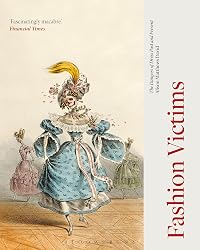
Fashion Victims: The Dangers of Dress Past and Present
by Alison Matthews David
On This Page
Description
From insidious murder weapons to blaze-igniting crinolines, clothing has been the cause of death, disease and madness throughout history, by accident and design. Clothing is designed to protect, shield and comfort us, yet lurking amongst seemingly innocuous garments we find hats laced with mercury, frocks laden with arsenic and literally 'drop-dead gorgeous' gowns. Fabulously gory and gruesome, Fashion Victims takes the reader on a fascinating journey through the lethal history of women's, show more men's and children's dress, in myth and reality. Drawing upon surviving fashion objects and numerous visual and textual sources, encompassing louse-ridden military uniforms, accounts of the fiery deaths of Oscar Wilde's half-sisters and dancer Isadora Duncan's accidental strangulation by entangled scarf; the book explores how garments have tormented those who made and wore them, and harmed animals and the environment in the process. Vividly chronicling evidence from Greek mythology to the present day, Matthews David puts everyday apparel under the microscope and unpicks the dark side of fashion. Fashion Victims is lavishly illustrated with over 125 images and is a remarkable resource for everyone from scholars and students to fashion enthusiasts. show lessTags
Recommendations










Member Reviews
This is a fascinating look at the various perils posed by our clothes from the dawn of the Industrial Revolution onwards -- from arsenic and aniline dyes to catching clothes in machinery and combustible crinolines. The focus is primarily on Europe and North America in the beginning, then expands to the rest of the world as the author discusses the dangers we face with our clothes today. Generally speaking, the past dangers affected both the wearer and the factory worker: a person wearing a dress dyed with an arsenic-based dye could succumb to poisoning just as easily as the person manufacturing the dress. Today, however, a lot of the dangers posed by our fashions are borne disproportionately by the people making the clothes: the show more labourers working in sweatshops under appalling conditions to create clothes that will be discarded in landfills three months from now. Granted, the environmental costs of discarding everything so quickly will affect the entire planet, but nowadays it seems as though many of these costs are externalized; for many in the Western world, it's out of sight, out of mind.
The information in this book is well presented and well laid-out, with carefully chosen photographs whose relevance is clearly explained. The endnotes for each chapter appear right after the chapter to which they apply, making it easy to look them up, and the bibliography at the back provides avenues for further reading. The book itself is a sizeable hardcover, but it's not too thick. There are a few gross parts: namely, a couple of images of wax figures showing symptoms of poisoning, and more than a few mentions of testing poisons on animals (especially rabbits). Overall, though, this is a highly interesting book that is very easy to plow through in a few hours. Recommended for those who enjoy books about medical issues in the real world and books about chemical elements (e.g. The Arsenic Century, The Elements of Murder). show less
The information in this book is well presented and well laid-out, with carefully chosen photographs whose relevance is clearly explained. The endnotes for each chapter appear right after the chapter to which they apply, making it easy to look them up, and the bibliography at the back provides avenues for further reading. The book itself is a sizeable hardcover, but it's not too thick. There are a few gross parts: namely, a couple of images of wax figures showing symptoms of poisoning, and more than a few mentions of testing poisons on animals (especially rabbits). Overall, though, this is a highly interesting book that is very easy to plow through in a few hours. Recommended for those who enjoy books about medical issues in the real world and books about chemical elements (e.g. The Arsenic Century, The Elements of Murder). show less
Although perhaps it shouldn’t have surprised me, I found the tone of ‘Fashion Victims’ disconcerting. It’s a curious mixture of academic textbook specificity and ghoulishness. Although I learned some interesting facts, they were all unpleasant and depressing. The title mentions ‘past and present’, but the focus is firmly on the 19th century and how industrialisation introduced exciting new hazards into clothing. Most of these revolved around poisons and flammability. I found the section on ballerinas' dangerous tutus particularly tragic. As the author puts it: ‘The 19th century ballerina was a physical labourer, known for her rigorous training and almost superhuman ability to withstand pain. A select few female stars show more became international celebrities, but the average member of the corps de ballet came from the poorest of working class backgrounds.’ On top of that they were constantly exposed to the risk of catching fire! As with books examining the social history of Britain’s industrialisation, I was left wondering how anyone managed to survive the barrage of hazards to which they were continually exposed. The afterword points out that many of these dangers, and some new ones, have since been outsourced to poorer countries. Despite the plethora of colourful illustrations, this is a book to leave you feeling distinctly gloomy. show less
I'm going to cite this book as the reason I wear jeans and t-shirts, because fashion is, literally, a killer throughout history. Extensively researched and never boring, this book is filled with tales not just of those who perished for their fashionable taste but also includes those who died creating those fashions. Terrible and tragic, but a brilliant read.
[Fashion Victims: the Dangers of Dress Past and Present] by [[Alison Matthews David]]
This is an interesting and fun look at how fashion has endangered our lives. David focuses on mainly the 1800s through the early 1900s, telling stories of dangerous dyes, flammable fabrics, and poisonous methods of construction.
The writing was interesting (not fabulous) but the illustrations are fantastic. This is a beautiful book with glossy pages and huge color prints, photos, and drawings. Without the illustrations, the book would be sort of boring, but instead it ends up being a fascinating read.
Of course, the author doesn't let us off the hook either. The final section gives several examples of our our clothing is still endangering our lives and show more especially the lives of those who make it. show less
This is an interesting and fun look at how fashion has endangered our lives. David focuses on mainly the 1800s through the early 1900s, telling stories of dangerous dyes, flammable fabrics, and poisonous methods of construction.
The writing was interesting (not fabulous) but the illustrations are fantastic. This is a beautiful book with glossy pages and huge color prints, photos, and drawings. Without the illustrations, the book would be sort of boring, but instead it ends up being a fascinating read.
Of course, the author doesn't let us off the hook either. The final section gives several examples of our our clothing is still endangering our lives and show more especially the lives of those who make it. show less
Wow, this book was... eye-opening. It is written in the style of a textbook, and I suppose it is one, though not one that would be found in any class I ever took. Guess I wasn't taking the interesting classes.
It's easy to look back into the past and laugh at what people once did that we see as insane today. Modern Medicine is a good example (ie, leaches, letting blood, stuffing who-knows-what in open wounds, etc). But fashion is an equally interesting one. Matthews-David covers so many different varieties of death and maiming by clothing that it's difficult to not think about parallels to today. Examples of subjects she covers are the use of mercury in hat making, arsenic in making green dye, and ton of different chemicals in making show more different fabrics.
Most of the time the people who suffered the most weren't the ones who wore the fashions, but the people who were making them. She adds several modern day examples of the same stuff still happening which makes you wonder even more about the clothes you're wearing right now and what exactly went into making them. Side note, these episodes of Planet Money were about the highly complicated process of making a simple T-Shirt and how it's so convoluted that changes are slow and hard to come by. It includes a fascinating section on what happens to our clothes when we donate them too.
At the end, she has this to say in conclusion:
The past shows us how profit and novelty have won out over safety and health. A better future would include the design and manufacture of clothing that could protect us rather than exposing us to mechanical harm, contagious disease, accidents and chemical toxins.
I suppose it makes me a very narrow-minded person, but I've never spent much time thinking about how the clothing I am wearing came to be, but it's definitely something I am interested in now. I feel pretty terrible knowing that I may have unknowingly contributed to someone elses pain while making my clothes. I can't imagine that people of past times would have felt differently than I did either, which makes this book all the more important for the story it tells.
Copy courtesy of Bloomsbury Academic, via Netgalley in exchange for an honest review show less
It's easy to look back into the past and laugh at what people once did that we see as insane today. Modern Medicine is a good example (ie, leaches, letting blood, stuffing who-knows-what in open wounds, etc). But fashion is an equally interesting one. Matthews-David covers so many different varieties of death and maiming by clothing that it's difficult to not think about parallels to today. Examples of subjects she covers are the use of mercury in hat making, arsenic in making green dye, and ton of different chemicals in making show more different fabrics.
Most of the time the people who suffered the most weren't the ones who wore the fashions, but the people who were making them. She adds several modern day examples of the same stuff still happening which makes you wonder even more about the clothes you're wearing right now and what exactly went into making them. Side note, these episodes of Planet Money were about the highly complicated process of making a simple T-Shirt and how it's so convoluted that changes are slow and hard to come by. It includes a fascinating section on what happens to our clothes when we donate them too.
At the end, she has this to say in conclusion:
The past shows us how profit and novelty have won out over safety and health. A better future would include the design and manufacture of clothing that could protect us rather than exposing us to mechanical harm, contagious disease, accidents and chemical toxins.
I suppose it makes me a very narrow-minded person, but I've never spent much time thinking about how the clothing I am wearing came to be, but it's definitely something I am interested in now. I feel pretty terrible knowing that I may have unknowingly contributed to someone elses pain while making my clothes. I can't imagine that people of past times would have felt differently than I did either, which makes this book all the more important for the story it tells.
Copy courtesy of Bloomsbury Academic, via Netgalley in exchange for an honest review show less
Fashion Victims - The Dangers of Dress Past and Present by Alison Matthews David takes a detailed look at fashion items responsible for death, disease and accidents throughout history.
The book is meticulously researched and cleverly broken down into separate chapters, each one denoted by colour coded page edges which make for an attractive hardback edition.
Some of the chapters include:
- Poisonous Pigments (Chapter 3)
- Entangled and Strangled (Chapter 5)
- Inflammatory Fabrics (Chapter 6)
Great chapter headings aren't they? I enjoyed learning about dangerous dyes, the deadly mercury used to make hats, the arsenic contained in green garments in the 1800s, ballerinas who burned to death but refused to change their stage dress and so much show more more.
The research covers both the garment makers (the dyers, dressmakers etc.) and the wearers, exposing the diseases, accidents and deaths attributed to both sides all in the name of fashion.
The following excerpt from the blurb sets the scene for what you'll find in Fashion Victims:
From insidious murder weapons to blaze-igniting crinolines, clothing has been the cause of death, disease and madness throughout history, by accident and design. Clothing is designed to protect, shield and comfort us, yet lurking amongst seemingly innocuous garments we find hats laced with mercury, frocks laden with arsenic and literally 'drop-dead gorgeous' gowns.
Wow, right? Fashion Victims - The Dangers of Dress Past and Present is an excellent reference for students and academics as well as readers interested in fashion and/or history.
* Copy courtesy of Bloomsbury Publishing * show less
The book is meticulously researched and cleverly broken down into separate chapters, each one denoted by colour coded page edges which make for an attractive hardback edition.
Some of the chapters include:
- Poisonous Pigments (Chapter 3)
- Entangled and Strangled (Chapter 5)
- Inflammatory Fabrics (Chapter 6)
Great chapter headings aren't they? I enjoyed learning about dangerous dyes, the deadly mercury used to make hats, the arsenic contained in green garments in the 1800s, ballerinas who burned to death but refused to change their stage dress and so much show more more.
The research covers both the garment makers (the dyers, dressmakers etc.) and the wearers, exposing the diseases, accidents and deaths attributed to both sides all in the name of fashion.
The following excerpt from the blurb sets the scene for what you'll find in Fashion Victims:
From insidious murder weapons to blaze-igniting crinolines, clothing has been the cause of death, disease and madness throughout history, by accident and design. Clothing is designed to protect, shield and comfort us, yet lurking amongst seemingly innocuous garments we find hats laced with mercury, frocks laden with arsenic and literally 'drop-dead gorgeous' gowns.
Wow, right? Fashion Victims - The Dangers of Dress Past and Present is an excellent reference for students and academics as well as readers interested in fashion and/or history.
* Copy courtesy of Bloomsbury Publishing * show less
Who'd have thought that ordinary articles of clothing could have such detrimental effects on the human body.
Hats containing mercury slowly poisoning the wearer, material containing fleas that brought plague.
Even the men and women making these items of clothing were not immune.
Hatters driven "mad" from injesting mercury, tailors becoming deformed from sitting in one position all day, even seamstresses turning to prostitution to fund their business.
An altogether fascinating account of the darker side of the clothing industry.
The illustrations and photographs accompanying the text are gory to say the least!
I was given a digital copy of this book by the publisher via Netgalley in return for an honest unbiased review.
Hats containing mercury slowly poisoning the wearer, material containing fleas that brought plague.
Even the men and women making these items of clothing were not immune.
Hatters driven "mad" from injesting mercury, tailors becoming deformed from sitting in one position all day, even seamstresses turning to prostitution to fund their business.
An altogether fascinating account of the darker side of the clothing industry.
The illustrations and photographs accompanying the text are gory to say the least!
I was given a digital copy of this book by the publisher via Netgalley in return for an honest unbiased review.
Members
- Recently Added By
Author Information

3 Works 231 Members
Common Knowledge
- Original title
- Fashion Victims: The Dangers of Dress Past and Present
- Original publication date
- 2015-09-24
- People/Characters
- Isadora Duncan; Karen Wetterham; Kyoichi Tsuzuki
- First words
- In a routine experiment on August 14, 1996, Karen Wetterham, a 48-year-old chemistry professor at Dartmouth College who specialized in the study of toxic metal exposure, accidentally spilled a few drops of mercury on her glov... (show all)e. Less than a year later she was dead.
- Publisher's editor
- Wright, Anna
- Blurbers
- Evans, Caroline; Crowston, Clare H.; Wetenhall, Tanya Williams; Vincent, Susan J.
- Original language
- English
Classifications
- Genres
- Nonfiction, General Nonfiction, Art & Design, History
- DDC/MDS
- 646.3 — Applied science & technology Home economics & family management Sewing, Grooming, Life Skills Style and Wardrobe Selection
- LCC
- RA779 .M38 — Medicine Public aspects of medicine Public aspects of medicine Public health. Hygiene. Preventive medicine Personal health and hygiene
- BISAC
Statistics
- Members
- 168
- Popularity
- 194,747
- Reviews
- 10
- Rating
- (4.17)
- Languages
- English
- Media
- Paper, Ebook
- ISBNs
- 5
- ASINs
- 1