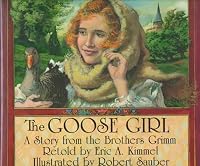
The Goose Girl: A Story from the Brothers Grimm
by Eric A. Kimmel
On This Page
Description
On her way to marry a distant prince, a young princess is forced to trade places with her evil serving maid and becomes a goose girl instead of a bride when she reaches her destination.Tags
Recommendations





Member Reviews
The Goose Girl, retold by Eric A. Kimmel, illustrated by Robert Sauber.
Prolific picture-book author Eric A. Kimmel retells the classic fairy-tale of the Goose Girl, originally from the Brothers Grimm, in this lovely title. Given a sheltered upbringing by her loving mother, a beautiful princess encounters envy and spite for the first time when she is sent out into the world in the care of the maid servant Margaret. Journeying to her intended bridegroom, the gentle princess is forced to trade places with Margaret, and she herself is made a goose girl, when they arrive at their destination. Only the prince's father suspects that there might be something more to this seeming servant...
Originally part of the Brothers Grimm collection from show more 1815, where it was known as Die Gänsemagd, this fairy-tale has been translated into English numerous times, although Kimmel does not specify the source for his own telling. Leaving that aside, the story here was engaging, with plenty of themes - the mother's protective love, the enchanted horse guardian - that I have encountered before in other tales. The artwork from Robert Sauber, who also illustrated Kimmel's Sirko and the Wolf: A Ukrainian Tale and I-Know-Not-What, I-Know-Not-Where: A Russian Tale, is lovely - sometimes dark, but also shot through with golden tones. Recommended to anyone who enjoys beautiful fairy-tale picture-books. show less
Prolific picture-book author Eric A. Kimmel retells the classic fairy-tale of the Goose Girl, originally from the Brothers Grimm, in this lovely title. Given a sheltered upbringing by her loving mother, a beautiful princess encounters envy and spite for the first time when she is sent out into the world in the care of the maid servant Margaret. Journeying to her intended bridegroom, the gentle princess is forced to trade places with Margaret, and she herself is made a goose girl, when they arrive at their destination. Only the prince's father suspects that there might be something more to this seeming servant...
Originally part of the Brothers Grimm collection from show more 1815, where it was known as Die Gänsemagd, this fairy-tale has been translated into English numerous times, although Kimmel does not specify the source for his own telling. Leaving that aside, the story here was engaging, with plenty of themes - the mother's protective love, the enchanted horse guardian - that I have encountered before in other tales. The artwork from Robert Sauber, who also illustrated Kimmel's Sirko and the Wolf: A Ukrainian Tale and I-Know-Not-What, I-Know-Not-Where: A Russian Tale, is lovely - sometimes dark, but also shot through with golden tones. Recommended to anyone who enjoys beautiful fairy-tale picture-books. show less
'The Goose Girl' is a piece of dark folklore, originally told by the famous Brothers Grimm, retold by Eric A. Kimmel and illustrations by Robert Sauber. The world's tone has cruel characters taking advantage of the innocence of others. This innocence in the form of our princess who has been sheltered by her mother, the queen, since birth from any evil around. This princess grows up to be kind but a victim to her own maid Margaret who was sent by the queen to accompany the princess, along with a horse able to understand and speak any human language, named Falada, to a prince's kingdom who are betrothed to one another. The maid harasses and abuse the kind princess, now away from her protective kingdom. Taking her place as the princess show more promised to the prince knowing the real princess will do nothing about it, she has Falada, who witness all of this, to be beheaded. A dark ending for the poor horse; that is something expected from the style of the Brothers Grimm. There tone flows through the story as the real princess is sent to be a goose girl assisting a boy, and eventually is seen as the true princess by the King of the land thanks to Falada's disembodied head speaking to the princess. It is a grim tone even for the medieval setting to the very end where the faux princess pronounced her own horrible death. This is a story where anyone who wants to read a folklore that is not modernized like today's fairy tales can get a feel of the story of the original lore as it was when first created by the Brothers Grimm. show less
This book tells the story of a young princess on her journey to meet her prince. Along the way she is abused and forced to change identities with her rude and evil servant. When they arrive to the kingdom the prince falsely takes the servant as his wife and leaves the true princess to become a goose hearder. Eventually the king finds out and sends out to kill the imposter while the princess lives happily ever after. I personally found this book to be one of the darker fairy tales I have read. The style was still whimsical but it was no where near the childlike innocence you would expect from a fairytale. I do not think this would be a good book to read to a group of young children. However I think for any study on ancient kingdoms or show more practice it would be fine. show less
Summary:
Goose girl is about a princess who has never known cruelty until she was sent to be married to a prince in the next kingdom. The servant who was supposed to serve her treated her unkindly and switched places with her and made the princess swear not to tell any living person. When they arrived to the new kingdom the servant was thought to be the princes and taken to marry the prince while the real princess was made to work as the servant to a boy who tended to geese. She is able to survive the mean goose boy, who likes to play tricks, by using her magic powers to keep him away. Every day she talks to her talking horse who was slain to deal with her sadness. When the king found out what had transpired he sentenced the the impostor show more to death and restore the true princess to her rightful place.
Reaction:
I thought it was a little dark and graphic in the way that it described the impostors death for this to be a children's book. If I ever did read this to a class I probably would ask for parent permission first. The artwork in this book is absolutely stunning though.
Extension:
1. Ask the students to assess whether the punishment was just or not.
2. Have students rewrite the ending of this story in the way that they see fit. show less
Goose girl is about a princess who has never known cruelty until she was sent to be married to a prince in the next kingdom. The servant who was supposed to serve her treated her unkindly and switched places with her and made the princess swear not to tell any living person. When they arrived to the new kingdom the servant was thought to be the princes and taken to marry the prince while the real princess was made to work as the servant to a boy who tended to geese. She is able to survive the mean goose boy, who likes to play tricks, by using her magic powers to keep him away. Every day she talks to her talking horse who was slain to deal with her sadness. When the king found out what had transpired he sentenced the the impostor show more to death and restore the true princess to her rightful place.
Reaction:
I thought it was a little dark and graphic in the way that it described the impostors death for this to be a children's book. If I ever did read this to a class I probably would ask for parent permission first. The artwork in this book is absolutely stunning though.
Extension:
1. Ask the students to assess whether the punishment was just or not.
2. Have students rewrite the ending of this story in the way that they see fit. show less
Kimmel, E. A., Sauber, R., Grimm, J., & Grimm, W. (1995). The goose girl: a story from the Brothers Grimm. New York: Holiday House.
Grades 1 through 3
A beautiful princess is sent by her mother to meet her betrothed. The queen gives her daughter a handkerchief stained with the queen’s royal blood as a protective charm and sends her magical talking horse Falada to protect the princess. Accompanying the young lady is Margaret, the queen’s trusted serving maid. Margaret, however, is evil and cruel; taking advantage of the princess’s kind nature, Margaret mistreats her. When the princess loses her mother’s protective charm, Margaret takes her place by forcing her to wear her servant’s clothes and ride the servant’s old jade. Once show more they arrive to the palace, the prince immediately assumes that Margaret is his bride. The king, however, notices how lovely and delicate the princess is, and gives her a job tending the geese. Margaret, afraid that Falada will denounce her, has the horse killed. The princess has Falada’s head nailed to the gate she must cross every day. Falada’s magic is now the princess’s, and she is able to talk to the horse and control the wind. The goose boy complains of her ways to the king, who, already suspicious, decides to question the girl. Bound by a promise to Margaret, the princess refuses to tell him her story. Using his wit, the king suggests that the princess open her heart to the iron stove. When he learns the truth, he approaches Margaret and ask her advice on how to deal with a servant who betrayed her mistress. Margaret suggests a particularly painful punishment, sealing her fate. The princess is restored to her position, and she and the prince live happily ever after.
The goose girl remains true to the original tale. As with most folk tales, the characters of the princess and Margaret represent absolutes of character—the princess as all that is good and pure; Margaret as evil and conniving. As it is common in folktales, good prevails over evil; Margaret is placed in a barrel lined with sharp spikes and dragged through the streets. This kind of violent end for the villain is not uncommon in folktales. The plot is simple and direct, and the theme highlights how evil deeds will lead to retribution. The borders in the illustrations help frame the oil painting. In some pictures, details seem to dissolve as they near the borders, giving the images a dreamlike quality. Parents may choose to exercise caution when sharing with children Margaret’s gruesome fate. show less
Grades 1 through 3
A beautiful princess is sent by her mother to meet her betrothed. The queen gives her daughter a handkerchief stained with the queen’s royal blood as a protective charm and sends her magical talking horse Falada to protect the princess. Accompanying the young lady is Margaret, the queen’s trusted serving maid. Margaret, however, is evil and cruel; taking advantage of the princess’s kind nature, Margaret mistreats her. When the princess loses her mother’s protective charm, Margaret takes her place by forcing her to wear her servant’s clothes and ride the servant’s old jade. Once show more they arrive to the palace, the prince immediately assumes that Margaret is his bride. The king, however, notices how lovely and delicate the princess is, and gives her a job tending the geese. Margaret, afraid that Falada will denounce her, has the horse killed. The princess has Falada’s head nailed to the gate she must cross every day. Falada’s magic is now the princess’s, and she is able to talk to the horse and control the wind. The goose boy complains of her ways to the king, who, already suspicious, decides to question the girl. Bound by a promise to Margaret, the princess refuses to tell him her story. Using his wit, the king suggests that the princess open her heart to the iron stove. When he learns the truth, he approaches Margaret and ask her advice on how to deal with a servant who betrayed her mistress. Margaret suggests a particularly painful punishment, sealing her fate. The princess is restored to her position, and she and the prince live happily ever after.
The goose girl remains true to the original tale. As with most folk tales, the characters of the princess and Margaret represent absolutes of character—the princess as all that is good and pure; Margaret as evil and conniving. As it is common in folktales, good prevails over evil; Margaret is placed in a barrel lined with sharp spikes and dragged through the streets. This kind of violent end for the villain is not uncommon in folktales. The plot is simple and direct, and the theme highlights how evil deeds will lead to retribution. The borders in the illustrations help frame the oil painting. In some pictures, details seem to dissolve as they near the borders, giving the images a dreamlike quality. Parents may choose to exercise caution when sharing with children Margaret’s gruesome fate. show less
This is an awesome book to see what kids think of personal character and betrayal. I read read this book to kids to find the bar a which they measure their own personal integrity.
OKC
Grimm's fairy tales
Collection Book on CD includes this story.
Grimm's fairy tales
Collection Book on CD includes this story.
Members
- Recently Added By
Author Information

142+ Works 16,850 Members
Eric Kimmel was born in Brooklyn, NY in 1946. He received a bachelor's degree in English Literature from Lafayette College. He also has a Ph.D. in Education from the University of Illinois. He was an elementary school teacher and college professor before becoming a full-time writer. He has published over fifty titles, many of which have won state show more and national awards. His titles "Hershel and the Hanukkah Goblins" won the Caldecott Honor Medal, "The Chanukkah Guest" and "Gershon's Monster" won the Sydney Taylor Picture Book Award and "Anansi and the Talking Melon" won the Utah Children's Choice Award. Kimmel travels nationally and internationally visiting schools and talking about his books and telling stories. (Bowker Author Biography) show less
All Editions
Some Editions
Awards and Honors
Work Relationships
Is retold in
Classifications
- Genres
- Children's Books, Picture Books
- DDC/MDS
- 398.21 — Society, Government, and Culture Customs, etiquette & folklore Folklore & Folktales Folk literature Fairy Tales
- LCC
- PZ8 .K527 .G — Language and Literature Fiction and juvenile belles lettres Fiction and juvenile belles lettres Juvenile belles lettres
- BISAC
Statistics
- Members
- 67
- Popularity
- 464,517
- Reviews
- 7
- Rating
- (3.96)
- Languages
- English, French
- Media
- Paper, Audiobook, Ebook
- ISBNs
- 6
- ASINs
- 1