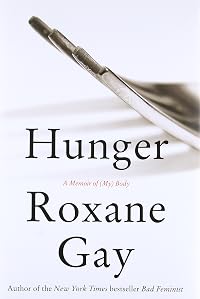
Hunger: A Memoir of (My) Body
by Roxane Gay
On This Page
Description
Roxane Gay addresses the experience of living in a body that she calls 'wildly undisciplined.' She casts an insightful and critical eye over her childhood, teens, and twenties -- including the devastating act of violence that was a turning point at age 12 -- and brings readers into the present and the realities, pains, and joys of her daily life. With candor, vulnerability, and authority, Roxane explores what it means to be overweight in a time when the bigger you are, the less you are seen.Tags
Recommendations









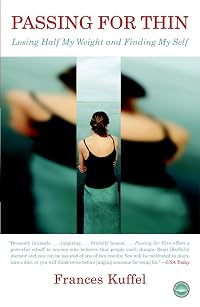
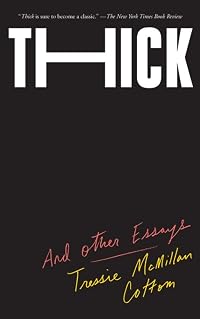

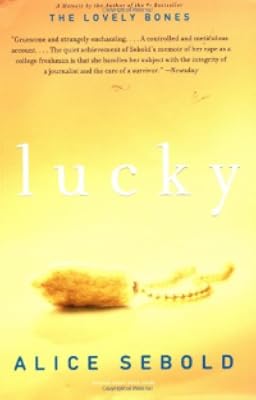













Member Recommendations
akblanchard Successful authors remember difficult times.
Member Reviews
Gay shares the experiences that have literally shaped her in this brave, heartbreaking memoir. A traumatic experience as an adolescent led to her developing coping mechanisms that involved using food for comfort and weight as a shield. Now, she faces the realities of existing in a world that is not set up to accommodate bodies of size.
While I don't share Gay's experience of trauma, I have (unfortunately) shared some of the experiences she relates about being a larger person in a world not suited for big figures. I applaud the bravery and raw honesty she shows in putting these words to paper. Gay starts out by telling her story chronologically, but then it feels like she moves over to handling things more topically, which leads to some show more jumping around in the timeline. Some later parts of the book also feel more like essays, leading me to wonder if they started out that way (the CIP data indicates that parts of the book appeared elsewhere prior to publication). I'm glad that I read this book. There's no lesson to be learned here -- Gay is on a journey, same as the rest of us; she hasn't figured out the magical secret to weight loss that we all would love to discover. show less
While I don't share Gay's experience of trauma, I have (unfortunately) shared some of the experiences she relates about being a larger person in a world not suited for big figures. I applaud the bravery and raw honesty she shows in putting these words to paper. Gay starts out by telling her story chronologically, but then it feels like she moves over to handling things more topically, which leads to some show more jumping around in the timeline. Some later parts of the book also feel more like essays, leading me to wonder if they started out that way (the CIP data indicates that parts of the book appeared elsewhere prior to publication). I'm glad that I read this book. There's no lesson to be learned here -- Gay is on a journey, same as the rest of us; she hasn't figured out the magical secret to weight loss that we all would love to discover. show less
A memoir about trauma and fatness which was painful to read both in the ways that it intersected with my experiences and those that it didn't. I find it interesting how many reviews describe the book as repetitive and thus bad, whereas I understood the circling back as a means of showing the compounding nature of trauma. A lot of readers seem to want Roxane Gay to have finished in some upward trajectory of a "weight-loss journey"—for her to perform some complicated feat of gymnastics that would let her bootstrap her way out of her own body—but as she says in Hunger's opening pages, this "is not a story of triumph". It's neither a How To nor a How Not To book. It's far more mixed than that, as indeed are some of my feelings about show more Hunger—but what is more fitting for a book about hunger than for me to have mixed feelings about it? show less
Roxane Gay's book about what it's like to live in the world as an obese woman approaches the experience from both universal and starkly personal angles. She's so honest and unflinching in her examination of her own weight, as well as why she is fat, that the book is often difficult to read; I felt that I really shouldn't be privy to such personal information. But Gay is unable to not be completely open, and it's that rawness that makes this book so powerful.
Gay ties her very personal experience to the wider one of how society treats larger women, pulling from her own life to demonstrate how ill-equipped and judgmental we are of people who we perceive as lacking control, and especially of women who take up more space than they should. show more Gay is also a tall woman, at 6'3" making her even more conspicuous than she would be at an average height, making ordinary things difficult, from airline seats to finding clothes.
While she was on a book tour for this book, she traveled to Australia and did an interview with a website which subsequently wrote an article about the unique problems accommodating Gay's size posed for them, from having to find a sturdy chair to the onerous task of checking how many pounds the elevator could carry. It was amazing how very much a publication which intended to be sympathetic missed the mark and the whole sordid tale proved Gay's points. It should be noted that had this company planned an interview with a man of similar size, they would have gone about their preparations with a great deal less hysteria and certainly never considered it fodder for an article. show less
Gay ties her very personal experience to the wider one of how society treats larger women, pulling from her own life to demonstrate how ill-equipped and judgmental we are of people who we perceive as lacking control, and especially of women who take up more space than they should. show more Gay is also a tall woman, at 6'3" making her even more conspicuous than she would be at an average height, making ordinary things difficult, from airline seats to finding clothes.
While she was on a book tour for this book, she traveled to Australia and did an interview with a website which subsequently wrote an article about the unique problems accommodating Gay's size posed for them, from having to find a sturdy chair to the onerous task of checking how many pounds the elevator could carry. It was amazing how very much a publication which intended to be sympathetic missed the mark and the whole sordid tale proved Gay's points. It should be noted that had this company planned an interview with a man of similar size, they would have gone about their preparations with a great deal less hysteria and certainly never considered it fodder for an article. show less
This was one of the most emotionally challenging listening experiences I’ve had. Not because the writing lacked anything. It was too powerful, too raw. I paused it often, unsure if I could keep going. Not because it wasn’t good, but because it was too much. Roxane Gay’s voice is steady and filled with nuance. There’s a richness to the way she shares her story that made it feel like I was hearing her read pages of a diary I wasn’t entirely sure I had the right to read. I hated how much of this I related to. I hated that it had to be written. I’m grateful that it was. This isn’t a book I can recommend to everyone. It’s too personal, too heavy, but it might be for you.
Suffering a despicable, traumatic experience at a young age, the author ate, a lot, to protect her body from future harm. But as a result, she became super obese (I like her personally acceptable description: a person of size). I gained a lot of weight last year (but significantly less than her) for health reasons, so I have a small taste of the shame she feels because of her size. But the bigger connection to this book for me is what I believe is likely universal, or almost universal, lifelong shame about something about something: something we did or said, or happened to us, something that eats at us and we hope to hide forever.
Gay’s extraordinary revelations about herself resonated deeply with me. That being said, she also opened show more my eyes to the struggles of the obese in this world. First, her gaining weight was a result of a child dealing the only way she knew how with the cruelty she endured, a cruelty against which she wages a daily battle. Second, she must plan her days to a level of infinite detail. We’ve all heard about the difficulty flying when overweight; but it’s true for seating at movie theaters, concert halls, and even restaurants! Third, enduring a world where just trying to sit in a chair can be torture leaving bruises and pain. Fourth, little to no clothes available for the super obese. And finally and most importantly, dealing with people who despise her for her weight (not to mention her race), who treat her as imaginary, whose faces fill with disgust upon seeing her—and conversely, those offering advice to her that she certainly doesn’t need from strangers much less family (as she points out, she’s extremely well-educated, she knows the problem and she’s tried everything to lose the weight). Or offering platitudes (“your face is pretty!).
Suffice it to say, this is a deeply personal book by Gay but that can resonate with every one of us on some level. If we all could be so brave as she is. show less
Gay’s extraordinary revelations about herself resonated deeply with me. That being said, she also opened show more my eyes to the struggles of the obese in this world. First, her gaining weight was a result of a child dealing the only way she knew how with the cruelty she endured, a cruelty against which she wages a daily battle. Second, she must plan her days to a level of infinite detail. We’ve all heard about the difficulty flying when overweight; but it’s true for seating at movie theaters, concert halls, and even restaurants! Third, enduring a world where just trying to sit in a chair can be torture leaving bruises and pain. Fourth, little to no clothes available for the super obese. And finally and most importantly, dealing with people who despise her for her weight (not to mention her race), who treat her as imaginary, whose faces fill with disgust upon seeing her—and conversely, those offering advice to her that she certainly doesn’t need from strangers much less family (as she points out, she’s extremely well-educated, she knows the problem and she’s tried everything to lose the weight). Or offering platitudes (“your face is pretty!).
Suffice it to say, this is a deeply personal book by Gay but that can resonate with every one of us on some level. If we all could be so brave as she is. show less
Roxane Gay is brilliant, readable and important in the struggles for women and blacks and I whipped through her book, yet I grew weary and dejected just as she did telling her tragic story. Her writing does spur one on even if there is a swathe of hopelessness about her recovering from the gang rape suffered at twelve. Yet I kept reading, fascinated by the depth of her confessions and laying bare of her pain and loneliness, and her self-understanding. It's what we're encouraged to do in memoir but how difficult it is.
"I do not want pity or appreciation or advice. I am not brave or heroic. I am not strong. I am not special. I am one woman who has experienced something countless women have experienced. I am a victim who survived."
"I do not want pity or appreciation or advice. I am not brave or heroic. I am not strong. I am not special. I am one woman who has experienced something countless women have experienced. I am a victim who survived."
Does it make sense to follow the review of a recipe book with a memoir about body image and being overweight? Maybe it does, or maybe it doesn't, but I can promise it was a sheer coincidence that my reading choices overlapped in this way.
In Hunger: A Memoir of (My) Body, author Roxane Gay reflects on the struggles she has with her weight, stemming from a vicious sexual assault at a young age. The author shares intimate details about her mental and physical health, fat phobia and the daily hassles and humiliations she endures due to her size.
"This is no way to live, but this is how I live." End of Chapter 59
As a reader in Australia who struggles with their weight, I was hoping to gain some insight or new angle on weight gain and body show more image from a bestselling author, professor and social commentator. However, Roxane Gay's experiences as a tall (1.91m), bisexual American woman of Haitian descent are nothing at all like mine. I realised half way through that I had entered into this memoir with a fixed agenda instead of the intention to learn about another person's battles and demons.
"The bigger you are, the smaller your world becomes." Chapter 62
Roxane Gay is raw and unapologetic in an endearing way and bares her soul in this memoir. Her struggles with confidence and self worth were well written yet hard to read and as a society, there is much we should be ashamed about. After finishing Hunger: A Memoir of (My) Body, it's clear we have a long way to go in learning how to treat one another. show less
In Hunger: A Memoir of (My) Body, author Roxane Gay reflects on the struggles she has with her weight, stemming from a vicious sexual assault at a young age. The author shares intimate details about her mental and physical health, fat phobia and the daily hassles and humiliations she endures due to her size.
"This is no way to live, but this is how I live." End of Chapter 59
As a reader in Australia who struggles with their weight, I was hoping to gain some insight or new angle on weight gain and body show more image from a bestselling author, professor and social commentator. However, Roxane Gay's experiences as a tall (1.91m), bisexual American woman of Haitian descent are nothing at all like mine. I realised half way through that I had entered into this memoir with a fixed agenda instead of the intention to learn about another person's battles and demons.
"The bigger you are, the smaller your world becomes." Chapter 62
Roxane Gay is raw and unapologetic in an endearing way and bares her soul in this memoir. Her struggles with confidence and self worth were well written yet hard to read and as a society, there is much we should be ashamed about. After finishing Hunger: A Memoir of (My) Body, it's clear we have a long way to go in learning how to treat one another. show less
Members
- Recently Added By
Lists

Best Autobiographies and Memoirs
370 works; 67 members

Best Biographies, Autobiographies and Memoirs
465 works; 160 members

Must-Read Books by Black Authors
114 works; 92 members

Top Five Books of 2018
802 works; 264 members
Top Five Books of 2017
757 works; 231 members

Read in 2018
2 works; 1 member

Top Five Books of 2021
604 works; 181 members

Black Authors
384 works; 32 members

2018 Notable Books for Adults
26 works; 4 members

Florida's Book Bans and Challenges
311 works; 4 members

Reading Group 2018
8 works; 1 member

Best Biographies of Notable Women
279 works; 101 members

Reading Glasses Podcast
410 works; 3 members
Featured in Fat Talk by Virginia Sole-Smith
103 works; 1 member

Books Read in 2022
5,218 works; 114 members

The Hermenautic Bookshelf
111 works; 7 members

Favourite Books
1,819 works; 316 members

Female Author
1,234 works; 64 members

KayStJ's to-read list
1,616 works; 11 members

Best 21st Century Books (So Far)
670 works; 86 members

Best of 2017
12 works; 2 members

Books Read in 2018
4,360 works; 110 members

HarperCollins Publishers
144 works; 3 members

Biographies: Women
112 works; 1 member
Author Information

38+ Works 12,559 Members
Roxane Gay is the New York Times bestselling author of Bad Feminist: Essays, the novel An Untamed State, the story collection Ayiti, and her memoir, Hunger: A Memoir of (My) Body. Her work has also appeared in Glamour, Best American Short Stories, and the New York Times Book Review. She won the PEN Center USA's 2015 Freedom to Write Award. The show more annual award is presented to individuals or organisations for 'producing notable work in the face of extreme adversity' or showing 'exceptional courage in the defense of free expression. In 2018, she was presented the Trustee Award for Excellence in Literature by the Lambda Literery Awards. She also won the Bisexual Nonfiction award for her memoir Hunger. (Bowker Author Biography) show less
Awards and Honors
Awards
Distinctions
The Guardian Book of the Day (2017-07-19)
Common Knowledge
- Canonical title
- Hunger: A Memoir of (My) Body (My)
- Alternate titles
- Hunger
- Original publication date
- 2017-06-13
- People/Characters
- Roxane Gay
- Dedication
- for you, my sunshine, showing me what I no longer need and finding the way to my warm
- First words
- Every body has a story and a history.
- Quotations
- This is the reality of living in my body: I am trapped in a cage. The frustrating thing about cages is that you're trapped but you can see exactly what you want. You can reach out from the cage, but only so far.
My body is a cage. My body is a cage of my own making. I am still trying to figure out my way out of it. I have been trying to figure a way out of it for more than twenty years.
When I was twelve years old, I was raped.
So many years past being raped, I tell myself what happened is "in the past." This is only partly true. In too many ways, the past is still with me. The past is written on my body.... (show all) I carry it every single day. The past sometimes feels like it might kill me. It is a very heavy burden.
Hating myself became as natural as breathing.
I ate and ate and ate at school. At home for breaks, I made a show of dieting (and continued eating everything I really wanted to eat, in secret). This double life of eating would become something that stayed with me well int... (show all)o adulthood. It lingers even now.
It is a powerful lie to equate thinness with self-worth.
What does it say about our culture that the desire for weight loss is considered a default feature of womanhood?
It is startling to realize that even Oprah, a woman in her early sixties, a billionaire and one of the most famous women in the world, isn't happy with herself, her body. That is how pervasive damaging cultural messages about... (show all) unruly bodies are—that even as we age, no matter what material successes we achieve, we cannot be satisfied or happy unless we are also thin.
In yet another commercial, Oprah somberly says, "Inside every overweight woman is a woman she knows she can be." This is a popular notion, the idea that the fat among us are carrying a thin woman inside. Each time I see this ... (show all)particular commercial, I think, I ate that thin woman and she was delicious but unsatisfying. And then I think about how fucked up it is to promote this idea that our truest selves are thin women hiding in our fat bodies like imposters, usurpers, illegitimates.
"People like me don't get to eat food like that in public," and it was one of the truest things I've ever said.
I think, Tomorrow, I will make good choices. I am always holding on to the hope of tomorrow.
I reserve my most elaborate delusions and disappointments for myself.
In order to maintain your body weight, you need to eat 11 calories for every pound you weigh. In order to lose a pound of fat, you must burn 3,500 calories.
I am the fattest person.
This is a constant, destructive refrain and I cannot escape it.
When I am eating a meal, I have no sense of portion control. I am a completist.
This is to say, I know what it means to hunger without being hungry. My father believe hunger is in the mind. I know differently. I know that hunger is in the mind and the body and the heart and the soul.
I often tell my students that fiction is about desire in one way or another. The older I get, the more I understand that life is generally the pursuit of desires. We want and want and oh how we want. We hunger. - Last words
- (Click to show. Warning: May contain spoilers.)See what I hunger for and what my truth has allowed me to create.
- Publisher's editor
- Griffin, Emily
- Blurbers
- Patchett, Ann
- Original language
- English
Classifications
- Genres
- Biography & Memoir, General Nonfiction, Sexuality and Gender Studies, Nonfiction
- DDC/MDS
- 306.4 — Society, government, & culture Social sciences, sociology & anthropology Social Behavior - Dating, Marriage, Divorce Specific aspects of culture
- LCC
- BF697.5 .B63 .G39 — Philosophy, Psychology and Religion Psychology Psychology Differential psychology. Individuality. Self
- BISAC
Statistics
- Members
- 2,724
- Popularity
- 6,787
- Reviews
- 136
- Rating
- (4.20)
- Languages
- 8 — Dutch, English, French, German, Italian, Portuguese, Spanish, Swedish
- Media
- Paper, Audiobook, Ebook
- ISBNs
- 31
- ASINs
- 6