When Green Becomes Tomatoes: Poems for All Seasons
by Julie Fogliano
On This Page
Description
"A book of poetry moving through the seasons"--Tags
Recommendations







Member Reviews
Opening and closing on March 20th, at the beginning of spring and the end of winter, this collection of forty-nine poems - some short, some long - chronicles the beauties of the year, with sections devoted to each of the seasons. The same poem book-ends the collection on each end, and makes for a lovely introduction and conclusion: "from a snow covered tree / one bird singing / each tweet poking / a tiny hole / through the edge of winter / and landing carefully / balancing gently / on the tip of spring."
From hot days at the beach to cold days snuggled up reading in a chair, the experiences depicted here are those many children might share, and correspond to the time of year. Fogliano captures the way in which seasonal change affects show more life for children very nicely in her poems, and some of her word choice, when describing the beauty of the natural world, is quite striking. I enjoyed the poems in When Green Becomes Tomatoes, which reminded me of some of my own joy at different times of the year, and found the accompanying artwork by Julie Morstad just lovely. Recommended to anyone looking for good collections of poetry for young children, or for seasonal picture-books. show less
From hot days at the beach to cold days snuggled up reading in a chair, the experiences depicted here are those many children might share, and correspond to the time of year. Fogliano captures the way in which seasonal change affects show more life for children very nicely in her poems, and some of her word choice, when describing the beauty of the natural world, is quite striking. I enjoyed the poems in When Green Becomes Tomatoes, which reminded me of some of my own joy at different times of the year, and found the accompanying artwork by Julie Morstad just lovely. Recommended to anyone looking for good collections of poetry for young children, or for seasonal picture-books. show less
I really enjoyed this book for multiple reasons, this book contains poetry written about the seasons and the changes they bring. It is written in a journal entry style, each poem is titled by it’s date of the year. Each poem is distinct and unique perfectly capturing the setting and how it plays on our senses. I think that this book is an excellent example of how poetry can teach students science. The illustrations match perfectly with the poetry, they are soft but colorful and expressive. They convey the imagery that the poems create in the readers mind.
Sheesh. This should be right up my alley. Nature poetry for children, pretty pictures, an author I've previously enjoyed. But no. The 'poems' are trite and instantly forgettable. The pictures are merely greeting card pretty. And the subject matter is very specific - I do not believe there are very many children who live where there are four seasons that fall exactly on the calendar dates (I know I never have lived in such a place, and certainly city children will be awfully lucky to have even half of these experiences at any time). But this is what Bechtel would call a 'parlor gift book' and what I would compare to Disney or Kincaid. Don't bother.
Fogliano celebrates the four seasons through journal entries in poetic form. Starting and ending with March 20, the vernal equinox, the author marks randomly chosen days with short, free verse observations ("if you want to be sure/that you are nothing more than small/stand at the edge of the ocean/looking out."). The timely text describes blooming crocuses, rainy spring days, warm summer sun, and falling leaves. Cleverly written and personal in nature, these offerings convey the beauty of the seasons.
In her poetry, Julie Fogliano reminds us of the beauty of seasons. Starting with the eve of spring, march 20: "from a snow-covered tree/one bird singing/each tweet poking/a tiny hole/through the edge of winter/and landing carefully/balancing gently/on the tip of spring".
I really loved most of the poems in this book and plan to reread them. Some have the rhythm and charm of nursery rhymes that could be repeated and easily memorized. Some make such strong impressions of seasons, and longing that they caught my breath: windows into nature that both adults and children could appreciate.
I would absolutely recommend this to any elementary (or middle school) teacher to get students enthused about poetry and more attuned to nature, and to show more introduce seasons to primary kids. (The poems are dates, so they would lend themselves perfectly to a school schedule.) Some of the short ones would be fun to memorize/chant, to feel the sound/images of poetry, and others would challenge children to see differently. I don't think children would appreciate just reading through this book; one a day or week (a little the way it's set up) would be perfect, and I think children would love rereading each poem for a week and would look forward to discovering the next one.
I have mixed feelings about the illustrations. Some, especially for june 30, are perfect. All are charming, with lovely textures. However, I found the large-headed, big-eyed children and the straight horizon lines in most of the pictures repetitious. show less
I really loved most of the poems in this book and plan to reread them. Some have the rhythm and charm of nursery rhymes that could be repeated and easily memorized. Some make such strong impressions of seasons, and longing that they caught my breath: windows into nature that both adults and children could appreciate.
I would absolutely recommend this to any elementary (or middle school) teacher to get students enthused about poetry and more attuned to nature, and to show more introduce seasons to primary kids. (The poems are dates, so they would lend themselves perfectly to a school schedule.) Some of the short ones would be fun to memorize/chant, to feel the sound/images of poetry, and others would challenge children to see differently. I don't think children would appreciate just reading through this book; one a day or week (a little the way it's set up) would be perfect, and I think children would love rereading each poem for a week and would look forward to discovering the next one.
I have mixed feelings about the illustrations. Some, especially for june 30, are perfect. All are charming, with lovely textures. However, I found the large-headed, big-eyed children and the straight horizon lines in most of the pictures repetitious. show less
WHEN GREEN BECOMES TOMATOES: POEMS FOR ALL SEASONS by Julie Fogliano uses forty-eight short poems to tell the story of a year.
The combination of Fogliano’s delicate, rhythmic voice with Morstad’s cheerful illustrations create a pleasing atmosphere for children to explore poetry. Most children will relate to the author’s exploration of everyday activities during each season.
Libraries will find this attractive picture book to be an enticing addition to the growing number of poetry books focusing on the seasons. Use it as a way to jumpstart student writing projects that explore the connection between nature and the human experience. The book features specific dates during the year. Ask students to write their own poems to fill in the show more gaps.
Published by Roaring Brook Press, an imprint of Macmillan on March 1, 2016. ARC courtesy of the publisher. show less
The combination of Fogliano’s delicate, rhythmic voice with Morstad’s cheerful illustrations create a pleasing atmosphere for children to explore poetry. Most children will relate to the author’s exploration of everyday activities during each season.
Libraries will find this attractive picture book to be an enticing addition to the growing number of poetry books focusing on the seasons. Use it as a way to jumpstart student writing projects that explore the connection between nature and the human experience. The book features specific dates during the year. Ask students to write their own poems to fill in the show more gaps.
Published by Roaring Brook Press, an imprint of Macmillan on March 1, 2016. ARC courtesy of the publisher. show less
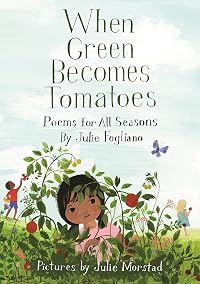
When Green Becomes Tomatoes Poems for All Seasons by Julie Fogliano, Pictures by Julie Morstad
Summary:
This picturebook is written in prose and uses complimentary interaction between the pictures and the text meaning both illustration and text are fully complimentary. The poems for each season would stand up as great literature on their own but with the artistic presentation in the illustration of each season there is much to be gained as one feels the mood in both literary and graphic expression through soft watercolor illustrations. We follow this complex relationship between the word and the illustrations as Fogliano crafts the colors of the seasons into the poetry with a duality of expression in the form of a shape, the color of a show more flower or the greys of the clouds which in turn has been complimented in the same fashion in the illustrations done meticulously by Morstad.
Personal Reaction:
I have been a writer an avid reader of poetry since the early 80’s as I did a study of poetic expression with the University of Connecticut and then found solace in expressing my own life challenges on paper. The many small poems thrilled my senses as I dug even deeper into their meanings during the 3rd and 4th reading of this amazing work of art. The combination of the poetic genius and graphics woven into the fabric of the story allowed me to live each season.
Classroom Extension Ideas
1.This read is appropriate for all ages in any classroom to include college settings. With so much art in both the poetry and the graphics I could use it as a perfect study for an English class or to illustrate the complex interwoven nature of text and graphic in an art session.
2.The graphics also bring in a multi-cultural property that would demonstrate to children the fact that we all feel the seasons the same way regardless of race, ethnicity, or economic status. This piece of art has significantly provided a class with the sense of unity and transition with purpose that could be the center of study for a social studies program.
3.As an open discussion forum for elementary students, I would see this work read out loud to the class at the change of each season as it challenges the stereotype mood of the transition and amplifies that each season has a benefit that could not be accomplished in the previous season. A great read for teaching children mental agility. show less
Summary:
This picturebook is written in prose and uses complimentary interaction between the pictures and the text meaning both illustration and text are fully complimentary. The poems for each season would stand up as great literature on their own but with the artistic presentation in the illustration of each season there is much to be gained as one feels the mood in both literary and graphic expression through soft watercolor illustrations. We follow this complex relationship between the word and the illustrations as Fogliano crafts the colors of the seasons into the poetry with a duality of expression in the form of a shape, the color of a show more flower or the greys of the clouds which in turn has been complimented in the same fashion in the illustrations done meticulously by Morstad.
Personal Reaction:
I have been a writer an avid reader of poetry since the early 80’s as I did a study of poetic expression with the University of Connecticut and then found solace in expressing my own life challenges on paper. The many small poems thrilled my senses as I dug even deeper into their meanings during the 3rd and 4th reading of this amazing work of art. The combination of the poetic genius and graphics woven into the fabric of the story allowed me to live each season.
Classroom Extension Ideas
1.This read is appropriate for all ages in any classroom to include college settings. With so much art in both the poetry and the graphics I could use it as a perfect study for an English class or to illustrate the complex interwoven nature of text and graphic in an art session.
2.The graphics also bring in a multi-cultural property that would demonstrate to children the fact that we all feel the seasons the same way regardless of race, ethnicity, or economic status. This piece of art has significantly provided a class with the sense of unity and transition with purpose that could be the center of study for a social studies program.
3.As an open discussion forum for elementary students, I would see this work read out loud to the class at the change of each season as it challenges the stereotype mood of the transition and amplifies that each season has a benefit that could not be accomplished in the previous season. A great read for teaching children mental agility. show less
Members
- Recently Added By
Lists

Youth: Earth Science
205 works; 1 member
Author Information

22 Works 3,304 Members
All Editions
Awards and Honors
Awards
Distinctions
Notable Lists
Classifications
Statistics
- Members
- 279
- Popularity
- 115,620
- Reviews
- 37
- Rating
- (4.43)
- Languages
- English
- Media
- Paper, Ebook
- ISBNs
- 4
- ASINs
- 1